
AnimaliaNot EvaluatedacceptedspeciesAccepted
Lytocarpia pilosa
Galea, 2020
GBIF:162505300
0year
ABOUT
Descriptions(7)
Description Colony erect, of strongly-built appearance, comprising a single plume arising from a well-developed, much branched hydrorhizal mass. Stem unbranched, strongly fascicled, proximal part (2.5 cm long) devoid of hydrocladia, and provided with two deeply-incised, oblique nodes passing through all (main and accessory) tubes at a time. Main tube with thick perisarc, without evident division into internodes, but comprising a regular succession of modules composed of a proximal, frontal nematotheca, a lateral apophysis supporting a cladium, bearing a conical nematotheca (with small, rounded, apical aperture) near its base, as well as a fronto-axillar nematotheca; stem nematothecae large, saccate, adnate for more than half their length, adaxial wall strongly emarginated. Exceedingly long and lax pseudophylactocarps are regularly given off from the cladial apophyses, projecting onto the side opposite to corresponding cladium, freely rippling with the water currents; pseudophylactocarps composed of a succession of elongated (390 – 405 µm long) internodes comprising triplets of nematothecae, one proximal and mesial in position, and two other distal and laterally-displaced; proximalmost internode comparatively shorter, retaining only its mesial nematotheca. Cladia close to one another, arched backwards, up to 1.8 cm long, divided into relatively short (385 – 435 µm) internodes by means of transverse nodes, each internode accommodating a hydrotheca with its three associated nematothecae (all gutter-shaped): one mesial and a pair of laterals. Hydrotheca strongly S-shaped, with an internal septum given off from the proximal portion of its adaxial wall, the end of which reaches almost the middle of the lumen; mesial nematotheca about half adnate, projecting out- and upwards, and overtopping the hydrothecal margin; aperture 180 – 185 µm wide, rim provided with a prominent, rounded, central, abaxial cusp, followed laterally by 3 pairs of low, wide, rather inconspicuous, triangular cusps; lateral nematothecae almost tubular, strongly projecting forwards and slightly upwards. Corbulae on highly modified hydrocladia, arising after a couple of normal cormidia; corbula up to 17 mm long, open, tubular, rachis decidedly geniculate, not divided into distinct internodes; each equivalent of internode with a costa and a spout-shaped nematotheca lateral to it; up to 34 costae per side of gonotheca; costa composed of a proximal, short, tubular part provided with a nematotheca, followed by a hydrotheca whose mesial nematotheca was displaced far below its base, so as to accommodate the insertion of a succession of highly modified hydrothecae not retaining their cavities, but represented only by their respective nematothecae; basal hydrotheca provided with an additional, posterior nematotheca; first modified hydrotheca in the row comparatively longer than the subsequent ones, and provided with two mesial nematothecae; all nematothecae on costa spout-shaped. Gonothecae lenticular, with flimsy perisarc, insert near the base of each costa.
Galea, Horia R. (2020): Aglaopheniid hydroids (Cnidaria: Hydrozoa: Aglaopheniidae) from off New Caledonia collected during KANACONO and KANADEEP expeditions of the French Tropical Deep-Sea Benthos Program. European Journal of Taxonomy 615: 1-47, DOI: 10.5852/ejt.2020.615
urn: lsid: zoobank. org: act: D 976 AA 1 A- 85 C 8 - 4 F 35 - A 03 C- 44118 BDAF 3 B 3 Figs 12 D – F, 14
Galea, Horia R. (2020): Aglaopheniid hydroids (Cnidaria: Hydrozoa: Aglaopheniidae) from off New Caledonia collected during KANACONO and KANADEEP expeditions of the French Tropical Deep-Sea Benthos Program. European Journal of Taxonomy 615: 1-47, DOI: 10.5852/ejt.2020.615
Diagnosis Lytocarpia forming robust, rigid, unbranched colonies with strongly fascicled stems. Division into internodes indistinct, but each module with a proximal, frontal nematotheca, a cladial apophysis with its conical nematotheca and a pseudophylactocarp, as well as a fronto-axillar nematotheca. Pseudophylactocarps composed of a long succession of internodes bearing a mesial and two lateral nematothecae. Cladia close to one another, composed of short internodes, each accommodating a strongly S-shaped hydrotheca and its 3 gutter-shaped nematothecae; mesial one half adnate, projecting obliquely upwards, overtopping hydrothecal rim; the latter with strong median triangular cusp and 3 lateral pairs of wider and lower cusps. Corbulae on modified cladia, after a sequence of two normal cormidia; rachis geniculate, repetitive units with a costa and a spout-like nematotheca lateral to it; each costa with a proximal nematotheca, a hydrotheca with a posterior nematotheca and a downwardlydisplaced mesial nematotheca, so as to give rise to a sequence of internodes, each with a complement of 3 nematothecae. Gonothecae lenticular, flimsy, inserted at the base of costae.
Galea, Horia R. (2020): Aglaopheniid hydroids (Cnidaria: Hydrozoa: Aglaopheniidae) from off New Caledonia collected during KANACONO and KANADEEP expeditions of the French Tropical Deep-Sea Benthos Program. European Journal of Taxonomy 615: 1-47, DOI: 10.5852/ejt.2020.615
Remarks Hydrothecae of L. pilosa sp. nov. are morphologically similar to those of L. brevirostris (Busk, 1852) and L. tridentata with respect to their sigmoid shape in lateral view. However, in none of these the hydrothecae are produced abaxially (in their lower halves) to a similar extent, and their apertures are less tilted frontally. In addition, the new species is a much more robust hydroid, with a thick and strongly fascicled stem, with longer and densely-set cladia, and with profuse, defensive structures, the pseudophylactocarps. Among its congeners, pseudophylactocarps were documented so far in L. angulosa (Lamarck, 1816) but, in this species, they replace normal hydrocladia (Billard 1913: fig. 73). Such structures also occur in the genus Taxella Allman, 1874 but, there, the 2 – 3 proximalmost internodes are represented by normal cormidia, while the remainder of the hydrocladium is modified so as to include only nematothecate internodes (e. g., T. longicornis (Busk, 1852) [Watson 2000: fig. 48 e; Ronowicz et al. 2017: fig. 11 d], T. hornelli (Thornely, 1904) [Thornely 1904: pl. 3 fig. 1 a; Ronowicz et al. 2017: fig. 10 c – d]). The new species Macrorhynchia spiralis sp. nov., described below, equally bears pseudophylactocarps, although their number per colony is far from significant.
Galea, Horia R. (2020): Aglaopheniid hydroids (Cnidaria: Hydrozoa: Aglaopheniidae) from off New Caledonia collected during KANACONO and KANADEEP expeditions of the French Tropical Deep-Sea Benthos Program. European Journal of Taxonomy 615: 1-47, DOI: 10.5852/ejt.2020.615
Distribution Known only from the type locality, off New Caledonia (present study).
Galea, Horia R. (2020): Aglaopheniid hydroids (Cnidaria: Hydrozoa: Aglaopheniidae) from off New Caledonia collected during KANACONO and KANADEEP expeditions of the French Tropical Deep-Sea Benthos Program. European Journal of Taxonomy 615: 1-47, DOI: 10.5852/ejt.2020.615
Etymology From the Latin ‘ pĭlōsus, - a, - um ’, meaning ‘ hairy’, with reference to the hirsute aspect of its colonies, due to the profuse occurrence of pseudophylactocarps.
Galea, Horia R. (2020): Aglaopheniid hydroids (Cnidaria: Hydrozoa: Aglaopheniidae) from off New Caledonia collected during KANACONO and KANADEEP expeditions of the French Tropical Deep-Sea Benthos Program. European Journal of Taxonomy 615: 1-47, DOI: 10.5852/ejt.2020.615
Material examined Holotype PACIFIC OCEAN • 1 colony devoid of its distal part, 9 cm high, fertile; off New Caledonia, stn CP 4675; 22 ° 50 ʹ S, 167 ° 30 ʹ E; 350 – 366 m; 13 Aug. 2016; KANACONO leg.; MNHN-IK- 2015 - 524.
Galea, Horia R. (2020): Aglaopheniid hydroids (Cnidaria: Hydrozoa: Aglaopheniidae) from off New Caledonia collected during KANACONO and KANADEEP expeditions of the French Tropical Deep-Sea Benthos Program. European Journal of Taxonomy 615: 1-47, DOI: 10.5852/ejt.2020.615
Export occurrence data
Darwin Core Archive (ZIP)
CLASSIFICATION
Taxonomic Classification Tree

MULTIMEDIA
Media Files(1)
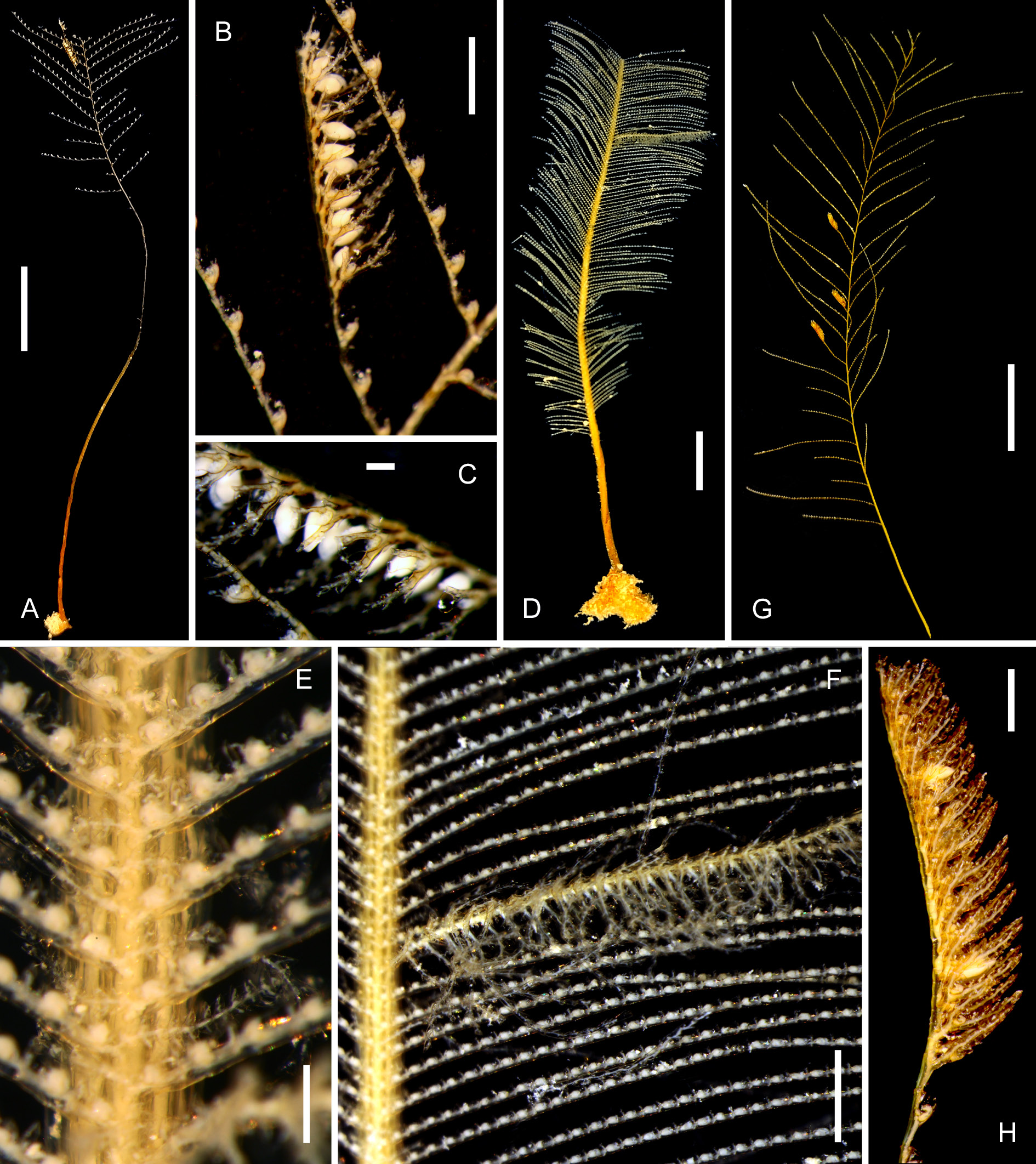
Fig. 12. A–C. Lytocarpia fragilis sp. nov, fertile colony (A) and details of a corbula (B–C), all from sample MNHN-IK-2015-523 (holotype). — D–F. Lytocarpia pilosa sp. nov., fertile colony (D), portion of stem, showing proximal parts of pseudophylactocarps (E), and corbula (F), all from sample MNHN-IK-2015-524 (holotype). — G–H. Lytocarpia pseudoctenata sp. nov., fertile colony (G) and corbula (H), all from sample MNHN-IK-2015-527 (holotype). Scale bars: A, D = 1 cm; B, H = 1 mm; C, E = 500 µm; F = 2 mm; G = 2 cm.
Imageimage/png© Galea, Horia R.Galea, Horia R.
IMAGES