AnimaliaNot EvaluatedacceptedspeciesAccepted
Pallisentis thapari

Pallisentis thapari

Gautam, Misra, Saxena & Monks, 2020

GBIF:163736793

0year

ABOUT

Descriptions(11)

Additional host: Channa striatus (Bloch, 1793) (Perciformes, Channidae). Site of infection: Intestine.
Gautam, Neelam Kumari, Misra, Pawan Kumar, Saxena, Anand Murari, Monks, Scott (2020): Description of Pallisentis thapari n. sp. and a re-description of Acanthosentis seenghalae (Acanthocephala, Quadrigyridae, Pallisentinae) using morphological and molecular data, with analysis on the validity of the sub-genera of Pallisentis. Zootaxa 4766 (1): 139-156, DOI: 10.11646/zootaxa.4766.1.7

Type host: Spotted snakehead Channa punctatus (Bloch, 1793) (Perciformes, Channidae).
Gautam, Neelam Kumari, Misra, Pawan Kumar, Saxena, Anand Murari, Monks, Scott (2020): Description of Pallisentis thapari n. sp. and a re-description of Acanthosentis seenghalae (Acanthocephala, Quadrigyridae, Pallisentinae) using morphological and molecular data, with analysis on the validity of the sub-genera of Pallisentis. Zootaxa 4766 (1): 139-156, DOI: 10.11646/zootaxa.4766.1.7
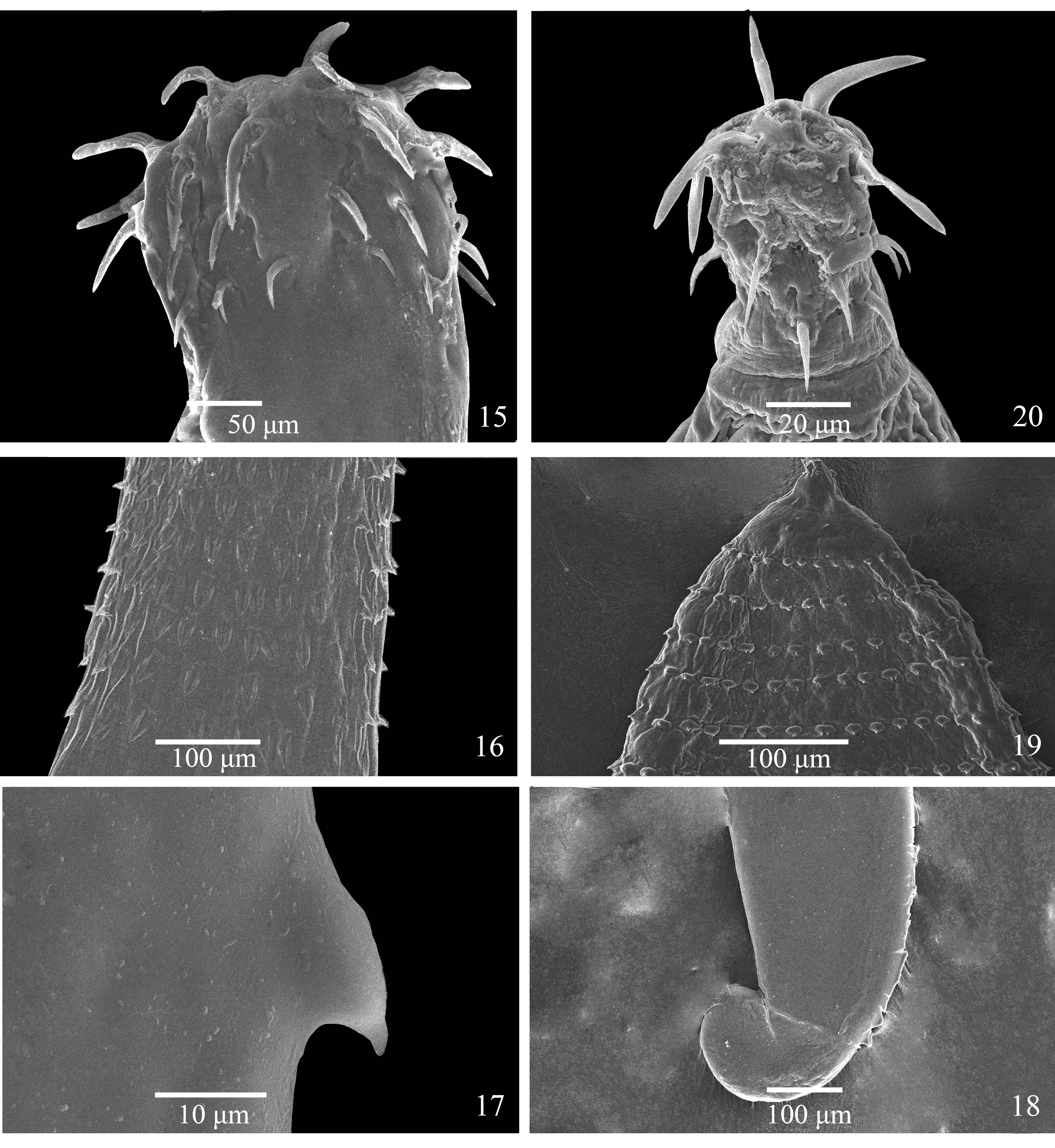
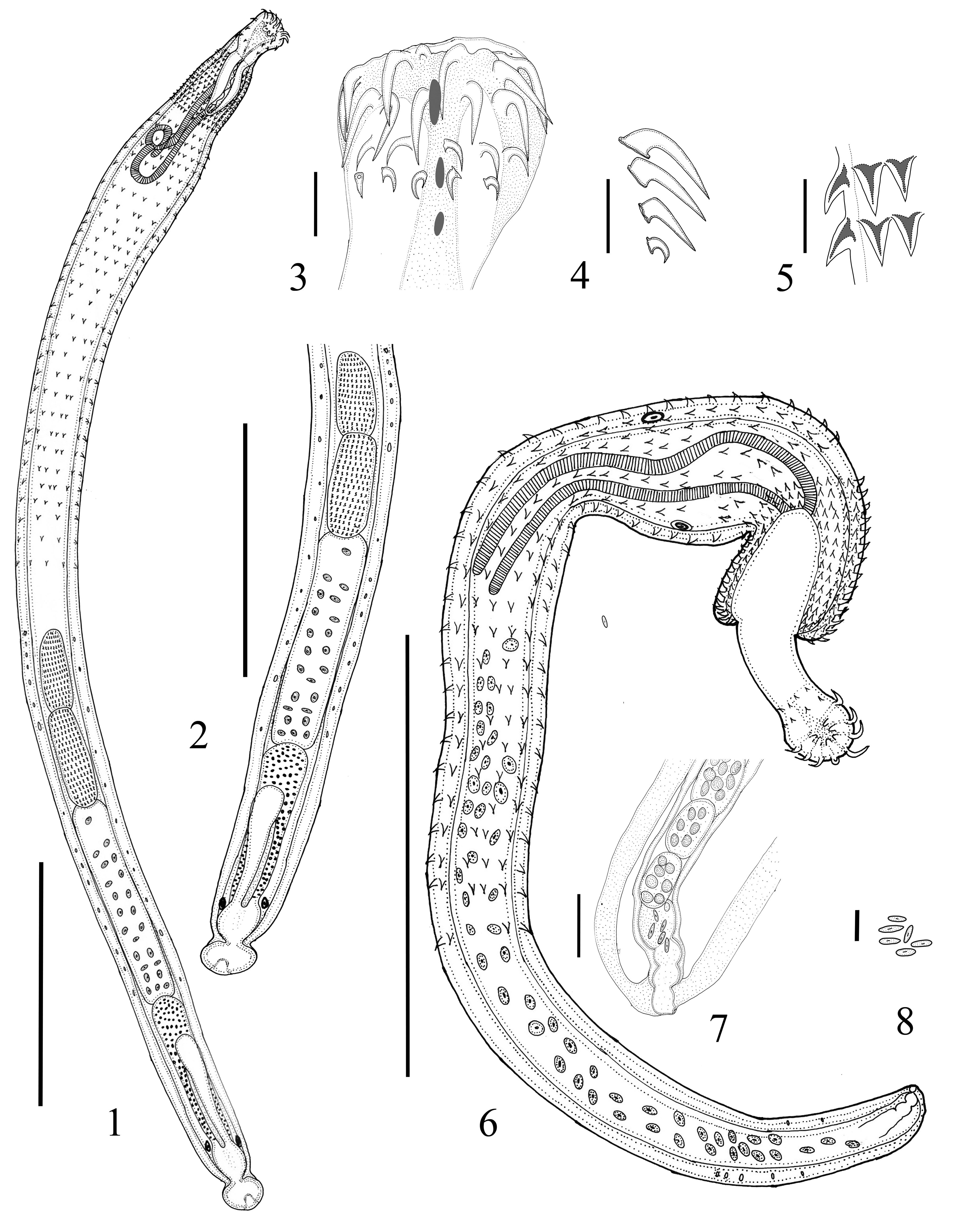
(Figs. 1 – 8 and 15 – 18)
Gautam, Neelam Kumari, Misra, Pawan Kumar, Saxena, Anand Murari, Monks, Scott (2020): Description of Pallisentis thapari n. sp. and a re-description of Acanthosentis seenghalae (Acanthocephala, Quadrigyridae, Pallisentinae) using morphological and molecular data, with analysis on the validity of the sub-genera of Pallisentis. Zootaxa 4766 (1): 139-156, DOI: 10.11646/zootaxa.4766.1.7
Description: Material examined: seven male and seven female specimens, and two specimens for SEM. Male. Worms relatively large in size (Fig. 1). Trunk 4.9 – 8.0 (6.6) mm long, 420 – 560 (484) µm a widest point. Anterior part of trunk (about 1 / 2) (Fig. 1) covered with 29 – 58 rings of tegmental spines, pointing posteriorly (Figs. 1 and 16), number of spines per ring declining in numbers from anterior to posterior. Circles of spines separated into two fields, anterior set composed of 15 – 17 closely spaced rings, each ring consisting of 12 – 22 spines, called collar spines, and posterior set of 21 – 41 more widely spaced rings of trunk spines, each anteriormost ring composed of 12 – 16 spines (Figs. 16 and 17). Area covered by collar spines 340 – 800 (457) long. Anterior and posterior groups of spines separated by narrow spine-free zone 100 – 180 (139) in length. Circles of trunk spines reaching posteriorly only to mid-body, ending anterior to testicular field. Individual spines 40 – 50 (47) long, 20 – 40 (30) wide at the base. Proboscis globular, broadly ovoid in shape, wider anteriorly and narrowing posteriorly, 230 – 280 (243) long, 220 – 260 (241.4) wide anteriorly (Figs. 1, 3 and 15). Proboscis with rooted hooks in 4 circles of 8 – 10 hooks each (Fig. 3). Hooks longest in first circle, decreasing in size posteriorly in succeeding rings (Figs. 3, 4 and 15). Blades of hooks in anterior circles relatively straight and oriented laterally because of position of insertion point or root; blades increasingly curved posteriorly. Length of hooks from anterior to posterior, 100 – 130 (112), 80 – 110 (96), 40 – 70 (52), 30 – 50 (34); size ratios anterior to posterior 1.0: 0.9: 0.5: 0.3. Neck short, robust, 150 – 290 (199) long, 160 – 290 (213) wide posteriorly. Proboscis receptacle 340 – 890 (547) long by 130 – 220 (161) wide. Lemnisci paired, cylindroid, much longer than the receptacle and almost equal sized; right lemniscus 730 – 2450 (1560) long, 40 – 60 (52) wide posteriorly, left lemniscus 1200 – 2450 (1625) long, 40 – 60 (52) wide. Reproductive system in posterior half of trunk. Testes dollioform-depressed in shape, contiguous with slight overlap. Anterior testis 440 – 720 (521) long, 140 – 210 (161) wide; posterior testis 440 – 730 (53) long, 140 – 220 (167) wide. Cement gland contiguous with testes, about size of testicular field, 680 – 1550 (1061) long by 130 – 240 (180) wide, containing 23 – 30 nuclei. Cement reservoir contiguous with cement gland, branching posteriorly into two ducts, 550 – 1070 (824) long, 140 – 230 (184) wide. Saefftigen’s pouch obdeltoid / very narrowly spatulate in shape, 160 – 340 (272) long, 130 – 200 (17) wide anteriorly. Seminal vesicle 400 – 800 (596) long, 70 – 140 (104) wide. Gonopore terminal (Figs. 1 and 2). Bursa, when extended (Figs. 1, 2 and 18), 200 – 300 (183) long and 100 – 240 (164) wide. Female. Worms slightly smaller in size than males (Fig. 6). Trunk 4.0 – 7.7 (6.3) mm long, 490 – 590 µm (503) µm at widest point. Anterior part of trunk (approximately anterior half) (Fig. 6) covered with 30 – 41 rings of tegmental spines, pointing posteriorly (Fig. 5), number of spines per ring declining in number from anterior to posterior. Circles of spines separated into two fields, anterior set composed of 14 – 15 closely spaced rings, called collar spines, each ring composed of 16 – 26 spines and posterior set of 14 – 40 more widely spaced rings of trunk spines, each ring made up of 12 – 24 spines. Length of trunk covered by collar spines 430 – 570 (530) long. Spine-free zone narrow 100 – 190 (147) in length. Circles of trunk spines reaching posteriorly only to mid-body, ending anterior to testicular field. Individual spines 40 – 51 (48) long, 20 – 40 (31) wide at the base. Proboscis globular, broadly ovoid in shape, wider anteriorly and narrowing posteriorly, 180 – 260 (213) long, 190 – 250 (220) wide anteriorly (Fig. 6). Proboscis with rooted hooks in 4 circles of 8 – 10 hooks each (Fig. 6). Hooks longest in first circle, hooks decreasing in size posteriorly in succeeding rings (Figs. 6). Blades of hooks in anterior circles relatively straight and oriented laterally because of position of insertion point or root; blades increasingly curved posteriorly. Length of hooks of proboscis of paratype female, from anterior to posterior, 140, 120, 70, 40; size ratios anterior to posterior 1.0: 0.9: 0.5: 0.3. Neck short, robust, 170 – 460 (296) long, 160 – 240 (197) wide posteriorly. Proboscis receptacle 440 – 840 (643) long, 80 – 250 (173) wide. Lemnisci paired, cylindroid, much longer than the receptacle and equal in size, 1,600 – 2,600 (2,110 ± 500.0) long, 40 – 60 (53) wide posteriorly. Reproductive system in posterior end of trunk, uterine bell cylindrical shaped, 240 – 330 (280) long and 50 – 110 (78) wide (Fig. 7). Uterus 50 – 260 (110) long, 30 – 110 (63) wide. Vagina 30 – 90 (53.3 ± 20.7) long, 30 – 50 (38.3 ± 9.8) wide. Ovarian balls present in some females, 40 – 80 (59) long, 20 – 60 (41) wide. Eggs 15 – 20 (18) long, 10 – 10 wide (Fig. 8) (width to length ratio about 2: 3). Gonopore ventro-terminal (Figs. 6 and 7).
Gautam, Neelam Kumari, Misra, Pawan Kumar, Saxena, Anand Murari, Monks, Scott (2020): Description of Pallisentis thapari n. sp. and a re-description of Acanthosentis seenghalae (Acanthocephala, Quadrigyridae, Pallisentinae) using morphological and molecular data, with analysis on the validity of the sub-genera of Pallisentis. Zootaxa 4766 (1): 139-156, DOI: 10.11646/zootaxa.4766.1.7
Zoobank Registration: The Life Science Identifier (LSID) urn: lsid: zoobank. org: pub: 53 DFA 57 F- 4 D 6 A- 49 DE- 8664 - 0 C 8 B 080 C 58 E 8
Gautam, Neelam Kumari, Misra, Pawan Kumar, Saxena, Anand Murari, Monks, Scott (2020): Description of Pallisentis thapari n. sp. and a re-description of Acanthosentis seenghalae (Acanthocephala, Quadrigyridae, Pallisentinae) using morphological and molecular data, with analysis on the validity of the sub-genera of Pallisentis. Zootaxa 4766 (1): 139-156, DOI: 10.11646/zootaxa.4766.1.7
urn: lsid: zoobank. org: act: 294 DD 60 F- 1233 - 47 D 0 - A 85 E-CDC 3 B 24 FABC 1
Gautam, Neelam Kumari, Misra, Pawan Kumar, Saxena, Anand Murari, Monks, Scott (2020): Description of Pallisentis thapari n. sp. and a re-description of Acanthosentis seenghalae (Acanthocephala, Quadrigyridae, Pallisentinae) using morphological and molecular data, with analysis on the validity of the sub-genera of Pallisentis. Zootaxa 4766 (1): 139-156, DOI: 10.11646/zootaxa.4766.1.7
Diagnosis: Quadrigyridae, Pallisentinae, with characters of the genus Pallisentis as diagnosed by Amin et al. (2000). Worms cylindrical, relatively large sized, range of length of males and females overlapping but mean length of males slightly longer than females. Trunk with Y-shaped spines in rings, with anterior set of 14 – 17 closely spaced rings of collar spines and posterior set of 14 – 41 more widely spaced rings of trunk spines; posterior set reaching posteriorly only to mid body. Anterior and posterior sets of trunk spines separated by a narrow region lacking spines. Trunk spines conical with an optically-dense Y-shaped core. Proboscis short, broadly ovoid, wider anteriorly, with 4 circles of 8 – 10 hooks each, hooks decreasing in size posteriorly. Proboscis receptacle single-walled, with cerebral ganglion located at base. Lemnisci cylindrical, much longer than the receptacle, posterior ends hanging loose in body cavity, about equal in length. In males, testes dollioform-depressed in shape (width to length ratio 1.0: 3.3), contiguous and slightly overlapping. Cement gland oblong-very depressed in shape, width to length ratio 1: 6, syncytial, about as long as testicular field, containing 23 – 30 giant nuclei. Cement reservoir and Saefftigen’s pouch present. Parasites of freshwater fishes in India.
Gautam, Neelam Kumari, Misra, Pawan Kumar, Saxena, Anand Murari, Monks, Scott (2020): Description of Pallisentis thapari n. sp. and a re-description of Acanthosentis seenghalae (Acanthocephala, Quadrigyridae, Pallisentinae) using morphological and molecular data, with analysis on the validity of the sub-genera of Pallisentis. Zootaxa 4766 (1): 139-156, DOI: 10.11646/zootaxa.4766.1.7
Remarks: Amin et al. (2000) re-described Pallisentis and provided a more detailed diagnosis for the genus. The new species is placed in Pallisentis because it has an anterior set of closely arranged rings of collar spines (15 – 17 rings) and a posterior set of more widely spaced rings of trunk spines (14 – 41) separated from the collar spines by a region lacking spines. Giant hypodermal nuclei are present in the trunk wall, the proboscis is broadly ovoid in shape with rooted hooks in 4 circles of 8 – 10 hooks in each, and the proboscis receptacle is single-walled with the cerebral ganglion located near the base. The lemnisci are much longer than the receptacle, and the syncytial cement gland is long (about as long as the testicular field) with many giant nuclei. The new species is placed in this genus because it shares these characters. If the subgenera of Pallisentis established by Amin et al. (2000) is accepted, P. thapari n. sp. is similar to species previously assigned to the subgenus P. (Pallisentis) Amin, Heckmann, Ha, Luc, and Doanh, 2000 because the longest hooks are in first circle and the hooks of succeeding circles decrease in size posteriorly (Amin et al. 2000). The new species can be distinguished from all known species of Pallisentis because the trunk spines do not extend to the posterior end of either sex, the proboscis hooks in first circles are more than 100 long, and the average length of the proboscis receptacle is more than 500 long. Pallisentis thapari n. sp. is most similar in form to P. clupei Gupta and Gupta, 1979); the length of the first hook in both is about 100, but P. clupei is reported to have conical trunk spines and the new species has spines with a Yshaped core (Gupta & Gupta 1979). In P. clupei, the number of circles of collar spines (12 – 13 circles in males and 13 – 14 in females) is similar bit less than that of the new species (15 – 17 in males and 14 – 15 in females), although the number of spines per circle in males of P. clupei overlaps with that of the new species (14 – 20 spines vs. 12 – 22, respectively). The number of circles of trunk spines in males in both species overlaps (P. clupei 28 – 30; P. thapari n. sp. 21 – 41), but the number of circles of trunk spines in females of P. clupei (61) is greater than for females of the new species (14 – 40). The number of trunk spines in P. clupei and that of the new species also overlaps (males 8 – 16; females 10 – 16 vs. males 12 – 16; females 12 – 24, respectively). Additionally, the new species can be distinguished from P. clupei in that the trunk spines of the new species extend only to mid-body but they extend to the posterior end in P. clupei. The number of spines in each circle of trunk spines in P. clupei (8 – 16 in males and 10 – 16 in females) is less than in P. thapari n. sp. (12 – 16 in males and 12 – 24) in females, although there is some overlap in range. Finally, in males, the size and position of testes and the size of the cement gland are similar in P. clupei (1390 – 1550 long) and the new species (680 – 1550 long), but in P. clupei there are 9 – 16 giant nuclei in the cement gland and that of the new species has 23 – 30 nuclei. Seven species of Pallisentis have been reported to have spines that are Y-shaped (Amin et al. 2000; Gautam et al. 2019): P. basiri Farooqi, 1958; P. cavasii Gupta and Verma, 1980; P. fasciata Gupta and Verma, 1980; P. guptai Gupta and Fatma, 1986; P. indica Mithal and Lai, 1981; P. mehrai Gupta and Fatma, 1986; P. panadei Rai, 1967; and P. unnaoensis Gautam, Misra, and Saxena, 2019 (Farooqi 1958; Rai 1967; Gupta & Verma 1980; Mithal & Lal 1981; Gupta & Fatma 1986; Gautam et al. 2019). In some species the spines are more flattened and evidence of the Y-shape core can be seen externally (Gautam et al. 2019). In the new species the spines are conical but with the Yshaped core (Figs. 5 and 17). Comparisons among species of Pallisentis are difficult because many of the type specimens are not available and one must rely on descriptions in the literature. However, the new species can be distinguished from the abovementioned species by various features. Pallisentis thapari n. sp. is larger than P. cavasii, P. fasciata, and P. unnaoensis (4.9 – 8.0 mm vs. 2.1 – 3.0, 2.9 – 4.0, and 3.4 – 4.4, respectively) and the new species has more nuclei in the cement gland (23 – 30 vs. 6 – 8, 8 – 10, and 7 – 8, respectively), and the proboscis hooks of the first row of the new species are longer (100 – 130) than those of P. cavasii (50 – 51), P. fasciata (60 – 70), and P. panadei (70 – 50) and they are shorter than those of P. unnaoensis (220). The hooks in the first row of the new species and those of P. basiri are about the same size (approximately 100), but the roots of the hooks of the new species are elongate and those of P. basiri are described as being knob-like (Amin et al. 2000). The cement gland of males of the new species is longer than that of P. guptai (680 – 1550 vs. 500 – 580, respectively) and the number of nuclei is greater (28 – 30 vs. 10 – 12, respectively). Males of the new species have more nuclei in the cement gland than those of P. indica (23 – 30 vs. 9 – 18) (Amin et al. 2017 a). The trunk spines of the new species reach posteriorly only to about mid-body but those of P. mehrai reach to the posterior end in both males and females. Finally, in results of the molecular analysis, P. unnaoensis is the sister taxa to the clade comprised of the three specimens of the new species. The new species is similar to P. unnaoensis in the number of rings and spines per ring of collar and trunk spines, but the cement gland is longer in the new species (680 – 1550 vs. 380 – 520) and the number of nuclei in the cement gland is greater (23 – 30 vs. 7 – 8).
Gautam, Neelam Kumari, Misra, Pawan Kumar, Saxena, Anand Murari, Monks, Scott (2020): Description of Pallisentis thapari n. sp. and a re-description of Acanthosentis seenghalae (Acanthocephala, Quadrigyridae, Pallisentinae) using morphological and molecular data, with analysis on the validity of the sub-genera of Pallisentis. Zootaxa 4766 (1): 139-156, DOI: 10.11646/zootaxa.4766.1.7
Type locality: Nabi Panah Pond, Malihabad, Lucknow, Uttar Pradesh, India (26.5830 ° N, 80.4322 ° E).
Gautam, Neelam Kumari, Misra, Pawan Kumar, Saxena, Anand Murari, Monks, Scott (2020): Description of Pallisentis thapari n. sp. and a re-description of Acanthosentis seenghalae (Acanthocephala, Quadrigyridae, Pallisentinae) using morphological and molecular data, with analysis on the validity of the sub-genera of Pallisentis. Zootaxa 4766 (1): 139-156, DOI: 10.11646/zootaxa.4766.1.7
Etymology: The new species is named in honor of the late Dr. Gobind Singh Thapar, Department of Zoology, University of Lucknow, Lucknow, India, for his outstanding contributions in Helminthology.
Gautam, Neelam Kumari, Misra, Pawan Kumar, Saxena, Anand Murari, Monks, Scott (2020): Description of Pallisentis thapari n. sp. and a re-description of Acanthosentis seenghalae (Acanthocephala, Quadrigyridae, Pallisentinae) using morphological and molecular data, with analysis on the validity of the sub-genera of Pallisentis. Zootaxa 4766 (1): 139-156, DOI: 10.11646/zootaxa.4766.1.7
Specimens deposited: Holotype deposited in Gangetic Plane Regional Centre, Zoological Survey of India (ZSI), Patna, India- male ZSI / GPRC, IV – 4356 a and allotype female ZSI / GPRC, IV – 4356 b. Paratypes deposited at the Helminthology Laboratory, Department of Zoology, University of Lucknow, U. P., India- males LU / Z / 2019 / 1 – LU / Z / 2019 / 07 and females LU / Z / 2019 / 08 – LU / Z / 2019 / 014.
Gautam, Neelam Kumari, Misra, Pawan Kumar, Saxena, Anand Murari, Monks, Scott (2020): Description of Pallisentis thapari n. sp. and a re-description of Acanthosentis seenghalae (Acanthocephala, Quadrigyridae, Pallisentinae) using morphological and molecular data, with analysis on the validity of the sub-genera of Pallisentis. Zootaxa 4766 (1): 139-156, DOI: 10.11646/zootaxa.4766.1.7

Export occurrence data

Darwin Core Archive (ZIP)

MULTIMEDIA

Media Files(2)

FIGURES 1–8. Drawing of specimens of Pallisentis thapari n. sp.: 1. Male worm; 2. Posterior part of male; 3. Proboscis; 4. Hooks of the proboscis; 5. Trunk spines with optically dense Y-shaped core; 6. Female worm containing ovarian balls; 7. Posterior end and gonopore with ovarian balls shown in uterine bell; 8. Eggs. Scale bars: 1, 2 and 6 = 1.0 mm; 3, 4, 5 and 7 = 100 µm; 8 = 10 µm.

Imageimage/png© Gautam, Neelam Kumari;Misra, Pawan Kumar;Saxena, Anand Murari;Monks, ScottGautam, Neelam Kumari;Misra, Pawan Kumar;Saxena, Anand Murari;Monks, Scott

FIGURES 15–20. Scanning electron micrographs: 15. Proboscis of Pallisentis thapari n. sp. showing hooks that decrease in size from anterior to posterior rings; 16. Trunk spines of P. thapari n. sp. with optically dense Y-shaped core and conical exterior; 17. Hooked point of a collar spine of P. thapari n. sp; 18. Bursa of a male worm of P. thapari n. sp.; 19. Trunk spines of a specimen of Acanthosentis seenghalae; 20. Proboscis of a male worm of A. seenghalae. Scale bars: 15 = 50 µm; 16, 18 and 19 = 100 µm; 17 = 10 µm; 20 = 20 µm.

Imageimage/png© Gautam, Neelam Kumari;Misra, Pawan Kumar;Saxena, Anand Murari;Monks, ScottGautam, Neelam Kumari;Misra, Pawan Kumar;Saxena, Anand Murari;Monks, Scott

IMAGES

Gallery(2)

See Gallery

Occurrences with images

Source Information

Description of Pallisentis thapari n. sp. and a re-description of Acanthosentis seenghalae (Acanthocephala, Quadrigyridae, Pallisentinae) using morphological and molecular data, with analysis on the validity of the sub-genera of Pallisentis

checklist

This dataset contains the digitized treatments in Plazi based on the original journal article Gautam, Neelam Kumari, Misra, Pawan Kumar, Saxena, Anand Murari, Monks, Scott (2020): Description of Pallisentis thapari n. sp. and a re-description of Acanthosentis seenghalae (Acanthocephala, Quadrigyridae, Pallisentinae) using morphological and molecular data, with analysis on the validity of the sub-genera of Pallisentis. Zootaxa 4766 (1): 139-156, DOI: 10.11646/zootaxa.4766.1.7

Abstract

One new species of Pallisentis Van Cleave, 1928 is described from Channa punctatus (Bloch) from Gomti River (tributary of the Ganga River), in Uttar Pradesh, Lucknow district, India. Pallisentis thapari n. sp. is characterized morphologically by individuals having a globular proboscis armed with rooted hooks in 4 circles of 8–10 hooks each, the first circle more than 100 long and hooks gradually declining in size posteriorly. The trunk is cylindrical, with collar spines comprised of 15–17 complete circles of spines, each ring with 12–22 spines. As common in members of the genus, a narrow spine-free zone lies in between the rings of collar and trunk spines. Field of spines extends posteriorly to half of the body length, ending above the level of testes in males and slightly past mid-body in females; trunk spines have an optically-dense Yshaped core. The trunk is only slightly wider at the anterior end. The syncytial cement gland of males contained 23–30 nuclei. Individuals of Channa striatus Bloch from the same locality also were infected with the new species. A second species of Acanthocephala, Acanthosentis seenghalae Chowhan, Gupta, Khera, 1988, was found as a parasite of Puntius sophore (Hamilton) from the same locality. The proboscis is short, globular, with 3 circles of hooks each circle bearing 6 hooks. The trunk is broad in the middle and tapered at both ends, with the posterior end narrower than the anterior end. Twelve to 16 circles of spines, each with 21–40 spines, extend from anterior end to just past mid-body in males and only to mid-body in females. The syncytial cement gland of males contains 6–10 nuclei. The analysis of 18s rDNA identified two clades of a monophyletic Pallisentis and placed the isolate of P. thapari n. sp. within that clade; previously established subgenera were not supported by the results of the analysis.

Gautam N K, Misra P K, Saxena A M, Monks S, carolina (2020). Description of Pallisentis thapari n. sp. and a re-description of Acanthosentis seenghalae (Acanthocephala, Quadrigyridae, Pallisentinae) using morphological and molecular data, with analysis on the validity of the sub-genera of Pallisentis. Plazi.org taxonomic treatments database. Checklist dataset https://doi.org/10.11646/zootaxa.4766.1.7 accessed via GBIF.org on 2026-06-17.

CC0Published 4/16/2020View dataset
GBIF Usage Key
163736793
Dataset Key
7fa0297c-3296-4d76-a6b4-db78862b142d
Origin
source
Backbone Key
10740627
Taxon ID
03F2AF175227FF8FFF0CBA22FB3CA7DC.taxon
Last Crawled
6/10/2026
Last Interpreted
6/10/2026