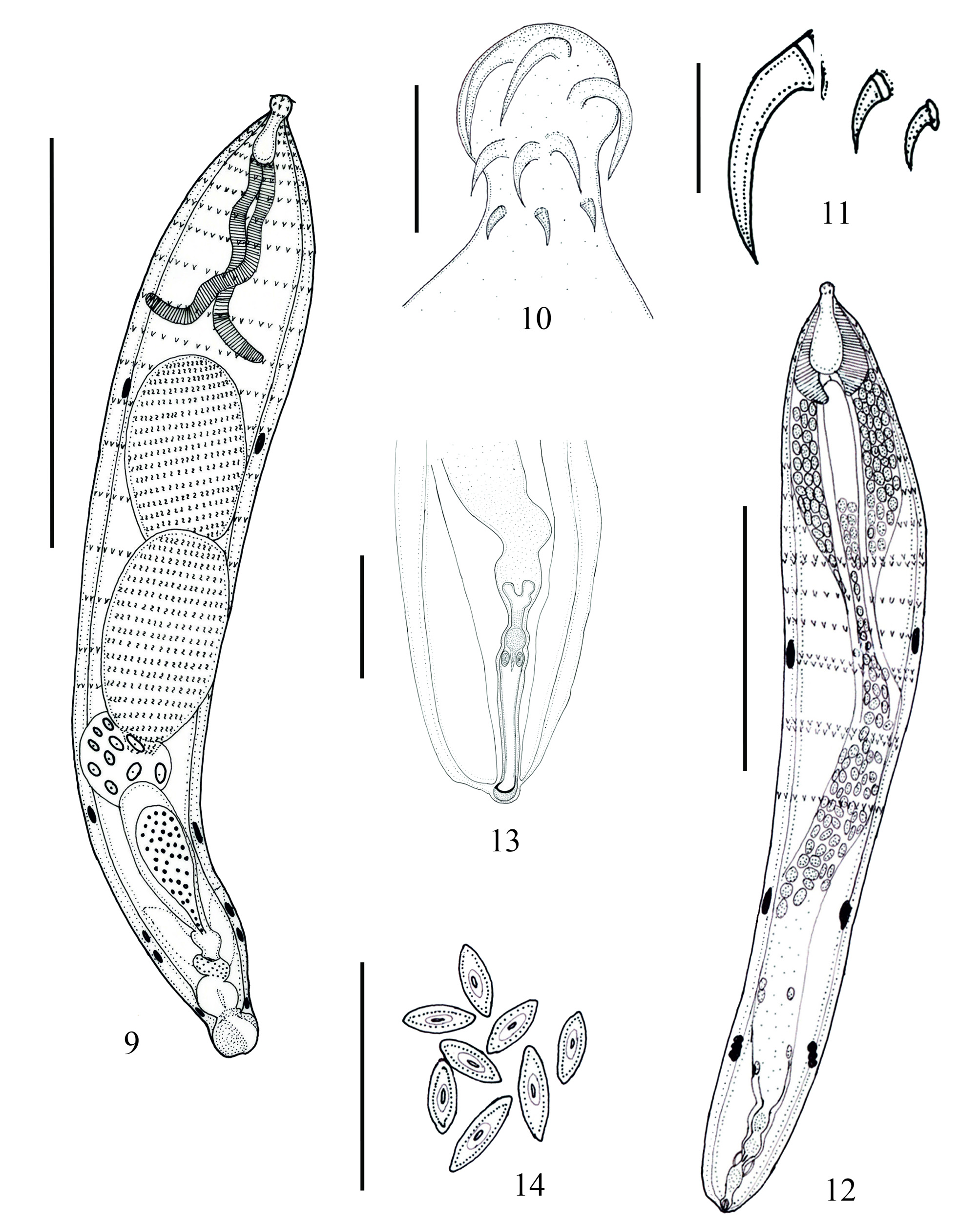
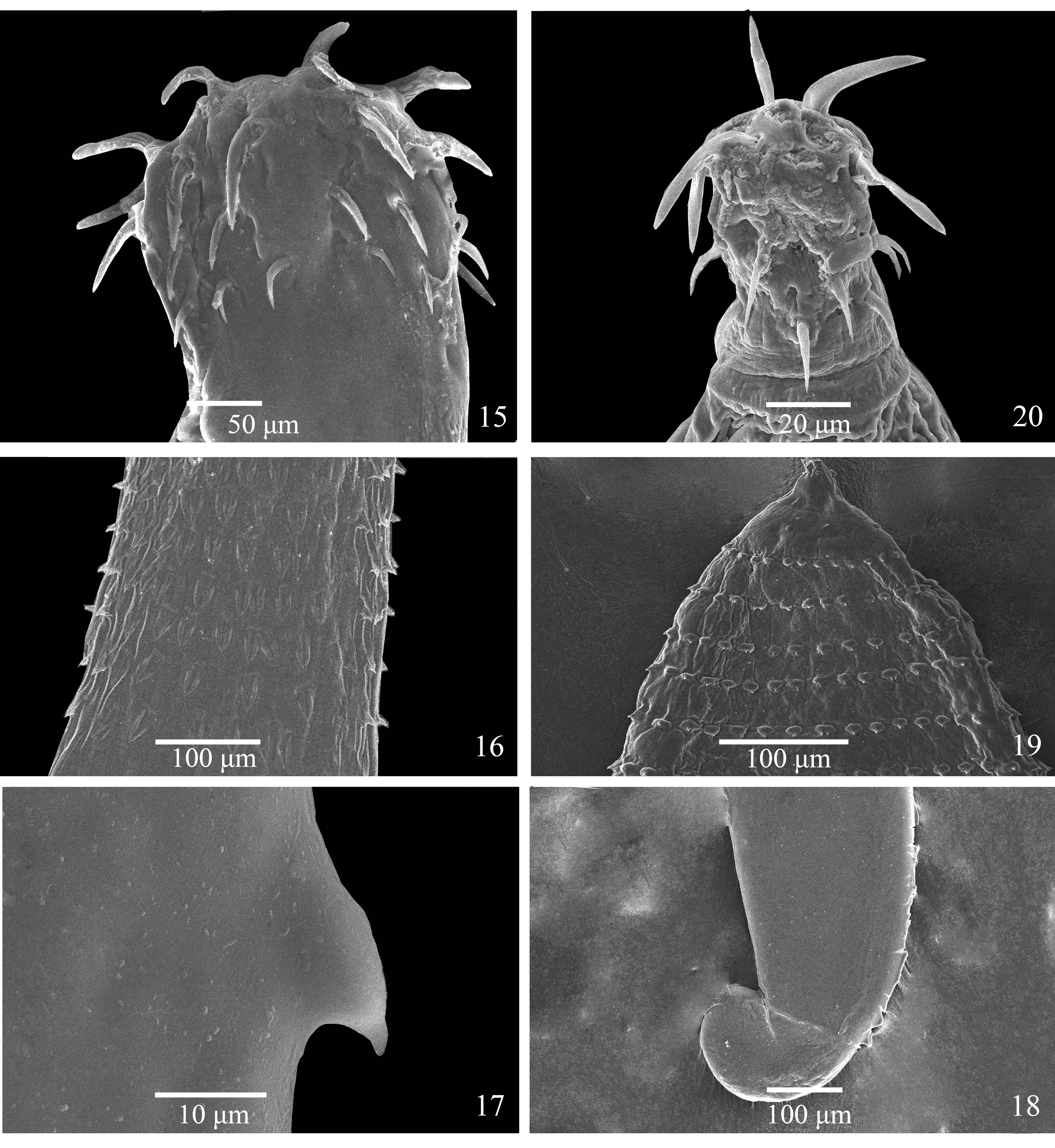
Description: Material Examined: Four males, three females, and two specimens for SEM. Male. Worm small in size, broadest at about 1 / 3 distance from anterior end, tapering to posterior end, anterior 2 / 3 of trunk straight, posterior 1 / 3 slightly curved ventrally. Trunk 2.43 – 2.16 (2.4) mm long, 320 – 370 (343) µm wide at widest point (measurements of type material from original description given in Table 2). Five pairs of giant hypodermal nuclei present. Trunk with rings of spines closely set anteriorly but gradually more widely apart as they proceed backward to just past mid-body to level of posterior testis, 12 – 16 circles of 21 – 40 spines, almost equal in size (Figs. 9 and 19). Proboscis short, orbicular in shape (length to width ratio 1: 1), 40 – 60 (45 ± 10) long, 40 – 60 (45) wide (Figs. 9, 10 and 20). Proboscis with rooted hooks in 3 circles of 6 hooks each (Figs. 10 and 20). Hooks longest in first circle, decreasing in size posteriorly in succeeding rings (Figs. 10, 11 and 20). Blades of hooks curved to point posteriorly. Length of hooks from anterior to posterior, 500 250, 200; size ratios anterior to posterior 1.0: 0.6: 0.5. Neck short, 16 – 23 (20). Proboscis receptacle very deeply ovoid, 120 – 160 (143) long, 50 – 80 (63) wide. Lemnisci cylindrical, much longer than proboscis receptacle, approximately equal in size, 690 – 700 (693) long, 40 – 50 (43) wide. Reproductive system in posterior 3 / 4 of body (Fig. 9). Testes eliptoid, tandem, contiguous. Anterior testis 420 – 490 (465) long, 300 – 300 wide; posterior testis 370 – 540 (470) long, 270 – 300 (290) wide. Anterior testis 1130 – 1700 (1367) from anterior end of body, posterior testes 1600 – 2060 (1767) from anterior end. Cement gland much smaller than testes, contiguous with posterior testis, 150 – 240 (198) long, 110 – 240 (193) wide, containing 6 – 10 giant nuclei. Cement reservoir larger than cement gland, contiguous, 280 – 390 (335) long, 130 – 150 (140) wide. Saefftigen’s pouch pyriform; 70 – 130 (100) long, 80 – 90 (88) wide, duct wide anteriorly tapering to posterior connection. Gonopore terminal (Fig. 9). Bursa, when everted, 80 – 140 (113) long, 90 – 160 (123) wide. Female. Females smaller than males, broadest at about 1 / 3 distance from anterior end, tapering to posterior end, anterior 1 / 1 of trunk straight, posterior 1 / 1 slightly curved ventrally (Fig. 12). Trunk 1.7 – 1.8 (1.7) mm long, 158 – 237 (198) µm wide at widest point. Five pairs of giant hypodermal nuclei present, posteriormost three nuclei clumped together at posterior part of trunk. Trunk with rings of spines closely set anteriorly but gradually more widely apart as they proceed backward to just past mid-body, 18 circles of 34 spines, fifth ring from last, third from last, and second from last rings double (12 single rings and 3 double rings) (Fig. 12). Spines almost equal in size. Proboscis short, orbicular in shape (length to width ratio 1: 1), 29 – 31 (30) long, 29 – 31 (30) wide (Fig. 12). Neck short, 16 – 20 (18). Proboscis receptacle very deeply ovoid, 142 – 150 (146) long, 67 – 70 (68) wide. Lemnisci cylindrical, much longer than proboscis receptacle, compressed by ligament sac, approximately equal in size, 196 – 200 (198) long, 56 – 60 (58) wide. Reproductive system in posterior 1 / 5 of trunk, ligament sac persistent, attached to anterior opening of uterine bell. Uterine bell 79 – 83 (81) long, 54 – 58 (56) wide (Fig. 13). Uterus 73 – 75 (74) long, 40 – 43 (41) wide. Vagina 32 – 35 (33) long, 38 wide. Gonopore approximately terminal, protruding slightly from body wall (Fig. 13). Ovarian balls somewhat elliptical in shape. Eggs narrowly fusiform in shape, with thick outer shell, 35 – 44 (39) long, 14 – 17 (15) wide (Fig. 14).
Gautam, Neelam Kumari, Misra, Pawan Kumar, Saxena, Anand Murari, Monks, Scott (2020): Description of Pallisentis thapari n. sp. and a re-description of Acanthosentis seenghalae (Acanthocephala, Quadrigyridae, Pallisentinae) using morphological and molecular data, with analysis on the validity of the sub-genera of Pallisentis. Zootaxa 4766 (1): 139-156, DOI: 10.11646/zootaxa.4766.1.7