
AnimaliaNot EvaluatedacceptedspeciesAccepted
Adeonella lichenoides

Adeonella lichenoides

(Lamarck, 1816)

GBIF:163752450

0year

ABOUT

Descriptions(4)

(Figs 35 – 44; Table 11) cf. Eschara lichenoides Lamarck, 1816: 176. cf. Eschara platalea: Busk, 1854: 90, pl. 105, figs 1 – 3, pl. 108, fig. 4. cf. Adeonella platalea: Harmer, 1957: 809, pl. 53, figs 2, 4 – 12. cf. Adeonella lichenoides: Taylor & Tan, 2015: 17, fig. 9. cf. Adeonella cf. lichenoides: Hirose, 2016: 4, figs 2, 3.
Martino, Emanuela Di, Taylor, Paul D. (2018): Early Pleistocene and Holocene bryozoans from Indonesia. Zootaxa 4419 (1): 1-70, DOI: 10.11646/zootaxa.4419.1.1
Description. Colony rigidly erect, adeoniform. Branches strap-like, about 2 mm wide, arising from an encrusting base, bifurcating at angles of 80 – 90 ˚, bilaminate, with 6 – 12 longitudinal rows of alternating autozooids, the zooids in the central rows aligned parallel to the branch axis and the outer zooids directing outwards. Autozooids distinct with shallow interzooidal furrows, dimorphic, hexagonal, elongate (mean L / W = 1.86). Frontal shield convex proximally owing to the presence of a solid tubercle, but flat distally, finely granular with a suboral spiramen. Areolar pores circular to oval, 15 – 30 µm in diameter, arranged in one to three rows; accessory pores delimiting the suboral avicularian cystid. Spiramen circular, relatively large, 40 – 55 µm in diameter, placed either medially or laterally (off-centre), about 30 µm below the orifice. Orifice semicircular to circular; peristome slightly projecting. A suboral avicularium often present, variously placed, either horizontally and parallel to the proximal rim of the orifice, at the same level but opposite to the spiramen, laterally and inwardly directed, or oblique and indenting the lateral or proximal rim of the orifice, distally directed; rostrum rounded or pointed triangular with a pair of blunt pivotal condyles. Frontal avicularia often present at about half zooidal length or more proximally placed, similar in shape to suboral avicularia but longer, rostrum proximolaterally directed. Vicarious avicularia rare, club-shaped, bordered by a row of marginal areolar pores. Orifice sealed in some zooids as ontogenetic calcification progresses. Fertile zooid slightly larger than autozooids, with pseudoporous frontal shield, crescentic orifice, divided spiramen, and small, paired, suboral avicularia, medially and distolaterally directed; no frontal avicularium. N, Number of colonies and number of zooids measured; SD, standard deviation; Av, avicularium; Vic, vicarious; * fertile zooids.
Martino, Emanuela Di, Taylor, Paul D. (2018): Early Pleistocene and Holocene bryozoans from Indonesia. Zootaxa 4419 (1): 1-70, DOI: 10.11646/zootaxa.4419.1.1
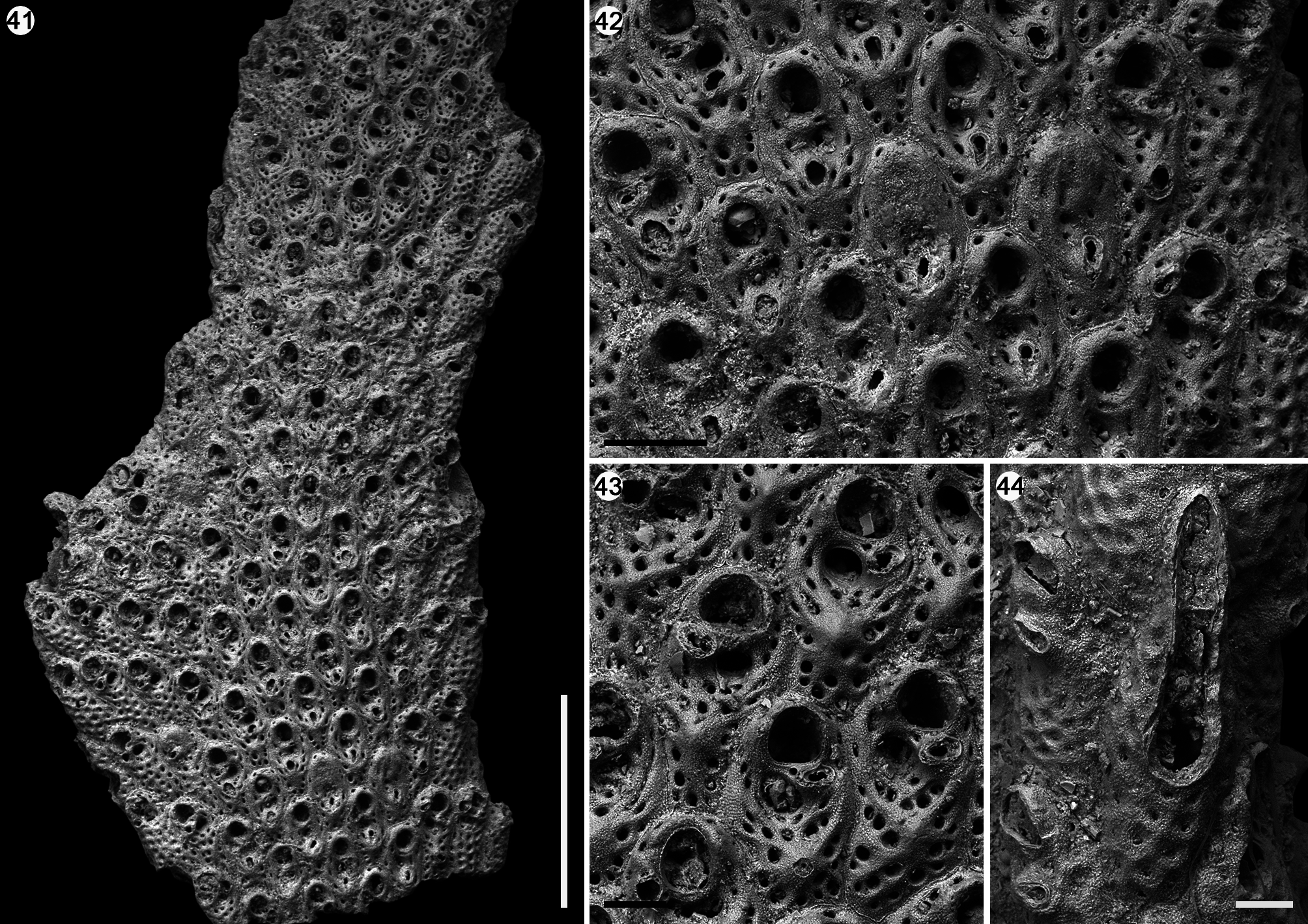
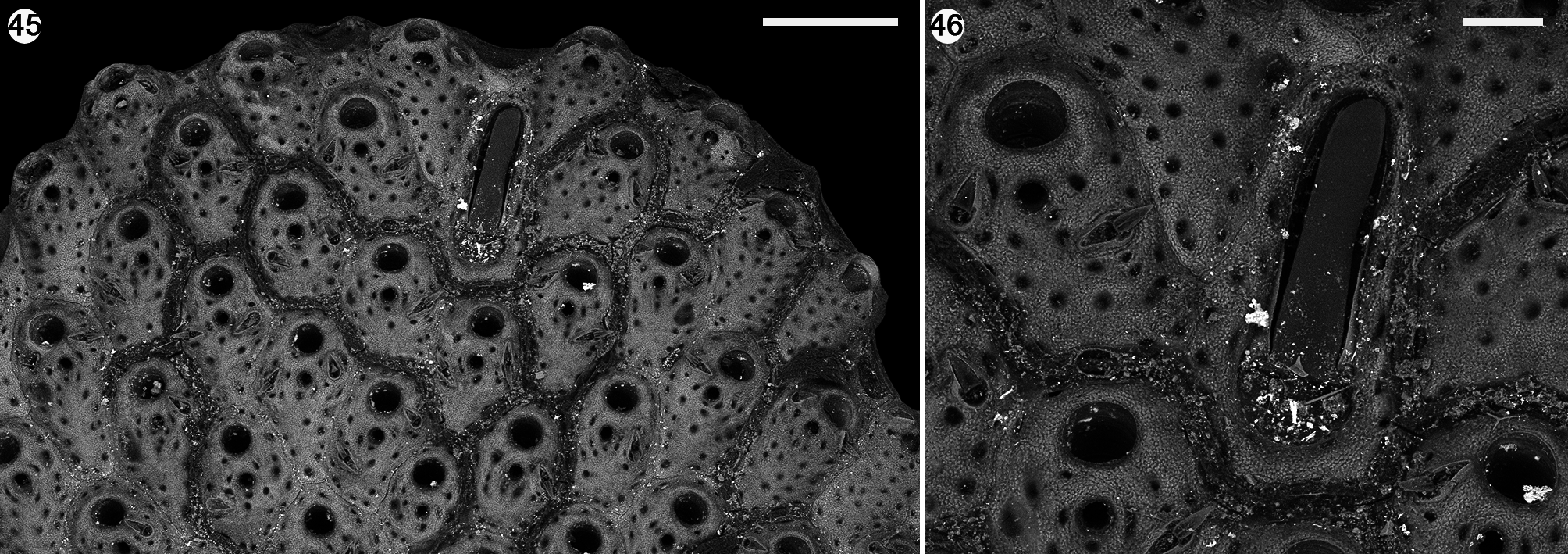
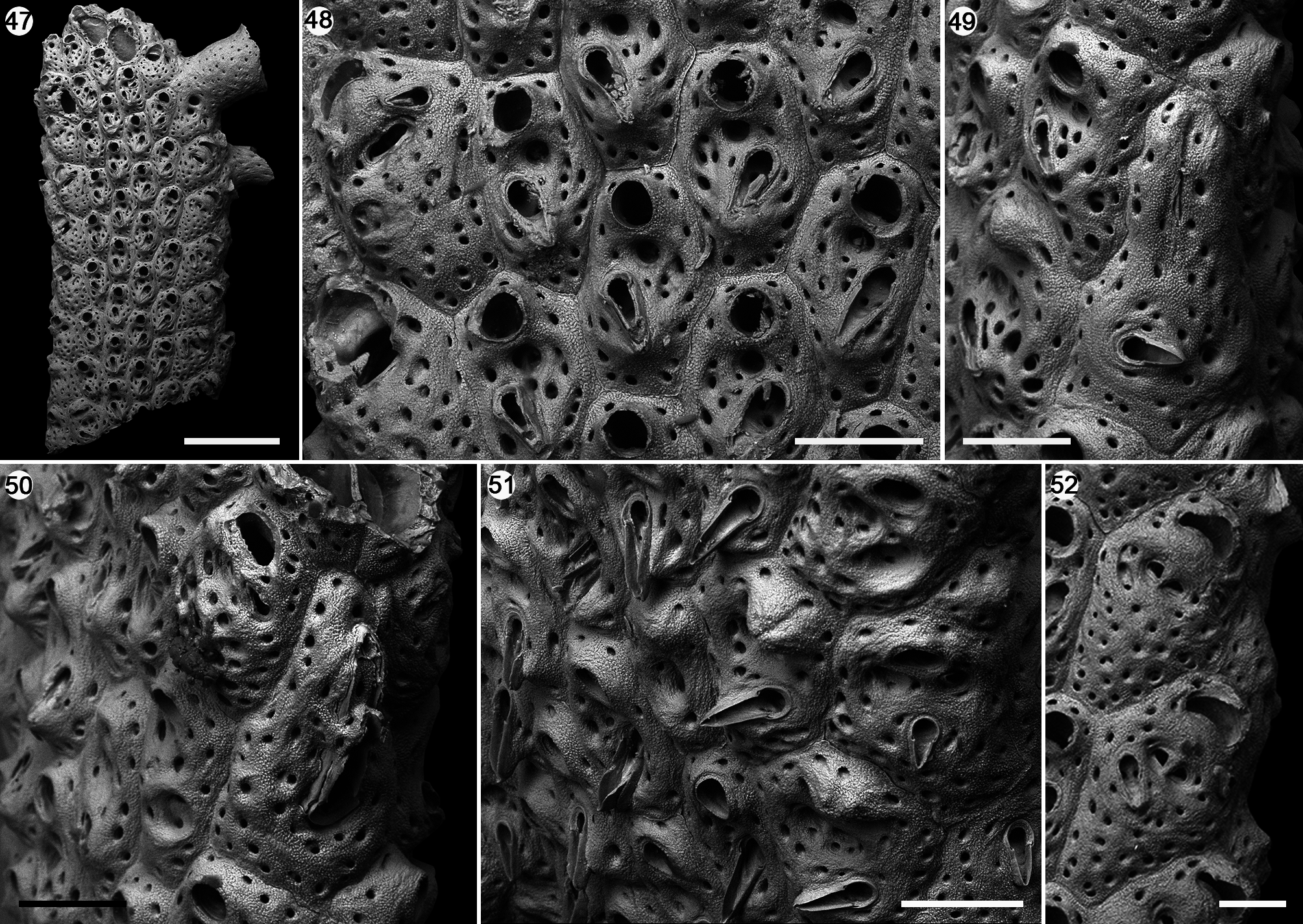
Remarks. Forty-seven branch fragments of Adeonella cf. lichenoides were found in our samples. Adeonella lichenoides was first described from the Indian Ocean, and subsequently recorded broadly from East Africa to eastern Australia. Harmer (1957) discussed the difficulty in establishing clear distinctions between species of Adeonella owing to the high intraspecific variability, and distinguished three variants of Adeonella platalea from the Indo-Pacific based on the shape of vicarious avicularia (i. e. absent, rounded or subtriangular). Hayward (1988), after examining the type material of A. platalea (Figs 45, 46; NHMUK 1854.11.15.185) and A. lichenoides, synonymized the two species. Specimens of A. cf. lichenoides found in our samples differ mainly in the shape of vicarious avicularia, which are subtriangular in specimens from the UPG sample (Fig. 44), and more rounded in the specimens from the Kali Klagen sample (Fig. 36). Hirose (2016, fig. 2 E) illustrated a specimen of A. cf. lichenoides from Japan which shows the variability of vicarious avicularia in the same fragment. Adeonella intricaria (Busk, 1884), recorded from the Malay Archipelago to the Torres Strait, differs in having especially long and acute frontal avicularia, and triangular vicarious avicularia (Figs 47 – 52; NHMUK 1899.7.1.25.19).
Martino, Emanuela Di, Taylor, Paul D. (2018): Early Pleistocene and Holocene bryozoans from Indonesia. Zootaxa 4419 (1): 1-70, DOI: 10.11646/zootaxa.4419.1.1
Figured material. RGM. 1350554, early Pleistocene, Java; RGM. 1350555, Holocene, UPGG 041, off South Sulawesi.
Martino, Emanuela Di, Taylor, Paul D. (2018): Early Pleistocene and Holocene bryozoans from Indonesia. Zootaxa 4419 (1): 1-70, DOI: 10.11646/zootaxa.4419.1.1

Export occurrence data

Darwin Core Archive (ZIP)

CLASSIFICATION

Taxonomic Classification Tree

MULTIMEDIA

Media Files(4)

FIGURES 35–40. Adeonella cf. lichenoides (Lamarck, 1816), RGM.1350554, early Pleistocene, Java. 35. View of a bifurcated branch fragment. 36. Group of autozooids with frontal adventitious avicularia and rounded vicarious avicularium. 37. Group of zooids, some with sealed orifices. 38. Group of autozooids with suboral avicularium variable in size, shape and orientation, and a fertile zooid. 39. Close-up of an autozooid with suboral and frontal avicularia. 40. Zooids with frontal avicularia variable in shape. Scale bars: Fig. 35 = 500 µm; Figs 36, 38–40 = 100 µm; Fig. 37 = 200 µm.
Imageimage/png© Martino, Emanuela Di;Taylor, Paul D.Martino, Emanuela Di;Taylor, Paul D.

FIGURES 41–44. Adeonella cf. lichenoides (Lamarck, 1816), RGM.1350555, Holocene, UPGG041, off South Sulawesi. 41. View of a branch fragment. 42. Group of autozooids with frontal avicularia and sealed orifice. 43. Group of zooids with suboral avicularium and tubercle on the frontal shield. 44. Close-up of a lateral subtriangular vicarious avicularium. Scale bars: Fig. 41 = 1 mm; Fig. 42 = 200 µm; Figs 43, 44 = 100 µm.
Imageimage/png© Martino, Emanuela Di;Taylor, Paul D.Martino, Emanuela Di;Taylor, Paul D.

FIGURES 45, 46. Adeonella lichenoides (Lamarck, 1816), syntype of Adeonella platalea (Busk, 1854), Recent, off Cape Capricorn (Queensland), NHMUK 1854.11.15.185. Group of autozooids and rounded vicarious avicularium. 46. Close-up of an autozooid and a vicarious avicularium. Scale bars: Fig. 45 = 400 µm; Fig. 46 = 100 µm.
Imageimage/png© Martino, Emanuela Di;Taylor, Paul D.Martino, Emanuela Di;Taylor, Paul D.

FIGURES 47–52. Adeonella intricaria (Busk, 1884), syntype, Recent, Challenger Expedition, Station 190 (8˚56’S; 136˚5’E), NHMUK 1899.7.1.2519. 47. View of a branch fragment. 48. Group of autozooids with frontal avicularia and fertile zooids. 49. Close-up of a lateral triangular vicarious avicularium with sealed opening. 50. Close-up of a lateral triangular vicarious avicularium with intramural budding. 51. Autozooids with long and acute frontal avicularia. 52. Close-up of two fertile zooids at the peripheral margin of the branch. Scale bars: Fig. 47 = 500 µm; Figs 48–51 = 200 µm; Fig. 52 = 100 µm.

Imageimage/png© Martino, Emanuela Di;Taylor, Paul D.Martino, Emanuela Di;Taylor, Paul D.

IMAGES

Gallery(4)

See Gallery

Occurrences with images

Source Information

Early Pleistocene and Holocene bryozoans from Indonesia

checklist

This dataset contains the digitized treatments in Plazi based on the original journal article Martino, Emanuela Di, Taylor, Paul D. (2018): Early Pleistocene and Holocene bryozoans from Indonesia. Zootaxa 4419 (1): 1-70, DOI: 10.11646/zootaxa.4419.1.1

Abstract

This paper describes 40 bryozoan species, comprising one cyclostome and 39 cheilostomes (8 anascan- and 31 ascophoran-grade), obtained from early Pleistocene and Holocene samples from two localities in Indonesia. Five of the cheilostomes are described as new species: Acanthodesia variegata n. sp., Pleurocodonellina javanensis n. sp., Calyptotheca sidneyi n. sp., Characodoma wesselinghi n. sp., and Turbicellepora yasuharai n. sp. All of the remaining species are extant and characterized by a tropical to subtropical Indo-West Pacific distribution.

Martino E D, Taylor P D, plazi (2018). Early Pleistocene and Holocene bryozoans from Indonesia. Plazi.org taxonomic treatments database. Checklist dataset https://doi.org/10.11646/zootaxa.4419.1.1 accessed via GBIF.org on 2026-06-18.

CC0Published 12/31/2018View dataset
GBIF Usage Key
163752450
Dataset Key
f0d6e3e8-7d48-4440-aad9-88eb43736798
Origin
source
Backbone Key
1009297
Taxon ID
CF6D87AAE85ED25AFF7DFA12091FFE59.taxon
Last Crawled
6/10/2026
Last Interpreted
6/10/2026