
AnimaliaNot EvaluatedacceptedspeciesAccepted
Adeonellopsis arculifera
(Canu & Bassler, 1929)
GBIF:163752453
0year
0
Synonyms
ABOUT
Descriptions(4)
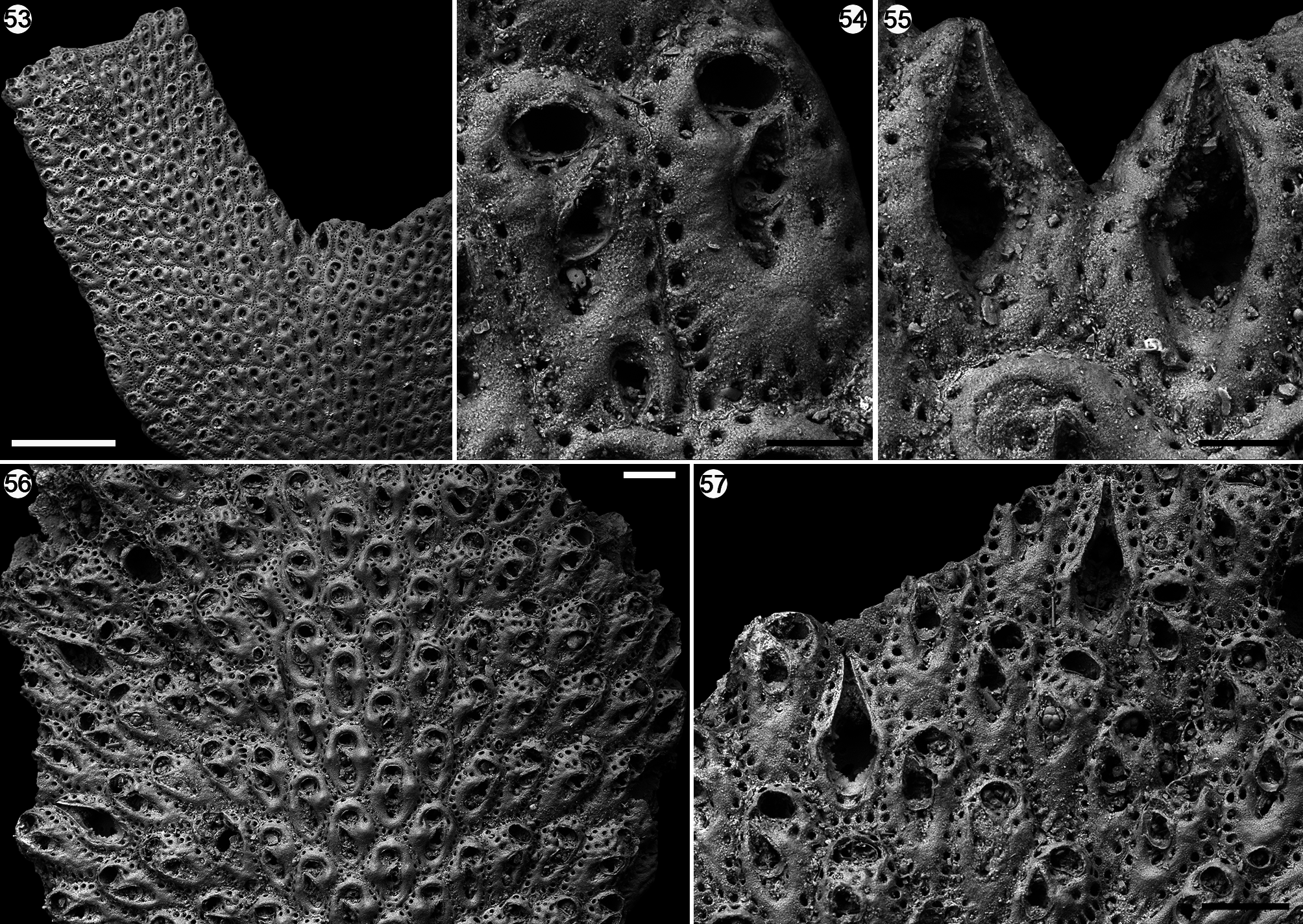
(Figs 53 – 57; Table 12)
Martino, Emanuela Di, Taylor, Paul D. (2018): Early Pleistocene and Holocene bryozoans from Indonesia. Zootaxa 4419 (1): 1-70, DOI: 10.11646/zootaxa.4419.1.1
Description. Colony rigidly erect, adeoniform. Branches strap-like, about 2 mm wide, arising from an encrusting base, bifurcating at angles of 80 – 90 ˚, bilaminate, tapering proximally with 6 – 12 longitudinal rows of alternating autozooids, with the zooids in the central rows aligned parallel to the branch axis and the outer zooids directing outwards. Autozooids distinct with shallow interzooidal furrows, apparently monomorphic, rhomboidal to hexagonal, longer than broad (mean L / W = 1.60). Frontal shield flat, finely granular with suboral avicularium and frontal spiramen. One or two small tubercles present at sides of orifice in some autozooids. Areolar pores circular to oval, 10 – 25 µm in diameter, forming a complete row around periphery of zooid; accessory pores delimiting the suboral avicularian cystid. Spiramen circular, relatively large, 30 – 40 µm in diameter, placed at about one-forth from the proximal end of the zooid. Orifice circular to semicircular. Suboral avicularium present on each autozooid, extending obliquely from a point distal to the spiramen to proximolateral corner of the orifice without indenting it except in a few cases; rostrum pointed triangular distolaterally and outwardly directed; a pair of blunt pivotal condyles define a pear-shaped opening. Additional frontal avicularia observed only in a few zooids, similar in shape and size to suboral avicularia, placed on the proximal end of the zooid, rostrum proximolaterally directed. Vicarious avicularia rare, placed on the branch margins, rostrum triangular and channelled, distally directed; cystid lozenge-shaped, finely granular, bordered by a row of areolar pores. Orifice sealed in some zooids as ontogenetic calcification progresses. Gonozooids not recognized.
Martino, Emanuela Di, Taylor, Paul D. (2018): Early Pleistocene and Holocene bryozoans from Indonesia. Zootaxa 4419 (1): 1-70, DOI: 10.11646/zootaxa.4419.1.1
Remarks. Sixty-six branch fragments of Adeonellopsis arculifera were found in our samples. This Indo- Pacific species has been recorded from the Sulu Archipelago (Philippines) at 38 – 53 m depth (Canu & Bassler 1929), and the Makassar Strait and off Halmaheira (Indonesia) at 0 – 45 m depth (Harmer 1957). N, Number of colonies and number of zooids measured; SD, standard deviation; Av, avicularium; Vic, vicarious.
Martino, Emanuela Di, Taylor, Paul D. (2018): Early Pleistocene and Holocene bryozoans from Indonesia. Zootaxa 4419 (1): 1-70, DOI: 10.11646/zootaxa.4419.1.1
Figured material. RGM. 1350556, RGM. 1350557, Holocene, UPGG 041, off South Sulawesi.
Martino, Emanuela Di, Taylor, Paul D. (2018): Early Pleistocene and Holocene bryozoans from Indonesia. Zootaxa 4419 (1): 1-70, DOI: 10.11646/zootaxa.4419.1.1
Export occurrence data
Darwin Core Archive (ZIP)
CLASSIFICATION
Taxonomic Classification Tree

NOMENCLATURE
Synonyms(1)
MULTIMEDIA
Media Files(1)
FIGURES 53–57. Adeonellopsis arculifera (Canu & Bassler, 1929), Holocene, UPGG041, off South Sulawesi. 53–55. RGM.1350556. 53. View of a branch fragment. 54. Close-up of two autozooids. 55. Close-up of two vicarious avicularia. 56, 57. RGM.1350557. 56. View of part of the branch. 57. Group of zooids and vicarious avicularia. Scale bars: Fig. 53 = 1 mm; Figs 54, 55 = 100 µm; Figs 56, 57 = 200 µm.
Imageimage/png© Martino, Emanuela Di;Taylor, Paul D.Martino, Emanuela Di;Taylor, Paul D.
IMAGES