
AnimaliaNot EvaluatedacceptedspeciesAccepted
Ascorhiza mawatarii

Ascorhiza mawatarii

d'Hondt, 1983

GBIF:163964170

0year

ABOUT

Descriptions(4)

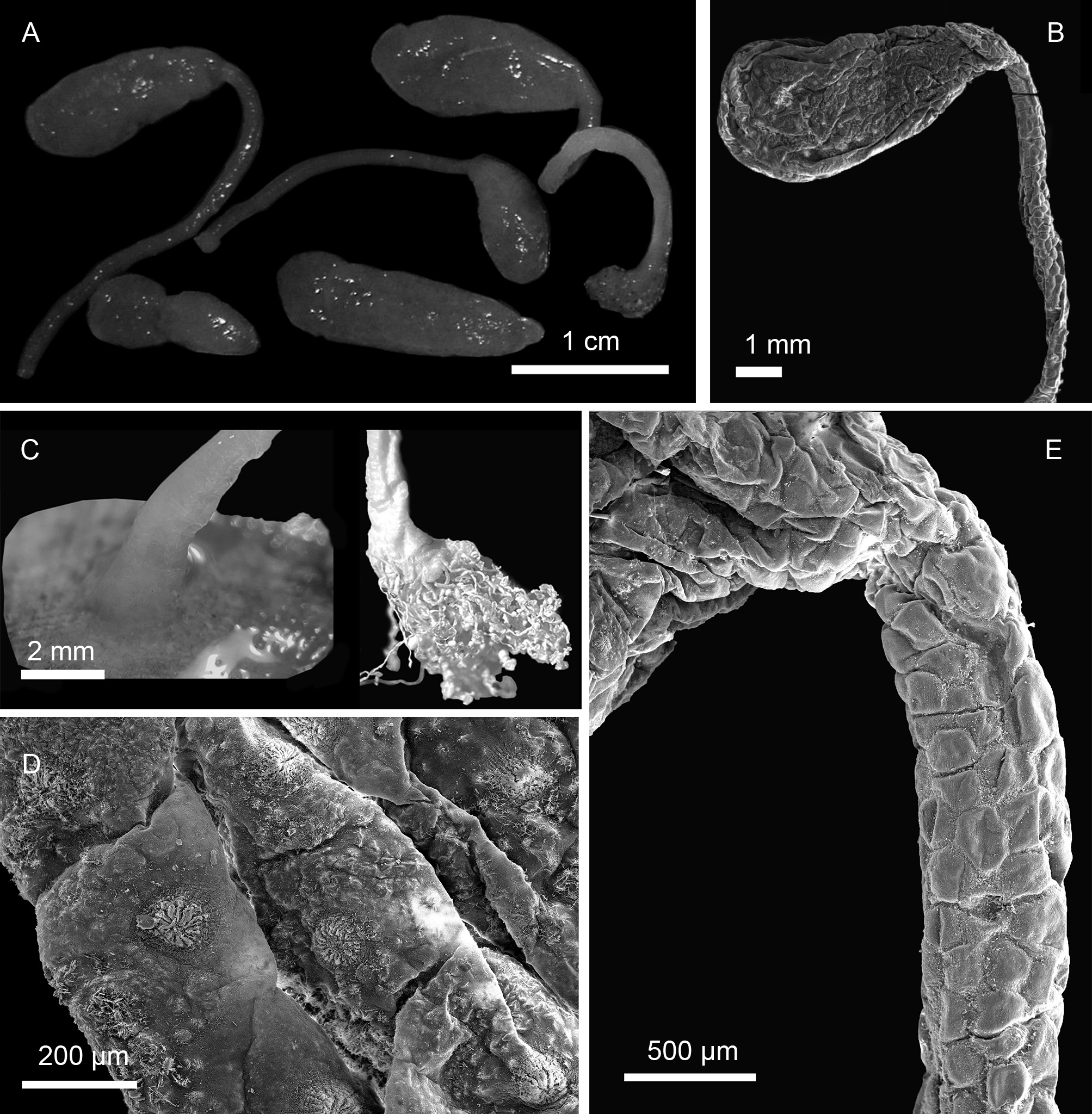
(Figs 2 A – E; 3 A)
Ramalho, Laís V., López-Fé, Carlos M., Mateo-Ramírez, Angel, Rueda, José Luis (2020): Bryozoa from deep-sea habitats of the northern Gulf of Cádiz (Northeastern Atlantic). Zootaxa 4768 (4): 451-478, DOI: 10.11646/zootaxa.4768.4.1
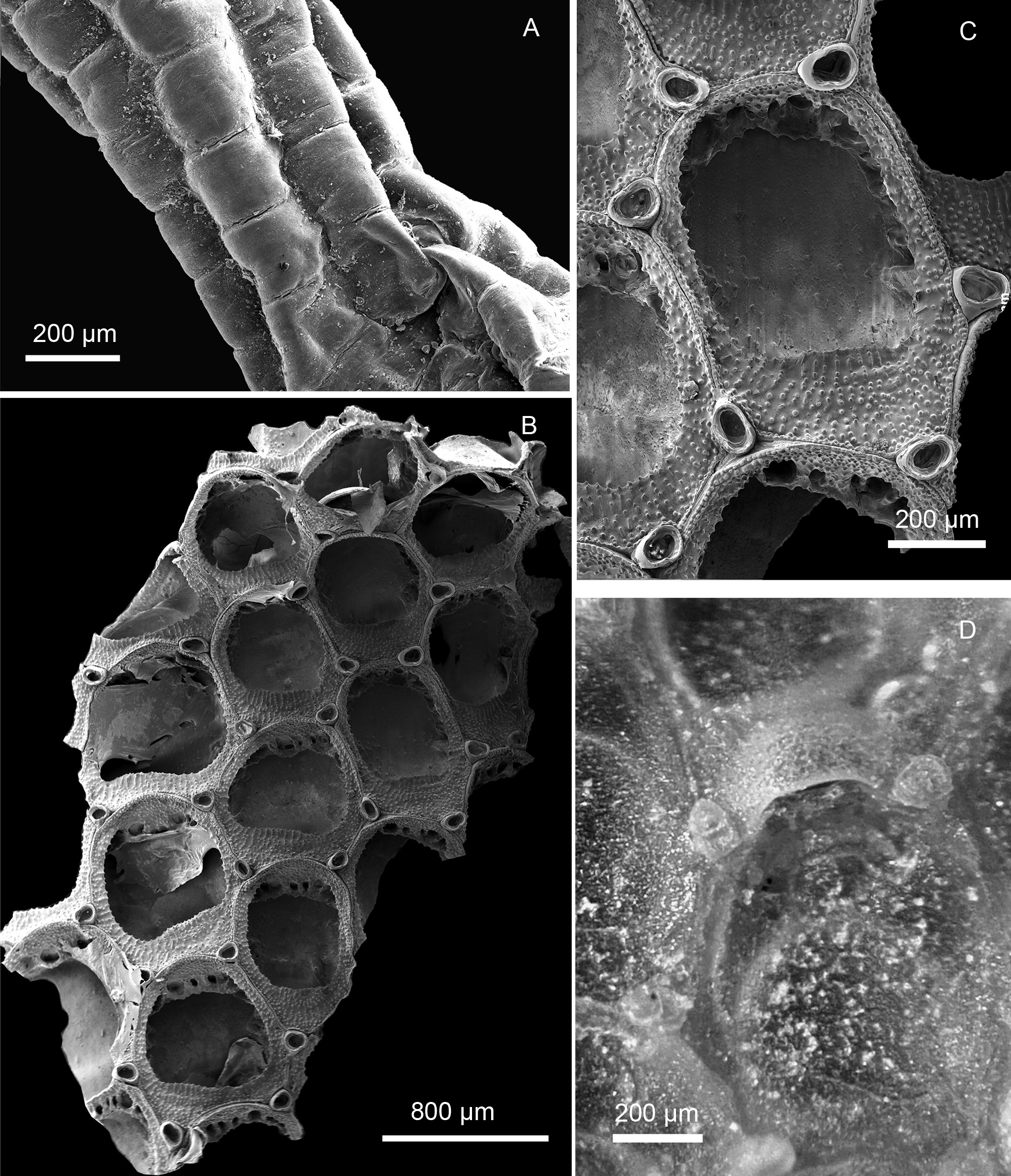
Description. Colony erect (22 – 42 mm long), delicate, formed by a dilated head (7 – 18 mm long x 3.5 – 6 mm wide) and a narrower peduncle (15 – 24 mm long x 1 – 1.5 mm wide) (Fig. 2 A, B), fixed to the substrate directly by expansion of the peduncle base or by rhizoids (Fig. 2 C). Zooids from the head disposed irregularly, hexagonal with circular aperture (Fig. 2 D); zooids from de peduncle (myoecia) with distinct form: those near the top polygonal, alternately arranged (Fig 2 E), those near the base somewhat rectangular, slightly longer than wide, arranged in rows (Fig. 3 A).
Ramalho, Laís V., López-Fé, Carlos M., Mateo-Ramírez, Angel, Rueda, José Luis (2020): Bryozoa from deep-sea habitats of the northern Gulf of Cádiz (Northeastern Atlantic). Zootaxa 4768 (4): 451-478, DOI: 10.11646/zootaxa.4768.4.1
Remarks. There are two described species of Ascorhiza: A. mawatari and A. occidentalis Fewkes, 1889 (Bock 2019; accessed 02.12.2019). The latter species is characterized by a narrow stalk composed of a number of segments, externally indicated by ferrules of uniform size with well-marked indentations. Ascorhiza mawatari was described from the Northern Pacific Ocean (d’Hondt 1983) and recorded later by Harmelin & d’Hondt (1992 b) in European waters, precisely in the GoC and in the Mediterranean Sea (Bouche des Bonifacio). Colony length in the original material is 20 mm (peduncle: 12 mm long by 1.8 mm wide; head: 4.5 mm wide), while the material described by Harmelin & d’Hondt (1992 b) from the GoC is more similar to our specimens (up to 55 mm long). The present material differs from that described by previous authors in having a narrower peduncle (often 1 mm wide) and smaller zooids (both length and width): d’Hondt (1983) reported that myoecia were almost 1 mm long by 0.4 – 0.5 mm width. Although the GoC material was poorly preserved, as all the peduncles were collapsed, the general features were similar. Two attachment modes were observed associated to the different type of substrate. In colonies attached to shells, the base was continuous and expanded, while colonies attached to sand grains used several rizhoids (Fig. 2 C). Apparently, this species varies in both the base of the peduncle and the shape of the peduncle zooids, and further studies are required to understand the reasons behind this variability, as the knowledge on this species is still scarce. Habitat and associated species. Ascorhiza mawatari was found associated with the bathyal cold-water coral framework (mainly Madrepora oculata Linnaeus), colonized by small gorgonians (Acanthogorgia and Bebryce). It was also found in sand and muddy sea bottoms with sea pens [Kophobelemnon stelliferum (Müller) and Funiculina quadrangularis (Pallas)], solitary corals (e. g. Flabellum chunii Marenzeller) and sea urchins, mainly Cidaris cidaris (Linnaeus).
Ramalho, Laís V., López-Fé, Carlos M., Mateo-Ramírez, Angel, Rueda, José Luis (2020): Bryozoa from deep-sea habitats of the northern Gulf of Cádiz (Northeastern Atlantic). Zootaxa 4768 (4): 451-478, DOI: 10.11646/zootaxa.4768.4.1
Material examined. MNCN 25.03 / 4194: DA 10, Gazul MV, 390 – 410 m depth, 26 June 2010, INDEMARES CHI- CA project, Instituto Español de Oceanografia (IEO) coll., on shells; MNCN 25.03 / 4195: BT 05, Chica MVD, 607 – 665 m depth, 19 February 2011, INDEMARES CHICA project, IEO coll., on shells.
Ramalho, Laís V., López-Fé, Carlos M., Mateo-Ramírez, Angel, Rueda, José Luis (2020): Bryozoa from deep-sea habitats of the northern Gulf of Cádiz (Northeastern Atlantic). Zootaxa 4768 (4): 451-478, DOI: 10.11646/zootaxa.4768.4.1

Export occurrence data

Darwin Core Archive (ZIP)

CLASSIFICATION

Taxonomic Classification Tree

MULTIMEDIA

Media Files(2)

FIGURE 2. Ascorhiza mawatari d’Hondt, 1983 (MNCN 25.03/4195). A. General view of some colonies. B. General view of a colony (SEM). C. Detail of the fixation mode: left, expanded base of the peduncle on a shell; right, base of the peduncle with several rizhoids. D. Detail of the head showing the circular aperture. E. Detail of the zooids forming the top of the peduncle.
Imageimage/png© Ramalho, Laís V.;López-Fé, Carlos M.;Mateo-Ramírez, Angel;Rueda, José LuisRamalho, Laís V.;López-Fé, Carlos M.;Mateo-Ramírez, Angel;Rueda, José Luis

FIGURE 3. A. Ascorhiza mawatari d’Hondt, 1983 (MNCN 25.03/4195), detail of the zooids which compose the base of the peduncle. B–D. Antropora gemarita Ramalho & López-Fé n. sp. (MNCN 25.03/4197). B. General view of a colony fragment. C. Detail of the colony showing one complete zooid with cryptocyst and interzooidal avicularia. D. Ovicellate zooid.

Imageimage/png© Ramalho, Laís V.;López-Fé, Carlos M.;Mateo-Ramírez, Angel;Rueda, José LuisRamalho, Laís V.;López-Fé, Carlos M.;Mateo-Ramírez, Angel;Rueda, José Luis

IMAGES

Gallery(2)

See Gallery

Occurrences with images

Source Information

Bryozoa from deep-sea habitats of the northern Gulf of Cádiz (Northeastern Atlantic)

checklist

This dataset contains the digitized treatments in Plazi based on the original journal article Ramalho, Laís V., López-Fé, Carlos M., Mateo-Ramírez, Angel, Rueda, José Luis (2020): Bryozoa from deep-sea habitats of the northern Gulf of Cádiz (Northeastern Atlantic). Zootaxa 4768 (4): 451-478, DOI: 10.11646/zootaxa.4768.4.1

Abstract

This study examines material collected in the northern part of the Gulf of Cádiz, in the Northeastern Atlantic Ocean, between the Iberian Peninsula and northern Africa, at 300–1200 m depth, within the Site of Community Importance “Volcanes de fango del Golfo de Cádiz” (Mud volcanoes of the Gulf of Cádiz, ESZZ-12002). Several previous studies were carried out in the Iberian Peninsula and Moroccan area (shallow and deep waters), recording ca. 300 bryozoan species from the Gulf of Cádiz. In the present study a total of 40 bryozoan taxa were identified, including two species new to science— Antropora gemarita n. sp. and Microporella funbio n. sp. —and three new records for the area.

Ramalho L V, López-Fé C M, Mateo-Ramírez A, Rueda J L, plazi (2020). Bryozoa from deep-sea habitats of the northern Gulf of Cádiz (Northeastern Atlantic). Plazi.org taxonomic treatments database. Checklist dataset https://doi.org/10.11646/zootaxa.4768.4.1 accessed via GBIF.org on 2026-06-15.

CC0Published 5/5/2020View dataset
GBIF Usage Key
163964170
Dataset Key
046b564d-0d89-43ea-83c7-9544dcf05225
Origin
source
Backbone Key
4985458
Taxon ID
03C8879DFFD2FFA35887FA68FE885DB0.taxon
Last Crawled
6/10/2026
Last Interpreted
6/10/2026