
AnimaliaNot EvaluatedacceptedspeciesAccepted
Antropora gemarita
Ramalho, López-Fé, Mateo-Ramírez & Rueda, 2020
GBIF:163964174
0year
ABOUT
Descriptions(5)
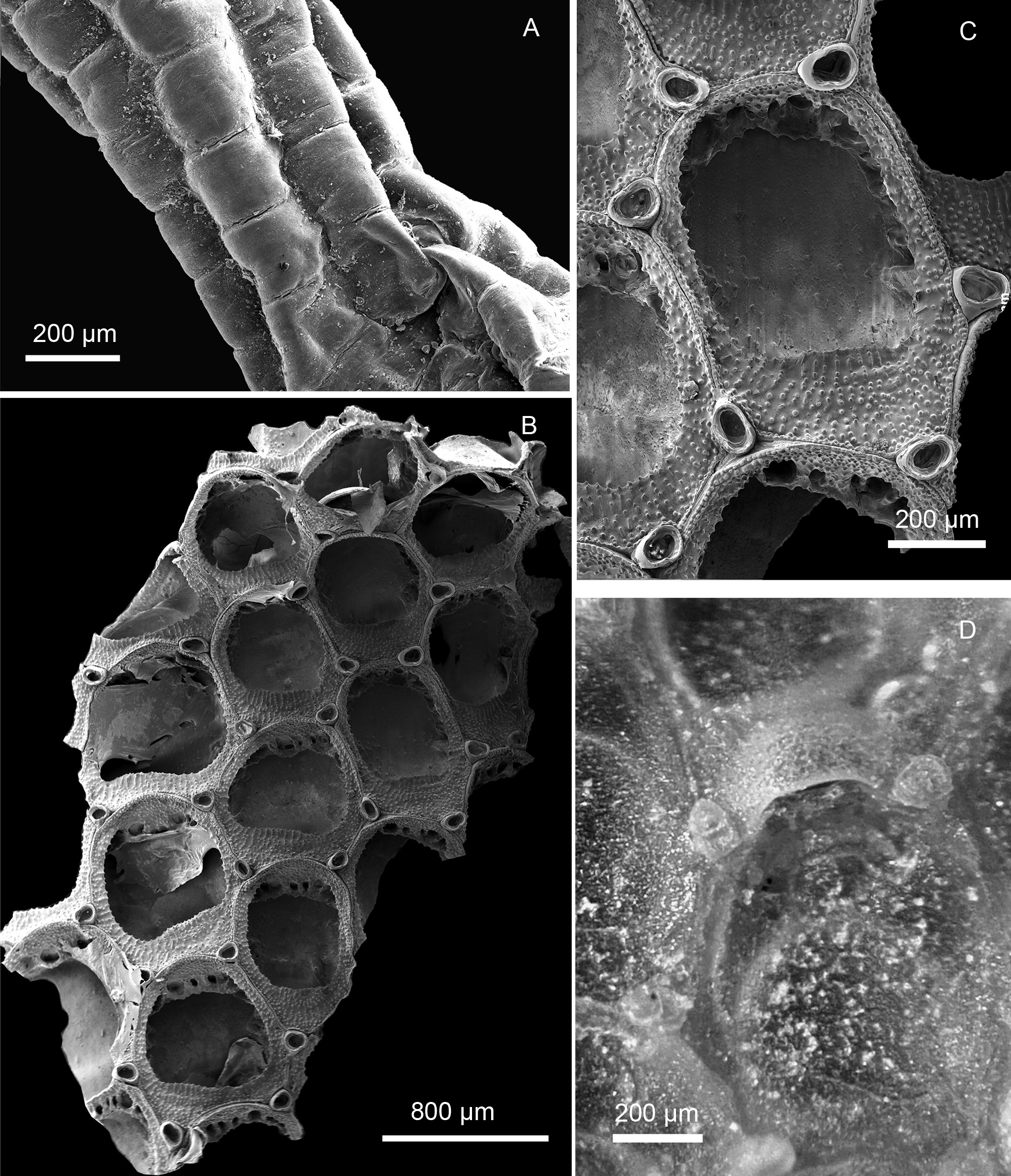
(Fig. 3 B – D; Table 4)
Ramalho, Laís V., López-Fé, Carlos M., Mateo-Ramírez, Angel, Rueda, José Luis (2020): Bryozoa from deep-sea habitats of the northern Gulf of Cádiz (Northeastern Atlantic). Zootaxa 4768 (4): 451-478, DOI: 10.11646/zootaxa.4768.4.1
Description. Colony encrusting, uni- to multilaminar. Autozooids large, oval, distinct by shallow grooves between thin, raised rims, not disjunct (Fig. 3 B, C). Gymnocyst absent; cryptocyst narrower distally and laterally, more developed and asymmetrical proximally, very finely crenulated. Opesia occupying three quarters of the frontal area (Fig. 3 B, C). One small, interzooidal avicularium usually located at the proximal corner of each zooid, in the angular interzooidal spaces, with each autozooid surrounded by six avicularia (Fig. 3 B, C). Rostrum elongate-oval, rounded and slightly broader at the tip, sometimes serrated, variably directed, without crossbar (Fig. 3 C). Large interzooidal avicularia not observed. Ovicell endozooecial, cap-shaped, extending beneath the cryptocyst of the distal zooid (Fig. 3 D).
Ramalho, Laís V., López-Fé, Carlos M., Mateo-Ramírez, Angel, Rueda, José Luis (2020): Bryozoa from deep-sea habitats of the northern Gulf of Cádiz (Northeastern Atlantic). Zootaxa 4768 (4): 451-478, DOI: 10.11646/zootaxa.4768.4.1
Remarks. Thirty-four species of Antropora have been described around the world, and most of them are fossil (Bock 2019; accessed 02.12.2019). Among the Recent species, two of them — A. compressa (Osburn, 1927) and A. minor (Hincks, 1880 b) — resemble Antropora gemarita Ramalho & López-Fé n. sp. The former species was de- scribed from the Caribbean Sea and has zooids disposed very close to each other without indication of an interopesial area. It also has interzooidal avicularia similar in shape but distally directed (in A. gemarita Ramalho & López- Fé n. sp. avicularia are variably directed), and smaller autozooids (300 – 400 µm long x 200 – 300 µm wide) (Osburn 1927). The latter species has similar cryptocyst appearance, but smaller zooids (320 – 500 µm long x 150 – 350 µm wide) (Tilbrook 1998), and a single avicularium (40 – 90 µm long). Habitat and associated species. This species was found on MDACs intermixed with coarse sediment dominated by sponges and coral rubble (mainly of M. oculata). It was also found in sandy mud with MDACs, sponges (Asconema setubalense Kent), small gorgonians (Acanthogorgia hirsuta Gray or Swiftia sp.), and echinoderms (C. cidaris and L. phalangium).
Ramalho, Laís V., López-Fé, Carlos M., Mateo-Ramírez, Angel, Rueda, José Luis (2020): Bryozoa from deep-sea habitats of the northern Gulf of Cádiz (Northeastern Atlantic). Zootaxa 4768 (4): 451-478, DOI: 10.11646/zootaxa.4768.4.1
Etymology. The specific name ‘ gemarita ’ is a combination of the name ‘ gemar ’ (short name of the GEociencias MARinas (Marine Geoscience) research group of the Instituto Español de Oceanografía, and ‘ - ita ’ (in Latin suffix that means ‘ belonging to’), in honour of the scientists and students of the GEMAR research group who helped in the INDEMARES CHICA project.
Ramalho, Laís V., López-Fé, Carlos M., Mateo-Ramírez, Angel, Rueda, José Luis (2020): Bryozoa from deep-sea habitats of the northern Gulf of Cádiz (Northeastern Atlantic). Zootaxa 4768 (4): 451-478, DOI: 10.11646/zootaxa.4768.4.1
Material examined. Holotype: MNCN 25.03 / 4197: DA 10, Gazul MV, 390 – 410 m depth, 26 June 2010, INDE- MARES CHICA project, IEO coll., on MDACs. Paratypes: MNCN 25.03 / 4196: DA 02, Gazul MV, 402 – 451 m depth, 21 June 2010, INDEMARES CHICA project, IEO coll., on MDACs; MNCN 25.03 / 4198: BT 17, Pipoca MV, 564 – 695 m depth, 23 February 2011, INDEMARES CHICA project, IEO coll., on shells.
Ramalho, Laís V., López-Fé, Carlos M., Mateo-Ramírez, Angel, Rueda, José Luis (2020): Bryozoa from deep-sea habitats of the northern Gulf of Cádiz (Northeastern Atlantic). Zootaxa 4768 (4): 451-478, DOI: 10.11646/zootaxa.4768.4.1
Export occurrence data
Darwin Core Archive (ZIP)
CLASSIFICATION
Taxonomic Classification Tree

MULTIMEDIA
Media Files(1)
FIGURE 3. A. Ascorhiza mawatari d’Hondt, 1983 (MNCN 25.03/4195), detail of the zooids which compose the base of the peduncle. B–D. Antropora gemarita Ramalho & López-Fé n. sp. (MNCN 25.03/4197). B. General view of a colony fragment. C. Detail of the colony showing one complete zooid with cryptocyst and interzooidal avicularia. D. Ovicellate zooid.
Imageimage/png© Ramalho, Laís V.;López-Fé, Carlos M.;Mateo-Ramírez, Angel;Rueda, José LuisRamalho, Laís V.;López-Fé, Carlos M.;Mateo-Ramírez, Angel;Rueda, José Luis
IMAGES