
AnimaliaNot EvaluatedacceptedspeciesAccepted
Porella tenuis

Porella tenuis

(Calvet, 1906)

GBIF:163964177

0year

0

Synonyms

ABOUT

Descriptions(4)

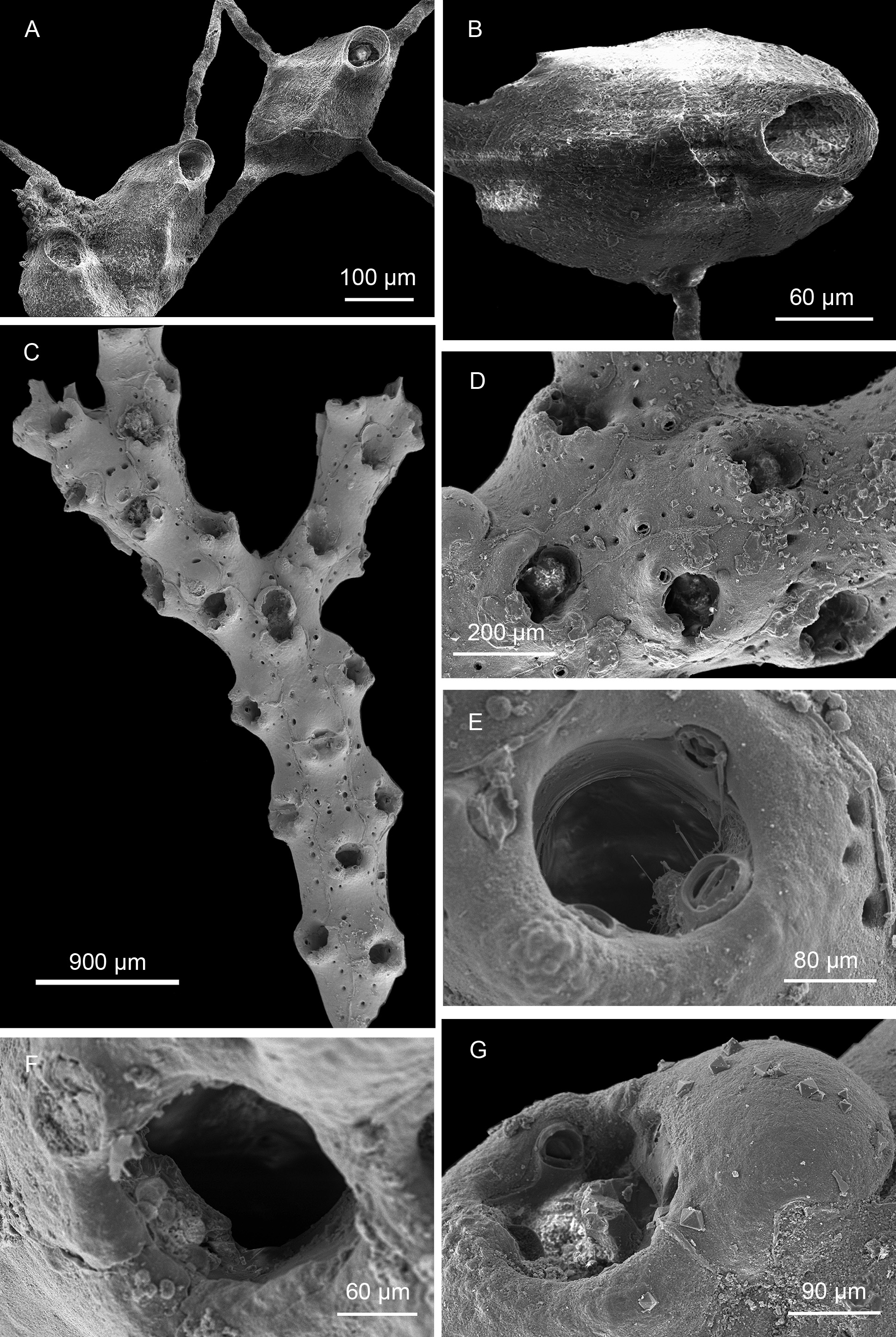
(Figs 4 C – G; 5 A, B; Table 6)
Ramalho, Laís V., López-Fé, Carlos M., Mateo-Ramírez, Angel, Rueda, José Luis (2020): Bryozoa from deep-sea habitats of the northern Gulf of Cádiz (Northeastern Atlantic). Zootaxa 4768 (4): 451-478, DOI: 10.11646/zootaxa.4768.4.1
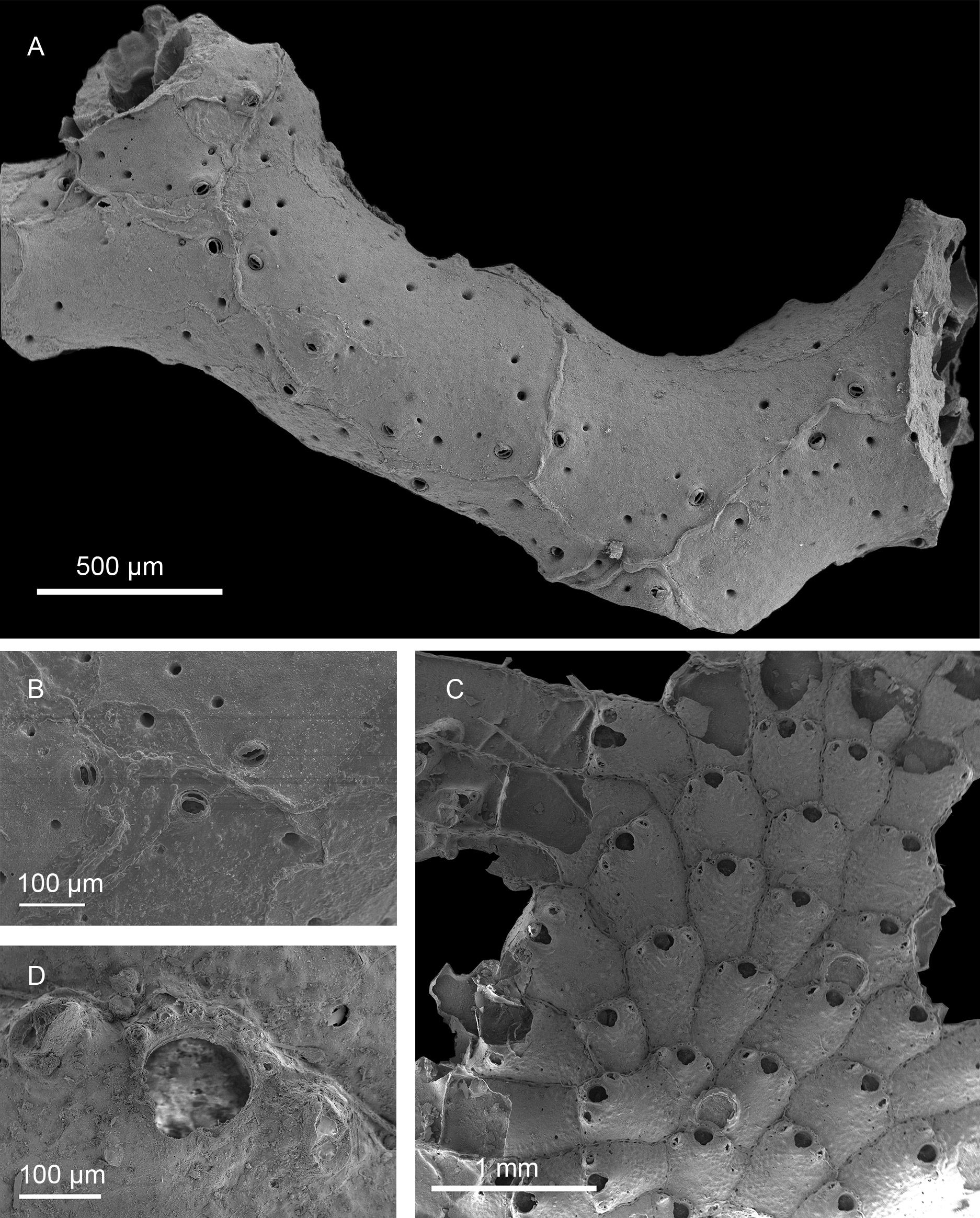
Description. Erect colony with cylindrical branches and zooids opening only on the frontal side (Fig. 4 C). Autozooids elongate, arranged in two or three longitudinal alternated series, orifices from the outer zooids facing away from the branch midline (Fig. 4 C, D); frontal shield smooth or slightly nodular, imperforate except for scattered, rounded marginal areolar pores varying in size; sometimes a row of smaller rounded pores at the base of the peristome; on some zooids a small avicularium replacing an areolar pore (Fig. 4 D). Peristome well developed, hiding the primary orifice and forming three tapered, cylindrical umbones (one median and two lateral) with nodular surface, and three inner avicularia placed at the base of each umbo (Fig. 4 D, E): the median avicularium wider than long and larger than lateral ones, directed upwards and outwards (Fig. 4 E). Primary orifice wider than long, with a wide and short lyrula at its proximal border (Fig. 4 F). All avicularia (frontal, peristomial and distal) circular to oval, small, rostrum with serrate border and complete, thick crossbar (Fig. 4 D, E, G). Ovicell slightly wider than long, globular, with a smooth surface and two, rounded to elliptical pores near the proximal border; becoming immersed with secondary calcification (Fig. 4 G); opening inside the peristome but not closed by the zooidal operculum. On the abfrontal side: several scattered small and rounded pores, more frequently near the sutures; avicularia (similar in size and shape to those on the frontal side) placed near the sutures as well, directed randomly (Fig. 5 A, B).
Ramalho, Laís V., López-Fé, Carlos M., Mateo-Ramírez, Angel, Rueda, José Luis (2020): Bryozoa from deep-sea habitats of the northern Gulf of Cádiz (Northeastern Atlantic). Zootaxa 4768 (4): 451-478, DOI: 10.11646/zootaxa.4768.4.1
Remarks. Porella tenuis has been described by Calvet (1906) from Cape Spartel (Gulf of Cádiz), occurring at 717 meters depth as Palmicellaria tenuis. Subsequently, d’Hondt (1974) recorded this species from the Gulf of Gascogne (North Atlantic) (as Palmicellaria skenei subspecies tenuis). Souto et al. (2016), while describing a new species of Porella, P. biserialis, had the opportunity to examine the type-material of Palmicellaria tenuis (MNHN 419) and transferred P. tenuis to the genus Porella. These authors suggested that P. tenuis fits better in the family Bryocryptellidae instead of Celleporidae, indicating features that are distinctive between the two species: P. biserialis has branches with two longitudinal series of zooids but lacks a lyrula, peristomial umbo, and avicularia on the ovicellate zooids. Comparing the specimens of this study with the holotype of Porella tenuis some differences were detected: the holotype shows three or four latero-peristomial umbones (our specimens have three umbones, one suboral plus one on each side), and the avicularia inside the peristome are not constant (three avicularia always present in our specimens). Nevertheless, d’Hondt (1974) mentioned that these characters can be very variable within and between colonies. The material studied here consisted of fragmented colonies suggesting that variability may be lost. Thus, we maintain these specimens as Porella tenuis. Habitat and associated species. This species occurs in fine sand and sandy mud with MDAC and coral rubble, L. phalangium, sponges [T. muricata and Pheronema carpenteri (Thomson)], M. oculata and some soft bottom octocorals (Isidella elongata (Esper), Radicipes cf. fragilis) and small gorgonians (Swiftia sp.).
Ramalho, Laís V., López-Fé, Carlos M., Mateo-Ramírez, Angel, Rueda, José Luis (2020): Bryozoa from deep-sea habitats of the northern Gulf of Cádiz (Northeastern Atlantic). Zootaxa 4768 (4): 451-478, DOI: 10.11646/zootaxa.4768.4.1
Material examined. MNCN 25.03 / 4202: DA 05, Gazul MV, 418 – 422 m depth, 22 June 2010, INDEMARES CHI- CA Project, IEO coll., no information on the original substrate; MNCN 25.03 / 4203: BT 26, Almazán MV, 930 – 940 m depth, 4 March 2011, INDEMARES CHICA Project, IEO coll., no information on the original substrate; MNCN 25.03 / 4204: BT 06, Chica MVD, 660 – 667 m depth, 19 February 2011, INDEMARES CHICA Project, IEO coll., on MDACs.
Ramalho, Laís V., López-Fé, Carlos M., Mateo-Ramírez, Angel, Rueda, José Luis (2020): Bryozoa from deep-sea habitats of the northern Gulf of Cádiz (Northeastern Atlantic). Zootaxa 4768 (4): 451-478, DOI: 10.11646/zootaxa.4768.4.1

Export occurrence data

Darwin Core Archive (ZIP)

CLASSIFICATION

Taxonomic Classification Tree

MULTIMEDIA

Media Files(2)

FIGURE 4. A–B. Hippothoa sp. (MNCN 25.03/4201). A. General view of some zooids. B. Detail of a zooid showing orifice and keeled frontal shield. C–G. Porella tenuis (Calvet, 1906) (MNCN 25.03/4204). C. General frontal view of a branch fragment. D. Group of zooids with three oral umbones, orificial and frontal avicularia. E. Detail of an orifice showing the three orificial avicularia. F. Detail of an orifice showing the lyrula. G. Detail of the distal region of a zooid showing orifice with avicularia, and ovicell with two proximal frontal pores.
Imageimage/png© Ramalho, Laís V.;López-Fé, Carlos M.;Mateo-Ramírez, Angel;Rueda, José LuisRamalho, Laís V.;López-Fé, Carlos M.;Mateo-Ramírez, Angel;Rueda, José Luis

FIGURE 5. A, B. Porella tenuis (Calvet, 1906) (MNCN 25.03/4204). A. General view of the abfrontal side of a branch fragment. B. Detail of the abfrontal side of a branch fragment showing some avicularia. C, D. Schizomavella (Schizomavella) linearis profunda Harmelin & d’Hondt, 1992 (MNCN 25.03/4205). C. General view of a colony with ovicellate and non-ovicellate zooids. D. Detail of the distal portion of a zooid showing the orifice, lateral avicularia and distal oral spines.

Imageimage/png© Ramalho, Laís V.;López-Fé, Carlos M.;Mateo-Ramírez, Angel;Rueda, José LuisRamalho, Laís V.;López-Fé, Carlos M.;Mateo-Ramírez, Angel;Rueda, José Luis

IMAGES

Gallery(2)

See Gallery

Occurrences with images

Source Information

Bryozoa from deep-sea habitats of the northern Gulf of Cádiz (Northeastern Atlantic)

checklist

This dataset contains the digitized treatments in Plazi based on the original journal article Ramalho, Laís V., López-Fé, Carlos M., Mateo-Ramírez, Angel, Rueda, José Luis (2020): Bryozoa from deep-sea habitats of the northern Gulf of Cádiz (Northeastern Atlantic). Zootaxa 4768 (4): 451-478, DOI: 10.11646/zootaxa.4768.4.1

Abstract

This study examines material collected in the northern part of the Gulf of Cádiz, in the Northeastern Atlantic Ocean, between the Iberian Peninsula and northern Africa, at 300–1200 m depth, within the Site of Community Importance “Volcanes de fango del Golfo de Cádiz” (Mud volcanoes of the Gulf of Cádiz, ESZZ-12002). Several previous studies were carried out in the Iberian Peninsula and Moroccan area (shallow and deep waters), recording ca. 300 bryozoan species from the Gulf of Cádiz. In the present study a total of 40 bryozoan taxa were identified, including two species new to science— Antropora gemarita n. sp. and Microporella funbio n. sp. —and three new records for the area.

Ramalho L V, López-Fé C M, Mateo-Ramírez A, Rueda J L, plazi (2020). Bryozoa from deep-sea habitats of the northern Gulf of Cádiz (Northeastern Atlantic). Plazi.org taxonomic treatments database. Checklist dataset https://doi.org/10.11646/zootaxa.4768.4.1 accessed via GBIF.org on 2026-06-15.

CC0Published 5/5/2020View dataset
GBIF Usage Key
163964177
Dataset Key
046b564d-0d89-43ea-83c7-9544dcf05225
Origin
source
Backbone Key
7952245
Taxon ID
03C8879DFFDBFFA65887F9D8FB2E588E.taxon
Last Crawled
6/10/2026
Last Interpreted
6/10/2026