
AnimaliaacceptedgenusAccepted
Hippothoa
Lamouroux, 1821
GBIF:163964179
0year
ABOUT
Descriptions(4)
(Fig. 4 A, B; Table 5)
Ramalho, Laís V., López-Fé, Carlos M., Mateo-Ramírez, Angel, Rueda, José Luis (2020): Bryozoa from deep-sea habitats of the northern Gulf of Cádiz (Northeastern Atlantic). Zootaxa 4768 (4): 451-478, DOI: 10.11646/zootaxa.4768.4.1
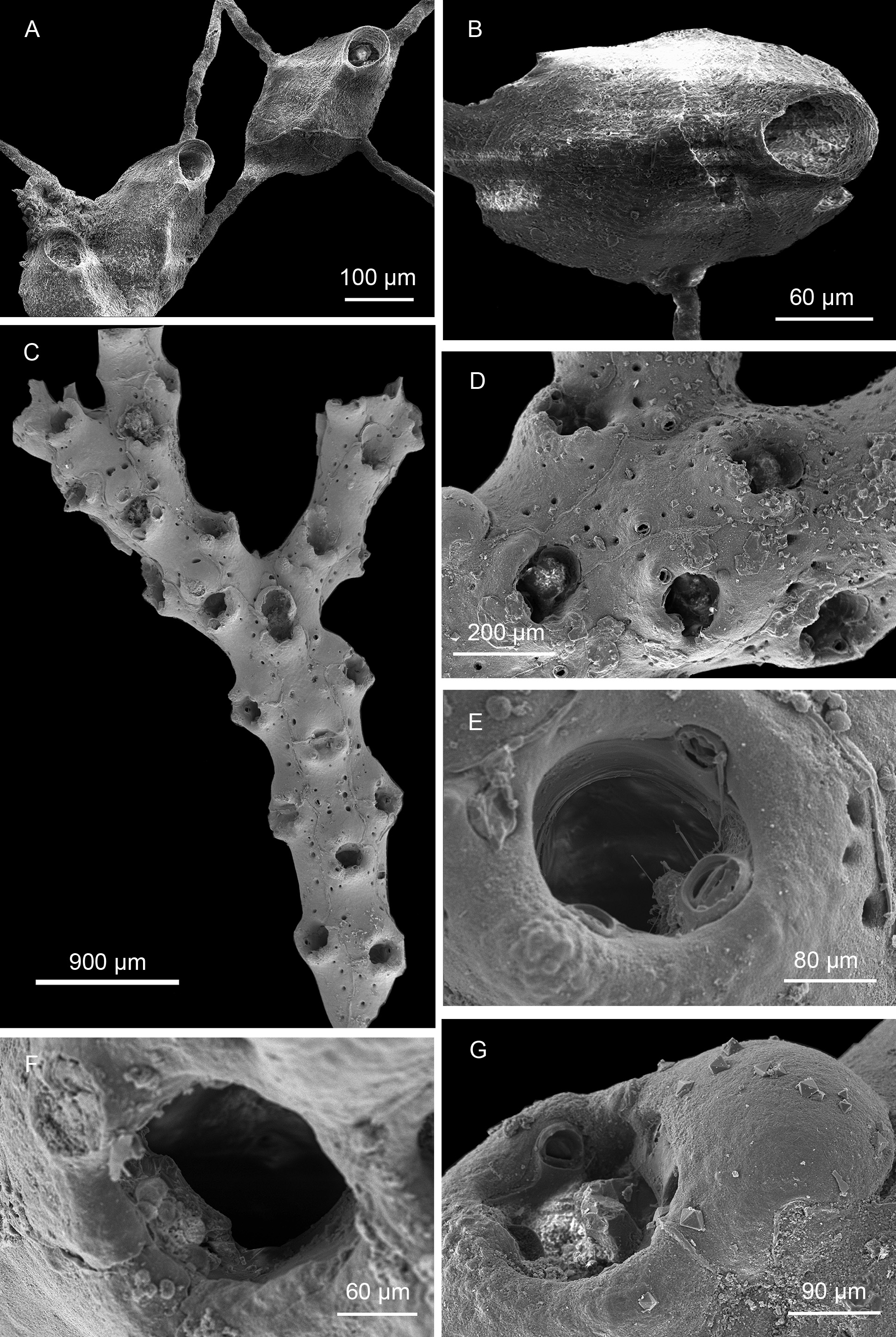
Description. Colony creeping, branching in uniserial chains of zooids (Fig. 4 A). Each autozooid giving rise to three new zooids: one distal and two lateral; the lateral connections come up near the median region of the zooid (Fig. 4 A). Autozooid elongate, fusiform with elongate, very thin tubular proximal cauda (Fig. 4 A). Frontal shield smooth, imperforate with a pronounced longitudinal median ridge ending close to the orifice, forming a short suboral umbo. Primary orifice longer than wide, oval distally and with a U-shaped sinus proximally, and a pair of small, dot-shaped condyles (Fig. 4 B). Fertile zooids not observed.
Ramalho, Laís V., López-Fé, Carlos M., Mateo-Ramírez, Angel, Rueda, José Luis (2020): Bryozoa from deep-sea habitats of the northern Gulf of Cádiz (Northeastern Atlantic). Zootaxa 4768 (4): 451-478, DOI: 10.11646/zootaxa.4768.4.1
Remarks. Colonies were found colonizing shell remains, generally more abundantly on the internal than on the external sides of those shells. This species is similar to Hippothoa divaricata Lamouroux, 1821 because of the presence of the longitudinal frontal keel, but orifice shape differs (H. divaricata has V-shaped sinus). Hippothoa longicauda Souto et al., 2016 has a similar orifice and long, thin caudae but lacks the frontal keel. Another similar species is H. flagellum Manzoni, 1870 because of the thin, elongate caudae, but H. flagellum has a narrower sinus and lacks a median keel. The species H. petrophila Dick & Grischenko, 2016 from the Pacific Ocean is similar in having long and thin caudae and a median keel, but the orifice has a large, deep, U-shaped sinus. This species is left in open nomenclature because fertile zooids are absent. Habitat and associated species. Hippothoa sp. was associated with coarse sediment and mixed bottoms with sand, muddy sand, bioclasts and MDACs, in which solitary scleractinian corals (Caryophyllia sp. and F. chunii), the sea urchin Cidaris cidaris, the polychaete Lanice sp. and the bivalve Bathyarca philippiana (Nyst) also occur.
Ramalho, Laís V., López-Fé, Carlos M., Mateo-Ramírez, Angel, Rueda, José Luis (2020): Bryozoa from deep-sea habitats of the northern Gulf of Cádiz (Northeastern Atlantic). Zootaxa 4768 (4): 451-478, DOI: 10.11646/zootaxa.4768.4.1
Material examined. MNCN 25.03 / 4199: DA 07, Gazul MV, 491 – 495 m depth, 24 June 2010, INDEMARES CHI- CA Project, IEO coll., on shells; MNCN 25.03 / 4200: DA 08, Gazul MV, 486 – 487 m depth, 24 June 2010, INDE- MARES CHICA Project, IEO coll., on shells; MNCN 25.03 / 4201: DA 11, Gazul MV, 461 – 462 m depth, 27 June 2010, INDEMARES CHICA Project, IEO coll., on shells.
Ramalho, Laís V., López-Fé, Carlos M., Mateo-Ramírez, Angel, Rueda, José Luis (2020): Bryozoa from deep-sea habitats of the northern Gulf of Cádiz (Northeastern Atlantic). Zootaxa 4768 (4): 451-478, DOI: 10.11646/zootaxa.4768.4.1
Export occurrence data
Darwin Core Archive (ZIP)
CLASSIFICATION
Taxonomic Classification Tree

MULTIMEDIA
Media Files(1)
FIGURE 4. A–B. Hippothoa sp. (MNCN 25.03/4201). A. General view of some zooids. B. Detail of a zooid showing orifice and keeled frontal shield. C–G. Porella tenuis (Calvet, 1906) (MNCN 25.03/4204). C. General frontal view of a branch fragment. D. Group of zooids with three oral umbones, orificial and frontal avicularia. E. Detail of an orifice showing the three orificial avicularia. F. Detail of an orifice showing the lyrula. G. Detail of the distal region of a zooid showing orifice with avicularia, and ovicell with two proximal frontal pores.
Imageimage/png© Ramalho, Laís V.;López-Fé, Carlos M.;Mateo-Ramírez, Angel;Rueda, José LuisRamalho, Laís V.;López-Fé, Carlos M.;Mateo-Ramírez, Angel;Rueda, José Luis
IMAGES