
AnimaliaacceptedsubspeciesAccepted
Schizomavella linearis profunda

Schizomavella linearis profunda

Harmelin & d'Hondt, 1992

GBIF:163964182

0year

0

Synonyms

ABOUT

Descriptions(3)

(Figs 5 C, D; 6 A)
Ramalho, Laís V., López-Fé, Carlos M., Mateo-Ramírez, Angel, Rueda, José Luis (2020): Bryozoa from deep-sea habitats of the northern Gulf of Cádiz (Northeastern Atlantic). Zootaxa 4768 (4): 451-478, DOI: 10.11646/zootaxa.4768.4.1
Remarks. Schizomavella (Schizomavella) linearis profunda described by Harmelin & d’Hondt (1992 a) differs from S. (S.) linearis (Hassall, 1841) in having 5 – 7 (more frequently 6) distal oral spines constantly in all zooids (in the typical form they disappear in older generations). The colonies collected in the present study (Fig. 5 C) were considered to belong to the subspecies profunda because of the number of oral spines (Fig. 5 D). Other similarity is the shape of the avicularia which have a triangular rostrum transversely directed (Figs 5 D, 6 A). Nevertheless, the paired lateral oral avicularia are positioned more distally than in the holotype of the subspecies. This variability was also observed in the S. (S.) linearis profunda reported by Souto et al. (2014) from Portugal. A single zooid with a supernumerary avicularium associated with the ovicell (Fig. 6 A) was observed in one colony of the present study; this avicularium, although rare, was considered, until now, typical only of the original form (S. (S.) linearis) (Reverter-Gil & Fernández-Pulpeiro 1996). Habitat and associated species. This species was associated with muddy-medium sandy sea bottoms with C. cidaris, F. chunii, sponges (T. muricata) and sea pens (K. stelliferum and F. quadrangularis), and fine sand with MDAC, M. oculata, L. phalangium and sponges (Cladocroce spathiformis Topsent).
Ramalho, Laís V., López-Fé, Carlos M., Mateo-Ramírez, Angel, Rueda, José Luis (2020): Bryozoa from deep-sea habitats of the northern Gulf of Cádiz (Northeastern Atlantic). Zootaxa 4768 (4): 451-478, DOI: 10.11646/zootaxa.4768.4.1
Material examined. MNCN 25.03 / 4205: DA 08, Gazul MV, 486 – 487 m depth, 24 June 2010, INDEMARES CHI- CA Project, IEO coll., on shells; MNCN 25.03 / 4206: BT 03, Gazul MV, 460 – 462 m depth, 23 June 2010, INDE- MARES CHICA Project, IEO coll., on MDACs; MNCN 25.03 / 4207: BT 06, Gazul MV, 422 – 450 m depth, 25 June 2010, INDEMARES CHICA Project, IEO coll., on MDACs.
Ramalho, Laís V., López-Fé, Carlos M., Mateo-Ramírez, Angel, Rueda, José Luis (2020): Bryozoa from deep-sea habitats of the northern Gulf of Cádiz (Northeastern Atlantic). Zootaxa 4768 (4): 451-478, DOI: 10.11646/zootaxa.4768.4.1

Export occurrence data

Darwin Core Archive (ZIP)

CLASSIFICATION

Taxonomic Classification Tree

MULTIMEDIA

Media Files(2)

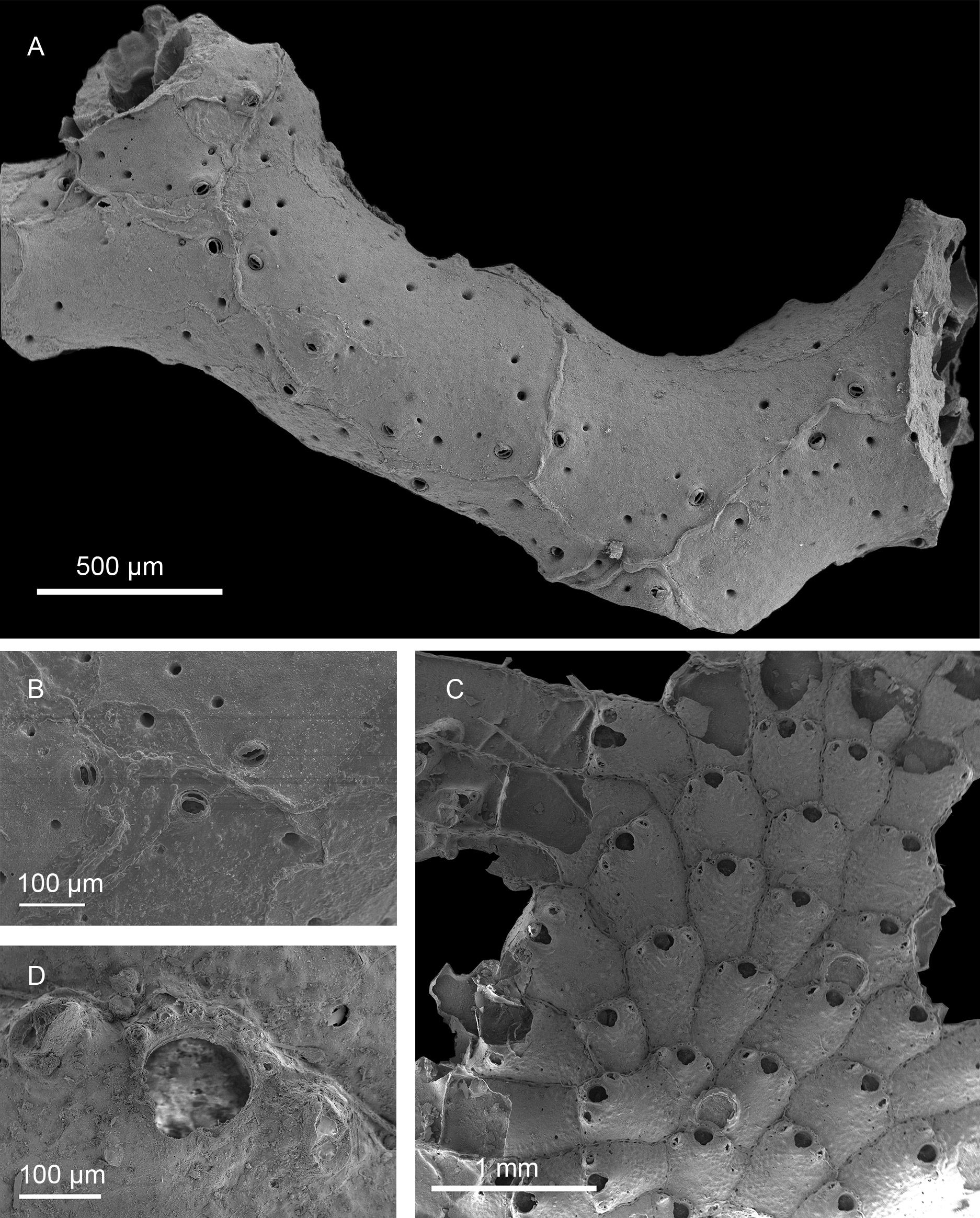
FIGURE 5. A, B. Porella tenuis (Calvet, 1906) (MNCN 25.03/4204). A. General view of the abfrontal side of a branch fragment. B. Detail of the abfrontal side of a branch fragment showing some avicularia. C, D. Schizomavella (Schizomavella) linearis profunda Harmelin & d’Hondt, 1992 (MNCN 25.03/4205). C. General view of a colony with ovicellate and non-ovicellate zooids. D. Detail of the distal portion of a zooid showing the orifice, lateral avicularia and distal oral spines.

Imageimage/png© Ramalho, Laís V.;López-Fé, Carlos M.;Mateo-Ramírez, Angel;Rueda, José LuisRamalho, Laís V.;López-Fé, Carlos M.;Mateo-Ramírez, Angel;Rueda, José Luis

FIGURE 6. A. Schizomavella (Schizomavella) linearis profunda Harmelin & d’Hondt, 1992 (MNCN 25.03/4205), ovicellate zooid showing orifice, latero-oral avicularia, and a supernumerary avicularium (latero-distal to the ovicell). B–E. Microporella funbio Ramalho & López-Fé n. sp. (MNCN 25.03/4209). B. General view of part of the colony showing ovicellate and non-ovicellate zooids. C. Detail of a fragment showing an ovicellate zooid and some autozooids with distal oral spines, lateral avicularia and ascopore. D. close-up of the orifice with crenulate proximal border and oral spines. E. Detail of an ovicellate zooid bearing four oral spines.

Imageimage/png© Ramalho, Laís V.;López-Fé, Carlos M.;Mateo-Ramírez, Angel;Rueda, José LuisRamalho, Laís V.;López-Fé, Carlos M.;Mateo-Ramírez, Angel;Rueda, José Luis

IMAGES

Gallery(2)

See Gallery

Occurrences with images

Source Information

Bryozoa from deep-sea habitats of the northern Gulf of Cádiz (Northeastern Atlantic)

checklist

This dataset contains the digitized treatments in Plazi based on the original journal article Ramalho, Laís V., López-Fé, Carlos M., Mateo-Ramírez, Angel, Rueda, José Luis (2020): Bryozoa from deep-sea habitats of the northern Gulf of Cádiz (Northeastern Atlantic). Zootaxa 4768 (4): 451-478, DOI: 10.11646/zootaxa.4768.4.1

Abstract

This study examines material collected in the northern part of the Gulf of Cádiz, in the Northeastern Atlantic Ocean, between the Iberian Peninsula and northern Africa, at 300–1200 m depth, within the Site of Community Importance “Volcanes de fango del Golfo de Cádiz” (Mud volcanoes of the Gulf of Cádiz, ESZZ-12002). Several previous studies were carried out in the Iberian Peninsula and Moroccan area (shallow and deep waters), recording ca. 300 bryozoan species from the Gulf of Cádiz. In the present study a total of 40 bryozoan taxa were identified, including two species new to science— Antropora gemarita n. sp. and Microporella funbio n. sp. —and three new records for the area.

Ramalho L V, López-Fé C M, Mateo-Ramírez A, Rueda J L, plazi (2020). Bryozoa from deep-sea habitats of the northern Gulf of Cádiz (Northeastern Atlantic). Plazi.org taxonomic treatments database. Checklist dataset https://doi.org/10.11646/zootaxa.4768.4.1 accessed via GBIF.org on 2026-06-16.

CC0Published 5/5/2020View dataset
GBIF Usage Key
163964182
Dataset Key
046b564d-0d89-43ea-83c7-9544dcf05225
Origin
source
Backbone Key
6153108
Taxon ID
03C8879DFFC7FFB95887FE8CFBC0587B.taxon
Last Crawled
6/10/2026
Last Interpreted
6/10/2026