
AnimaliaNot EvaluatedacceptedspeciesAccepted
Adeonella jahanai

Adeonella jahanai

Hirose, 2016

GBIF:164249538

0year

ABOUT

Descriptions(7)

Figs 4 – 5
Hirose, Masato (2016): Diversity and distribution of adeonid bryozoans (Cheilostomata: Adeonidae) in Japanese waters. European Journal of Taxonomy 203 (203): 1-41, DOI: 10.5852/ejt.2016.203
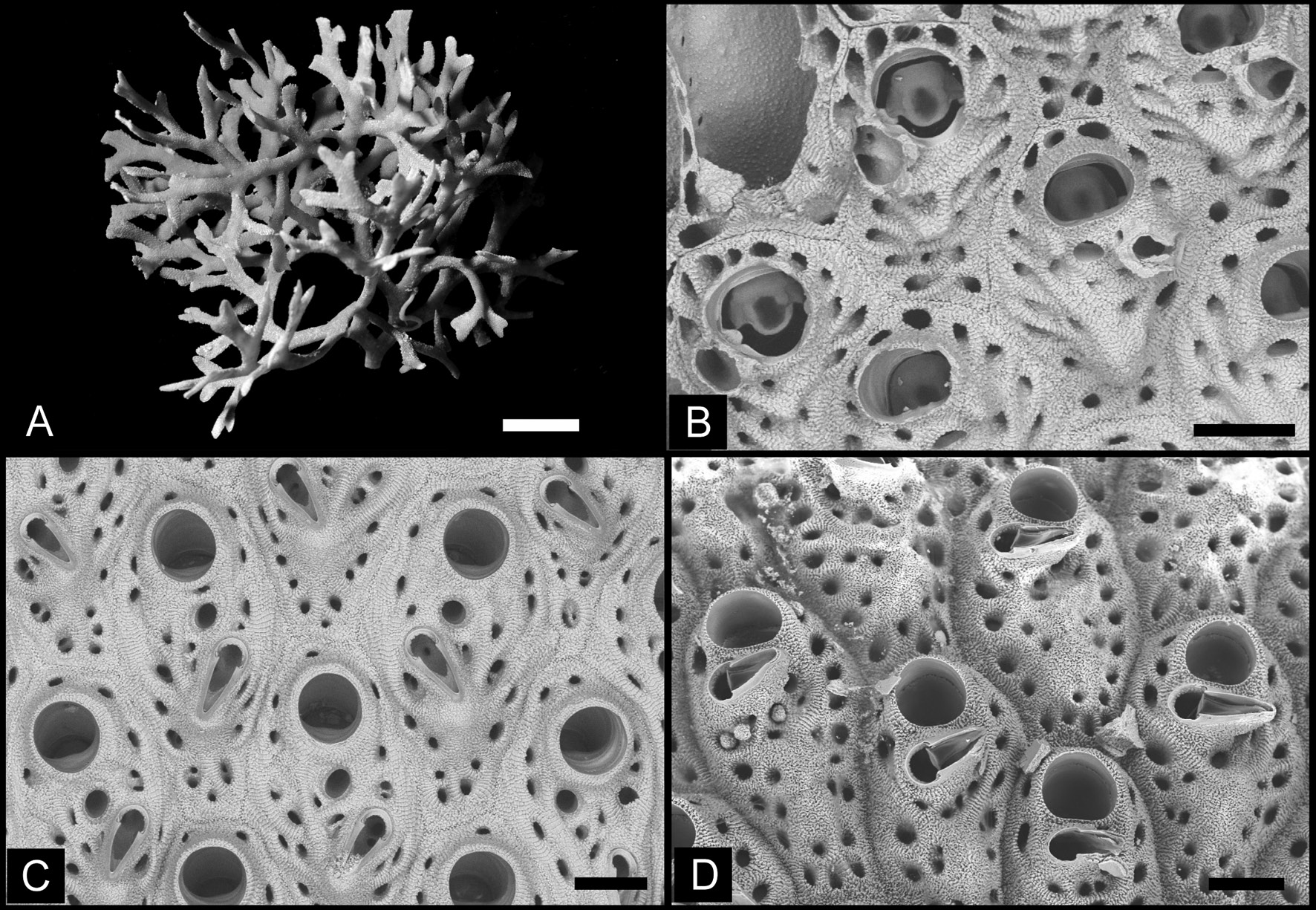
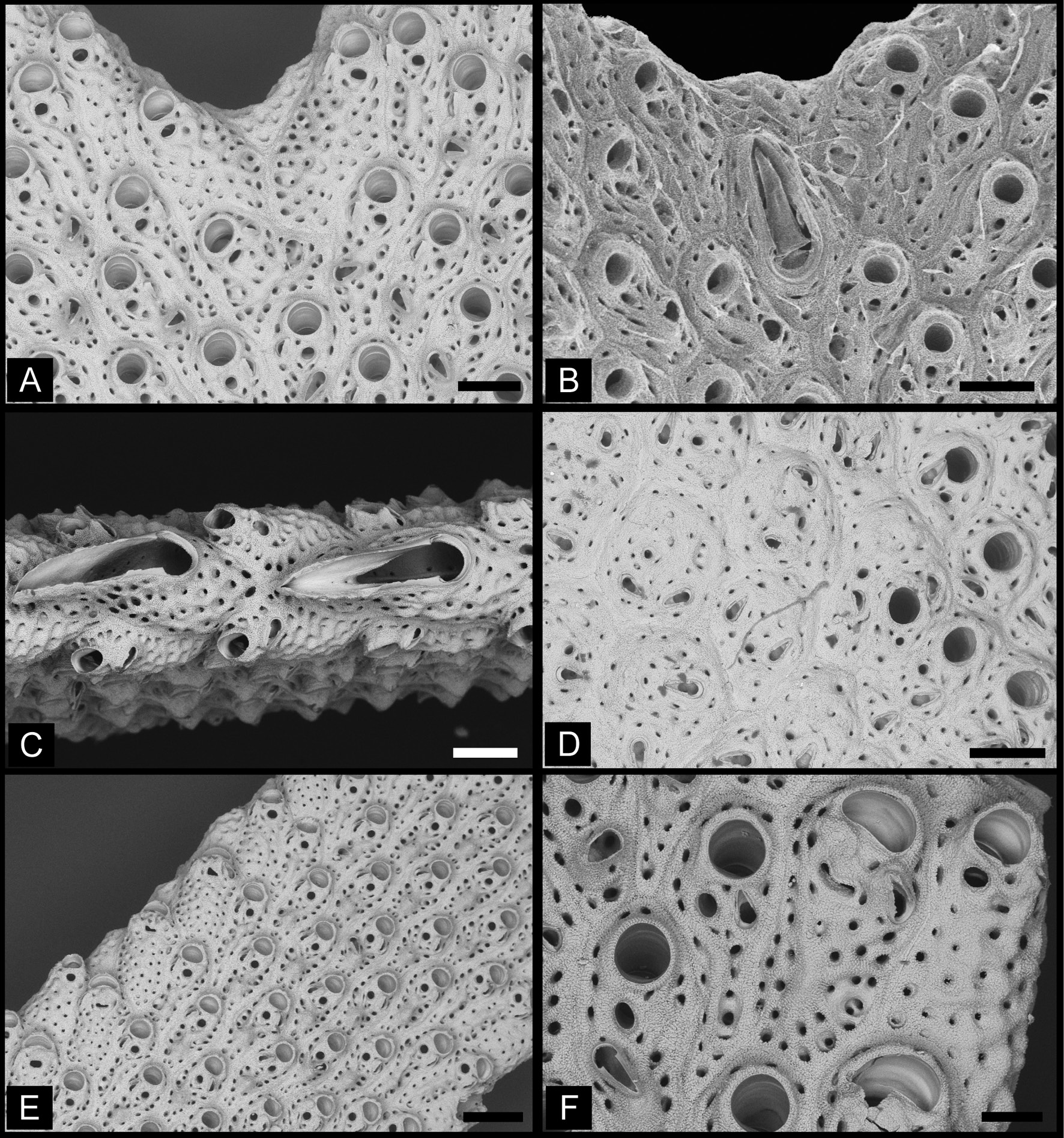
Measurements Autozooids. ZL: 374 ̅ 508 (437 ± 39); ZW: 196 ̅ 304 (242 ± 31); n = 17. SOrL: 67 ̅ 99 (82 ± 13); SOrW: 78 ̅ 92 (85 ± 5); n = 7. FAvL: 71 ̅ 121 (94 ± 18); FAvW: 36 ̅ 46 (39 ± 3); n = 9. SpL: 24 ̅ 35 (30 ± 4); SpW: 24 ̅ 32 (28 ± 2); n = 7. Gonozooids. ZL: 455 ̅ 666 (515 ± 79); ZW: 250 ̅ 335 (285 ± 37); n = 6. SOrL: 57 ̅ 96 (71 ± 14); SOrW: 95 ̅ 128 (103 ± 12); n = 6. SpL: 19 ̅ 27 (23 ± 3); SpW: 38 ̅ 49 (42 ± 4); n = 6. Description Colony brown, erect, dichotomously branching, widely and irregularly spreading, forming a bushy three-dimensional structure; up to 6 cm in diameter and 5 cm high (Fig. 4 A). Branches slender, nearly uniform in width, flattened, multiserial, with zooids opening on both sides, 1.1 – 2.4 mm wide (average 1.7 mm; n = 34); rounded at tip. Autozooids oval or hexagonal, surrounded by a distinct marginal groove (Fig. 4 C – D). Frontal shield convex, entirely covered with minute granules, with about 10 – 20 small, circular or slit-like areolar pores inside each lateral margin, many additional irregular pores in central region, and one large peristomial spiramen proximal to orifice (Figs 4 C, 5 B). Peristome deep, secondary orifice circular or transversely oval. Primary orifice deeply immersed in peristome, visible only in early ontogenetic zooids; with a deep and broadly U-shaped sinus and conspicuous condyles (Fig. 4 B), 59 ̅ 78 μm (average 72 μm) long by 71 ̅ 90 μm (average 82 μm) wide (n = 5). Frontal avicularia triangular, narrow, elongate, single or paired, occurring in center of frontal shield or toward proximal margin and oriented proximally or inward (Fig. 4 C). Another frontal avicularium abutting the proximal margin of peristome, rostrum slightly projected, directed laterally (Fig. 4 D). Gonozooids present at periphery of branches (Fig. 5 E). Gonozooids larger than autozooids, with broader orifice and porous frontal shield; peristomial spiramen transversely broad, with median projection from distal margin (Fig. 5 F). Vicarious avicularia rarely present near branch bifurcations, often lacking; elongate, as long as or sometimes longer than autozooids (Fig. 5 B), 384 ̅ 617 μm (average 500 μm) long by 126 ̅ 158 μm (average 142 μm) wide (n = 2). Rostrum of vicarious avicularia lanceolate, acute, directed distally; up to 410 μm long (348 ± 97, n = 2). Large vicarious avicularia also occur along branch edges (Fig. 5 C), up to 579 μm long (572 ± 9, n = 2) by 142 μm wide (139 ± 5, n = 2). In basal part of branches and colony, autozooids are often replaced by kenozooids (Fig. 5 D); 380 ̅ 416 μm (average 400 μm) long by 252 ̅ 304 μm (average 284 μm) wide (n = 5).
Hirose, Masato (2016): Diversity and distribution of adeonid bryozoans (Cheilostomata: Adeonidae) in Japanese waters. European Journal of Taxonomy 203 (203): 1-41, DOI: 10.5852/ejt.2016.203
Diagnosis Colony dichotomously branching; branches narrow, about 1.2 – 2.5 mm wide. Autozooids oval or hexagonal, distinct, delineated by deep groove. Frontal shield entirely covered with minute granules, with more than 10 circular or slit-like areolar pores. Peristome deep, secondary orifice circular, primary orifice with a deep and broadly U-shaped sinus, condyles short but broad and blunt. Many irregular frontal pores in central region. Frontal avicularia triangular, narrow, elongate; in center or at proximal margin of frontal shield, directed inward or proximally. Another frontal avicularium abuts proximal margin of peristome, rostrum slightly projected, directed laterally. Large, triangular vicarious avicularia present along branch margins and at bifurcations. Gonozooids slightly larger than autozooids, with porous frontal shield; secondary orifice broad, with slightly convex proximal margin.
Hirose, Masato (2016): Diversity and distribution of adeonid bryozoans (Cheilostomata: Adeonidae) in Japanese waters. European Journal of Taxonomy 203 (203): 1-41, DOI: 10.5852/ejt.2016.203
Remarks Adeonella jahanai sp. nov. resembles A. lichenoides in having a granulated frontal shield, and in the location of the small, triangular frontal avicularium, but differs from the latter in having markedly narrower branches, numerous slit-like areolar pores on the frontal shield, elongate frontal avicularia, and the frontal avicularia directed proximally. Autozooids of Adeonella jahanai sp. nov. also differ from A. lichenoides in having another frontal avicularium, triangular, slightly projected, directing laterally, abutting the proximal margin of the peristome. Adeonella jahanai sp. nov. resembles A. extensa Harmer, 1957 in having narrow branches, gonozooids along the margin of branches, and slightly longer frontal avicularia, and in generally lacking vicarious avicularia near branch bifurcations, but differs from the latter in the direction of the frontal avicularia, and in having gonozooids with a non-tubular peristome, with the peristomial spiramen being very closely situated to the secondary orifice.
Hirose, Masato (2016): Diversity and distribution of adeonid bryozoans (Cheilostomata: Adeonidae) in Japanese waters. European Journal of Taxonomy 203 (203): 1-41, DOI: 10.5852/ejt.2016.203
Distribution Japan: Nansei Islands (near Yakushima and west of Okinawa), at depths of 37 – 95 m.
Hirose, Masato (2016): Diversity and distribution of adeonid bryozoans (Cheilostomata: Adeonidae) in Japanese waters. European Journal of Taxonomy 203 (203): 1-41, DOI: 10.5852/ejt.2016.203
Etymology The species is named after Mr. Yoshikazu Jahana, the fisherman who collected the holotype specimen off Motobu, Okinawa.
Hirose, Masato (2016): Diversity and distribution of adeonid bryozoans (Cheilostomata: Adeonidae) in Japanese waters. European Journal of Taxonomy 203 (203): 1-41, DOI: 10.5852/ejt.2016.203
Material examined Holotype JAPAN: large colony collected 19 Mar. 2014 north of Motobu, Okinawa, 26 ° 42 ' 54.72 " N, 127 ° 53 ' 25.62 " E, 60 m depth, by basket net (NSMT-Te 1050). Paratypes JAPAN: several branches, same collection data as for holotype (NSMT-Te 889); single small branch collected 25 May 2009 southwest of Yakushima, 30 ° 05 ' 08.40 " N, 130 ° 04 ' 43.20 " E, 87 – 88 m depth, by dredge, T / V Toyoshio-maru (NSMT-Te 749); many branches collected 23 May 2010 south of Nagannu Island, Okinawa, 26 ° 14 ' 37.80 " N, 127 ° 32 ' 28.20 " E, 37 – 46 m depth, by dredge, T / V Toyoshiomaru (NSMT-Te 775); some fragments collected 21 May 2011 south of Nagannu Island, Okinawa, 26 ° 14 ' 39.00 " N, 127 ° 32 ' 55.20 " E to 26 ° 14 ' 43.20 " N, 127 ° 31 ' 48.60 " E, 47 – 52 m depth, by dredge, T / V Toyoshio-maru (NSMT-Te 751); some fragments collected 27 May 2012 south of Nagannu Island, Okinawa, 26 ° 14 ' 34.68 " N, 127 ° 32 ' 1.26 " E to 26 ° 14 ' 36.66 " N, 127 ° 31 ' 54.18 " E, 52 – 54 m depth, by dredge, T / V Toyoshio-maru (NSMT-Te 804); some fragments collected 27 May 2012 east of Maeshima Island, Okinawa, 26 ° 11 ' 41.40 " N, 127 ° 27 ' 20.34 " E to 26 ° 11 ' 39.90 " N, 127 ° 27 ' 18.36 " E, 55 – 57 m depth, by dredge, T / V Toyoshio-maru (NSMT-Te 805); some fragments collected 28 May 2012 south of Iejima Island, Okinawa, 26 ° 39 ' 14.28 " N, 127 ° 41 ' 47.52 " E to 26 ° 39 ' 19.38 " N, 127 ° 41 ' 52.98 " E, 94 – 95 m depth, by dredge, T / V Toyoshio-maru (NSMT-Te 806).
Hirose, Masato (2016): Diversity and distribution of adeonid bryozoans (Cheilostomata: Adeonidae) in Japanese waters. European Journal of Taxonomy 203 (203): 1-41, DOI: 10.5852/ejt.2016.203

Export occurrence data

Darwin Core Archive (ZIP)

CLASSIFICATION

Taxonomic Classification Tree

MULTIMEDIA

Media Files(2)

Fig. 4. Adeonella jahanai sp. nov. A. Holotype colony with narrow branches (NSMT-Te1050, Okinawa). B. Young autozooids at distal end of branch, showing primary orifices NSMT-Te889. C. Autozooids with elongate frontal avicularia (NSMT-Te889, Okinawa). D. Young autozooids with a single triangular avicularium abutting the proximal margin of the peristome (NSMT-Te889, Okinawa). A = optical photograph; B–D = SEM images. Scale bars: A = 1 cm; B–D = 100 μm.
Imageimage/png© Hirose, MasatoHirose, Masato

Fig. 5. Adeonella jahanai sp. nov. A. Branch bifurcation lacking vicarious avicularaia (NSMT- Te889, Okinawa). B. Branch bifurcation with vicarious avicularium (NSMT-Te749, off Yakushima). C. Vicarious avicularia on side of branch (NSMT-Te889, Okinawa). D. Old part of branch showing autozooids and kenozooids (NSMT-Te889, Okinawa). E. Gonozooids at periphery of branch (NSMT- Te889, Okinawa). F. Gonozooid at periphery of branch (NSMT-Te889, Okinawa). SEM images. Scale bars: A– D = 200 μm; E = 300 μm; F = 100 μm.

Imageimage/png© Hirose, MasatoHirose, Masato

IMAGES

Gallery(2)

See Gallery

Occurrences with images

Source Information

Diversity and distribution of adeonid bryozoans (Cheilostomata: Adeonidae) in Japanese waters

checklist

This dataset contains the digitized treatments in Plazi based on the original journal article Hirose, Masato (2016): Diversity and distribution of adeonid bryozoans (Cheilostomata: Adeonidae) in Japanese waters. European Journal of Taxonomy 203 (203): 1-41, DOI: 10.5852/ejt.2016.203

Abstract. Adeonid bryozoans construct antler-like erect colonies and are common in bryozoan assemblages along the Japanese Pacific coast. The taxonomy of Japanese adeonid species, however, has not been studied since their original descriptions more than 100 years ago. In the present study, adeonid specimens from historical collections and material recently collected along the Japanese coast are examined. Eight adeonid species in two genera were detected, of which Adeonella jahanai sp. nov., Adeonellopsis parvirostrum sp. nov., and Adeonellopsis toyoshioae sp. nov. are described as new species based on the branch width, size and morphology of frontal or suboral avicularia, shape and size of areolar pores, and size of the spiramen. Adeonellopsis arculifera (Canu & Bassler, 1929) is a new record for Japan. Lectotypes for Adeonellopsis japonica (Ortmann, 1890) and Adeonella sparassis (Ortmann, 1890) were selected among Ortmann’s syntypes. Most species of Adeonellopsis around Japan have a southern distribution from Sagami Bay to Okinawa, while A. japonica shows a more northern distribution from Kouchi to Otsuchi. In contrast, Adeonellopsis arculifera was collected only from southwestern Japan. A key to Japanese adeonid species is provided.

Hirose M, valdenar (2016). Diversity and distribution of adeonid bryozoans (Cheilostomata: Adeonidae) in Japanese waters. European Journal of Taxonomy. Checklist dataset https://doi.org/10.5852/ejt.2016.203 accessed via GBIF.org on 2026-06-22.

CC0Published 6/8/2016View dataset
GBIF Usage Key
164249538
Dataset Key
af31502e-3df0-4f1a-bea6-e24ed3f38a88
Origin
source
Backbone Key
9023719
Taxon ID
C55487F1FFDDFFABFDF8FD95FB43FBA4.taxon
Last Crawled
6/19/2026
Last Interpreted
6/19/2026