
AnimaliaNot EvaluatedacceptedspeciesAccepted
Adeonella lichenoides

Adeonella lichenoides

(Lamarck, 1816)

GBIF:164249539

0year

ABOUT

Descriptions(5)

Figs 2 – 3 cf. Eschara lichenoides Lamarck, 1816: 176. cf. Eschara platalea Busk, 1854: 90, pl. 105, figs 1 – 3, pl. 108, fig. 4. cf. Adeonella lichenoides – Harmer 1957: 799. — Busk 1854: 90, pl. 106, figs 1 – 3. — Hayward 1988: 126, figs 1 C, 2 – 3. cf. Adeonella platalea – Busk 1884: pl. 184, pl. 21, figs 4, 4 a. — Harmer 1957: 809, pl. LIII, figs 2, 4 – 12. — Hayward 1983: 582, fig. 1 A, C – D. Adeona japonica – Mawatari 1952: pl. 12, fig. 1 [figured specimen].
Hirose, Masato (2016): Diversity and distribution of adeonid bryozoans (Cheilostomata: Adeonidae) in Japanese waters. European Journal of Taxonomy 203 (203): 1-41, DOI: 10.5852/ejt.2016.203
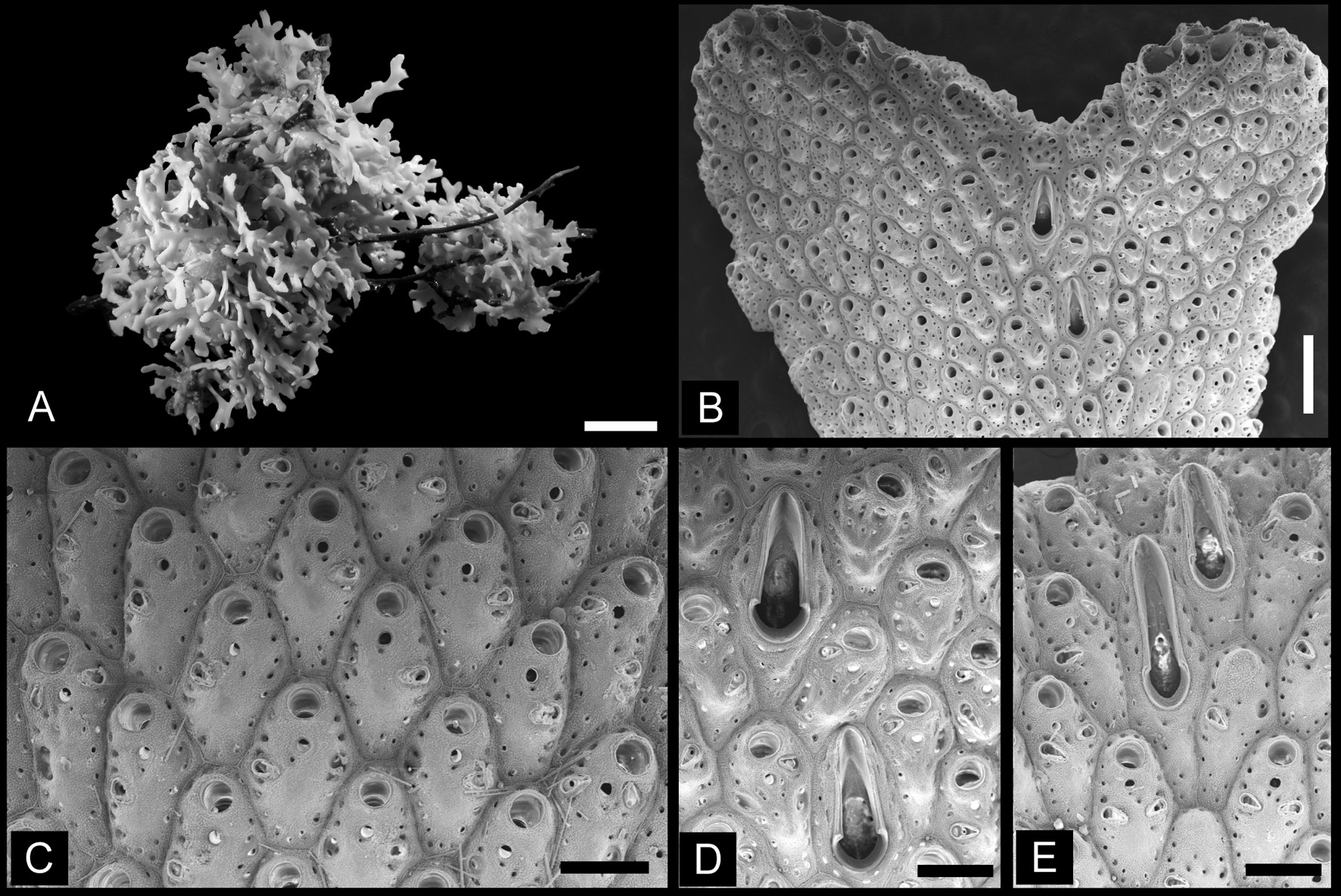
Measurements Autozooids. ZL: 298 ̅ 526 (411 ± 44); ZW: 203 ̅ 317 (239 ± 21); n = 39. SOrL: 44 ̅ 92 (68 ± 12); SOrW: 60 ̅ 101 (77 ± 10); n = 38. FAvL: 53 ̅ 86 (68 ± 9); FAvW: 25 ̅ 47 (37 ± 5); n = 32. SpL: 22 ̅ 39 (30 ± 5); SpW: 22 ̅ 37 (28 ± 6); n = 18. Gonozooids. ZL: 456 ̅ 521 (488 ± 32); ZW: 290 ̅ 334 (318 ± 24); n = 3. SOrL: 75 ̅ 77 (76 ± 1); SOrW: 93 ̅ 122 (111 ± 16); n = 3. FAvL: 61 ̅ 67 (63 ± 3); FAvW: 25 ̅ 36 (29 ± 5); n = 4. SpL: 34 ̅ 38 (36 ± 2); SpW: 35 ̅ 81 (61 ± 23); n = 3. Description Colony brown, erect, dichotomously branching, widely and irregularly spreading, forming a threedimensional bushy structure; up to 12 cm in diameter and 10 cm high (Fig. 2 A). Branches flattened, multiserial, with zooids opening on both sides, 1.9 – 4.1 mm wide (average 2.7 mm; n = 39); rounded at end. Autozooids oval or rhomboidal, surrounded by distinct, deep marginal groove (Fig. 2 B – C). Frontal shield convex, entirely covered with minute granules, with about 10 small, circular areolar pores inside each lateral margin, some additional pores in central region, and one large peristomial spiramen proximal to orifice (Fig. 2 C). Peristome deep, secondary orifice circular or transversely oval. Frontal avicularia small, 1 to 4 in number, occurring near both margins on frontal shield and oriented inward (Fig. 2 C) or distally (Fig. 3 C). Gonozooids (Fig. 3 A) present in broad region at branch bifurcations and at periphery of branches. Gonozooids larger than autozooids, with broader orifice and swollen, porous frontal shield; peristomial spiramen transversely broad, with median projection from distal margin (Fig. 3 A). Vicarious avicularia occur near branch bifurcations, often replaced by gonozooids; elongate, as long as or sometimes longer than autozooids (Fig. 2 B), 316 ̅ 495 μm (average 390 μm) long by 124 ̅ 164 μm (average 140 μm) wide (n = 6). Vicarious avicularian chamber large (Fig. 2 D – E); 425 ̅ 814 μm (average 572 μm) long by 228 ̅ 340 μm (average 274 μm) wide (n = 6). Rostrum of vicarious avicularia lanceolate, acute, directed distally; variable in form and length, up to 400 μm long. Large, triangular vicarious avicularia also occur along branch edges. In basal part of branches and colony, autozooids often replaced by kenozooids (Fig. 3 B); 342 ̅ 460 μm (average 388 μm) long by 167 ̅ 234 μm (average 192 μm) wide (n = 4).
Hirose, Masato (2016): Diversity and distribution of adeonid bryozoans (Cheilostomata: Adeonidae) in Japanese waters. European Journal of Taxonomy 203 (203): 1-41, DOI: 10.5852/ejt.2016.203
Remarks This species was previously known as Adeonella platalea (Busk, 1854) in Japan. Lamarck (1816) first described Eschara lichenoides from the Indian Ocean, and Harmer (1957) transferred it to Adeonella. Harmer (1957) discussed the high variability in A. lichenoides and A. platalea; although he did not synonymize these species, he noted three groups of A. platalea based on variant forms of vicarious avicularia and mandible. Although Harmer’s concept of the nature of intra- vs interspecific variation was different from that of more recent authors, Hayward (1988) restudied a syntype of Eschara lichenoides and found this specimen to be nearly identical to the paratype of A. platalea, and thus considered A. lichenoides to be a subjective senior synonym. Morphological variation within the extremely broad recorded distribution of this species from East Africa to eastern Australia, however, might indicate the presence of two or more unrecognized species. Mawatari (1952) reported Adeona (Adeonellopsis) japonica from off Minabe and Shirahama, Wakayama Prefecture, without any description but with a photograph of a single branch in which zooids have a swollen frontal shield with a single spiramen, quite resembling Adeonella. The photograph in Mawatari (1952) may be of a branch of A. cf. lichenoides (Brz. 17) in the SMBL collection.
Hirose, Masato (2016): Diversity and distribution of adeonid bryozoans (Cheilostomata: Adeonidae) in Japanese waters. European Journal of Taxonomy 203 (203): 1-41, DOI: 10.5852/ejt.2016.203
Distribution Adeonella lichenoides has previously been reported from the Indo-West Pacific (Philippines, Malay Archipelago, Queensland coast, Torres Strait, northern and western coasts of Australia and Victoria, and eastward to Zanzibar and East Africa) (Hayward, 1988). In Japan, Adeonella cf. lichenoides has been collected from Sagami Bay, Sagami Sea, around the Izu Peninsula, off the Kii Peninsula, the west coast of Kyushu (Koshiki Strait), and Ogasawara, at depths of 3 – 328 m. Although Adeonella cf. lichenoides was not collected from the eastern part of Sagami Bay by Döderlein or Doflein, it was very abundant in the western Sagami Sea (in ES collection) such as exposed shallow rocky habitat (3 – 45 m) at the southernmost part of the Izu Peninsula (Hirose et al. 2012).
Hirose, Masato (2016): Diversity and distribution of adeonid bryozoans (Cheilostomata: Adeonidae) in Japanese waters. European Journal of Taxonomy 203 (203): 1-41, DOI: 10.5852/ejt.2016.203
Material examined JAPAN: Izu, Sagami Sea, Emperor Showa collection (NSMT-BryR 292, BryR 297, BryR 299, BryR 303, BryR 304, BryR 315, BryR 317, BryR 324 (SEM specimen only), BryR 357 (SEM specimen only), BryR 358, BryR 359, BryR 360 (SEM specimen only), BryR 365, BryR 367, BryR 377); Seto, Kii Peninsula (SMBL-Brz. 17, some fragments NSMT-Te 1049), Aug. 1936, probably specimen studied in Okada & Mawatari (1938); Sagami Bay and Sagami Sea, collected by NSMT (NSMT-TeS 13, TeS 14, TeS 30 (SEM specimen only )); off Shimoda, Izu Peninsula (NSMT-Te 891); Koshiki Strait (NSMT-Te 752); Ogasawara (NSMT-Te 753, Te 754, Te 755, Te 756).
Hirose, Masato (2016): Diversity and distribution of adeonid bryozoans (Cheilostomata: Adeonidae) in Japanese waters. European Journal of Taxonomy 203 (203): 1-41, DOI: 10.5852/ejt.2016.203

Export occurrence data

Darwin Core Archive (ZIP)

CLASSIFICATION

Taxonomic Classification Tree

MULTIMEDIA

Media Files(2)

Fig. 2. Adeonella cf. lichenoides (Lamarck, 1816). A. Large, robust branching colony in Showa Emperor Collection (NSMT-BryR299, Sagami Sea). B. Distal end of branch, showing vicarious avicularia associated with a branch bifurcation (NSMT-BryR297, Sagami Sea). C. Autozooids (NSMT-BryR359, Sagami Sea). D–E. Two types of lanceolate avicularia near branch bifurcations. D. Short type (NSMT- BryR297). E. Long type (NSMT-BryR359, Sagami Sea). A = optical photograph; B–E = SEM images. Scale bars: A = 2 cm; B = 500 μm; C–E = 200 μm.

Imageimage/png© Hirose, MasatoHirose, Masato

Fig. 3. Adeonella cf. lichenoides (Lamarck, 1816). A. Gonozooids at branch bifurcation (NSMT-Bry R 365, Sagami Sea). B. Kenozooids with numerous frontal avicularia (NSMT-BryR360, Sagami Sea). C. Autozooids with numerous frontal avicularia (NSMT-TeS14, Sagami Sea). SEM images. Scale bars: A, C = 200 μm; B = 100 μm.

Imageimage/png© Hirose, MasatoHirose, Masato

IMAGES

Gallery(2)

See Gallery

Occurrences with images

Source Information

Diversity and distribution of adeonid bryozoans (Cheilostomata: Adeonidae) in Japanese waters

checklist

This dataset contains the digitized treatments in Plazi based on the original journal article Hirose, Masato (2016): Diversity and distribution of adeonid bryozoans (Cheilostomata: Adeonidae) in Japanese waters. European Journal of Taxonomy 203 (203): 1-41, DOI: 10.5852/ejt.2016.203

Abstract. Adeonid bryozoans construct antler-like erect colonies and are common in bryozoan assemblages along the Japanese Pacific coast. The taxonomy of Japanese adeonid species, however, has not been studied since their original descriptions more than 100 years ago. In the present study, adeonid specimens from historical collections and material recently collected along the Japanese coast are examined. Eight adeonid species in two genera were detected, of which Adeonella jahanai sp. nov., Adeonellopsis parvirostrum sp. nov., and Adeonellopsis toyoshioae sp. nov. are described as new species based on the branch width, size and morphology of frontal or suboral avicularia, shape and size of areolar pores, and size of the spiramen. Adeonellopsis arculifera (Canu & Bassler, 1929) is a new record for Japan. Lectotypes for Adeonellopsis japonica (Ortmann, 1890) and Adeonella sparassis (Ortmann, 1890) were selected among Ortmann’s syntypes. Most species of Adeonellopsis around Japan have a southern distribution from Sagami Bay to Okinawa, while A. japonica shows a more northern distribution from Kouchi to Otsuchi. In contrast, Adeonellopsis arculifera was collected only from southwestern Japan. A key to Japanese adeonid species is provided.

Hirose M, valdenar (2016). Diversity and distribution of adeonid bryozoans (Cheilostomata: Adeonidae) in Japanese waters. European Journal of Taxonomy. Checklist dataset https://doi.org/10.5852/ejt.2016.203 accessed via GBIF.org on 2026-06-22.

CC0Published 6/8/2016View dataset
GBIF Usage Key
164249539
Dataset Key
af31502e-3df0-4f1a-bea6-e24ed3f38a88
Origin
source
Backbone Key
1009297
Taxon ID
C55487F1FFD8FFA4FD9EFA7EFCAAFDD7.taxon
Last Crawled
6/19/2026
Last Interpreted
6/19/2026