
AnimaliaNot EvaluatedacceptedspeciesAccepted
Adeonellopsis arculifera

Adeonellopsis arculifera

(Canu & Bassler, 1929)

GBIF:164249543

0year

0

Synonyms

ABOUT

Descriptions(5)

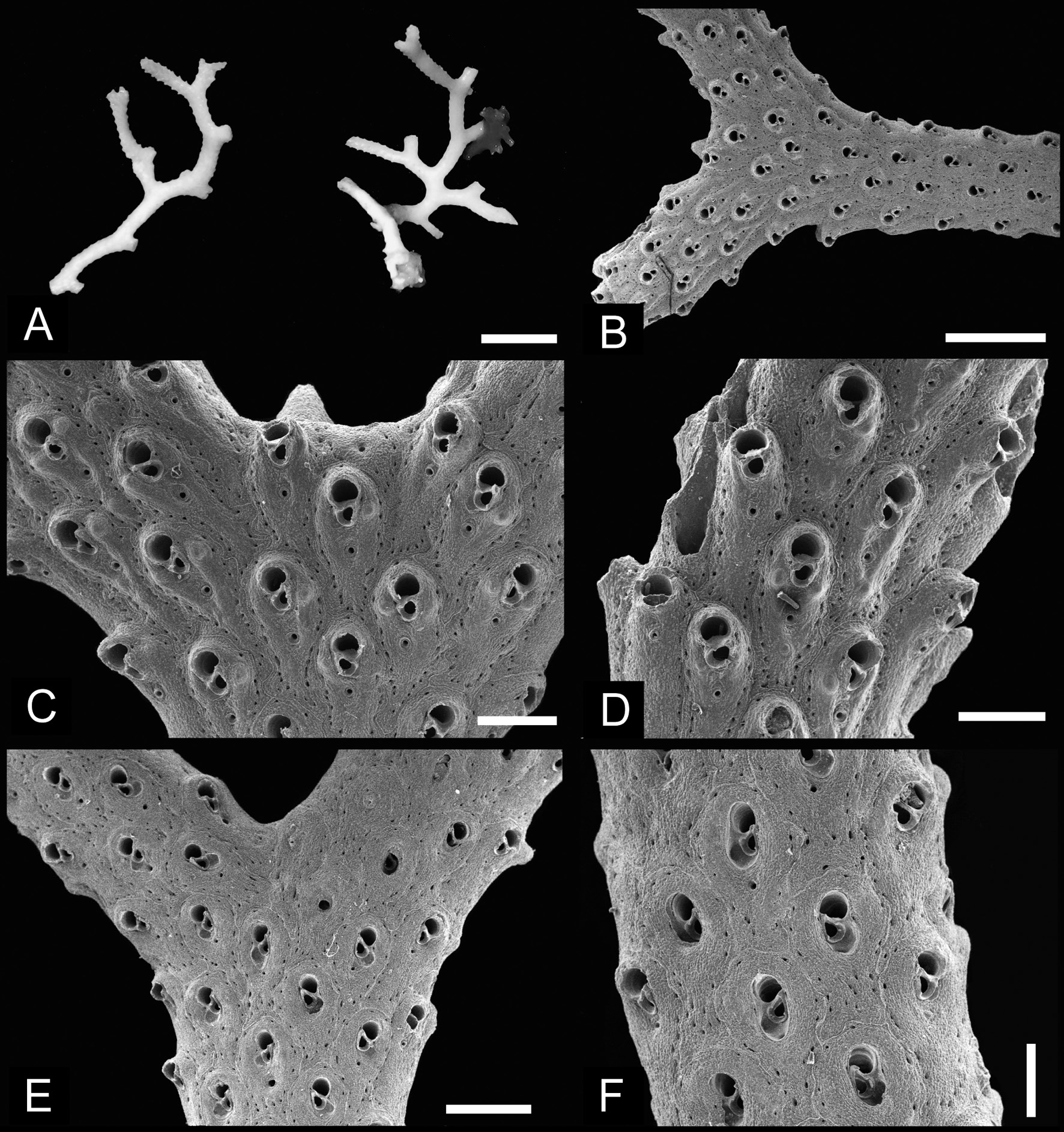
Fig. 6
Hirose, Masato (2016): Diversity and distribution of adeonid bryozoans (Cheilostomata: Adeonidae) in Japanese waters. European Journal of Taxonomy 203 (203): 1-41, DOI: 10.5852/ejt.2016.203
Measurements Autozooids. ZL: 505 ̅ 762 (590 ± 62); ZW: 207 ̅ 387 (288 ± 53); n = 39. SOrL: 54 ̅ 91 (71 ± 10); SOrW: 62 ̅ 103 (83 ± 9); n = 30. SAvL: 76 ̅ 147 (100 ± 13); SAvW: 50 ̅ 85 (64 ± 7); n = 38. SpL: 12 ̅ 27 (20 ± 4); SpW: 16 ̅ 25 (20 ± 3); n = 28. Description Colony small, slender, dichotomously branching (Fig. 6 A); yellowish white. Branches subcylindrical or flat (Fig. 6 B); slender, on average 1 mm wide (0.9 – 1.3 mm, n = 8), multiserial, zooids opening on both sides. Zooids oval, boundaries indistinct, delineated by shallow groove and opposing single rows of tiny, irregular areolar pores (Fig. 6 D). Frontal shield smooth, or finely granulate and slightly wrinkled. Zooids raised distally towards a low peristomial rim; primary orifice D-shaped, with straight or convex proximal margin; secondary orifice broader than long. Spiramen small, uniporous, circular, situated close to center of frontal shield proximal to orifice, often in depressed frontal zone (Fig. 6 C). Suboral avicularium abutting proximal margin of peristome, smaller in area than secondary orifice, rostrum slightly raised and sometimes hooked distally, slightly curved toward distal side, directed distolaterally; no crossbar; mandible equilaterally triangular (Fig. 6 C). No other types of avicularia observed. Autozooids distal to branch bifurcations elongate, sometimes bearing up to three umbonate bosses 47 – 76 μm in diameter (average 61 μm, n = 18), on one or both sides proximolateral to orifice and toward proximal end of frontal shield (Fig. 6 D). Older autozooids in basal part of branch broad, irregular in outline; zooidal boundaries indistinct; frontal shield heavily secondarily calcified; spiramen often lacking; suboral avicularium lies in depression in thickened frontal shield (Fig. 6 F). Rarely, kenozooids occur at basal bifurcations (Fig. 6 E); same size as autozooids. Gonozooids not found.
Hirose, Masato (2016): Diversity and distribution of adeonid bryozoans (Cheilostomata: Adeonidae) in Japanese waters. European Journal of Taxonomy 203 (203): 1-41, DOI: 10.5852/ejt.2016.203
Remarks Canu & Bassler (1929) originally described Adeona arculifera from Jolo and Sulade Islands, Sulu Archipelago, Philippines, on the basis of the single spiramen, although the branched colony resembles the condition in Adeonellopsis. Harmer (1957) then transferred the species to Adeonellopsis on the basis of the operculum, which is not widely sinuate. Adeonellopsis arculifera resembles A. subsulcata (Smitt, 1873) in the arrangement of the suboral avicularia but differs from the latter in having a circular spiramen in the center of the frontal shield.
Hirose, Masato (2016): Diversity and distribution of adeonid bryozoans (Cheilostomata: Adeonidae) in Japanese waters. European Journal of Taxonomy 203 (203): 1-41, DOI: 10.5852/ejt.2016.203
Distribution Adeonellopsis arculifera has previously been reported from the Philippines, Indonesia, and the Indian Ocean, at depths of 38 – 53 m. In Japan, it has been detected only in the southwestern region, from Okinawa and near Yakushima Island, at depths of 47 – 88 m. Although this is the first Recent record for Japan, Hayami (1971) reported the species from the Pliocene Shinzato Tuff on Okinawa Island.
Hirose, Masato (2016): Diversity and distribution of adeonid bryozoans (Cheilostomata: Adeonidae) in Japanese waters. European Journal of Taxonomy 203 (203): 1-41, DOI: 10.5852/ejt.2016.203
Material examined JAPAN: many branches collected from Hirase, southwest of Yakushima Island, 87 – 88 m depth (NSMT- Te 781, Te 783, Te 784, Te 785, Te 786, Te 787, Te 788, Te 789); single colony collected from South of Nagannu Island, 47 – 52 m depth (NSMT-Te 782).
Hirose, Masato (2016): Diversity and distribution of adeonid bryozoans (Cheilostomata: Adeonidae) in Japanese waters. European Journal of Taxonomy 203 (203): 1-41, DOI: 10.5852/ejt.2016.203

Export occurrence data

Darwin Core Archive (ZIP)

CLASSIFICATION

Taxonomic Classification Tree

MULTIMEDIA

Media Files(1)

Fig. 6. Adeonellopsis arculifera (Canu & Bassler, 1929). A. Colonies collected SW of Yakushima Island (NSMT-Te789). B. Branch showing crenulate periphery (NSMT-Te781). C. Enlargement of bifurcation showing autozooids with oblique avicularium and single small spiramen (NSMT-Te781). D. Young autozooids showing peristomial rim and single small spiramen (NSMT-Te781). E. Old part of branch, showing various stages in formation of kenozooids (NSMT-Te781). F. Old part of branch, showing autozooids with depression containing avicularium and spiramen (NSMT-Te781). A = optical photograph; B–F = SEM images. Scale bars: A = 5 mm; B = 1 mm; C–D = 300 μm; E = 500 μm; F = 250 μm.

Imageimage/png© Hirose, MasatoHirose, Masato

IMAGES

Gallery(1)

See Gallery

Occurrences with images

Source Information

Diversity and distribution of adeonid bryozoans (Cheilostomata: Adeonidae) in Japanese waters

checklist

This dataset contains the digitized treatments in Plazi based on the original journal article Hirose, Masato (2016): Diversity and distribution of adeonid bryozoans (Cheilostomata: Adeonidae) in Japanese waters. European Journal of Taxonomy 203 (203): 1-41, DOI: 10.5852/ejt.2016.203

Abstract. Adeonid bryozoans construct antler-like erect colonies and are common in bryozoan assemblages along the Japanese Pacific coast. The taxonomy of Japanese adeonid species, however, has not been studied since their original descriptions more than 100 years ago. In the present study, adeonid specimens from historical collections and material recently collected along the Japanese coast are examined. Eight adeonid species in two genera were detected, of which Adeonella jahanai sp. nov., Adeonellopsis parvirostrum sp. nov., and Adeonellopsis toyoshioae sp. nov. are described as new species based on the branch width, size and morphology of frontal or suboral avicularia, shape and size of areolar pores, and size of the spiramen. Adeonellopsis arculifera (Canu & Bassler, 1929) is a new record for Japan. Lectotypes for Adeonellopsis japonica (Ortmann, 1890) and Adeonella sparassis (Ortmann, 1890) were selected among Ortmann’s syntypes. Most species of Adeonellopsis around Japan have a southern distribution from Sagami Bay to Okinawa, while A. japonica shows a more northern distribution from Kouchi to Otsuchi. In contrast, Adeonellopsis arculifera was collected only from southwestern Japan. A key to Japanese adeonid species is provided.

Hirose M, valdenar (2016). Diversity and distribution of adeonid bryozoans (Cheilostomata: Adeonidae) in Japanese waters. European Journal of Taxonomy. Checklist dataset https://doi.org/10.5852/ejt.2016.203 accessed via GBIF.org on 2026-06-18.

CC0Published 6/8/2016View dataset
GBIF Usage Key
164249543
Dataset Key
af31502e-3df0-4f1a-bea6-e24ed3f38a88
Origin
source
Backbone Key
1009954
Taxon ID
C55487F1FFD2FFA9FE75FB45FAC1FBA5.taxon
Last Crawled
6/10/2026
Last Interpreted
6/10/2026