
AnimaliaNot EvaluatedacceptedspeciesAccepted
Adeonellopsis sparassis

Adeonellopsis sparassis

(Ortmann, 1890)

GBIF:164249547

0year

0

Synonyms

ABOUT

Descriptions(5)

Figs 12 – 13
Hirose, Masato (2016): Diversity and distribution of adeonid bryozoans (Cheilostomata: Adeonidae) in Japanese waters. European Journal of Taxonomy 203 (203): 1-41, DOI: 10.5852/ejt.2016.203
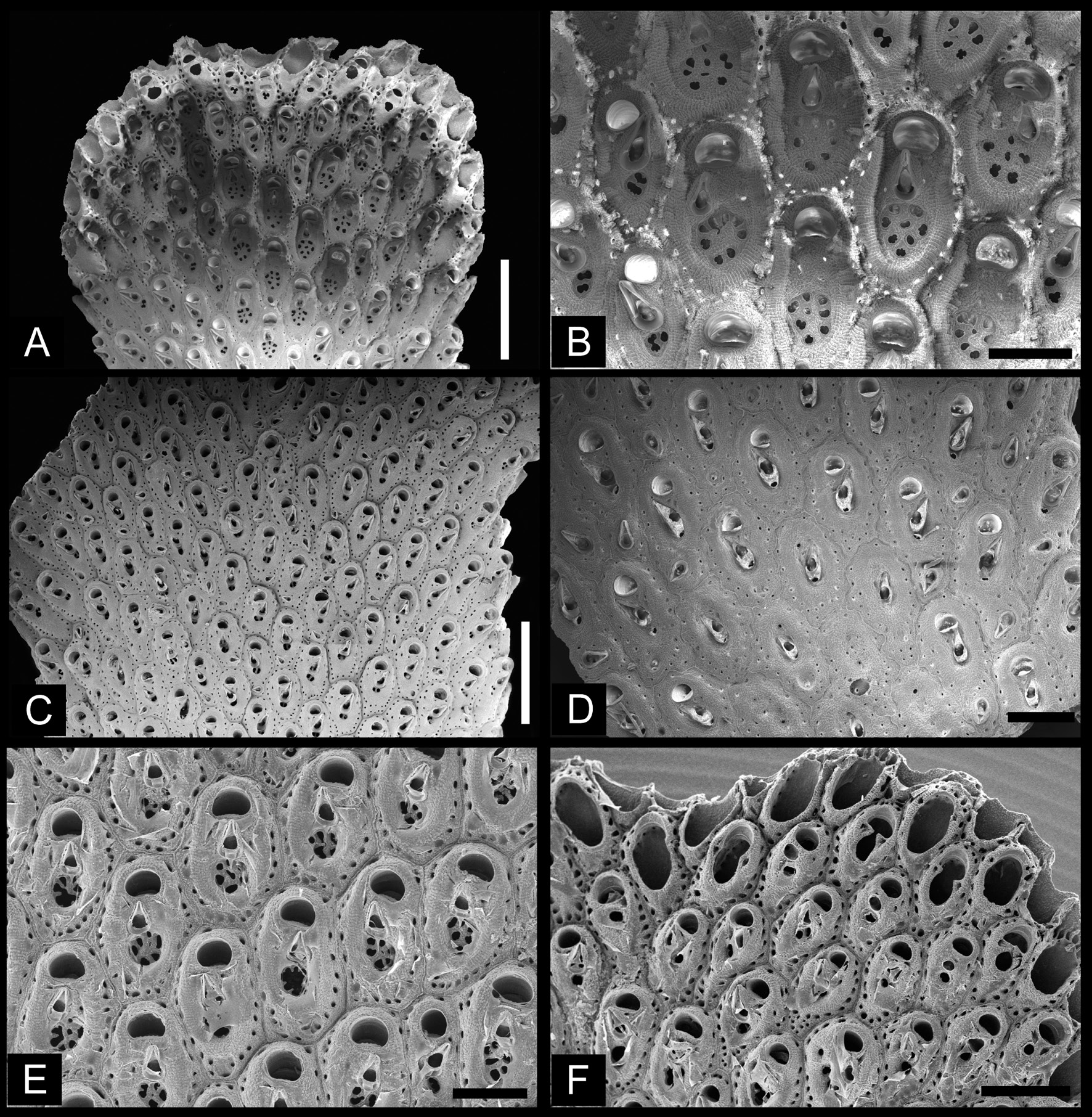
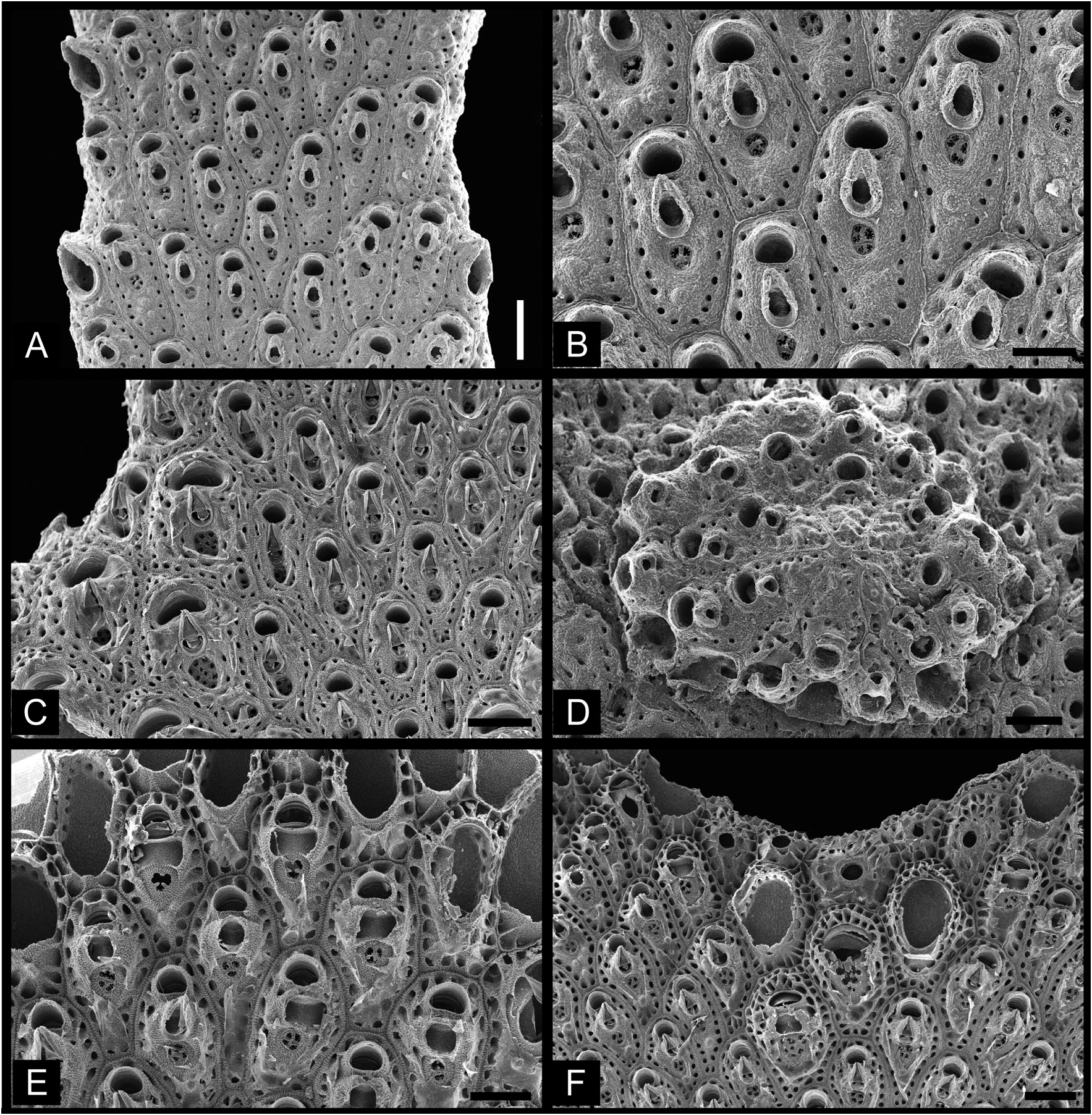
Measurements Autozooids. ZL: 358 ̅ 659 (527 ± 64); ZW: 186 ̅ 379 (263 ± 39); n = 75. SOrL: 46 ̅ 91 (63 ± 8); SOrW: 72 ̅ 118 (89 ± 9); n = 53. SAvL: 106 ̅ 174 (139 ± 15); SAvW: 48 ̅ 105 (75 ± 13); n = 75. SpL: 29 ̅ 76 (54 ± 11); SpW: 32 ̅ 83 (52 ± 11); n = 74. Gonozooids. ZL: 623 ̅ 855 (722 ± 54); ZW: 445 ̅ 630 (534 ± 54); n = 24. SOrL: 52 ̅ 112 (77 ± 14); SOrW: 136 ̅ 265 (223 ± 26); n = 21. SAvL: 137 ̅ 218 (162 ± 22); SAvW: 88 ̅ 117 (104 ± 8); n = 21. SpL: 97 ̅ 185 (129 ± 20); SpW: 99 ̅ 267 (159 ± 33); n = 23. Young autozooids in ancestrular complex. ZL: 320 ̅ 396 (361 ± 32); ZW: 198 ̅ 283 (231 ± 31); n = 6. SOrL: 67 ̅ 83 (77 ± 6); SOrW: 93 ̅ 109 (100 ± 7); n = 6. SAvL: 56 ̅ 75 (67 ± 8); SAvW: 28 ̅ 55 (46 ± 12); n = 6. SpL: 18 ̅ 31 (23 ± 5); SpW: 31 ̅ 56 (41 ± 9); n = 6. Vicarious avicularia at branch margins. L: 253 ̅ 476 (327 ± 69); W: 154 ̅ 228 (174 ± 26); n = 8. Description Colony brownish yellow, dichotomously branching, irregularly spreading, many proximal branches anastomosing, forming compact three-dimensional structure (Fig. 12 A); anastomosed basal region can exceed 4 cm high (3.67 – 4.64 cm). Branches flat, ribbon-like, variable in width (Fig. 12 B); 1.6 – 8.6 mm wide (average 4.0 mm; n = 101); much wider basally. Autozooids on both sides of branch, oval or hexagonal, outlined by deep marginal groove (Figs 12 C, 13 B); younger zooids at end of branch shorter (average 382 μm; n = 6) and broader (average 324 μm; n = 9) than older zooids in anastomosed basal region. Frontal shield minutely granulate, with numerous marginal pores and small ascopore (Figs 12 C, 13 B). Spiramen almost circular in younger zooids, divided into 3 ̅ 5 denticulate pores (Fig. 13 B, E); slightly broader in older zooids in basal part of colony (average 66 μm; n = 12). Peristome transversely oval, roughly semicircular in outline, not tubular; primary orifice submersed in peristome. Triangular suboral avicularium in center of frontal shield, between spiramen and orifice, directed distally (Figs 12 F, 13 B). Rarely autozooids have an additional, smaller frontal avicularium, budded from frontal areolae near proximal margin of zooid, directed distally (Fig. 12 C). Gonozooids (Figs 12 D, 13 C, F) occur at branch bifurcations (Fig. 13 C, F); larger than autozooids, hexagonal; with single or double rows of marginal pores (Fig. 12 D); slightly crescentic orifice compressed, much wider than long; spiramen large, rounded-triangular or oval in outline, divided into 6 ̅ 10 small, denticulate pores (Figs 12 D, 13 C). Gonozooids in basal part of colony much broader (average 602 μm; n = 6), and with a slightly larger spiramen (average 142 μm long by 199 μm wide; n = 5). Vicarious avicularia (Fig. 13 A) often along edges of branches; triangular, directed distally; about same length as autozooids; rostrum length about half of autozooid length. One young colony observed (Fig. 13 D); encrusting, circular, 1.2 cm in diameter; ancestrular complex consisting of six zooids radiating from center. Autozooids in young, encrusting colonies (Figs 12 E – F, 13 D) oval, surrounded by distinct shallow groove; frontal shield with few marginal pores and 4 – 6 knobs (Fig. 12 F); secondary orifice broadly semicircular; spiramen circular, divided into 2 – 4 small, denticulate pores; triangular suboral avicularium much smaller than that of mature autozooids; between spiramen and orifice, directed distally, often partly overlapping proximal orificial margin (Fig. 12 F).
Hirose, Masato (2016): Diversity and distribution of adeonid bryozoans (Cheilostomata: Adeonidae) in Japanese waters. European Journal of Taxonomy 203 (203): 1-41, DOI: 10.5852/ejt.2016.203
Remarks Ortmann’s specimens comprise only the basal, anastomosed parts of colonies (Fig. 8 A), and zooidal characters in these specimens are identical to those in the basal parts of the more-complete Adeonellopsis sparassis colonies that I studied. Adeonellopsis sparassis resembles A. sulcata (Milne Edwards, 1836) in having a multiporous spiramen and small, distally directed suboral avicularia, but differs from the latter in having a smaller, circular spiramen. MacGillivray’s (1880: plate 48, fig. 7) illustration of Eschara mucronata (MacGillivray, 1868) (= A. sulcata) appears to represent the basal part of a colony of Adeonellopsis that resembles A. sparassis. However, as I did not examine MacGillivray’s type specimen, I do not include it in the synonymy of A. sparassis. I identified an encrusting colony in the Emperor Showa collection as a young colony of A. sparassis based on the small, round multiporous spiramen and the triangular suboral avicularium between the ascopore and orifice. Hayward & McKinney (2002) described a similar ancestrular complex consisting of six zooids in the closely related encrusting genus Reptadeonella. Bock & Cook (2000) also reported a similar encrusting ancestrular complex in Adeonellopsis, but they described a remarkably different bipolar ancestrular colony in the articulated genus Adeona. I conclude the ancestrular complex in the Emperor Showa collection to be A. sparassis rather than Reptadeonella or the other genera, based on the orifice shape and the multiporous spiramen. The knobs on the frontal shield of zooids in the encrusting colony appear to be a character common to young zooids in several adeonid species. Okada (1920) described another adeonid bryozoan, Adeonella hexangularis Okada, 1920, from Misaki (Sagami Bay) and the Kagoshima Gulf (southern Kyushu), which surely is Adeonellopsis according to his description of a multiporous spiramen. Due to the limited original description and apparent loss of the type specimens, the identity of A. hexangularis is unclear, but Okada’s description of an anastomosed colony morphology, frontal shields with a single or double rows of marginal pores, and gonozooids located at branch bifurcation and having a broad, proximodistally compressed orifice indicate that it is conspecific with A. sparassis and constitutes a junior synonym of the latter. Mawatari (1952) reported nominal A. hexangularis from off Wakayama and Minabe, Kii Peninsula, without a description; according to this record, A. sparassis is probably also distributed around the Kii Peninsula.
Hirose, Masato (2016): Diversity and distribution of adeonid bryozoans (Cheilostomata: Adeonidae) in Japanese waters. European Journal of Taxonomy 203 (203): 1-41, DOI: 10.5852/ejt.2016.203
Distribution Japan: detected in this study from Sagami Bay, Tokyo Bay (Yokohama), Sagami Sea (Izu Peninsula), Ariake Sea, Nansei Islands (near Yakushima and west of Okinawa), and Ogasawara, at depths of 24 – 141 m. It was collected from eastern Sagami Bay and western Sagami Sea by Döderlein and Emperor Showa, but was not found recently in those areas by NSMT.
Hirose, Masato (2016): Diversity and distribution of adeonid bryozoans (Cheilostomata: Adeonidae) in Japanese waters. European Journal of Taxonomy 203 (203): 1-41, DOI: 10.5852/ejt.2016.203
Material examined Lectotype [designated herein] JAPAN: colony, Sagami Bay, 1882, collected by L. Döderlein, MZS 1 - 2 (SEM specimen NSMT-Te 745). Paralectotypes [designated herein] JAPAN: colony, Yokohama, 1891, collected by Rolle, MZS 1 - 1 (SEM specimen NSMT-Te 747); colony, Sagami Bay, 1882, collected by L. Döderlein, MZS 1 - 3 (SEM specimen NSMT-Te 740). Other material examined JAPAN: colonies collected from Suzaki, Izu, Sagami Sea, in the Emperor Showa collection at NSMT (NSMT-BryR 362); colonies collected from Ariake Sea (NSMT-Te 770), from near Yakushima and Tanegashima (NSMT-Te 772, Te 773, Te 774); from off Shimoda (NSMT-Te 890); from south of Nagannu Island (NSMT-Te 750, Te 803); from Ogasawara (NSMT-Te 771).
Hirose, Masato (2016): Diversity and distribution of adeonid bryozoans (Cheilostomata: Adeonidae) in Japanese waters. European Journal of Taxonomy 203 (203): 1-41, DOI: 10.5852/ejt.2016.203

Export occurrence data

Darwin Core Archive (ZIP)

CLASSIFICATION

Taxonomic Classification Tree

MULTIMEDIA

Media Files(3)

Fig. 8. Adeonellopsis japonica (Ortmann, 1890). A. Distal end of branch just starting to bifurcate, showing young autozooids and gonozooids (NSMT-BryR277). B. Enlargement of young gonozooids, showing peripheral rim with rows of granulation perpendicular to margin, and large multiporous spiramen (NSMT-BryR277). C. Autozooids in middle of branch, showing immersed spiramen (NSMT- Bry R 193). D. Basal part of branch, showing autozooids, and some kenozooids with closed orifice (NSMT-BryR36). E. Young gonozooids, showing distinct marginal pores and multiporous spiramen (NSMT-Te758). F. Distal end of branch, showing autozooid formation (NSMT-Te758). SEM images. Scale bars: A, C = 1 mm, B, D–E = 300 μm; F = 500 μm.

Imageimage/png© Hirose, MasatoHirose, Masato

Fig. 12. Adeonellopsis sparassis (Ortmann, 1890). A. Left, lectotype (MZS 1-2); right, paralectotype (MZS 1-1) from among Ortmann’s (1890) syntypes in the Döderlein Collection. B. Colonies collected at Tanegashima (NSMT-Te774). C. Autozooids (MZS 1-2) (NSMT-Te745). D. Gonozooids (MZS 1-2) (NSMT-Te745). E. Young, encrusting colony in Showa Emperor Collection (NSMT-BryR362). F. Enlargement showing young autozooids with small spiramen (NSMT-BryR362). A–B = optical photographs; C–F = SEM images. Scale bars: A–B = 2 cm; C = 150 μm; D–E = 200 μm; F = 100 μm.
Imageimage/png© Hirose, MasatoHirose, Masato

Fig. 13. Adeonellopsis sparassis (Ortmann, 1890). A. Autozooids and marginal vicarious avicularia (NSMT-Te772). B. Enlargement of autozooids (NSMT-Te772). C. Autozooids and gonozooids (NSMT- Te774). D. Young, encrusting colony (NSMT-Te770). E. Young autozooids, showing circular spiramen and large areolar pores (NSMT-Te774). F. Young autozooids and gonozooids at branch bifurcation (NSMT-Te774). SEM images. Scale bars: A, C = 300 μm; B = 150 μm; D–E = 200 μm; F = 300 μm.

Imageimage/png© Hirose, MasatoHirose, Masato

IMAGES

Gallery(3)

See Gallery

Occurrences with images

Source Information

Diversity and distribution of adeonid bryozoans (Cheilostomata: Adeonidae) in Japanese waters

checklist

This dataset contains the digitized treatments in Plazi based on the original journal article Hirose, Masato (2016): Diversity and distribution of adeonid bryozoans (Cheilostomata: Adeonidae) in Japanese waters. European Journal of Taxonomy 203 (203): 1-41, DOI: 10.5852/ejt.2016.203

Abstract. Adeonid bryozoans construct antler-like erect colonies and are common in bryozoan assemblages along the Japanese Pacific coast. The taxonomy of Japanese adeonid species, however, has not been studied since their original descriptions more than 100 years ago. In the present study, adeonid specimens from historical collections and material recently collected along the Japanese coast are examined. Eight adeonid species in two genera were detected, of which Adeonella jahanai sp. nov., Adeonellopsis parvirostrum sp. nov., and Adeonellopsis toyoshioae sp. nov. are described as new species based on the branch width, size and morphology of frontal or suboral avicularia, shape and size of areolar pores, and size of the spiramen. Adeonellopsis arculifera (Canu & Bassler, 1929) is a new record for Japan. Lectotypes for Adeonellopsis japonica (Ortmann, 1890) and Adeonella sparassis (Ortmann, 1890) were selected among Ortmann’s syntypes. Most species of Adeonellopsis around Japan have a southern distribution from Sagami Bay to Okinawa, while A. japonica shows a more northern distribution from Kouchi to Otsuchi. In contrast, Adeonellopsis arculifera was collected only from southwestern Japan. A key to Japanese adeonid species is provided.

Hirose M, valdenar (2016). Diversity and distribution of adeonid bryozoans (Cheilostomata: Adeonidae) in Japanese waters. European Journal of Taxonomy. Checklist dataset https://doi.org/10.5852/ejt.2016.203 accessed via GBIF.org on 2026-06-18.

CC0Published 6/8/2016View dataset
GBIF Usage Key
164249547
Dataset Key
af31502e-3df0-4f1a-bea6-e24ed3f38a88
Origin
source
Backbone Key
8896296
Taxon ID
C55487F1FFC9FFB4FDA7F95BFCA3FB61.taxon
Last Crawled
6/10/2026
Last Interpreted
6/10/2026