AnimaliaNot EvaluatedacceptedspeciesAccepted
Halopteris infundibulum

Halopteris infundibulum

Vervoort, 1966

GBIF:167407435

0year

ABOUT

Descriptions(5)

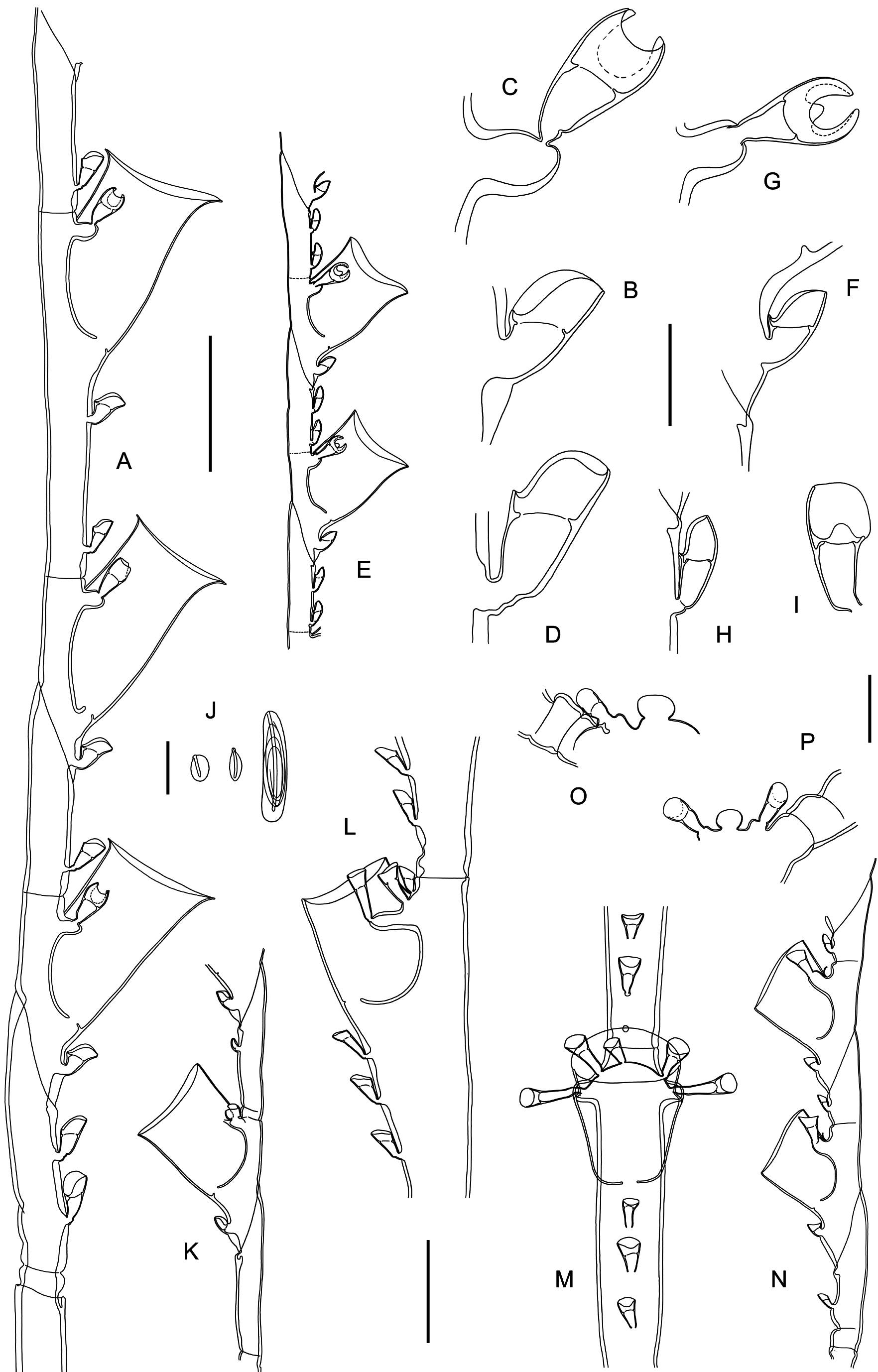
Description Stems upright and quite rigid, simple, monosiphonic, ca 8 cm high, arising from reticulate hydrorhiza; composed of long (5 – 6 cm) proximal part devoid of hydrothecae and hydrocladia, and comparatively shorter (2 – 3 cm) distal part bearing hydrothecae and hydrocladia. Proximal part with few closely-set transverse nodes immediately above origin from stolon, as well as few, irregular, more distant ones above; nematothecae in two closely-set, longitudinal rows, only in distal part of this portion of stem; nematothecae alternate along most length of nematothecate part of stem, distalmost ones being gradually arranged in subopposite to opposite pairs. Upper part of stem starting with two consecutive prosegments delimited at both ends by deeply-incised, very oblique nodes, each comprising a proximally-placed, quite damaged hydrotheca, 11 nematothecae, and cladial apophysis arising only from side of second hydrotheca; nematothecae: one mesial, two pairs of laterals, as well as 3 opposite pairs above hydrotheca, in two closely-set, longitudinal rows. Remainder of stem slightly geniculate, with faintly-marked to almost imperceptible segmentation through slightly oblique nodes; each internode with hydrotheca proximally, short cladial apophysis laterally, and at least 9 nematothecae: one mesial, two pairs of laterals and 2 pairs above hydrotheca; presence of axillar nematotheca could not be checked properly, for cladial apophyses being shifted on to anterior part of stem, forming acute angle between two rows. Cladia up to 5 mm long, bearing up to 11 hydrothecate internodes; proximally short, almost indistinct, athecate internode, with proximal node straight and distal node oblique; nodes on remainder of cladium generally indistinct but, when present, transverse, immediately above each hydrotheca; each internode with hydrotheca, flanked by double pair of nematothecae, as well as 3 – 4 additional nematothecae above; anterior pair of laterals borne on conspicuous apophyses, thecae projecting above hydrothecal rim; posterior pair sessile, at base of apophyses supporting anterior pair; proximalmost nematotheca among those situated between consecutive hydrothecae always situated behind adaxial wall of proximal hydrotheca, either decidedly in axil or certain distance above. All nematothecae conical, bithalamic, wall of upper chamber slightly lowered on adaxial side. Hydrotheca tubular, rather deep, ¾ rd adnate, abaxial wall straight or nearly so, aperture circular, forming an angle of ca 40 ° with internode. Single gonotheca arising laterally from below basis of cladial hydrotheca; urn-shaped, slightly flattened, tapering abruptly basally, distally truncate, and there provided with ovoid, deciduous, filmy flap; two exceedingly long nematothecae inserted at above ¼ rd of its length.
Galea, Horia R., Maggioni, Davide (2020): Plumularioid hydroids (Cnidaria: Hydrozoa) from off New Caledonia collected during KANACONO and KANADEEP expeditions of the French Tropical Deep-Sea Benthos Program. European Journal of Taxonomy 708: 1-58, DOI: 10.5852/ejt.2020.708
Figs 14 L – M, 15 C
Galea, Horia R., Maggioni, Davide (2020): Plumularioid hydroids (Cnidaria: Hydrozoa) from off New Caledonia collected during KANACONO and KANADEEP expeditions of the French Tropical Deep-Sea Benthos Program. European Journal of Taxonomy 708: 1-58, DOI: 10.5852/ejt.2020.708
Remarks The present material agrees generally well with the type (Vervoort 1966; Schuchert 1997) and specimens examined by Vervoort & Watson (2003) and Ansín Agís et al. (2009), although it shows a number of differences: 1) it bears 2 opposite pairs of nematothecae above the cauline hydrothecae, while the occurrence of only two nematothecae in a row has been documented previously; 2) there are 3 – 4 nematothecae, instead of only two as documented earlier, between two successive cladial hydrothecae, of which the proximalmost can be either decidedly axillar or situated a short distance above the axil; 3) the gonotheca is urn-shaped and not piriform, as described by Vervoort & Watson (2003), and bears 2 exceedingly long nematothecae. I can see little reason to separate specifically the present material from that described earlier, as the species is still poorly-known, and the intraspecific variation insufficiently documented. The gonotheca in my material could belong to the opposite sex with respect to that described earlier by Vervoort & Watson (2003); as to the length of the nematothecae it carries, this could likely not be used as a valid taxonomic criterion at this stage, given that, in this hydroid, at least the lateral nematothecae display a “ very variable ” length (Vervoort & Watson 2003).
Galea, Horia R., Maggioni, Davide (2020): Plumularioid hydroids (Cnidaria: Hydrozoa) from off New Caledonia collected during KANACONO and KANADEEP expeditions of the French Tropical Deep-Sea Benthos Program. European Journal of Taxonomy 708: 1-58, DOI: 10.5852/ejt.2020.708
Distribution Tasman Sea (Vervoort 1966), New Zealand (Vervoort & Watson 2003), New Caledonia (Ansín Agís et al. 2009; present study).
Galea, Horia R., Maggioni, Davide (2020): Plumularioid hydroids (Cnidaria: Hydrozoa) from off New Caledonia collected during KANACONO and KANADEEP expeditions of the French Tropical Deep-Sea Benthos Program. European Journal of Taxonomy 708: 1-58, DOI: 10.5852/ejt.2020.708
Material examined PACIFIC OCEAN • 2 stems, both ca 8 cm high, 1 bearing a (damaged) gonotheca; off New Caledonia, stn DW 5026; 20 ° 22 ′ S, 158 ° 40 ′ E; 360 – 410 m; 21 Sep. 2016; KANADEEP leg.; MNHN-IK- 2015 - 608.
Galea, Horia R., Maggioni, Davide (2020): Plumularioid hydroids (Cnidaria: Hydrozoa) from off New Caledonia collected during KANACONO and KANADEEP expeditions of the French Tropical Deep-Sea Benthos Program. European Journal of Taxonomy 708: 1-58, DOI: 10.5852/ejt.2020.708

Export occurrence data

Darwin Core Archive (ZIP)

CLASSIFICATION

Taxonomic Classification Tree

MULTIMEDIA

Media Files(1)

Fig. 14 (opposite page). A–D. Corhiza patula Galea sp. nov., from holotype MNHN-IK-2015-602, proximal portion of cladium (A); nematothecae: mesial (B), lateral (C), and from ahydrothecate internode (D). — E–J. Corhiza pauciarmata Ansín Agís et al., 2009, from sample MNHN-IK-2015-604, portion of cladium (E); nematothecae: mesial (F), lateral (G) and from ahydrothecate internode in lateral (H) and adaxial (I) aspects; cnidome (J). — K. Halopteris campanula (Busk, 1852), portion of cladium from sample MNHN-IK-2015-597. — L–M. Halopteris infundibulum Vervoort, 1966, cladial hydrotheca in lateral (L) and frontal (M) aspects, both from sample MNHN-IK-2015-608. — N–P. Halopteris peculiaris Billard, 1913, proximal portion of cladium seen laterally (N); single (O) or paired (P) lateral nematothecae associated to cauline hydrothecae; all from sample MNHN-IK-2015-609. Scale bars: A, E = 500 µm; B–D, F–I, O–P = 100 µm; J = 10 µm; K–N = 300 µm

Imageimage/png© Galea, Horia R.;Maggioni, DavideGalea, Horia R.;Maggioni, Davide

IMAGES

Gallery(1)

See Gallery

Occurrences with images

Source Information

Plumularioid hydroids (Cnidaria: Hydrozoa) from off New Caledonia collected during KANACONO and KANADEEP expeditions of the French Tropical Deep-Sea Benthos Program

checklist

This dataset contains the digitized treatments in Plazi based on the original journal article Galea, Horia R., Maggioni, Davide (2020): Plumularioid hydroids (Cnidaria: Hydrozoa) from off New Caledonia collected during KANACONO and KANADEEP expeditions of the French Tropical Deep-Sea Benthos Program. European Journal of Taxonomy 708: 1-58, DOI: 10.5852/ejt.2020.708

Abstract. This study reports on 25 species of hydroids occurring in the collections gathered during KANACONO and KANADEEP expeditions carried out in the SE of New Caledonia in 2016, and off the western coast of the island in 2017, respectively. Of these, 19 have not been dealt with in earlier reports on these collections. Two new genera and four new species are described, viz, Actinopluma mirifica Galea gen. et sp. nov., provisionally assigned to the family Kirchenpaueriidae Stechow, 1921, Schizoplumularia helicoidalis sp. nov., belonging to the Plumulariidae McCrady, 1859, and Corhiza patula Galea sp. nov. and Thamnopteros uniserius Galea gen. et sp. nov., both placed in the family Halopterididae Millard, 1962. The gonotheca and the medusoid gonophore of Plumularia contraria Ansín Agís et al., 2014 are described for the first time, allowing a genus transfer to Dentitheca Stechow, 1919, as D. contraria comb. nov. Plumularia conjuncta Billard, 1913, known earlier from a minute portion of colony, is redescribed based on a complete, though infertile, specimen. Similarly, complete specimens corresponding to the hydroid previously referred to as Antennella megatheca Ansín Agís et al., 2009 are documented, allowing a provisional reallocation to Corhiza Millard, 1962 and a description of its so far unknown gonothecae. Fertile material assignable to the poorly-known Monostaechas fisheri Nutting, 1905 allows the recognition of this hydroid as a valid species, distinct from M. quadridens (McCrady, 1859). Most taxa are illustrated to validate the reliability of their identifications. Finally, phylogenetic reconstructions of the families Aglaopheniidae, Plumulariidae, and Halopterididae, based on the 16S rRNA, allowed a first genetic characterization of some of the species dealt with in this work.

Galea H R, Maggioni D, valdenar (2020). Plumularioid hydroids (Cnidaria: Hydrozoa) from off New Caledonia collected during KANACONO and KANADEEP expeditions of the French Tropical Deep-Sea Benthos Program. European Journal of Taxonomy. Checklist dataset https://doi.org/10.5852/ejt.2020.708 accessed via GBIF.org on 2026-06-19.

CC0Published 8/26/2020View dataset
GBIF Usage Key
167407435
Dataset Key
0c523d70-0815-45f8-a69d-1698f78a0998
Origin
source
Backbone Key
5185907
Taxon ID
03D92045FFAAFFD3E6352528C19DFA4A.taxon
Last Crawled
6/10/2026
Last Interpreted
6/10/2026
