
AnimaliaNot EvaluatedacceptedspeciesAccepted
Thamnopteros uniserius

Thamnopteros uniserius

Galea, 2020

GBIF:167407437

0year

ABOUT

Descriptions(8)

Description Colony erect, originally ca 17.2 cm high, now broken into two, almost equal parts, of rigid appearance, with brown perisarc, arising from rhizoid stolon. Stem unbranched, 2.5 mm thick at base, strongly fascicled, displaying superficially a number of tortuous tubes that seem to wrap an internal beam of straight counterparts, as shown by a couple of small, less organized areas on surface that reveal a possible sheath-like general structure. Tubes on stem surface provided with two longitudinal, laterally-set rows of opposite nematothecae along their length. Upper half of stem gives rise unilaterally, at regular intervals, to monosiphonic, Halopteris - like branches arising from internal beam of component tubes; before each of these tubes becomes free from the fascicled stem, the distal ends of their fused parts become apparent at the surface of the stem for a varied length, displaying on their exposed side two closely-set rows of alternate nematothecae; a short distance (no longer than 1 cm) after diverging from the stem, each tube acquires suddenly a well-organized structure: a basal prosegment is followed by a regular succession of hydrothecae (with their associated nematothecae) and lateral apophyses supporting the cladia. Except for the prosegment, that is delimited at both ends by deeply-incised, very oblique nodes, the remainder of tube is unsegmented. The prosegment bears a hydrotheca devoid of cladial apophyses, its 5 associated nematothecae (1 mesial, far below the base, 1 pair of laterals and 1 pair of axillar), as well as up to 4 nematothecae in two rows above the hydrotheca. Remainder of tube with modules composed of a hydrotheca and its 5 associated nematothecae (as above), an apophysis lateral to it (except for proximalmost hydrotheca that has a pair), as well as 0 – 1 nematothecae above the hydrotheca. Hydrothecae shifted alternately left and right; truncated cones in shape (broader at base than at aperture), half free from the ‘ internode’; abaxial wall straight, free adaxial wall slightly concave, both with quite thick perisarc; mesial nematotheca movable, with wall of upper chamber lowered on adaxial side; lateral nematothecae borne on fairly-developed apophyses fused distally to the hydrothecal wall, as illustrated by a peg-like projection of perisarc, running frontally for a short distance over the hydrothecal wall; lateral nematothecae of varied length, generally short on proximalmost cormidia, and exceedingly long distally; basal chamber very tall, upper chamber shallow, with circular, entire rim; axillar nematothecae bithalamic, wall of upper chamber slightly lowered on adaxial side. Cladial apophyses short, athecate, shifted laterally so that the two rows of hydrocladia they carry form an acute angle between them. Hydrocladia up to 4 mm long, unsegmented, except for a short, proximal, quadrangular segment; cladia comprising up to 10 modules, each with one hydrotheca and its 5 associated nematothecae (as above); there are no additional nematothecae between 2 successive hydrothecae; the lateral nematothecae are generally exceedingly tall and often of unequal length. Gonothecae, likely female, borne on cladia, each inserted laterally between the base of a hydrotheca and its mesial nematotheca through a short apophysis; pedicel of one short, quadrangular piece; gonotheca piriform, with 2 – 3 proximal, quite long nematothecae, distally truncate, with distinctly thickened, circular rim, apparently without lid.
Galea, Horia R., Maggioni, Davide (2020): Plumularioid hydroids (Cnidaria: Hydrozoa) from off New Caledonia collected during KANACONO and KANADEEP expeditions of the French Tropical Deep-Sea Benthos Program. European Journal of Taxonomy 708: 1-58, DOI: 10.5852/ejt.2020.708
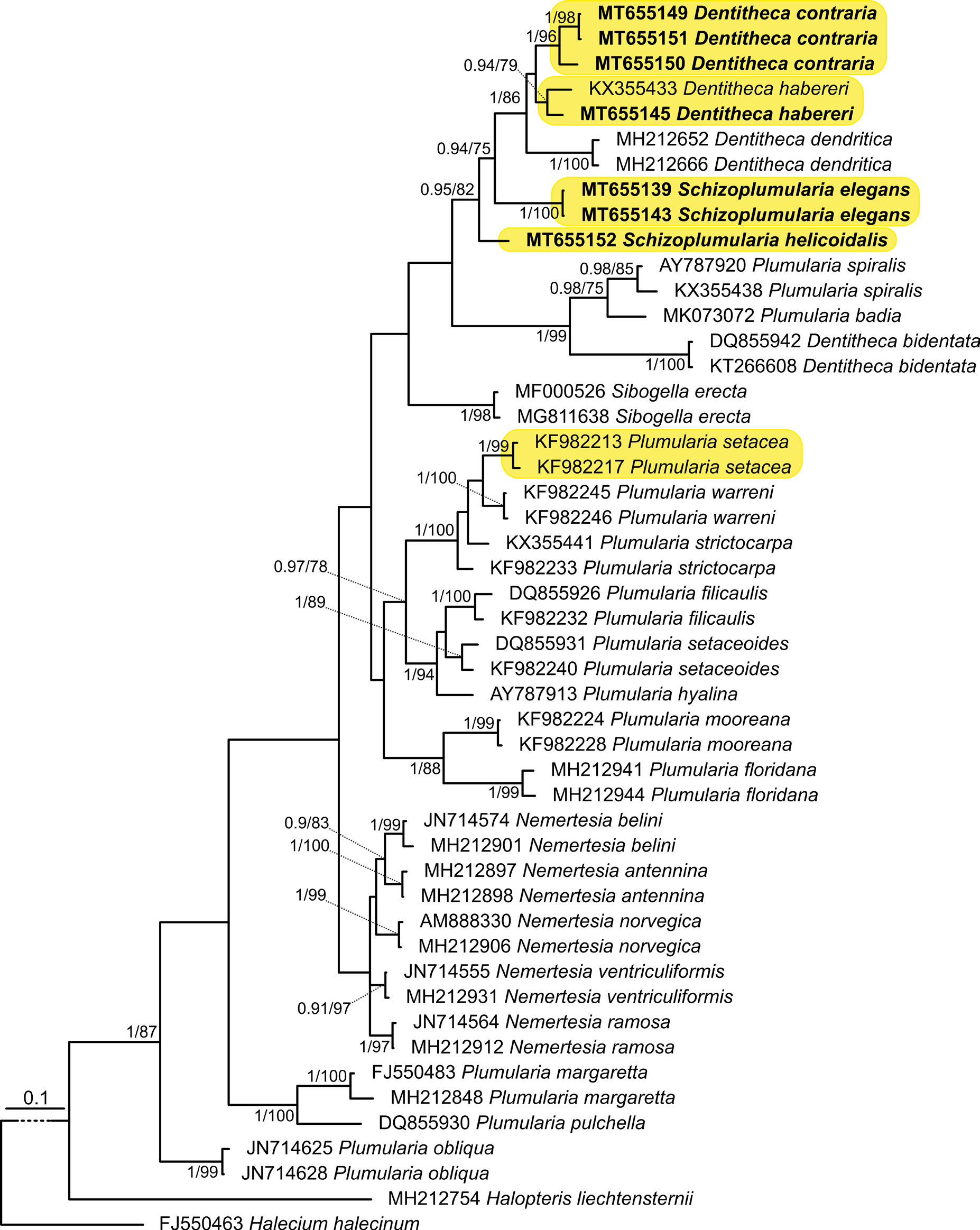
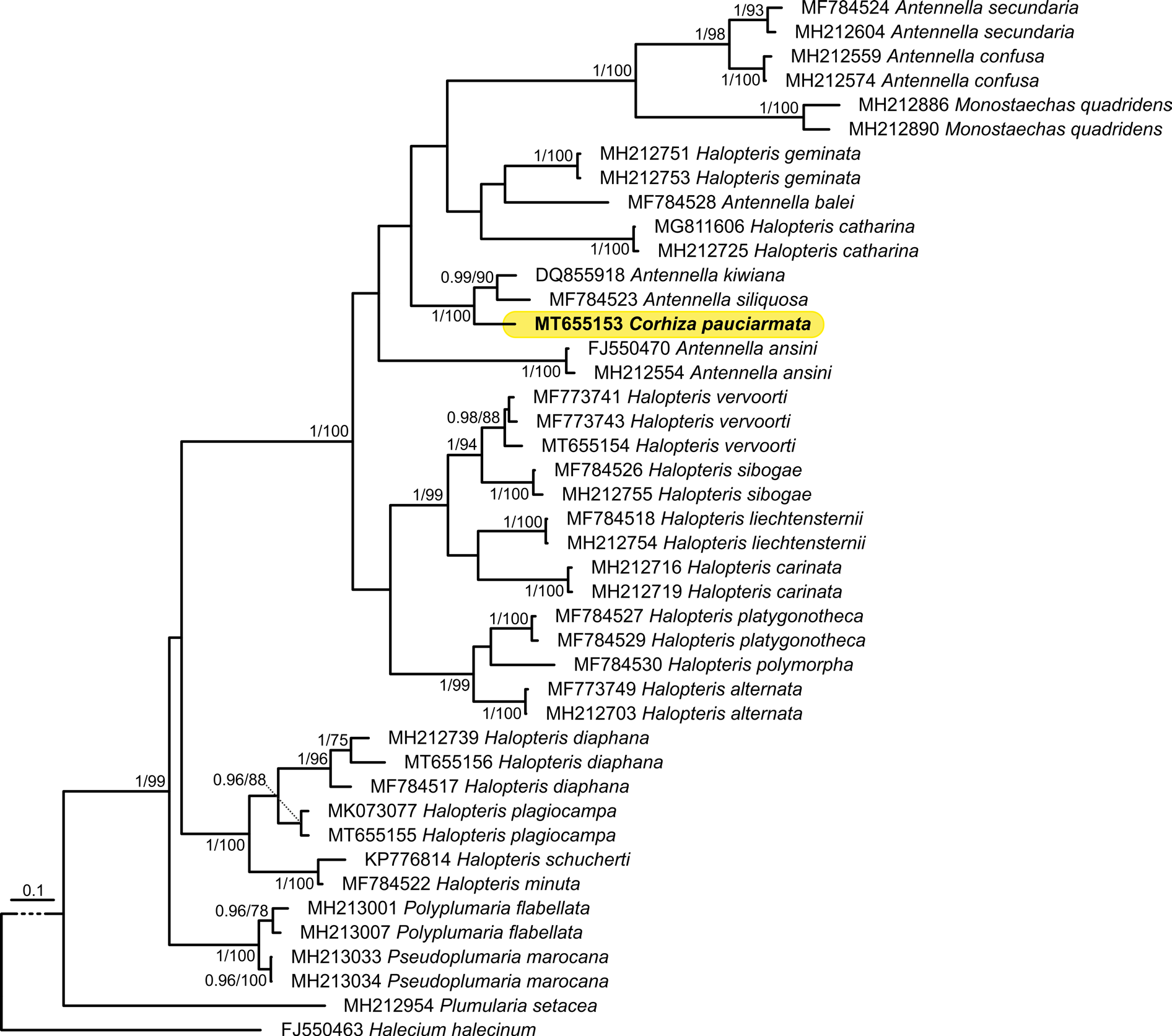
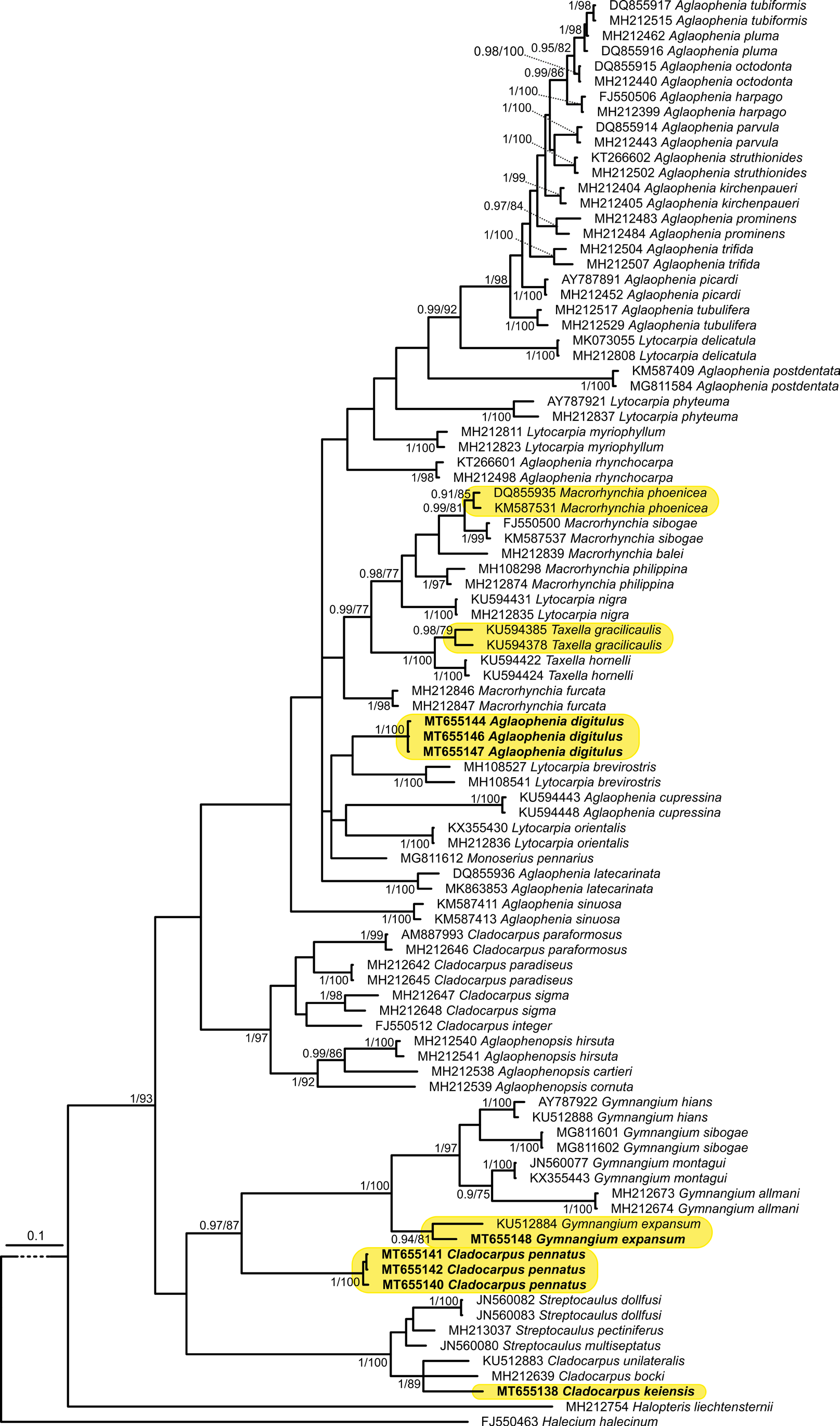
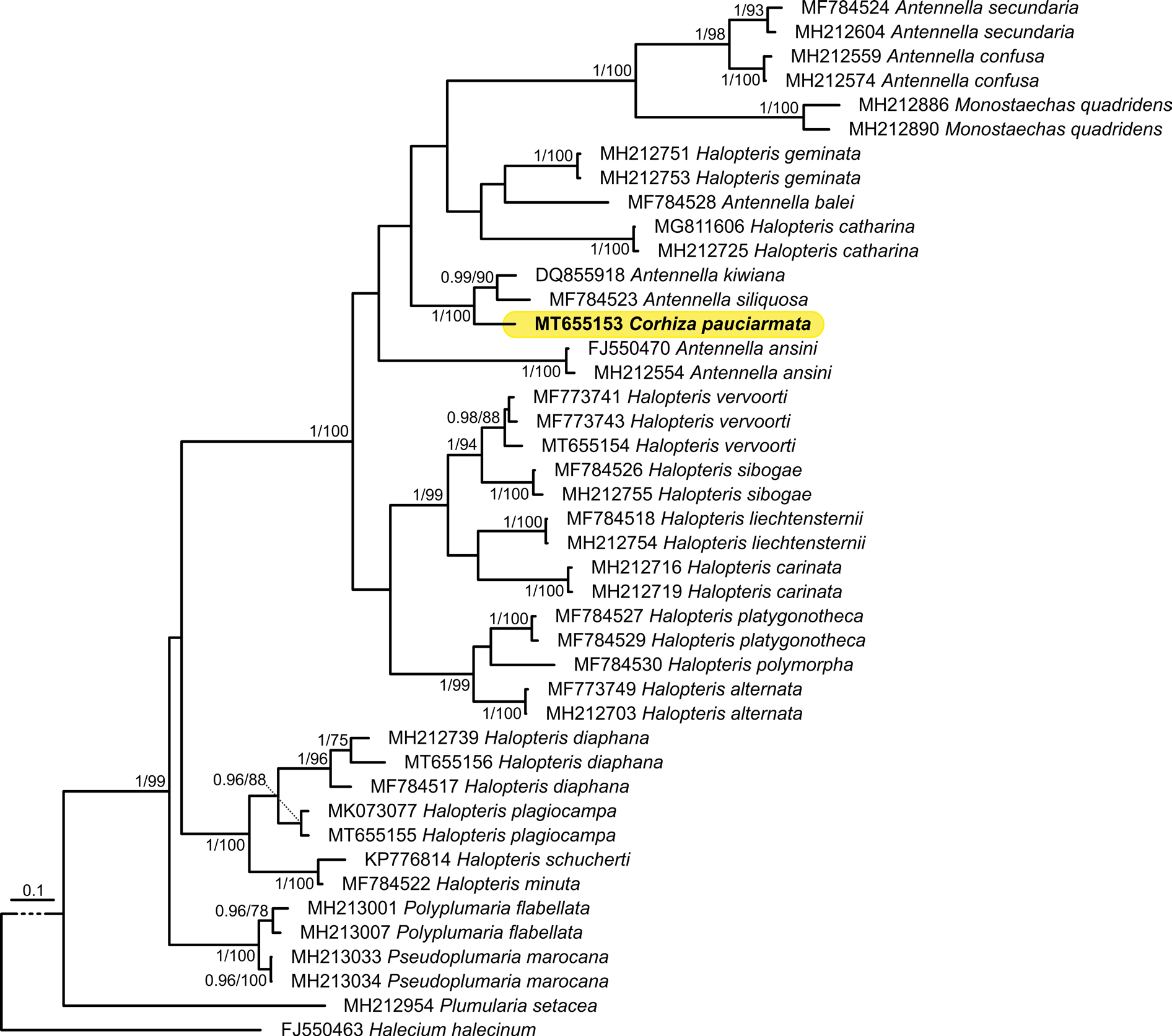
Genetic results The newly sequenced specimens were used to build updated phylogenetic hypotheses for the families Aglaopheniidae, Plumulariidae, and Halopterididae, based on the 16 S rRNA region (Figs 21 – 23). Overall, all families showed a pervasive polyphyly of genera, as previously demonstrated by other studies using the same DNA region (e. g., Galea et al. 2018; Moura et al. 2018), but non-monophyly was also commonly observed using multi-locus approaches (Maronna et al. 2016). Therefore, a thorough integrative morpho-molecular revision is needed to better define the generic and specific boundaries in these plumularioid families. In the Aglaopheniidae tree (Fig. 21), the newly produced sequences represent the first genetic data for the analysed species, except for Gymnangium expansum (Jäderholm, 1903), which clusters with a conspecific sequence. Sequences of the recently-described Cladocarpus pennatus Galea, 2020 cluster in a monophyletic group, divergent from all other Cladocarpus sequences, and the same happens for Aglaophenia digitulus Vervoort & Watson, 2003, highlighting the peculiar nature of these species and their possible belonging to other genera. Finally, Cladocarpus keiensis Schuchert, 2003 clusters with C. unilateralis Schuchert, 2005 and C. bocki Jäderholm, 1919, and all together form a fully-supported monophyletic group with 3 species of Streptocaulus, suggesting that the scope of these genera is in need of a revision. Regarding the Plumulariidae (Fig. 22), the newly-produced sequence of Dentitheca habereri (Stechow, 1909) clusters with a conspecific sequence from Japan, and this species is closely-related to D. contraria comb. nov. (confirming the assumption based on morphological grounds alone, see above), even though with low nodal support, and with D. dendritica (Nutting, 1900). Sequences of Schizoplumularia are sister to the group composed of the species of Dentitheca mentioned above, and the two species, Schizoplumularia elegans Ansín Agís et al., 2016 and S. helicoidalis sp. nov. do not form a monophyletic group in our phylogenetic hypothesis. Sequences of Schizoplumularia spp. and D. contraria comb. nov. were also produced for the first time with this work. Finally, the sequence of Corhiza pauciarmanta Ansín Agis et al., 2009, in the Halopterididae tree (Fig. 23), forms a fully supported group with Antennella kiwiana Schuchert, 1997 and A. siliquosa (Hincks, 1877), and represents the first genetic data obtained for both genus and species.
Galea, Horia R., Maggioni, Davide (2020): Plumularioid hydroids (Cnidaria: Hydrozoa) from off New Caledonia collected during KANACONO and KANADEEP expeditions of the French Tropical Deep-Sea Benthos Program. European Journal of Taxonomy 708: 1-58, DOI: 10.5852/ejt.2020.708
urn: lsid: zoobank. org: act: BFE 82 D 80 - 8626 - 4 B 67 - B 66 F- 24 C 230 D 91882 Figs 16 B, 20; Table 9
Galea, Horia R., Maggioni, Davide (2020): Plumularioid hydroids (Cnidaria: Hydrozoa) from off New Caledonia collected during KANACONO and KANADEEP expeditions of the French Tropical Deep-Sea Benthos Program. European Journal of Taxonomy 708: 1-58, DOI: 10.5852/ejt.2020.708
Diagnosis General description as for the genus. Branches with basal prosegment, followed by a regular succession of modules comprising hydro- and nematothecae, each hydrotheca accompanied by a lateral, cladial apophysis; apophyses alternate; hydrothecae truncated cones, with 5 associated nematothecae and 0 – 1 nematothecae above; cladia with short, proximal, quadrangular segment, followed by an succession of modules, each bearing a tubular hydrotheca and its complement of 5 nematothecae; no nematothecae between successive cladial hydrothecae. All hydrothecae ca ¼ rd adnate, with one mesial, a pair of lateral (often of varied length), and two axillar nematothecae; all nematothecae bithalamic. Gonothecae borne on cladia; piriform, with 3 basal, elongated nematothecae, distally truncate, rim rounded, thickened.
Galea, Horia R., Maggioni, Davide (2020): Plumularioid hydroids (Cnidaria: Hydrozoa) from off New Caledonia collected during KANACONO and KANADEEP expeditions of the French Tropical Deep-Sea Benthos Program. European Journal of Taxonomy 708: 1-58, DOI: 10.5852/ejt.2020.708
Remarks The new species differs from Thamnopteros valdiviae (Stechow, 1923) in having: 1) all Halopteris - like branchlets given off unilaterally from the stem, instead of pointing in all directions around it; 2) undivided axes and cladia; 3) cladia missing an intervening nematothecate internode between the proximalmost, quadrangular segment and the remainder of cladium; 4) hydrothecae with an even rim, not sinuated laterally; 5) bithalamic instead of scale-shaped axillar nematothecae.
Galea, Horia R., Maggioni, Davide (2020): Plumularioid hydroids (Cnidaria: Hydrozoa) from off New Caledonia collected during KANACONO and KANADEEP expeditions of the French Tropical Deep-Sea Benthos Program. European Journal of Taxonomy 708: 1-58, DOI: 10.5852/ejt.2020.708
Distribution Only known from its type locality, off New Caledonia (present study).
Galea, Horia R., Maggioni, Davide (2020): Plumularioid hydroids (Cnidaria: Hydrozoa) from off New Caledonia collected during KANACONO and KANADEEP expeditions of the French Tropical Deep-Sea Benthos Program. European Journal of Taxonomy 708: 1-58, DOI: 10.5852/ejt.2020.708
Etymology From Latin ‘ ūnus, - a, - um’, meaning ‘ one’, and ‘ sěrĭēs ’, meaning ‘ row’, to emphasize the unilateral arrangement of branches along the main stem.
Galea, Horia R., Maggioni, Davide (2020): Plumularioid hydroids (Cnidaria: Hydrozoa) from off New Caledonia collected during KANACONO and KANADEEP expeditions of the French Tropical Deep-Sea Benthos Program. European Journal of Taxonomy 708: 1-58, DOI: 10.5852/ejt.2020.708
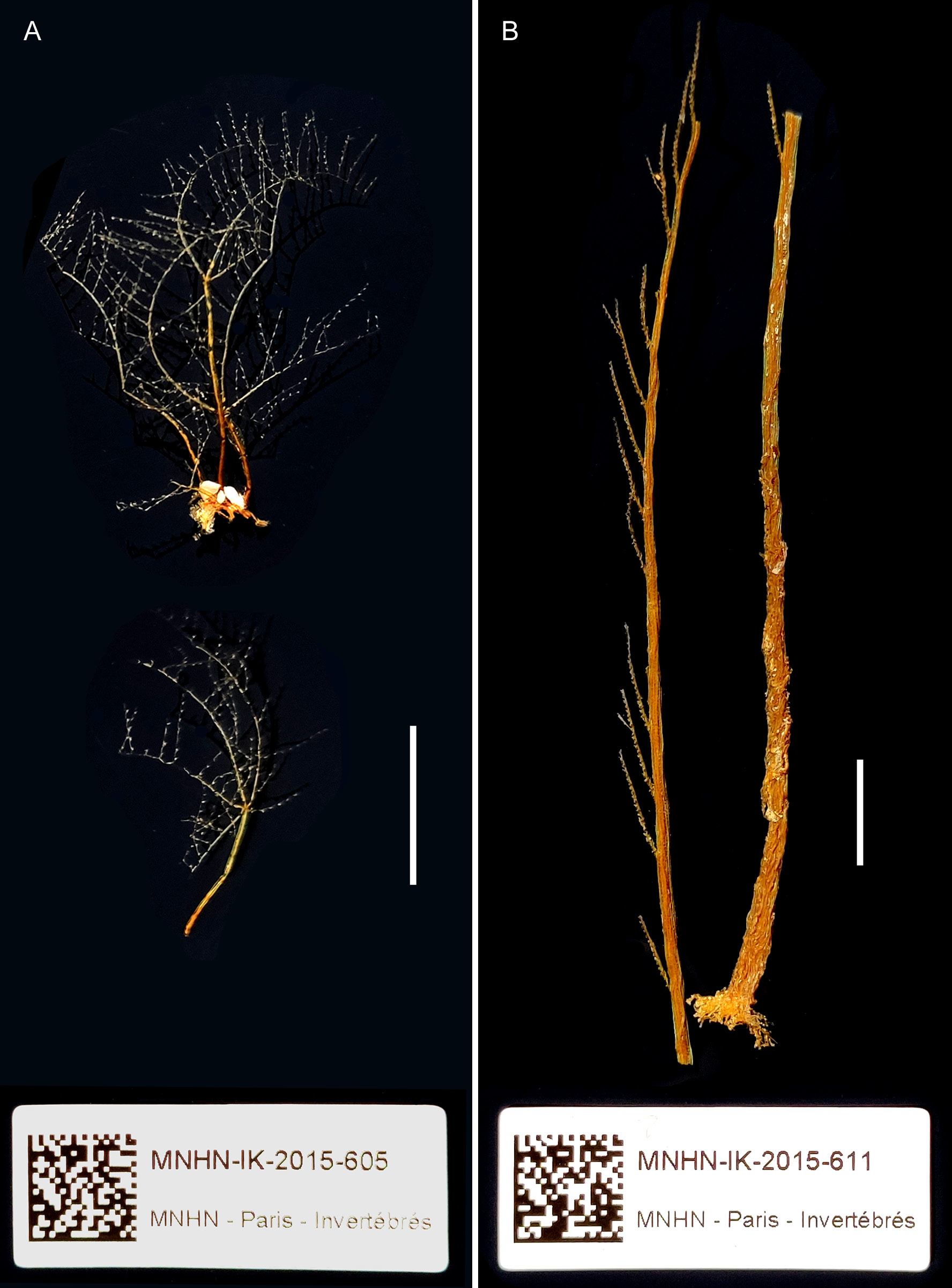
Material examined Holotype PACIFIC OCEAN • 1 sterile colony broken into two pieces, basal part ca 8.5 cm high, distal part ca 8.7 cm high; off New Caledonia, stn CP 4754; 23 ° 22 ′ S, 167 ° 54 ′ E; 1009 – 1019 m; 25 Aug. 2016; KANACONO leg.; MNHN-IK- 2015 - 611.
Galea, Horia R., Maggioni, Davide (2020): Plumularioid hydroids (Cnidaria: Hydrozoa) from off New Caledonia collected during KANACONO and KANADEEP expeditions of the French Tropical Deep-Sea Benthos Program. European Journal of Taxonomy 708: 1-58, DOI: 10.5852/ejt.2020.708

Export occurrence data

Darwin Core Archive (ZIP)

CLASSIFICATION

Taxonomic Classification Tree

MULTIMEDIA

Media Files(5)

Fig. 16. A. Monostaechas fisheri Nutting, 1905, two colonies from sample MNHN-IK-2015-605. — B. Thamnopteros uniserius Galea gen. et sp. nov., holotype colony, MNHN-IK-2015-611. Scale bars: 1 cm.
Imageimage/png© Galea, Horia R.;Maggioni, DavideGalea, Horia R.;Maggioni, Davide

Fig. 22. Phylogenetic hypothesis for the Plumulariidae McCrady, 1859. Species discussed in this study are highlighted in yellow. Newly produced sequences are in bold. Numbers at nodes represent BPP and BS, respectively, and are shown only when both BPP Ż 0.9 and BS Ż 75.
Imageimage/png© Galea, Horia R.;Maggioni, DavideGalea, Horia R.;Maggioni, Davide

Fig. 23. Phylogenetic hypothesis for the Halopterididae Millard, 1962. The species discussed in this study is highlighted in yellow, and the newly-produced sequence is in bold. Numbers at nodes represent BPP and BS, respectively, and are shown only when both BPP Ż 0.9 and BS Ż 75.
Imageimage/png© Galea, Horia R.;Maggioni, DavideGalea, Horia R.;Maggioni, Davide

Fig. 20 (opposite page). Thamnopteros uniserius Galea gen. et sp. nov., portion of fascicled stem giving rise laterally to a Halopteris-like branch, of which only the proximalmost part, showing the prosegment, is depicted (A); more distal portion of another branch, note slight change in the hydrothecal shape (the arrow indicates a cladial apophysis) (B); two cauline hydrothecae seen laterally, to show variation in the length of the lateral nematothecae (C–D); cladial hydrothecae seen laterally (E) and frontally (F), note differences in the size of the lateral nematothecae belonging to each pair; detail of the hydrothecal axil (G); nematothecae: mesial (H), of the component tubes of the fascicled stem (I), and from above the cauline hydrothecae (J); gonotheca (K); all from sample MNHN-IK-2015-611. Scale bars: A–B = 500 µm; C–F = 200 µm; G–J = 100 µm; K = 300 µm.
Imageimage/png© Galea, Horia R.;Maggioni, DavideGalea, Horia R.;Maggioni, Davide

Fig. 21 (opposite page). Phylogenetic hypothesis for the Aglaopheniidae Marktanner-Turneretscher, 1890. Species discussed in this study are highlighted in yellow. Newly produced sequences are in bold. Numbers at nodes represent Bayesian posterior probabilities (BPP) and maximum likelihood bootstrap supports (BS), respectively, and are shown only when both BPP Ż 0.9 and BS Ż 75.

Imageimage/png© Galea, Horia R.;Maggioni, DavideGalea, Horia R.;Maggioni, Davide

IMAGES

Gallery(5)

See Gallery

Occurrences with images

Source Information

Plumularioid hydroids (Cnidaria: Hydrozoa) from off New Caledonia collected during KANACONO and KANADEEP expeditions of the French Tropical Deep-Sea Benthos Program

checklist

This dataset contains the digitized treatments in Plazi based on the original journal article Galea, Horia R., Maggioni, Davide (2020): Plumularioid hydroids (Cnidaria: Hydrozoa) from off New Caledonia collected during KANACONO and KANADEEP expeditions of the French Tropical Deep-Sea Benthos Program. European Journal of Taxonomy 708: 1-58, DOI: 10.5852/ejt.2020.708

Abstract. This study reports on 25 species of hydroids occurring in the collections gathered during KANACONO and KANADEEP expeditions carried out in the SE of New Caledonia in 2016, and off the western coast of the island in 2017, respectively. Of these, 19 have not been dealt with in earlier reports on these collections. Two new genera and four new species are described, viz, Actinopluma mirifica Galea gen. et sp. nov., provisionally assigned to the family Kirchenpaueriidae Stechow, 1921, Schizoplumularia helicoidalis sp. nov., belonging to the Plumulariidae McCrady, 1859, and Corhiza patula Galea sp. nov. and Thamnopteros uniserius Galea gen. et sp. nov., both placed in the family Halopterididae Millard, 1962. The gonotheca and the medusoid gonophore of Plumularia contraria Ansín Agís et al., 2014 are described for the first time, allowing a genus transfer to Dentitheca Stechow, 1919, as D. contraria comb. nov. Plumularia conjuncta Billard, 1913, known earlier from a minute portion of colony, is redescribed based on a complete, though infertile, specimen. Similarly, complete specimens corresponding to the hydroid previously referred to as Antennella megatheca Ansín Agís et al., 2009 are documented, allowing a provisional reallocation to Corhiza Millard, 1962 and a description of its so far unknown gonothecae. Fertile material assignable to the poorly-known Monostaechas fisheri Nutting, 1905 allows the recognition of this hydroid as a valid species, distinct from M. quadridens (McCrady, 1859). Most taxa are illustrated to validate the reliability of their identifications. Finally, phylogenetic reconstructions of the families Aglaopheniidae, Plumulariidae, and Halopterididae, based on the 16S rRNA, allowed a first genetic characterization of some of the species dealt with in this work.

Galea H R, Maggioni D, valdenar (2020). Plumularioid hydroids (Cnidaria: Hydrozoa) from off New Caledonia collected during KANACONO and KANADEEP expeditions of the French Tropical Deep-Sea Benthos Program. European Journal of Taxonomy. Checklist dataset https://doi.org/10.5852/ejt.2020.708 accessed via GBIF.org on 2026-06-19.

CC0Published 8/26/2020View dataset
GBIF Usage Key
167407437
Dataset Key
0c523d70-0815-45f8-a69d-1698f78a0998
Origin
source
Backbone Key
10834344
Taxon ID
03D92045FFA5FFC3E6162673C4A0FE9F.taxon
Last Crawled
6/10/2026
Last Interpreted
6/10/2026