AnimaliaNot EvaluatedacceptedspeciesAccepted
Corhiza megatheca

Corhiza megatheca

(Ansin Agis, 2009)

GBIF:167407443

0year

0

Synonyms

ABOUT

Descriptions(5)

Description Relatively flaccid, upright colonies, reaching as much as 7 cm in height, arising from rhizoid stolon securing the whole into sediment. Stem fascicled for most of its length, becoming monosiphonic distally; accessory tubes tortuous, anastomosing, devoid of nematothecae; main tube almost straight, unsegmented, athecate, giving rise at more or less regular intervals to short hydrocladial apophyses springing in all directions around stem; occasionally two apophyses are given off at the same level; apophyses ending in straight nodes distally. Cladia up to 1.1 cm long, heteromerously segmented by alternating straight and oblique nodes; first segment relatively short, delimited by straight nodes at both ends, with distally-placed nematotheca at its upper side; remainder of hydrocladium with regular structure, composed of alternating ahydro- and hydrothecate internodes. Ahydrothecate internodes comparatively longer than their hydrothecate counterparts, with proximal node transverse and distal node oblique; first internode exceedingly long, with 4 – 6 frontal nematothecae in row, subsequent ones shorter and provided with 2 frontal nematothecae, length of internodes decreasing distally, so that only 1 nematotheca is to be found on them. Hydrothecate internodes with proximal node oblique and distal node transverse, with one hydrotheca and its three associated nematothecae: a mesial one, not reaching the hydrothecal base, and pair of relatively short laterals, borne on moderately-long apophyses, together reaching half-length the adnate wall of hydrotheca. Hydrothecae very deep, tubular, somehow flared at margin, rim circular, entire. Gonothecae borne on cladia, given off singly from lateral side of hydrothecate internode, between hydrothecal basis and mesial nematotheca; pedicel of two short, quadrangular, athecate segments; gonotheca large, piriform, thin-walled, tapering basally and provided there with 3 nematothecae; aperture apical, ovoid, provided with watch-glass-shaped operculum. All nematothecae bithalamic, conical, upper chamber shorter than basal one, with rim scooped on both ab-and adaxial sides, distinctly more on the latter.
Galea, Horia R., Maggioni, Davide (2020): Plumularioid hydroids (Cnidaria: Hydrozoa) from off New Caledonia collected during KANACONO and KANADEEP expeditions of the French Tropical Deep-Sea Benthos Program. European Journal of Taxonomy 708: 1-58, DOI: 10.5852/ejt.2020.708
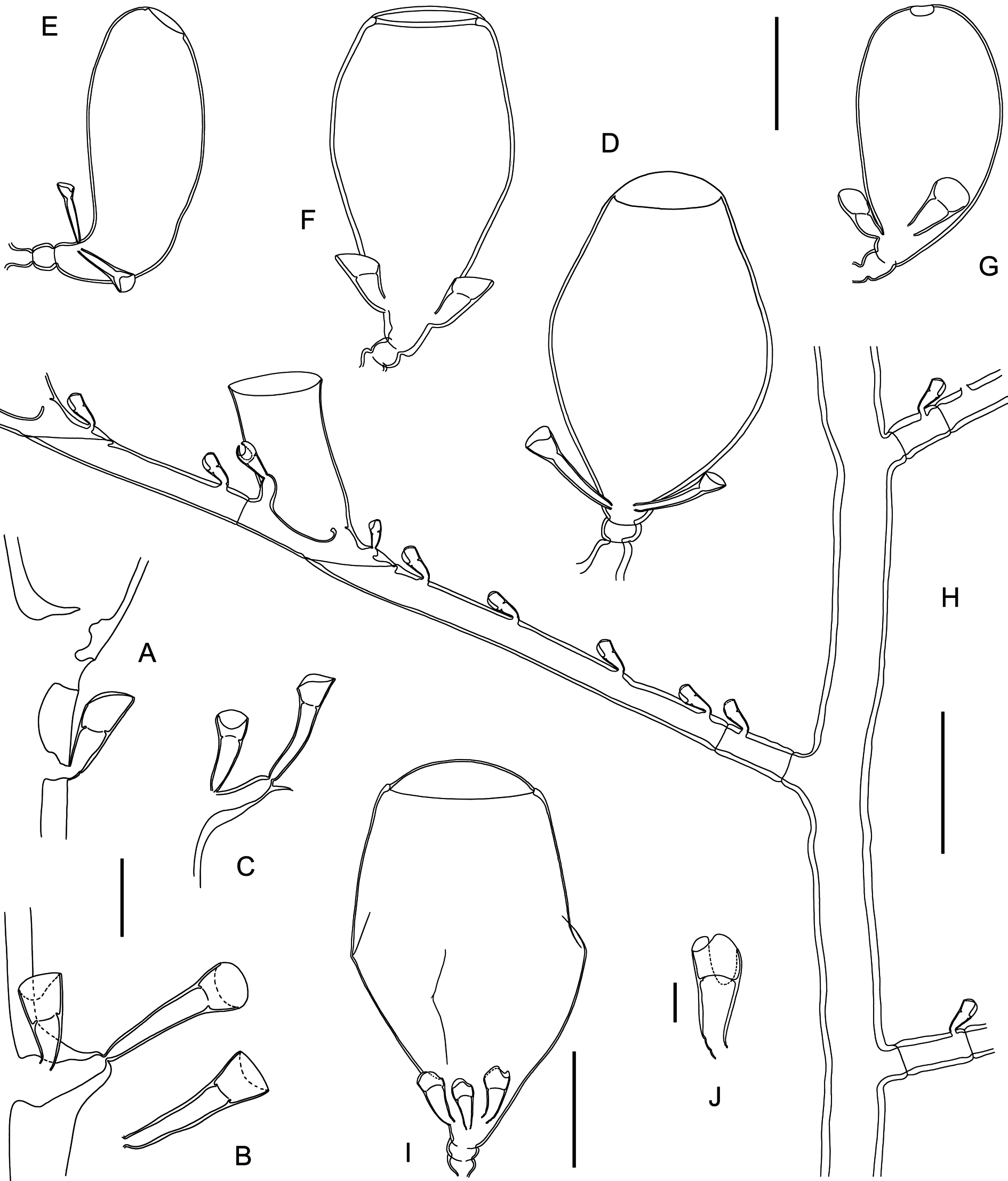
Figs 11 B, 13 H – J; Table 5
Galea, Horia R., Maggioni, Davide (2020): Plumularioid hydroids (Cnidaria: Hydrozoa) from off New Caledonia collected during KANACONO and KANADEEP expeditions of the French Tropical Deep-Sea Benthos Program. European Journal of Taxonomy 708: 1-58, DOI: 10.5852/ejt.2020.708
Remarks There is little doubt that the present materials belong to the same species as that described by Ansín Agís et al. (2009) under the basionym Antennella megatheca. The morphology of their trophosomes, as well as their measurements (see Table 5), agree well. It is likely that these authors had only tips of colonies, not exceeding 13 mm in length, that were provided with a limited number of cladia. This prompted them to consider the distal, monosiphonic parts of the main stems as representing potential stolons. No fertile specimens were reported so far, but the colony from sample MNHN-IK- 2015 - 600 bears gonothecae. Corhiza megatheca is unique among its congeners in that its cladia, instead of being given off from the component tubes of the stem, arise from a single, main tube, while all other counterparts have a strictly accessory function. This particular condition raises the question of the generic limitation in Corhiza Millard, 1962. At least morphologically speaking, the genus appears to be polyphyletic, with several species not meeting the original scope defined by Millard (1962: 275), viz, “ fascicled stem composed of a number of interwoven and intercommunicating tubes of equal diameter and importance. Hydrocladia arising from the component tubes in a completely irregular fashion, not rebranching ”. Indeed, C. sociabilis Millard, 1980 is a branched species with a pinnate appearance, in which three types of component tubes have been identified: 1) one to several axial tubes, each branched or unbranched; tubes bearing alternate cladia; 2) companion tubes, provided with hydrothecae, that accompany each branch; 3) peripheral tubes carrying nematothecae only (Millard 1980). Another species, formerly known as C. valdiviae (Stechow, 1923) (Millard 1975) is shown to belong to the new genus, Thamnopteros Galea gen. nov. (see below). For the time being, it is preferred to leave provisionally the present species in Corhiza, until additional data at both specific and generic levels become available.
Galea, Horia R., Maggioni, Davide (2020): Plumularioid hydroids (Cnidaria: Hydrozoa) from off New Caledonia collected during KANACONO and KANADEEP expeditions of the French Tropical Deep-Sea Benthos Program. European Journal of Taxonomy 708: 1-58, DOI: 10.5852/ejt.2020.708
Distribution Known only from off New Caledonia (Ansín Agís et al. 2009; present study).
Galea, Horia R., Maggioni, Davide (2020): Plumularioid hydroids (Cnidaria: Hydrozoa) from off New Caledonia collected during KANACONO and KANADEEP expeditions of the French Tropical Deep-Sea Benthos Program. European Journal of Taxonomy 708: 1-58, DOI: 10.5852/ejt.2020.708
Material examined PACIFIC OCEAN • 1 sterile colony, ca 7 cm high; off New Caledonia, stn DW 4725; 22 ° 41 ′ S, 167 ° 05 ′ E; 240 – 256 m; 20 Aug. 2016; KANACONO leg.; MNHN-IK- 2015 - 595 • 1 ca 5 cm high, fertile colony; off New Caledonia, stn DW 4711; 22 ° 47 ′ S, 167 ° 24 ′ E; 335 – 338 m; 18 Aug. 2016; KANACONO leg.; MNHN-IK- 2015 - 600.
Galea, Horia R., Maggioni, Davide (2020): Plumularioid hydroids (Cnidaria: Hydrozoa) from off New Caledonia collected during KANACONO and KANADEEP expeditions of the French Tropical Deep-Sea Benthos Program. European Journal of Taxonomy 708: 1-58, DOI: 10.5852/ejt.2020.708

Export occurrence data

Darwin Core Archive (ZIP)

CLASSIFICATION

Taxonomic Classification Tree

MULTIMEDIA

Media Files(2)

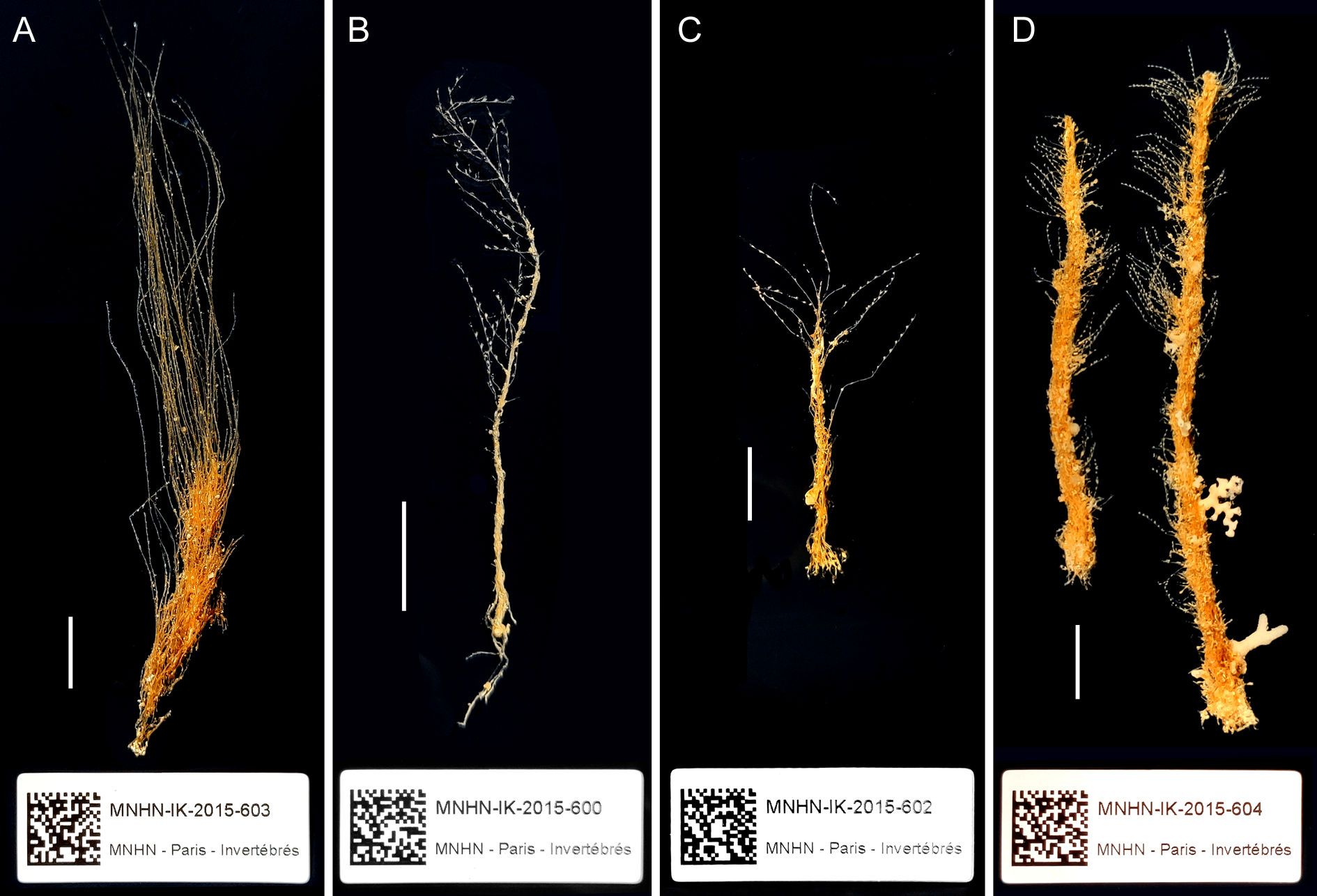
Fig. 11. A. Antennella aff. varians (Billard, 1911), colony, MNHN-IK-2015-603. — B. Corhiza megatheca (Ansín Agís et al., 2009), colony, MNHN-IK-2015-600. — C. Corhiza patula Galea sp. nov., holotype colony, MNHN-IK-2015-602. — D. Corhiza pauciarmata Ansín Agís et al., 2009, colony, MNHN-IK-2015-604. Scale bars: 1 cm.

Imageimage/png© Galea, Horia R.;Maggioni, DavideGalea, Horia R.;Maggioni, Davide

Fig. 13. A–B. Antennella aff. varians (Billard, 1911), cauline nematotheca (A); lateral nematothecae (B) compared to those of the true A. varians (C); female (D) and male (E) gonothecae of true A. varians compared to their counterparts from A. balei (F–G, respectively). D–E from sample HRG-1584; F–G from sample HRG-0546. — H–J. Corhiza megatheca (Ansín Agís et al., 2009), distal, monosiphonic portion of stem with three successive cladial apophyses and proximal part of a cladium (H), from sample MNHN-IK-2015-595; gonotheca (I) and detail of one of its basal nematothecae (J), from sample MNHN-IK-2015-600. Scale bars: A–C = 100 µm; D–G = 200 µm; H = 500 µm; I = 300 µm; J = 50 µm.

Imageimage/png© Galea, Horia R.;Maggioni, DavideGalea, Horia R.;Maggioni, Davide

IMAGES

Gallery(2)

See Gallery

Occurrences with images

Source Information

Plumularioid hydroids (Cnidaria: Hydrozoa) from off New Caledonia collected during KANACONO and KANADEEP expeditions of the French Tropical Deep-Sea Benthos Program

checklist

This dataset contains the digitized treatments in Plazi based on the original journal article Galea, Horia R., Maggioni, Davide (2020): Plumularioid hydroids (Cnidaria: Hydrozoa) from off New Caledonia collected during KANACONO and KANADEEP expeditions of the French Tropical Deep-Sea Benthos Program. European Journal of Taxonomy 708: 1-58, DOI: 10.5852/ejt.2020.708

Abstract. This study reports on 25 species of hydroids occurring in the collections gathered during KANACONO and KANADEEP expeditions carried out in the SE of New Caledonia in 2016, and off the western coast of the island in 2017, respectively. Of these, 19 have not been dealt with in earlier reports on these collections. Two new genera and four new species are described, viz, Actinopluma mirifica Galea gen. et sp. nov., provisionally assigned to the family Kirchenpaueriidae Stechow, 1921, Schizoplumularia helicoidalis sp. nov., belonging to the Plumulariidae McCrady, 1859, and Corhiza patula Galea sp. nov. and Thamnopteros uniserius Galea gen. et sp. nov., both placed in the family Halopterididae Millard, 1962. The gonotheca and the medusoid gonophore of Plumularia contraria Ansín Agís et al., 2014 are described for the first time, allowing a genus transfer to Dentitheca Stechow, 1919, as D. contraria comb. nov. Plumularia conjuncta Billard, 1913, known earlier from a minute portion of colony, is redescribed based on a complete, though infertile, specimen. Similarly, complete specimens corresponding to the hydroid previously referred to as Antennella megatheca Ansín Agís et al., 2009 are documented, allowing a provisional reallocation to Corhiza Millard, 1962 and a description of its so far unknown gonothecae. Fertile material assignable to the poorly-known Monostaechas fisheri Nutting, 1905 allows the recognition of this hydroid as a valid species, distinct from M. quadridens (McCrady, 1859). Most taxa are illustrated to validate the reliability of their identifications. Finally, phylogenetic reconstructions of the families Aglaopheniidae, Plumulariidae, and Halopterididae, based on the 16S rRNA, allowed a first genetic characterization of some of the species dealt with in this work.

Galea H R, Maggioni D, valdenar (2020). Plumularioid hydroids (Cnidaria: Hydrozoa) from off New Caledonia collected during KANACONO and KANADEEP expeditions of the French Tropical Deep-Sea Benthos Program. European Journal of Taxonomy. Checklist dataset https://doi.org/10.5852/ejt.2020.708 accessed via GBIF.org on 2026-06-17.

CC0Published 8/26/2020View dataset
GBIF Usage Key
167407443
Dataset Key
0c523d70-0815-45f8-a69d-1698f78a0998
Origin
source
Backbone Key
10942697
Taxon ID
03D92045FF93FFEBE60227BDC421F81C.taxon
Last Crawled
6/10/2026
Last Interpreted
6/10/2026