
AnimaliaNot EvaluatedacceptedspeciesAccepted
Schizoplumularia helicoidalis

Schizoplumularia helicoidalis

Galea & Maggioni, 2020

GBIF:167407466

0year

0

Synonyms

ABOUT

Descriptions(7)

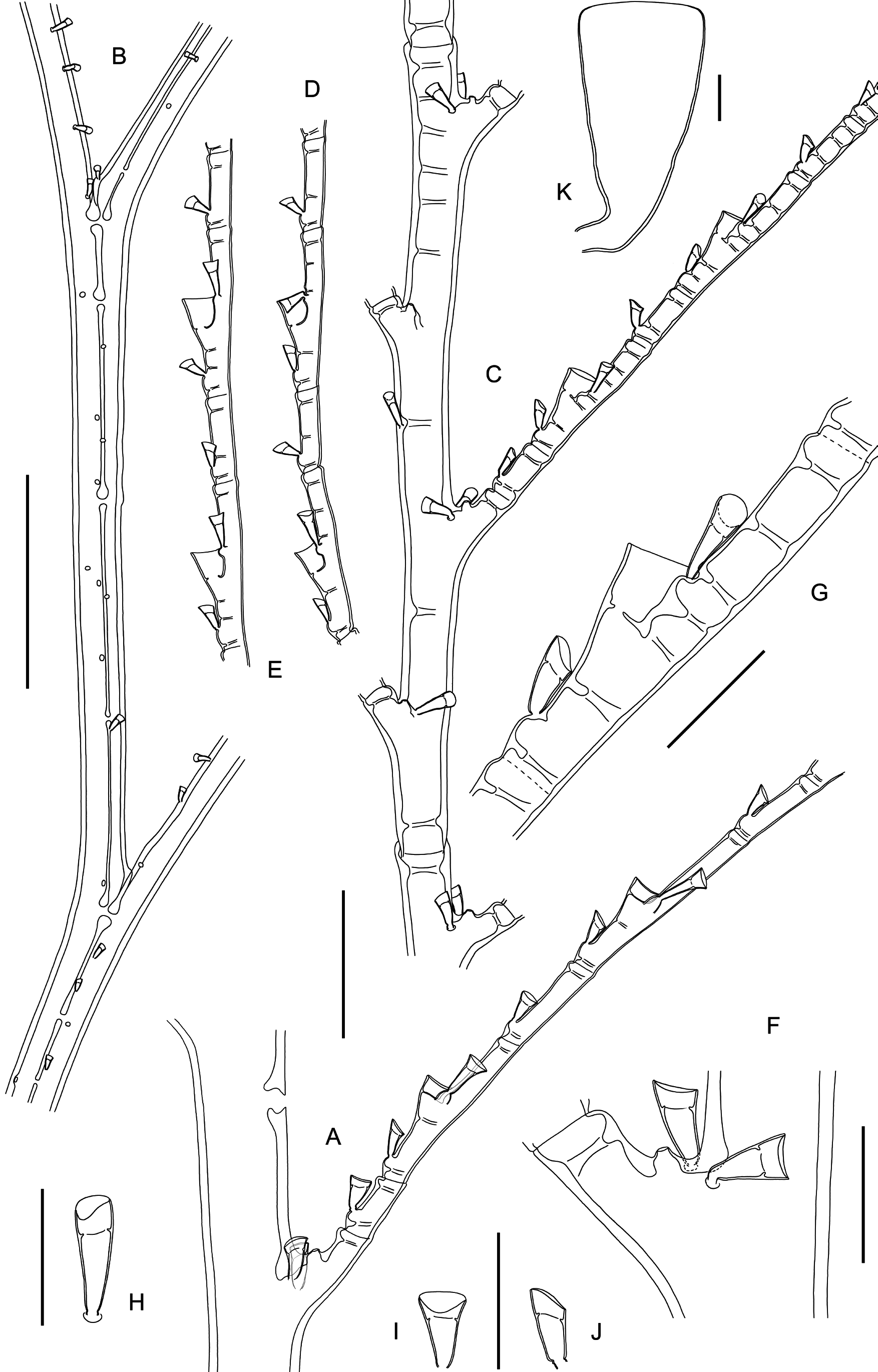
Description A 15.5 cm high colony of very delicate and flaccid appearance, detached from its hydrorhiza; stem slender, composed proximally of bundle of few tubes running parallel to each other and communicating, at intervals, through common holes in the perisarc; nematothecae scattered along their length; more distally, remainder of stem composed of only two contiguous tubes forming alternately-placed geniculations at intervals of 3.5 – 5.5 mm; at each geniculation, one of tubes diverges from stem at acute angle and transforms itself into cladia-bearing branch; it also gives rise simultaneously, at level of axil thus formed with its henceforth single counterpart, to another tube running upward along that counterpart, so as to ensure the obligatory presence of two adjacent tubes composing stem; at next geniculation, there is a reversal of roles played by couple of tubes: that newly-added at previous geniculation continues unaffected (skips one geniculation), while its counterpart detaches distally from stem as cladia-bearing branch; stem tubes with two parallel rows of alternately-placed nematothecae; between successive geniculations, stem acquires slight torsion, so that its cladia-bearing branches are arranged in helicoidal manner along it. Stem, branches and cladia very slender; perisarc straw colored. Cladia-bearing branches up to 2 cm long, unsegmented, but each equivalent of internode with distallyplaced cladial apophysis and 1 – 2 nematothecae on side opposite to apophysis (up to 6 nematothecae in two closely-set whorls found on proximalmost ‘ internode’); apophyses alternate, not coplanar, but forming wide angle between two rows; axil with conical mamelon provided with rounded aperture on summit, and two nematothecae, one on each side. Cladia up to 2.5 mm long, heteromerously segmented by means of transverse nodes into alternating ahydrothecate and hydrothecate internodes; proximalmost internode ahydrothecate, slightly shorter than its subsequent counterparts, with proximal nematotheca on its upper side; ahydrothecate internodes with generally two (occasionally up to four) internal, incomplete perisarc ridges near both ends, and proximal nematotheca placed frontally; hydrothecate internodes, up to 6 per cladium, comparatively longer than their ahydrothecate counterparts, with almost centrally-placed hydrotheca and its three associated nematothecae: a mesial one and pair of laterals; up to eight internal incomplete perisarcal ridges per hydrothecate internode. Nematothecae of colony all alike: trumpet-shaped, bithalamic, lower chamber tall, upper chamber shallow, wall of the latter lowered on adaxial side. Gonothecae in axils of cladia-bearing branches; immature in material at hand; broadly piriform, tapering gradually below into an indistinct, laterally curved pedicel; distal end truncate, not fully formed.
Galea, Horia R., Maggioni, Davide (2020): Plumularioid hydroids (Cnidaria: Hydrozoa) from off New Caledonia collected during KANACONO and KANADEEP expeditions of the French Tropical Deep-Sea Benthos Program. European Journal of Taxonomy 708: 1-58, DOI: 10.5852/ejt.2020.708
urn: lsid: zoobank. org: act: 902 D 24 C 0 - DC 53 - 4610 - A 3 D 0 - 80 EBC 01 A 9 B 09 Figs 9 B, 10 B – K; Table 3
Galea, Horia R., Maggioni, Davide (2020): Plumularioid hydroids (Cnidaria: Hydrozoa) from off New Caledonia collected during KANACONO and KANADEEP expeditions of the French Tropical Deep-Sea Benthos Program. European Journal of Taxonomy 708: 1-58, DOI: 10.5852/ejt.2020.708
Diagnosis Schizoplumularia with slender, flaccid, geniculate stem, lightly fascicled proximally, then composed of only two adjacent tubes for most of its length; tubes with scattered nematothecae along their length; at each geniculation, one tube, while diverging as a cladia-bearing branch, gives rise to an auxiliary tube running upwards along the second tube, a situation that is reversed throughout the stem; branches undivided, but each equivalent of internode with a latero-distal cladial apophysis (the latter with a mamelon and 2 axillar nematothecae) and 1 – 2 nematothecae on side opposite the apophysis; apophyses shifted on to the upper side of the branch; cladia heteromerously segmented into short, ahydrothecate internodes with 1 nematotheca alternating with comparatively longer hydrothecate internodes bearing a small, cup-shaped hydrotheca and its 3 associated nematothecae.
Galea, Horia R., Maggioni, Davide (2020): Plumularioid hydroids (Cnidaria: Hydrozoa) from off New Caledonia collected during KANACONO and KANADEEP expeditions of the French Tropical Deep-Sea Benthos Program. European Journal of Taxonomy 708: 1-58, DOI: 10.5852/ejt.2020.708
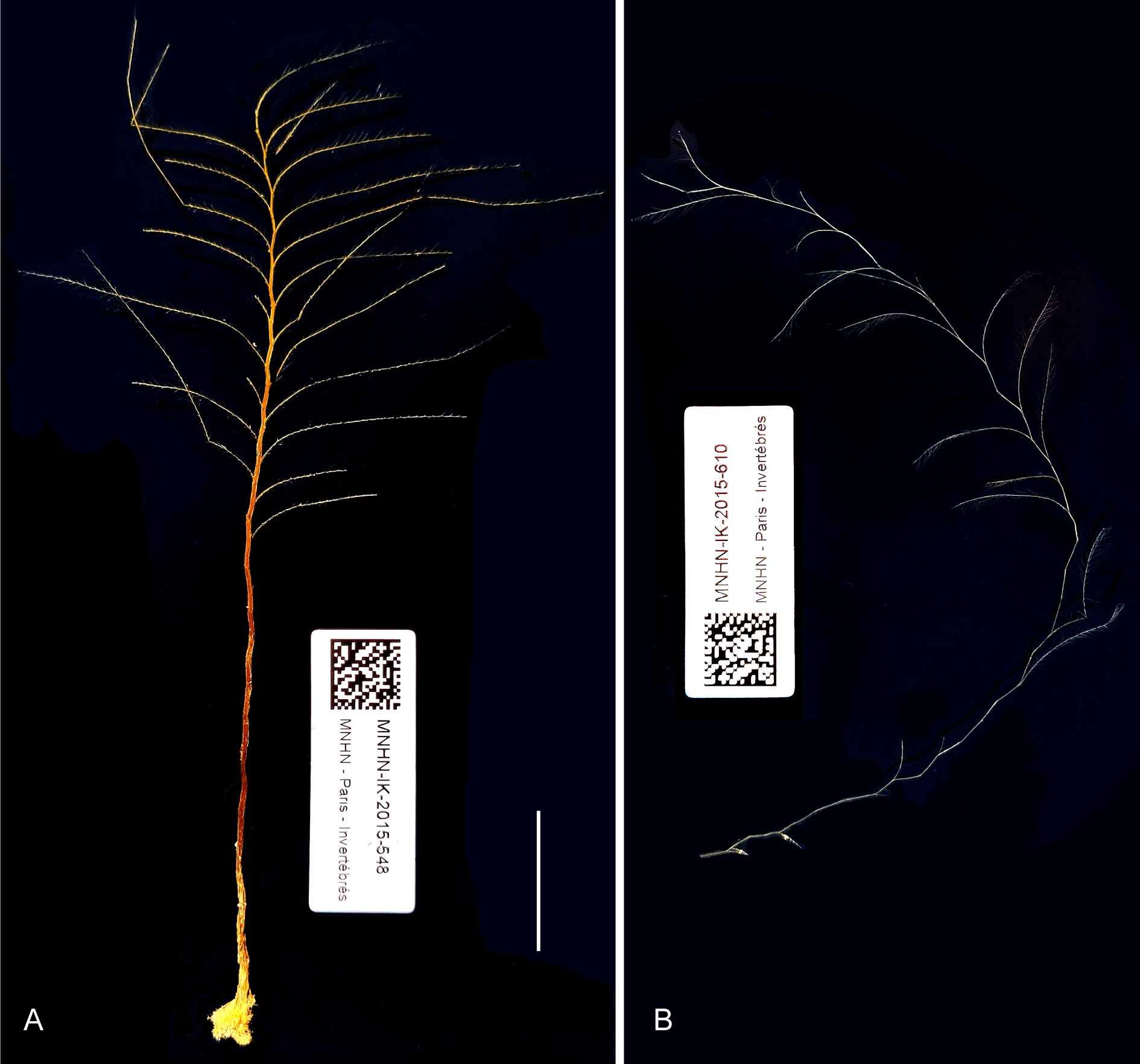
Remarks The present material is, with little doubt, conspecific with part of that originally assigned to S. elegans by Ansín Agís et al. (2016), as for instance the colony from SMIB 4, stn DW 53 that displays a “ spirallybuilt ” appearance (see their fig. 6 a) and “ larger hydrothecae ” (see their fig. 8 c – d). Although these authors acknowledged that “ the remaining characters are similar to the other examined colonies ” of S. elegans, they refrained from separating it specifically. However, when compared to all available specimens of S. elegans occurring in the present collections, the colony from sample MNHN-IK- 2015 - 610 is comparatively more slender and decidedly lax, and, most importantly, displays a spiral arrangement of the hydrocladia-bearing branches around the stem; the latter is lightly fascicled for the proximal 2.5 cm of its length, while the remainder (13 cm high) is composed of only two contiguous tubes. In S. elegans, the stems are fairly fascicled for nearly their whole length, with only the very tips of the colonies being monosiphonic, and their cladia-bearing branches of both rows are strictly coplanar (compare Fig. 9 A and Fig. 9 B). The material MNHN-IK- 2015 - 596, besides displaying shorter stem internodes (and consequently more closely-set cladia-bearing branches) compared to the holotype, has similar cladia (Fig. 10 D – E). Due to the scarcity of the available specimens of S. helicoidalis sp. nov., its intraspecific variability could not be assessed properly. In order to avoid any possible identification error, these specimens are not selected as a paratype, despite one of them being provided with (immature) gonothecae.
Galea, Horia R., Maggioni, Davide (2020): Plumularioid hydroids (Cnidaria: Hydrozoa) from off New Caledonia collected during KANACONO and KANADEEP expeditions of the French Tropical Deep-Sea Benthos Program. European Journal of Taxonomy 708: 1-58, DOI: 10.5852/ejt.2020.708
Distribution Known only from off New Caledonia (Ansín Agís et al. 2016; present study).
Galea, Horia R., Maggioni, Davide (2020): Plumularioid hydroids (Cnidaria: Hydrozoa) from off New Caledonia collected during KANACONO and KANADEEP expeditions of the French Tropical Deep-Sea Benthos Program. European Journal of Taxonomy 708: 1-58, DOI: 10.5852/ejt.2020.708
Etymology From Greek ‘ ἑΛΙΚΟΕΙΔής ’, meaning ‘ in the form of a helix’, to describe the arrangement of the cladiabearing branches along the stem.
Galea, Horia R., Maggioni, Davide (2020): Plumularioid hydroids (Cnidaria: Hydrozoa) from off New Caledonia collected during KANACONO and KANADEEP expeditions of the French Tropical Deep-Sea Benthos Program. European Journal of Taxonomy 708: 1-58, DOI: 10.5852/ejt.2020.708
Material examined Holotype PACIFIC OCEAN • a 15.5 cm high, sterile colony without hydrorhiza; off New Caledonia, stn DW 4711; 22 ° 47 ′ S, 167 ° 24 ′ E; 335 – 338 m; 18 Aug. 2016; KANACONO leg.; MNHN-IK- 2015 - 610. Additional material PACIFIC OCEAN • 1 ca 6 cm high, sterile colony, and the top part (ca 2 cm high) of a colony with immature gonothecae; off New Caledonia, stn DW 4762; 23 ° 16 ′ S, 168 ° 06 ′ E; 810 – 805 m; 26 Aug. 2016; KANACONO leg.; barcode identifier MT 655152; MNHN-IK- 2015 - 596.
Galea, Horia R., Maggioni, Davide (2020): Plumularioid hydroids (Cnidaria: Hydrozoa) from off New Caledonia collected during KANACONO and KANADEEP expeditions of the French Tropical Deep-Sea Benthos Program. European Journal of Taxonomy 708: 1-58, DOI: 10.5852/ejt.2020.708

Export occurrence data

Darwin Core Archive (ZIP)

CLASSIFICATION

Taxonomic Classification Tree

MULTIMEDIA

Media Files(2)

Fig. 9. A. Schizoplumularia elegans Ansín Agís et al., 2016, colony from sample MNHN-IK-2015-548. — B. Schizoplumularia helicoidalis sp. nov., holotype colony, MNHN-IK-2015-610. Scale bar: 2 cm.
Imageimage/png© Galea, Horia R.;Maggioni, DavideGalea, Horia R.;Maggioni, Davide

Fig. 10 (opposite page). A. Schizoplumularia elegans Ansín Agís et al., 2016, monosiphonic portion of a branch with proximal part of a cladium, from sample MNHN-IK-2015-548. — B–K. Schizoplumularia helicoidalis sp. nov., portion of stem showing fate of component tubes (B); portion of branch with five successive cladial apophyses and proximal part of a cladium (C); portions of cladia from material other than the holotype (D–E); detail of cladial apophysis (F); cladial internode with hydrotheca and its associated nematothecae (G); nematothecae of stem (H) and of cladial intersegment in adaxial (I) and lateral (J) views; gonotheca from material not belonging to the type (K); B–C, F–J from the holotype, MNHN-IK-2015-610; D–E, K from sample MNHN-IK-2015-596. Scale bars: A, C–E = 300 µm; B = 1 mm; F–K = 100 µm

Imageimage/png© Galea, Horia R.;Maggioni, DavideGalea, Horia R.;Maggioni, Davide

IMAGES

Gallery(2)

See Gallery

Occurrences with images

Source Information

Plumularioid hydroids (Cnidaria: Hydrozoa) from off New Caledonia collected during KANACONO and KANADEEP expeditions of the French Tropical Deep-Sea Benthos Program

checklist

This dataset contains the digitized treatments in Plazi based on the original journal article Galea, Horia R., Maggioni, Davide (2020): Plumularioid hydroids (Cnidaria: Hydrozoa) from off New Caledonia collected during KANACONO and KANADEEP expeditions of the French Tropical Deep-Sea Benthos Program. European Journal of Taxonomy 708: 1-58, DOI: 10.5852/ejt.2020.708

Abstract. This study reports on 25 species of hydroids occurring in the collections gathered during KANACONO and KANADEEP expeditions carried out in the SE of New Caledonia in 2016, and off the western coast of the island in 2017, respectively. Of these, 19 have not been dealt with in earlier reports on these collections. Two new genera and four new species are described, viz, Actinopluma mirifica Galea gen. et sp. nov., provisionally assigned to the family Kirchenpaueriidae Stechow, 1921, Schizoplumularia helicoidalis sp. nov., belonging to the Plumulariidae McCrady, 1859, and Corhiza patula Galea sp. nov. and Thamnopteros uniserius Galea gen. et sp. nov., both placed in the family Halopterididae Millard, 1962. The gonotheca and the medusoid gonophore of Plumularia contraria Ansín Agís et al., 2014 are described for the first time, allowing a genus transfer to Dentitheca Stechow, 1919, as D. contraria comb. nov. Plumularia conjuncta Billard, 1913, known earlier from a minute portion of colony, is redescribed based on a complete, though infertile, specimen. Similarly, complete specimens corresponding to the hydroid previously referred to as Antennella megatheca Ansín Agís et al., 2009 are documented, allowing a provisional reallocation to Corhiza Millard, 1962 and a description of its so far unknown gonothecae. Fertile material assignable to the poorly-known Monostaechas fisheri Nutting, 1905 allows the recognition of this hydroid as a valid species, distinct from M. quadridens (McCrady, 1859). Most taxa are illustrated to validate the reliability of their identifications. Finally, phylogenetic reconstructions of the families Aglaopheniidae, Plumulariidae, and Halopterididae, based on the 16S rRNA, allowed a first genetic characterization of some of the species dealt with in this work.

Galea H R, Maggioni D, valdenar (2020). Plumularioid hydroids (Cnidaria: Hydrozoa) from off New Caledonia collected during KANACONO and KANADEEP expeditions of the French Tropical Deep-Sea Benthos Program. European Journal of Taxonomy. Checklist dataset https://doi.org/10.5852/ejt.2020.708 accessed via GBIF.org on 2026-06-18.

CC0Published 8/26/2020View dataset
GBIF Usage Key
167407466
Dataset Key
0c523d70-0815-45f8-a69d-1698f78a0998
Origin
source
Backbone Key
10700736
Taxon ID
03D92045FF9AFFE1E6262567C421F81C.taxon
Last Crawled
6/10/2026
Last Interpreted
6/10/2026