
AnimaliaNot EvaluatedacceptedspeciesAccepted
Plumularia setacea
Linnaeus, 1758
GBIF:167407469
0year
ABOUT
Descriptions(3)
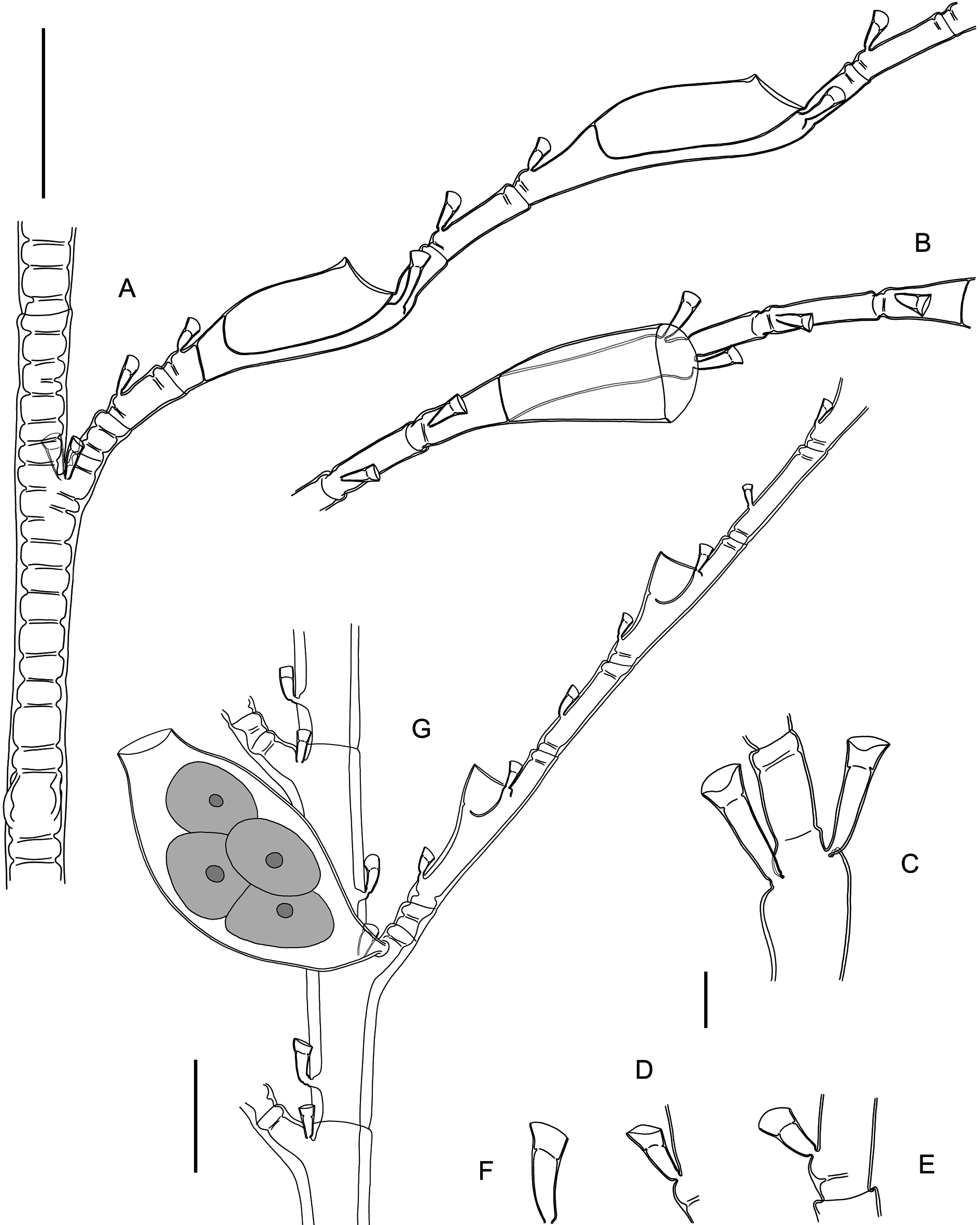
Fig. 8 G
Galea, Horia R., Maggioni, Davide (2020): Plumularioid hydroids (Cnidaria: Hydrozoa) from off New Caledonia collected during KANACONO and KANADEEP expeditions of the French Tropical Deep-Sea Benthos Program. European Journal of Taxonomy 708: 1-58, DOI: 10.5852/ejt.2020.708
Distribution Nearly cosmopolitan (Schuchert 2013), except for Arctic and Antarctic waters. According to Schuchert (2014), the taxon could be regarded as either a multitude of cryptic, geographically delimited lineages, or as a species with an extensive population subdivision.
Galea, Horia R., Maggioni, Davide (2020): Plumularioid hydroids (Cnidaria: Hydrozoa) from off New Caledonia collected during KANACONO and KANADEEP expeditions of the French Tropical Deep-Sea Benthos Program. European Journal of Taxonomy 708: 1-58, DOI: 10.5852/ejt.2020.708
Material examined PACIFIC OCEAN • 2 cormoids, ca 3.5 cm high, one of them with ♀ gonothecae; off New Caledonia, stn DW 4670; 22 ° 58 ′ S, 167 ° 24 ′ E; 680 – 612 m; 12 Aug. 2016; KANACONO leg.; MNHN-IK- 2015 - 594.
Galea, Horia R., Maggioni, Davide (2020): Plumularioid hydroids (Cnidaria: Hydrozoa) from off New Caledonia collected during KANACONO and KANADEEP expeditions of the French Tropical Deep-Sea Benthos Program. European Journal of Taxonomy 708: 1-58, DOI: 10.5852/ejt.2020.708
Export occurrence data
Darwin Core Archive (ZIP)
CLASSIFICATION
Taxonomic Classification Tree

MULTIMEDIA
Media Files(1)
Fig. 8. A–F. Plumularia conjuncta Billard, 1919, portion of branch with proximalmost part of a cladium seen laterally (A); portion of cladium in frontal view (B); insertion of lateral nematothecae, seen frontally (C); nematothecae: mesial (D), from cladial intersegment (E) and from axil of cladium (F); all from sample MNHN-IK-2015-590. — G. Plumularia setacea (Linnaeus, 1758), portion of stem, proximal part of a cladium and female gonotheca, from sample MNHN-IK-2015-594. Scale bars: A–B, G = 300 µm; C–F = 50 µm.
Imageimage/png© Galea, Horia R.;Maggioni, DavideGalea, Horia R.;Maggioni, Davide
IMAGES