
AnimaliaNot EvaluatedacceptedspeciesAccepted
Plumularia conjuncta
Billard, 1913
GBIF:167407470
0year
0
Synonyms
ABOUT
Descriptions(5)
Description Colony ca 30 cm high, detached from its substrate immediately above origin from hydrorhiza; flaccid, delicate, composed of lightly fascicled, slender, exceedingly elongate stem, composed of a few auxiliary tubes surrounding main tube that gives rise regularly to spirally-arranged, monosiphonic, up to 2 cm long hydrocladia-bearing branches, 0.35 – 0.55 mm distant from one another; main stem neither divided into internodes nor with internal partitions of perisarc, with row of frontal nematothecae, and short, inconspicuous apophyses supporting lateral branches. The latter arch graciously outwards and nearly horizontally; division into internodes inconspicuous, though incomplete transverse septa delimit segments composed of 1 – 2 apophyses for hydrocladia; nematotheca a certain distance above each apophysis on opposite side of internode; each internode with dense, annular, internal perisarcal ridges; apophyses alternate, shifted on to lower side of branches, resulting in cladia facing downwards and forming acute angle between two rows; mamelon and pair of nematothecae on each side of axil. Cladia sinusoid, up to 2.5 mm long, heteromerously divided into internodes by means of transverse nodes; proximally, 1 – 2 short internodes, first one athecate, second always bearing nematotheca; remainder of cladium composed of sequence of up to 3 hydrothecate internodes alternating with short, ahydrothecate internodes provided with proximally-placed nematotheca on their upper side; all internodes with two incomplete internal ridges near both ends; hydrothecate internode about thrice length of their ahydrothecate counterparts, with centrally-placed, deep, tubular, wholly adnate hydrotheca and its three associated nematothecae: one mesial, far below hydrothecal base, borne on small protuberance, and pair of laterals, not situated at same level, borne on indistinct apophyses; hydrothecal rim entire, circular in apical view, slightly scooped when seen in lateral view, aperture tilted abaxially; all nematothecae bithalamic, conical, with high basal chamber and relatively shallow upper chamber, whose rim is slightly lowered on adaxial side. Gonothecae unknown.
Galea, Horia R., Maggioni, Davide (2020): Plumularioid hydroids (Cnidaria: Hydrozoa) from off New Caledonia collected during KANACONO and KANADEEP expeditions of the French Tropical Deep-Sea Benthos Program. European Journal of Taxonomy 708: 1-58, DOI: 10.5852/ejt.2020.708
Figs 7, 8 A – F; Table 2
Galea, Horia R., Maggioni, Davide (2020): Plumularioid hydroids (Cnidaria: Hydrozoa) from off New Caledonia collected during KANACONO and KANADEEP expeditions of the French Tropical Deep-Sea Benthos Program. European Journal of Taxonomy 708: 1-58, DOI: 10.5852/ejt.2020.708
Remarks Considered as a variety of Plumularia insignis Allman, 1883 by Billard (1913), it was raised to species by Ansín Agís et al. (2016) upon the reexamination of Allman’s hydroid. Plumularia conjucta was exclusively known earlier from its holo- (a 5 mm long fragment) and schizoholotype (a 1.5 mm long fragment).
Galea, Horia R., Maggioni, Davide (2020): Plumularioid hydroids (Cnidaria: Hydrozoa) from off New Caledonia collected during KANACONO and KANADEEP expeditions of the French Tropical Deep-Sea Benthos Program. European Journal of Taxonomy 708: 1-58, DOI: 10.5852/ejt.2020.708
Distribution Sulu Sea (Billard 1913), Coral Sea off New Caledonia (present study).
Galea, Horia R., Maggioni, Davide (2020): Plumularioid hydroids (Cnidaria: Hydrozoa) from off New Caledonia collected during KANACONO and KANADEEP expeditions of the French Tropical Deep-Sea Benthos Program. European Journal of Taxonomy 708: 1-58, DOI: 10.5852/ejt.2020.708
Material examined PACIFIC OCEAN • 1 ca 30 cm high, sterile colony devoid of hydrorhiza; off New Caledonia, stn CP 5019; 21 ° 09 ′ S, 159 ° 11 ′ E; 400 – 640 m; 20 Sep. 2017; KANADEEP leg.; MNHN-IK- 2015 - 590.
Galea, Horia R., Maggioni, Davide (2020): Plumularioid hydroids (Cnidaria: Hydrozoa) from off New Caledonia collected during KANACONO and KANADEEP expeditions of the French Tropical Deep-Sea Benthos Program. European Journal of Taxonomy 708: 1-58, DOI: 10.5852/ejt.2020.708
Export occurrence data
Darwin Core Archive (ZIP)
CLASSIFICATION
Taxonomic Classification Tree

MULTIMEDIA
Media Files(2)
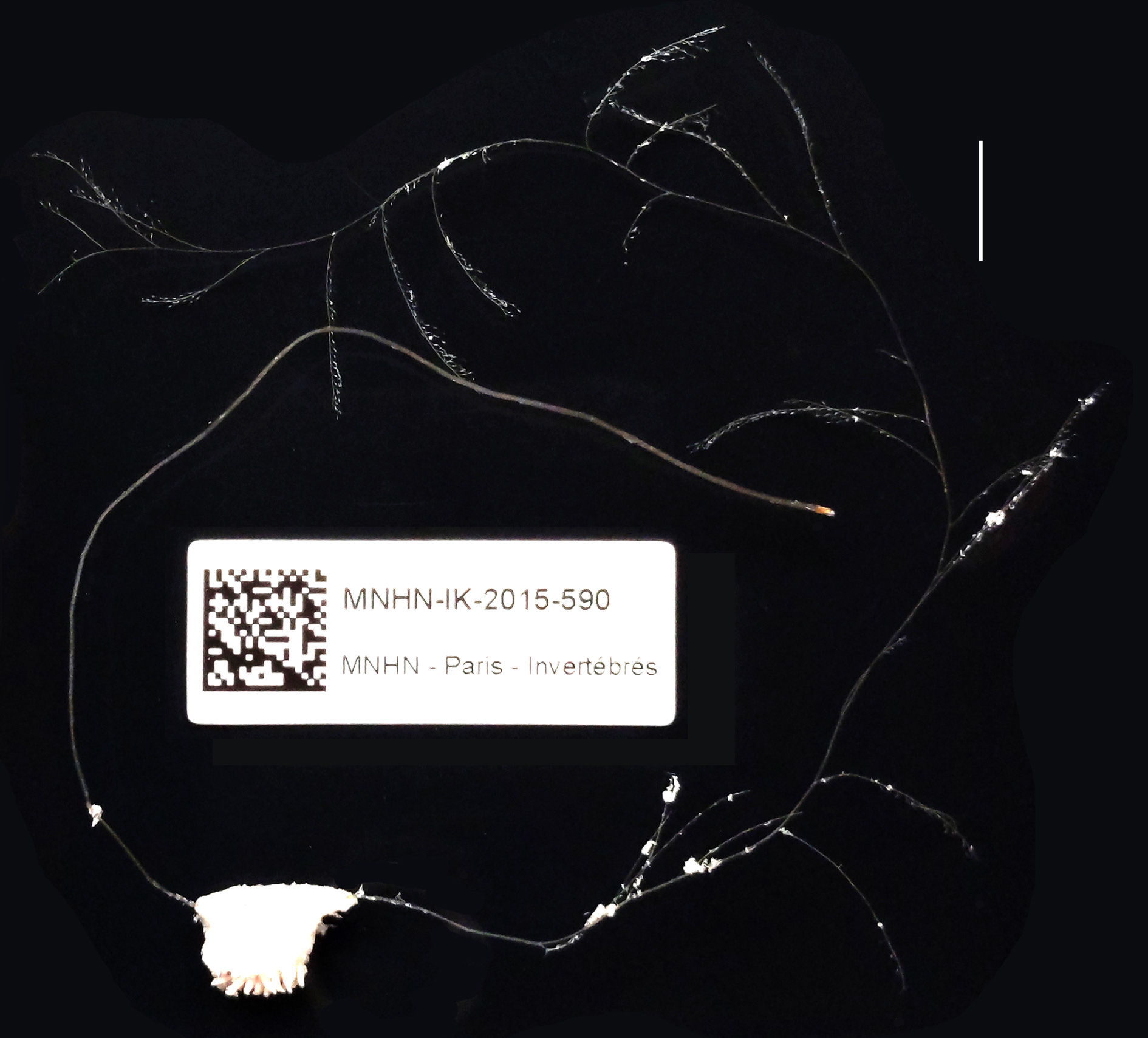
Fig. 7. Plumularia conjuncta Billard, 1919, colony, MNHN-IK-2015-590. Scale bar: 2 cm.
Imageimage/png© Galea, Horia R.;Maggioni, DavideGalea, Horia R.;Maggioni, Davide
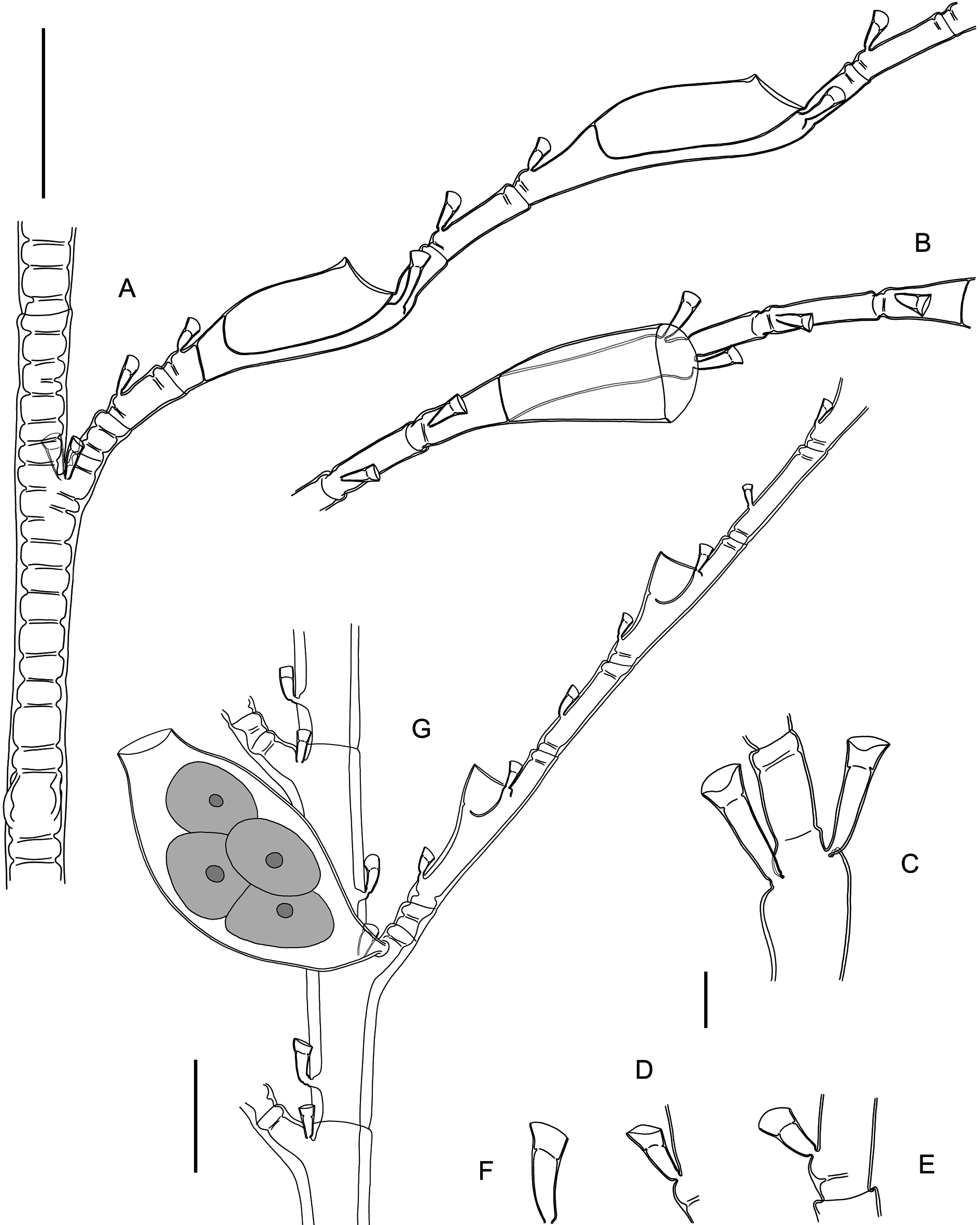
Fig. 8. A–F. Plumularia conjuncta Billard, 1919, portion of branch with proximalmost part of a cladium seen laterally (A); portion of cladium in frontal view (B); insertion of lateral nematothecae, seen frontally (C); nematothecae: mesial (D), from cladial intersegment (E) and from axil of cladium (F); all from sample MNHN-IK-2015-590. — G. Plumularia setacea (Linnaeus, 1758), portion of stem, proximal part of a cladium and female gonotheca, from sample MNHN-IK-2015-594. Scale bars: A–B, G = 300 µm; C–F = 50 µm.
Imageimage/png© Galea, Horia R.;Maggioni, DavideGalea, Horia R.;Maggioni, Davide
IMAGES