
AnimaliaNot EvaluatedacceptedspeciesAccepted
Dentitheca contraria
(Ansin Agis et al., 2014) Galea & Maggioni, 2020
GBIF:167407473
0year
0
Synonyms
ABOUT
Descriptions(4)
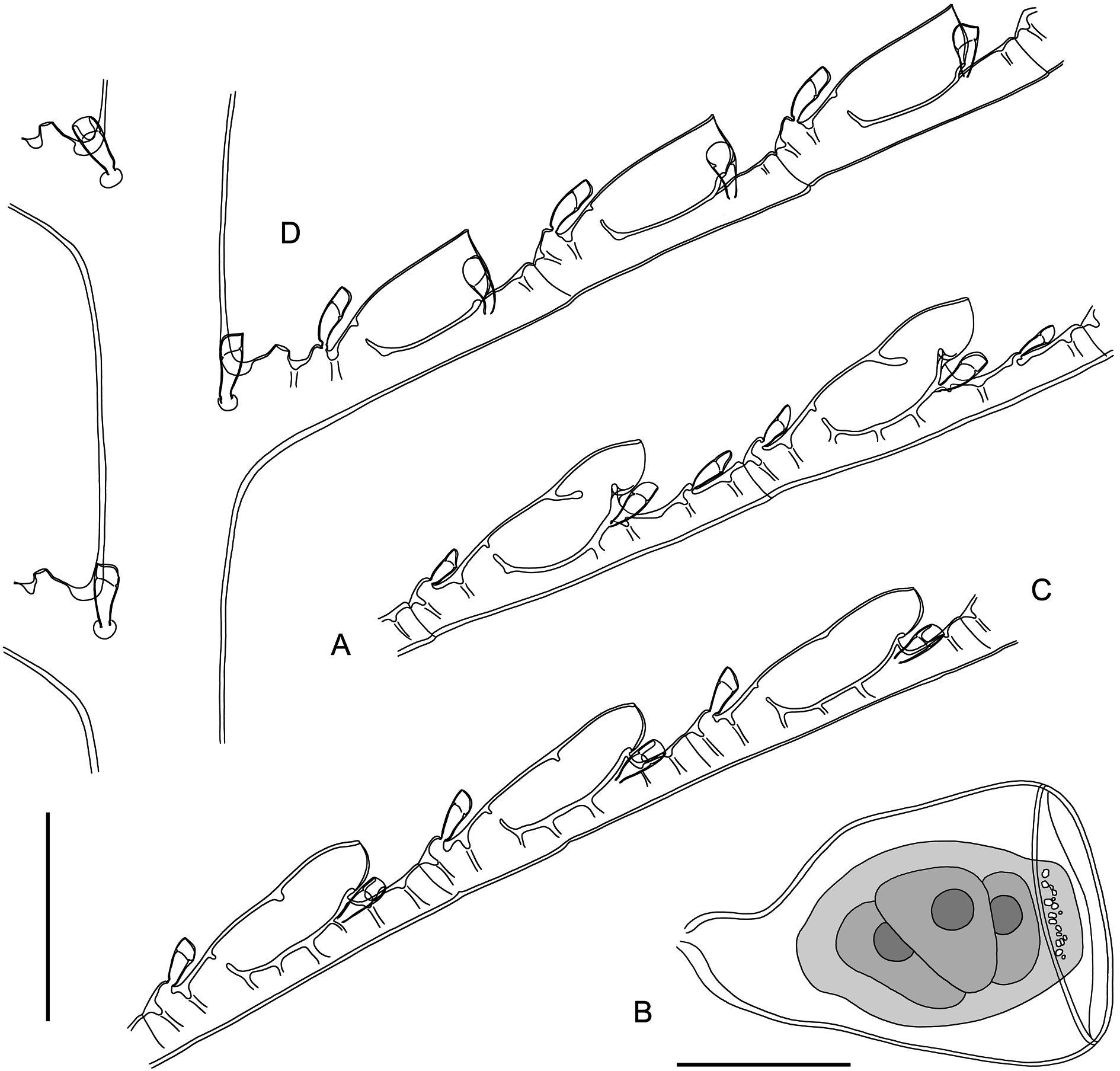
Fig. 6 A – B
Galea, Horia R., Maggioni, Davide (2020): Plumularioid hydroids (Cnidaria: Hydrozoa) from off New Caledonia collected during KANACONO and KANADEEP expeditions of the French Tropical Deep-Sea Benthos Program. European Journal of Taxonomy 708: 1-58, DOI: 10.5852/ejt.2020.708
Remarks For a comprehensive account on the trophosome of this species, refer to Ansín Agís et al. (2014). Gonothecae were not documented in the original account, but the material MNHN-IK- 2015 - 585 is a fertile colony. Its gonothecae are borne on the side branches in the axil formed by the cladial apophyses with their corresponding internodes; they are broadly piriform, with a truncate distal end that bears a wide, circular aperture closed by a filmy perisarc, possibly becoming a deciduous operculum that is lost upon the release of the gonophores. The latter are undoubtedly medusoids, as suggested by the presence of an apical belt of small, spherical, refringent corpuscles. Two or three large oocytes, occupying the whole subumbrellar cavity, are clearly discernible inside each gonophore (Fig. 6 B). The elongated hydrothecae, whose lateral walls produce two arched lobes flanking their apertures, the characteristic shape of the gonotheca, and the production of medusoid gonophores, suggest that this species is better assignable to the genus Dentitheca Stechow, 1919. For the same reasons as those listed above, additionally supported by molecular evidence (Moura et al. 2018), Plumularia elongata Billard, 1913 is equally assigned to Dentitheca, as D. elongata comb. nov. As noted by Ansín Agís et al. (2014), this species shows certain similarities with D. contraria comb. nov., notably the shape of its hydrothecae. However, Billard’s species forms planar colonies, while those of D. contraria comb. nov. have spirally-arranged cladia-bearing branches; additionally, the cladial internodes of the latter continue for a longer distance above the hydrotheca, and are provided there with an additional nematotheca, otherwise absent in D. elongata (compare Fig. 6 A and Fig. 6 C). Piriform gonothecae, very similar to those of D. contraria comb. nov., some of them reportedly containing a medusoid gonophore, are known for instance in D. alata (Bale, 1888) (Watson 1997: fig. 7 e; probable medusoid), D. asymmetrica (Bale, 1914) (Bale 1914: 30; medusoid), D. bidentata (Jäderholm, 1920) (Migotto & Marques 1999: figs 1 e, 3 b – d, 4; medusoid), D. dendritica (Nutting, 1900) (Galea et al. 2012: figs 1 c – m, 2 a – g; medusoid), D. elongata (Billard, 1913) (Di Camillo et al. 2010: figs 2 e, 3 d, as D. habereri), D. habereri (Stechow, 1909) (Inaba 1892: fig. 9, as Plumularia sp.; Stechow 1913: fig. 60; probably medusoid), and D. hertwigi (Stechow, 1907) (Stechow 1913: fig. T 1; Hirohito 1995: fig. 88 d – e; probably medusoid).
Galea, Horia R., Maggioni, Davide (2020): Plumularioid hydroids (Cnidaria: Hydrozoa) from off New Caledonia collected during KANACONO and KANADEEP expeditions of the French Tropical Deep-Sea Benthos Program. European Journal of Taxonomy 708: 1-58, DOI: 10.5852/ejt.2020.708
Distribution Scattered records form off New Caledonia (Ansín Agís et al. 2014; present study).
Galea, Horia R., Maggioni, Davide (2020): Plumularioid hydroids (Cnidaria: Hydrozoa) from off New Caledonia collected during KANACONO and KANADEEP expeditions of the French Tropical Deep-Sea Benthos Program. European Journal of Taxonomy 708: 1-58, DOI: 10.5852/ejt.2020.708
Material examined PACIFIC OCEAN • 1 ca 21 cm high, sterile colony, devoid of its hydrorhiza; off New Caledonia, stn DW 4742; 22 ° 53 ′ S, 167 ° 37 ′ E; 290 – 345 m; 23 Aug. 2016; KANACONO leg.; barcode identifier MT 655149; MNHN-IK- 2015 - 582 • 1 ca 14 cm high, sterile colony without hydrorhiza; off New Caledonia, stn DW 4745; 22 ° 57 ′ S, 167 ° 39 ′ E; 310 – 403 m; 23 Aug. 2016; KANACONO leg.; MNHN-IK- 2015 - 583 • 1 ca 20 cm high, sterile colony; off New Caledonia, stn DW 4741; 22 ° 52 ′ S, 167 ° 41 ′ E; 210 – 210 m; 23 Aug. 2016; KANACONO leg.; barcode identifier MT 655150; MNHN-IK- 2015 - 584 • a fully fertile colony of ca 19 cm in height; off New Caledonia, stn DW 4744; 22 ° 55 ′ S, 167 ° 37 ′ E; 310 – 290 m; 23 Aug. 2016; KANACONO leg.; barcode identifier MT 655151; MNHN-IK- 2015 - 585 • a 8.5 cm high, sterile colony; off New Caledonia, stn DW 4743; 22 ° 52 ′ S, 167 ° 34 ′ E; 380 – 340 m; 23 Aug. 2016; KANACONO leg.; MNHN-IK- 2015 - 592. Additional material BALI SEA • 3 sterile colonies of D. elongata, 8 – 11 cm high; Indonesia, NE Bali, near Amed, Japanese shipwreck; 8 ° 21 ′ 50.29 ″ S, 115 ° 42 ′ 1.61 ″ E; 5 – 15 m; 4 Oct. 2010; HRG- 1236. CELEBES SEA • 1 ca 9 cm high, fully-fertile colony fragment of Dentitheca elongata (Billard, 1913); Indonesia, Derawan Archipelago, off Sangalaki Island; 2 ° 05 ′ 21 ″ N, 118 ° 24 ′ 04 ″ E; 20 m; 23 Apr. 2010; HRG- 0132.
Galea, Horia R., Maggioni, Davide (2020): Plumularioid hydroids (Cnidaria: Hydrozoa) from off New Caledonia collected during KANACONO and KANADEEP expeditions of the French Tropical Deep-Sea Benthos Program. European Journal of Taxonomy 708: 1-58, DOI: 10.5852/ejt.2020.708
Export occurrence data
Darwin Core Archive (ZIP)
CLASSIFICATION
Taxonomic Classification Tree

NOMENCLATURE
Synonyms(1)
MULTIMEDIA
Media Files(1)
Fig. 6. A–B. Dentitheca contraria (AnsínAgís et al., 2014), portion of cladium (A) from sample MNHN- IK-2015-582, and comparison with its counterpart of Dentitheca elongata (Billard, 1913), sample HRG- 1236 (C); gonotheca with female medusoid (B), from sample MNHN-IK-2015-585. — D. Dentitheca habereri (Stechow, 1909), portion of monosiphonic stem with three cladial apophyses and proximalmost part of a cladium, from sample MNHN-IK-2015-573. Scale bars: A, C–D = 300 µm; B = 200 µm.
Imageimage/png© Galea, Horia R.;Maggioni, DavideGalea, Horia R.;Maggioni, Davide
IMAGES