
AnimaliaNot EvaluatedacceptedspeciesAccepted
Anthothela echinata

Anthothela echinata

(Kukenthal, 1915) Watling, 2020

GBIF:170532487

0year

0

Synonyms

ABOUT

Descriptions(5)

(Figs. 1 – 4)
Watling, Les (2020): Toward a revision of the bamboo corals: Part 1, species in the Muricellisidinae (Octocorallia: Isididae). Zootaxa 4881 (2): 361-371, DOI: 10.11646/zootaxa.4881.2.9
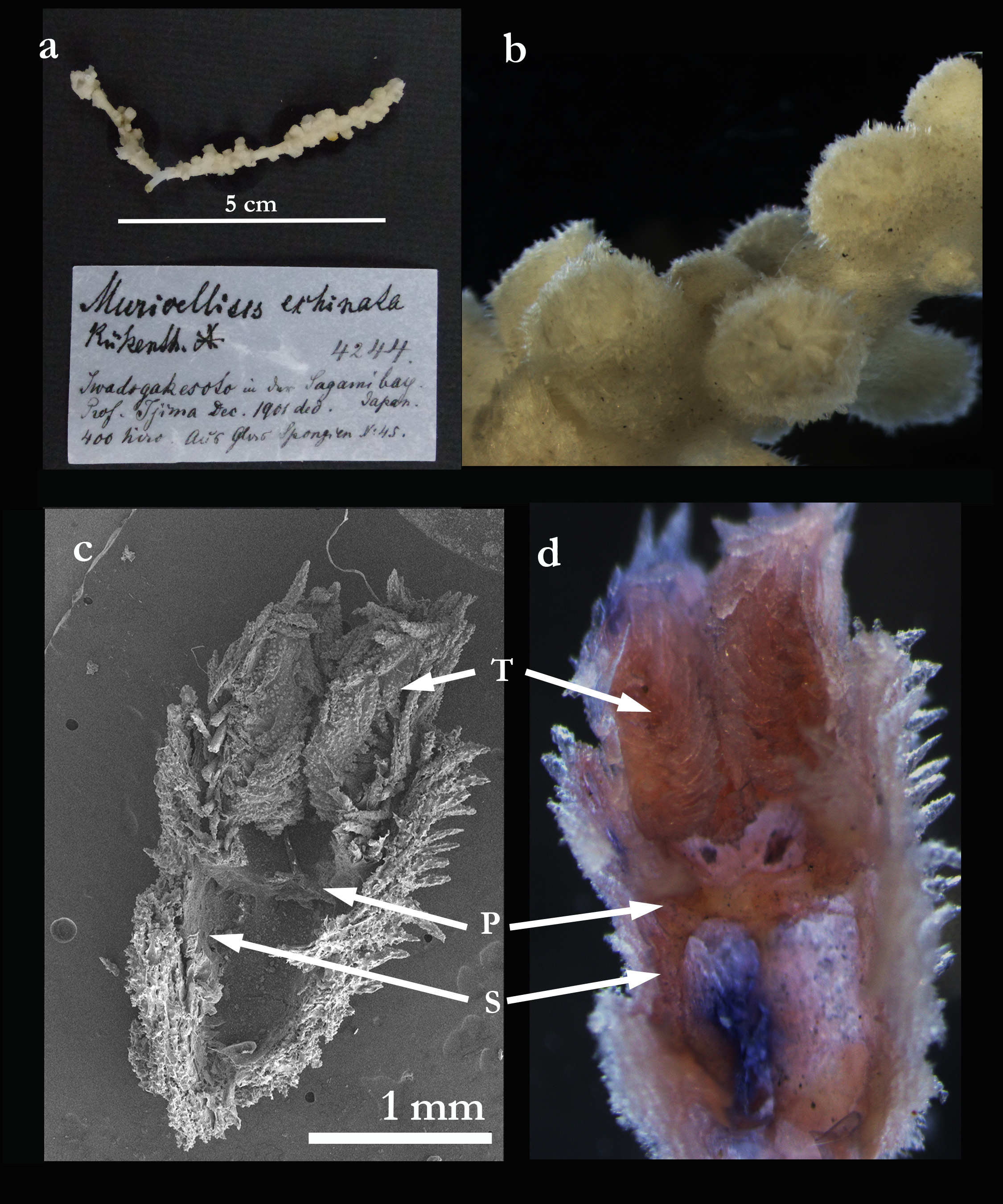
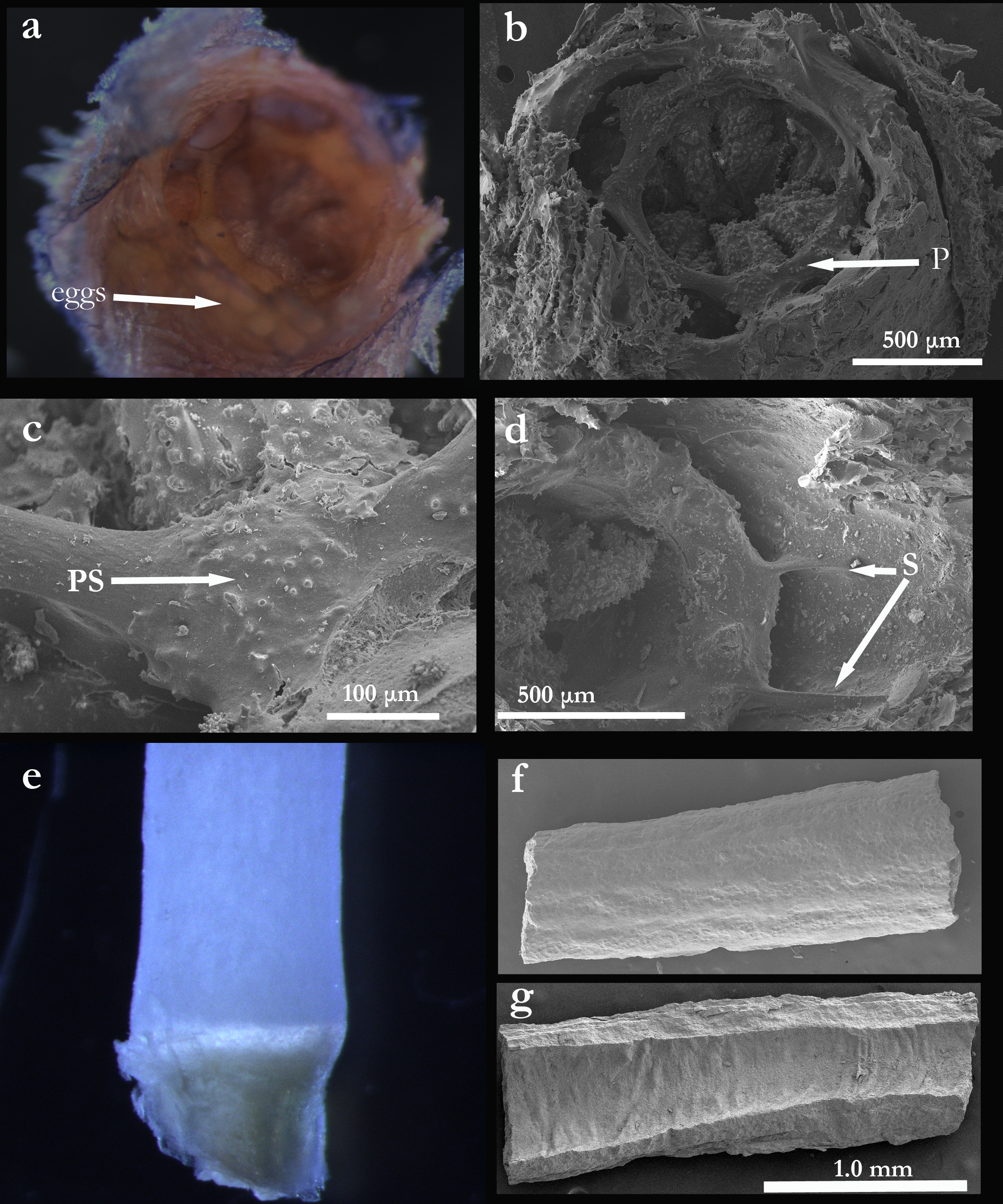
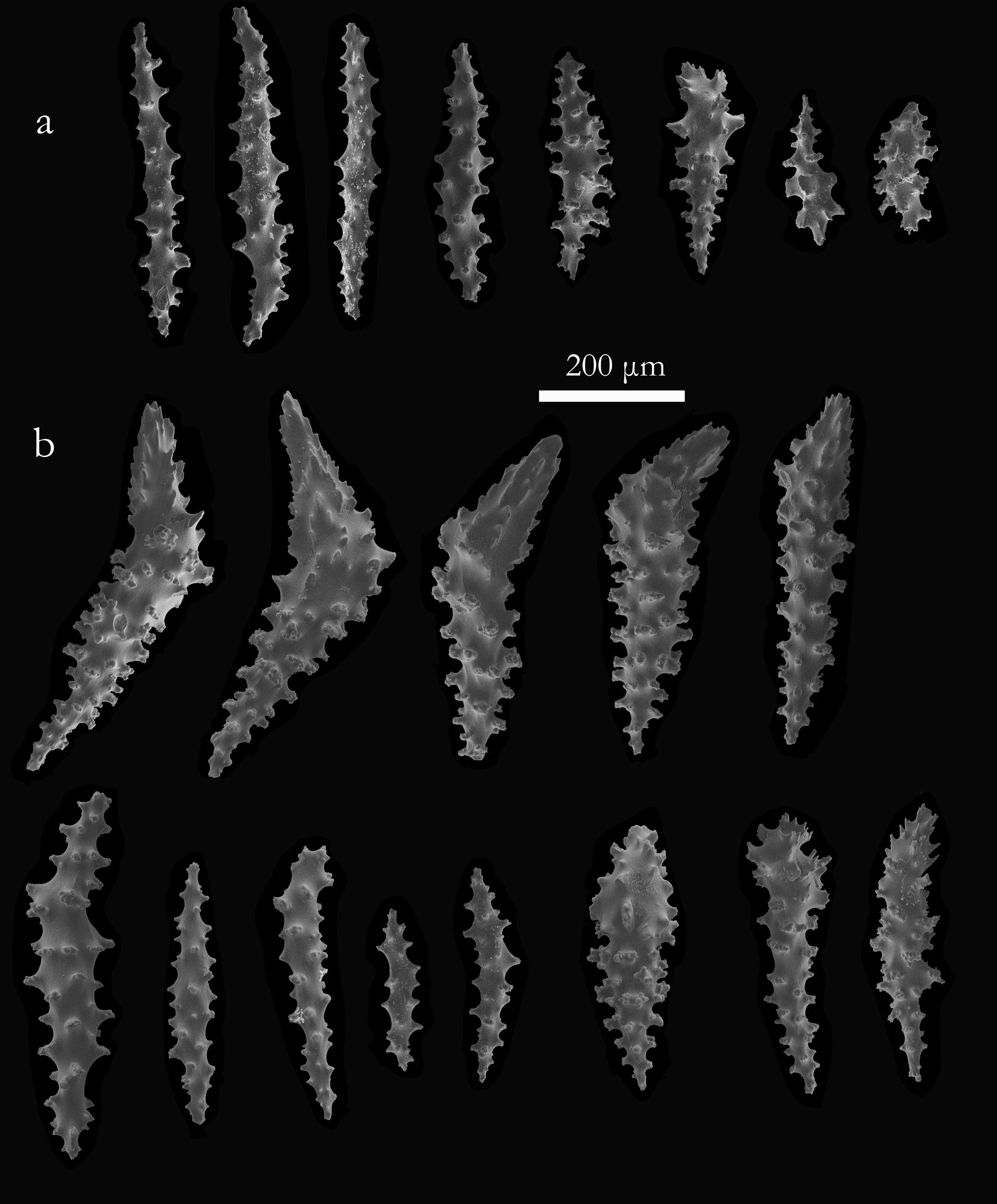
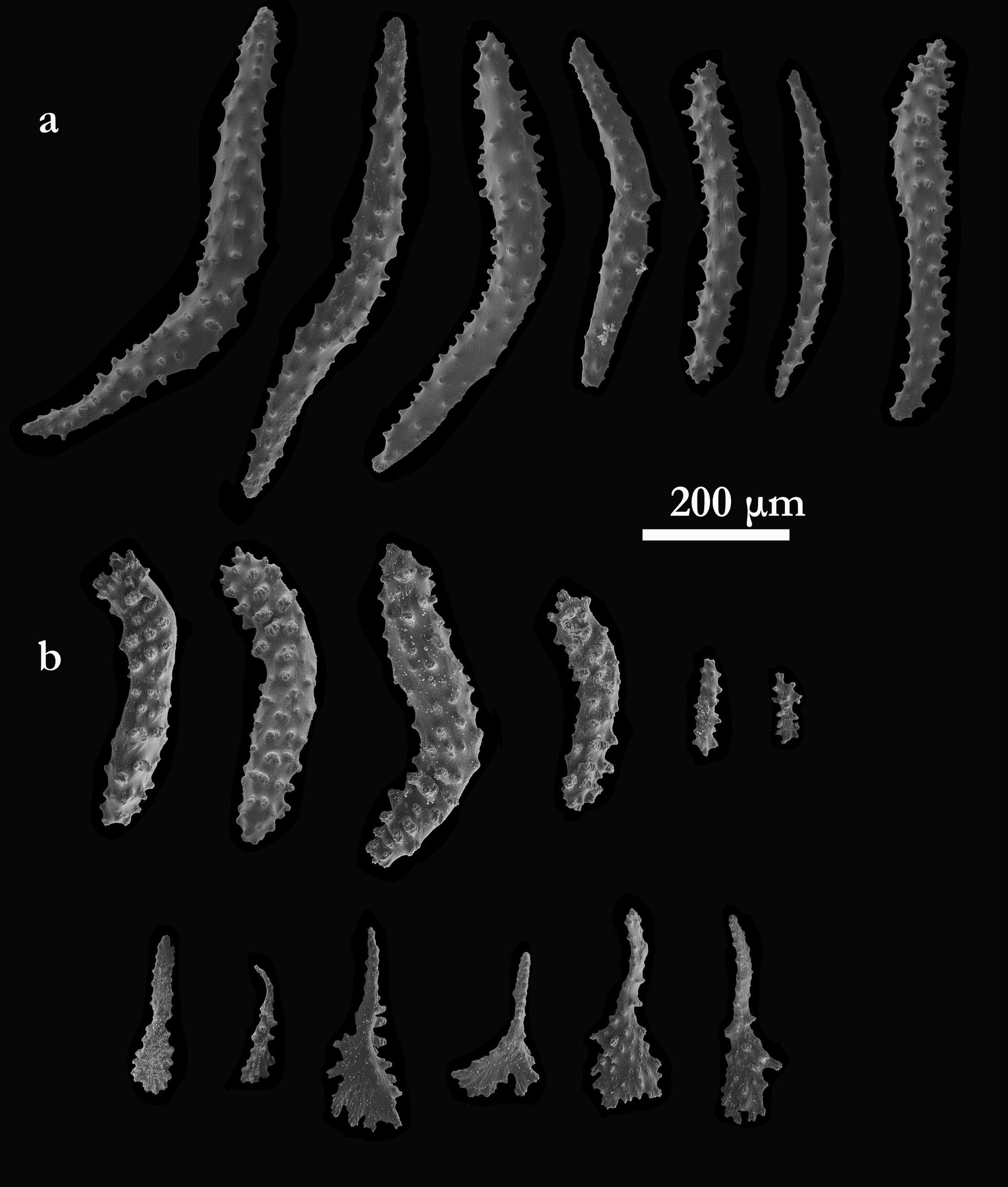
Description. The type consists of three fragments totaling 11 cm according to Kükenthal (1919). The following description applies to an 8 cm piece loaned from the Museum für Naturkunde (Fig. 1 a). The colony is membranaceous, overgrowing a piece of axis from a keratoisid bamboo coral (Fig. 2 e – g). Polyp calyces are very closely arranged with little coenenchyme space between them (Fig. 1 b). The polyps are cylindrical, short, and mostly invaginated within the calyx, with the tentacles folded into the polyp (Fig. 1 c, d). The polyp does not appear to have a typical cylindrical pharynx, rather there is a thick ring of tissue (“ pharyngeal ring ”) attached at the proximal end of the polyp as it invaginates into the calyx (Fig 1 c, d, P). A few sclerites are visible under the tissue on the proximal (ventral) side of the pharyngeal ring (Fig. 2 b, c). Short septa (S) extend proximally to the calyx wall from the pharyngeal ring and seem to spread across the interior of the calyx (Fig. 1 c, d, Fig. 2 d). In one case, eggs appear to be present along the inner calyx wall (Fig. 2 a). The sclerites of the coenenchyme consists of sticks and small clubs (Fig. 3 a). Most of the calyx sclerites are small clubs and thorn clubs of various sizes (Fig. 3 b). The polyp sclerites are spindles in a collaret (?) and points arrangement. Flattened tuberculate rods are common on the tentacle rachis and small rods and spatulate clubs are found in the pinnules.
Watling, Les (2020): Toward a revision of the bamboo corals: Part 1, species in the Muricellisidinae (Octocorallia: Isididae). Zootaxa 4881 (2): 361-371, DOI: 10.11646/zootaxa.4881.2.9
Diagnosis. Colony membranaceous. Polyp cylindrical, often exsert or invaginated into calyx, crowded together with little coenenchyme space. Coenenchyme and calyx sclerites clubs, thorn-clubs, sticks and spindles; polyp sclerites sticks and spindles arranged as collaret and points. Tentacle sclerites short, flat tuberculate rods along the rachis with spatulate clubs in the pinnules. Pharyngeal sclerites not known.
Watling, Les (2020): Toward a revision of the bamboo corals: Part 1, species in the Muricellisidinae (Octocorallia: Isididae). Zootaxa 4881 (2): 361-371, DOI: 10.11646/zootaxa.4881.2.9
Remarks. Kükenthal (1915, 1919) created the new genus Muricellisis for this species and added it to the Family Isididae as a new subfamily Muricellisidinae due to the presence of a calcareous axis with nodes and internodes underlying the polyps and coenenchyme. However, the curious form of the polyps and the spiny and tuberculate sclerites were unlike anything seen in the Isididae to that time. Kükenthal noted that had the calcareous axis not been present, he would have thought this species to be similar to Muriceides. The sclerites of this species, in particular the thorn-clubs of the calyx wall and spatulate clubs in the pinnules, suggests that the species belongs to the Anthothelidae. In addition, the documentation by Moore et al. (2017) that some members of the genus Anthothela could exist as membranous colonies with no axis cortex and medulla, hinted at the possibility that the keratoisidid axis present here could merely be a substrate on which the colony was growing. In fact, the form of the axis is definitely keratoisid-like, but also seems to be considerably degraded (images not shown). However, there are no members of the Keratoisidinae that have sclerites in the form possessed by this species. The most parsimonious explanation for the disparity between the form of the axis and the nature of the polyps and sclerites is that the octocoral and the axis on which it is growing do not belong to the same species. From the review of the Anthothelidae by Moore et al. (2017), there does not seem to be any known species in the genus Anthothela to which this species could belong. Several species have colonies with fully formed axes but as well are membranous growing on some unrelated substrate such as sponge spicules. Of the seven species of Anthothela, three have thorn clubs: in A. vickersi the thorn clubs are mostly rounded at the tips; those of A. aldersladei and A. tropicalis are most like those seen here in A. echinata. As with A. aldersladei, the thorn clubs are shorter (0.4 – 0.55 mm) than in A. tropicalis (0.33 – 0.78 mm). The calyces in A. aldersladei, however, are much taller than in A. echinata (1.5 – 2.5 mm in height vs. 1 – 1.5 mm, and 2 – 2.5 mm in width vs. 1.5 – 2 mm). Hockey stick sclerites were not observed in the few calyces and polyps of A. echinata that were examined. Their absence would further distinguish these two species.
Watling, Les (2020): Toward a revision of the bamboo corals: Part 1, species in the Muricellisidinae (Octocorallia: Isididae). Zootaxa 4881 (2): 361-371, DOI: 10.11646/zootaxa.4881.2.9
Type specimen. Museum für Naturkunde, Berlin, Germany Type locality. Sagami Bay, 730 m.
Watling, Les (2020): Toward a revision of the bamboo corals: Part 1, species in the Muricellisidinae (Octocorallia: Isididae). Zootaxa 4881 (2): 361-371, DOI: 10.11646/zootaxa.4881.2.9

Export occurrence data

Darwin Core Archive (ZIP)

CLASSIFICATION

Taxonomic Classification Tree

MULTIMEDIA

Media Files(4)

FIGURE 1. Anthothela echinata: a, piece of the holotype with original specimen label; b, several polyps on the distal part of the longer branch; c, SEM view of sagittal section of polyp including calyx (T, infolded tentacle, P, pharyngeal ring, S, septum); d, light microscopy view of sagittal section of polyp and calyx.
Imageimage/png© Watling, LesWatling, Les

FIGURE 2. Anthothela echinata: a, light microscopy view of polyp from below toward pharyngeal ring showing “eggs” on the inner wall of the calyx; b, same, view from SEM showing pharyngeal ring (P), within which are the tips of the infolded tentacles; c, higher magnification SEM view of the ventral surface of the pharyngeal ring with apparent sclerite (PS) covered with tissue; d, SEM view of septa (S) extending from the pharyngeal ring to the inner wall of the calyx; e, light microscope view of the calcareous internode and organic node of the axis on which the coral was growing; f, SEM view of the outer surface of the calcareous internode; g, SEM view of the inner surface of the calcareous internode.
Imageimage/png© Watling, LesWatling, Les

FIGURE 3. Anthothela echinata: a, sclerites from the coenenchyme; b, sclerites from the calyx.

Imageimage/png© Watling, LesWatling, Les

FIGURE 4. Anthothela echinata: a, sclerites of the polyp head collaret (left) and points (right); b, sclerites of the tentacles, lower row spatulate clubs from the pinnules.

Imageimage/png© Watling, LesWatling, Les

IMAGES

Gallery(4)

See Gallery

Occurrences with images

Source Information

Toward a revision of the bamboo corals: Part 1, species in the Muricellisidinae (Octocorallia: Isididae)

checklist

This dataset contains the digitized treatments in Plazi based on the original journal article Watling, Les (2020): Toward a revision of the bamboo corals: Part 1, species in the Muricellisidinae (Octocorallia: Isididae). Zootaxa 4881 (2): 361-371, DOI: 10.11646/zootaxa.4881.2.9

Abstract

The subfamily Muricellisidinae was erected by Kükenthal in 1915 and placed in the family Isididae in order to accommodate an unusual species collected in Sagami Bay, Japan. In 1931, Thomson and Dean added a second species collected in Indonesia during the Siboga Expedition. The holotypes of both species have been re-examined. Muricellisis echinata was found to be an anthothelid living on the axis of a keratoisid bamboo coral and M. cervicornis is a melithaeid. Both species are redescribed.

Key words: Muricellisis, Isididae, Sagami Bay, Siboga Expedition, Melithaeidae, Anthothelidae

Watling L, plazi (2020). Toward a revision of the bamboo corals: Part 1, species in the Muricellisidinae (Octocorallia: Isididae). Plazi.org taxonomic treatments database. Checklist dataset https://doi.org/10.11646/zootaxa.4881.2.9 accessed via GBIF.org on 2026-06-17.

CC0Published 11/19/2020View dataset
GBIF Usage Key
170532487
Dataset Key
96ee279e-6611-4b0e-9fd4-23ca3e63ecb7
Origin
source
Backbone Key
10844484
Taxon ID
03C087E4FFFD4D5EFF39F924FE7DDDA9.taxon
Last Crawled
6/10/2026
Last Interpreted
6/10/2026