
AnimaliaNot EvaluatedacceptedspeciesAccepted
Lophopodella stuhlmanni
Kraepelin, 1914
GBIF:176569448
0year
ABOUT
Descriptions(5)
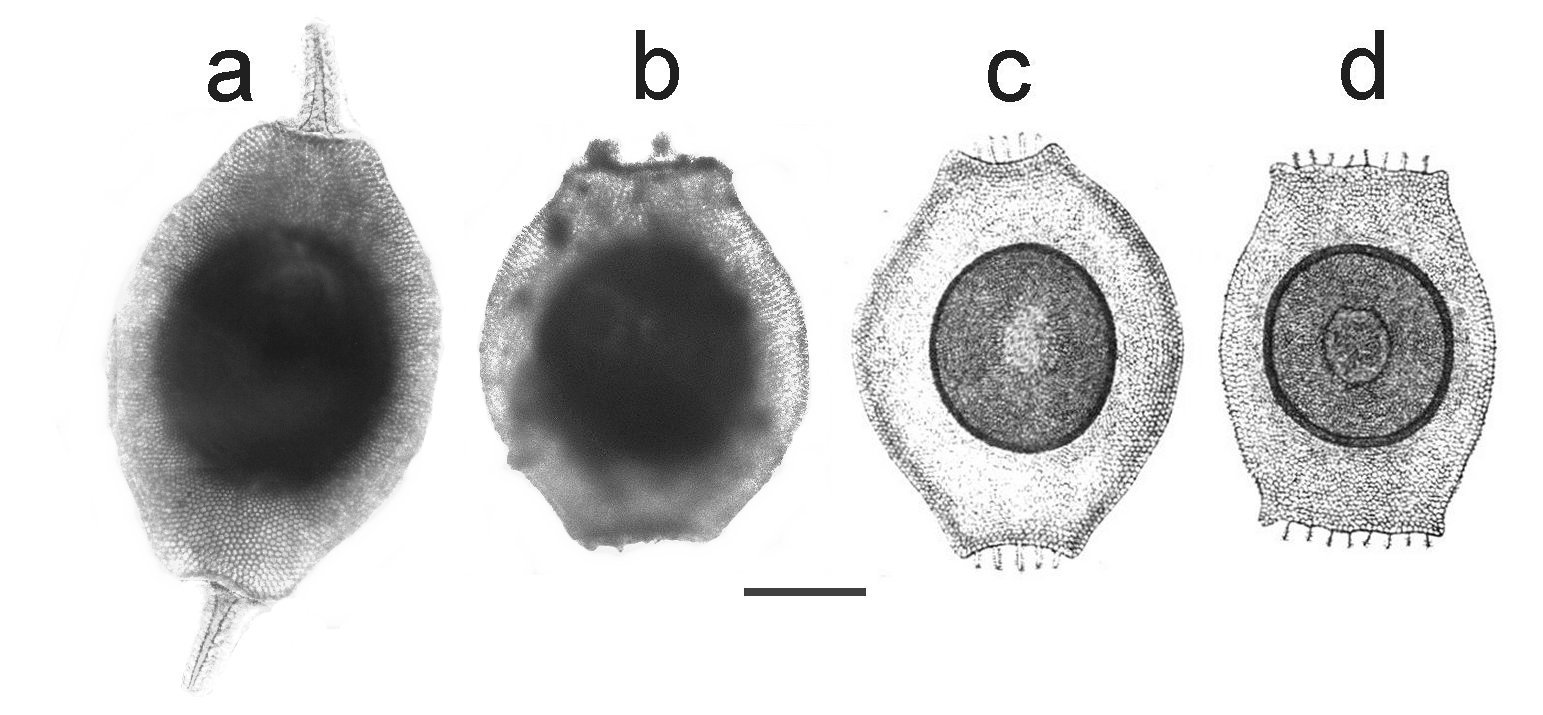
(Fig. 1 b)
Wood, Timothy S. (2020): Review of freshwater Bryozoa (Phylactolaemata) of Central Africa with descriptions of two new species. Zootaxa 4820 (3): 581-600, DOI: 10.11646/zootaxa.4820.3.11
Description. The MRAC specimen is contracted into a tight wad and could not be examined without causing tissue damage. There was a single statoblast. This species is distinguished by statoblasts in which the two poles each present a broad, straight margin with 7 – 8 spines bearing many minute hooks. As clearly illustrated by Kraepelin 1914, the wide, straight, polar truncation in L. stuhlmanni (Fig. 1 c) contrasts with the narrow, concave polar truncation of L. thomasi Rousselet, 1904 (Fig. 1 d), also from southern Africa.
Wood, Timothy S. (2020): Review of freshwater Bryozoa (Phylactolaemata) of Central Africa with descriptions of two new species. Zootaxa 4820 (3): 581-600, DOI: 10.11646/zootaxa.4820.3.11
Remarks. The status of L. stuhlmanni is in dispute, and the MRAC specimen exemplifies the reason. The single statoblast appears more similar to L. thomasi than L. stuhlmann i (Fig. 1 b). The truncated ends are narrow, and there is even a hint of concavity in the distal margins. This raises the possibility that the poles of L. thomasi statoblasts exhibit a range of morphology that accommodates Kraepelin’s L. stuhlmanni, and that the two species are actually one. Toriumi (1974) dismissed L. stuhlmanni altogether as a valid species after showing that the statoblast morphology described by Kraepelin (1914) fell within the range of variation for L. carteri (Hyatt, 1866) in Japan. These issues could be easily resolved with genetic analysis of fresh material.
Wood, Timothy S. (2020): Review of freshwater Bryozoa (Phylactolaemata) of Central Africa with descriptions of two new species. Zootaxa 4820 (3): 581-600, DOI: 10.11646/zootaxa.4820.3.11
Distribution. The species is known only from the type locality in northwestern Tanzania.
Wood, Timothy S. (2020): Review of freshwater Bryozoa (Phylactolaemata) of Central Africa with descriptions of two new species. Zootaxa 4820 (3): 581-600, DOI: 10.11646/zootaxa.4820.3.11
Material examined. No. 202 (labeled “ paratype ”) collected in northwestern Tanzania at Bibisande, by Stuhlmann. “ Bibisande ” does not appear on any modern maps, but the site is associated with a number of plant and animal species collected by Stuhlmann. According to Karanovic (2012) it is in Tanzania, 135 km south of Lake Victoria and 30 km SSW of Kahama, with coordinates 04 ° 09 ’ S, 32 ° 43 ’ E.
Wood, Timothy S. (2020): Review of freshwater Bryozoa (Phylactolaemata) of Central Africa with descriptions of two new species. Zootaxa 4820 (3): 581-600, DOI: 10.11646/zootaxa.4820.3.11
Export occurrence data
Darwin Core Archive (ZIP)
CLASSIFICATION
Taxonomic Classification Tree

MULTIMEDIA
Media Files(1)
FIGURE 1. Lophopodella statoblasts from the MRAC collection and from illustrations by Kraepelin (1914). (a) Specimen No. 201, Lophopodella capensis var. michaelseni; (b) Specimen No. 202, L. stuhlmanni with broad polar truncation; (c) L. thomasi with narrow polar truncation; (d) L. stuhlmanni (fig. 1c, d from Kraepelin, 1914). Scale bar for all statoblasts = 200 μm.
Imageimage/png© Wood, Timothy S.Wood, Timothy S.
IMAGES