
AnimaliaacceptedvarietyAccepted
Lophopodella capensis michaelseni
Kraepelin, 1914
GBIF:176569449
0year
ABOUT
Descriptions(4)
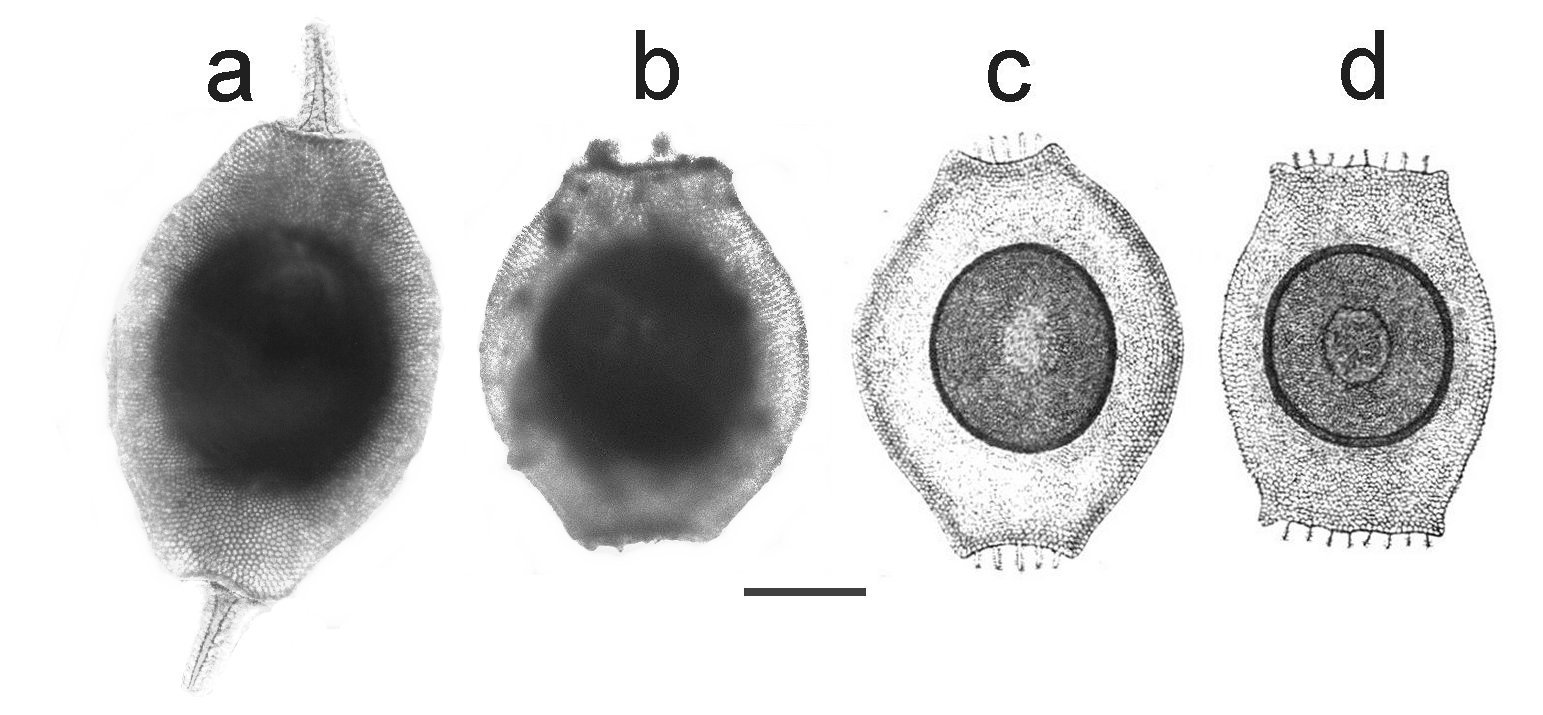
(Fig. 1 a)
Wood, Timothy S. (2020): Review of freshwater Bryozoa (Phylactolaemata) of Central Africa with descriptions of two new species. Zootaxa 4820 (3): 581-600, DOI: 10.11646/zootaxa.4820.3.11
Description. In life, Lophopodella capensis has a gelatinous, nontubular colony up to 20 mm in diameter. In typical lophopodid fashion, the zooids originate by budding at the outer periphery and gradually migrate towards the center. In this species the statoblast is distinguished by a prominent spine extending from each end and bearing minute hooks (Fig. 1 a). Unfortunately, the MRAC specimen was contracted into a tight mass and could not be examined without damaging the tissues. There are no more than two statoblasts.
Wood, Timothy S. (2020): Review of freshwater Bryozoa (Phylactolaemata) of Central Africa with descriptions of two new species. Zootaxa 4820 (3): 581-600, DOI: 10.11646/zootaxa.4820.3.11
Remarks. Kraepelin (1914) believed the michaelseni variety was warranted by details of the statoblast: a larger number of hooks on the spine, a slight truncation at the poles, and a broader, more rounded shape of the capsule. While these features are confirmed in the MRAC material (Fig. 1 a), Hastings (1929) considered them to be well within the normal range of variation for this species. New material and genetic analysis should easily resolve this issue. The type locality for L. capensis is Florida Lake in South Africa, a 24 ha water body that is now part of the city park system of Johannesburg.
Wood, Timothy S. (2020): Review of freshwater Bryozoa (Phylactolaemata) of Central Africa with descriptions of two new species. Zootaxa 4820 (3): 581-600, DOI: 10.11646/zootaxa.4820.3.11
Material examined. No. 201 (labeled “ paratype ”) collected in Namibia at a plateau lake in the Khomas Region near Neudamm, about 42 km northeast of Windhoek. The specimen is a gift from the Zoologische Museum in Hamburg.
Wood, Timothy S. (2020): Review of freshwater Bryozoa (Phylactolaemata) of Central Africa with descriptions of two new species. Zootaxa 4820 (3): 581-600, DOI: 10.11646/zootaxa.4820.3.11
Export occurrence data
Darwin Core Archive (ZIP)
CLASSIFICATION
Taxonomic Classification Tree

MULTIMEDIA
Media Files(1)
FIGURE 1. Lophopodella statoblasts from the MRAC collection and from illustrations by Kraepelin (1914). (a) Specimen No. 201, Lophopodella capensis var. michaelseni; (b) Specimen No. 202, L. stuhlmanni with broad polar truncation; (c) L. thomasi with narrow polar truncation; (d) L. stuhlmanni (fig. 1c, d from Kraepelin, 1914). Scale bar for all statoblasts = 200 μm.
Imageimage/png© Wood, Timothy S.Wood, Timothy S.
IMAGES