
AnimaliaNot EvaluatedacceptedspeciesAccepted
Plumatella philippinensis
Kraepelin, 1887
GBIF:176569458
0year
ABOUT
Descriptions(4)
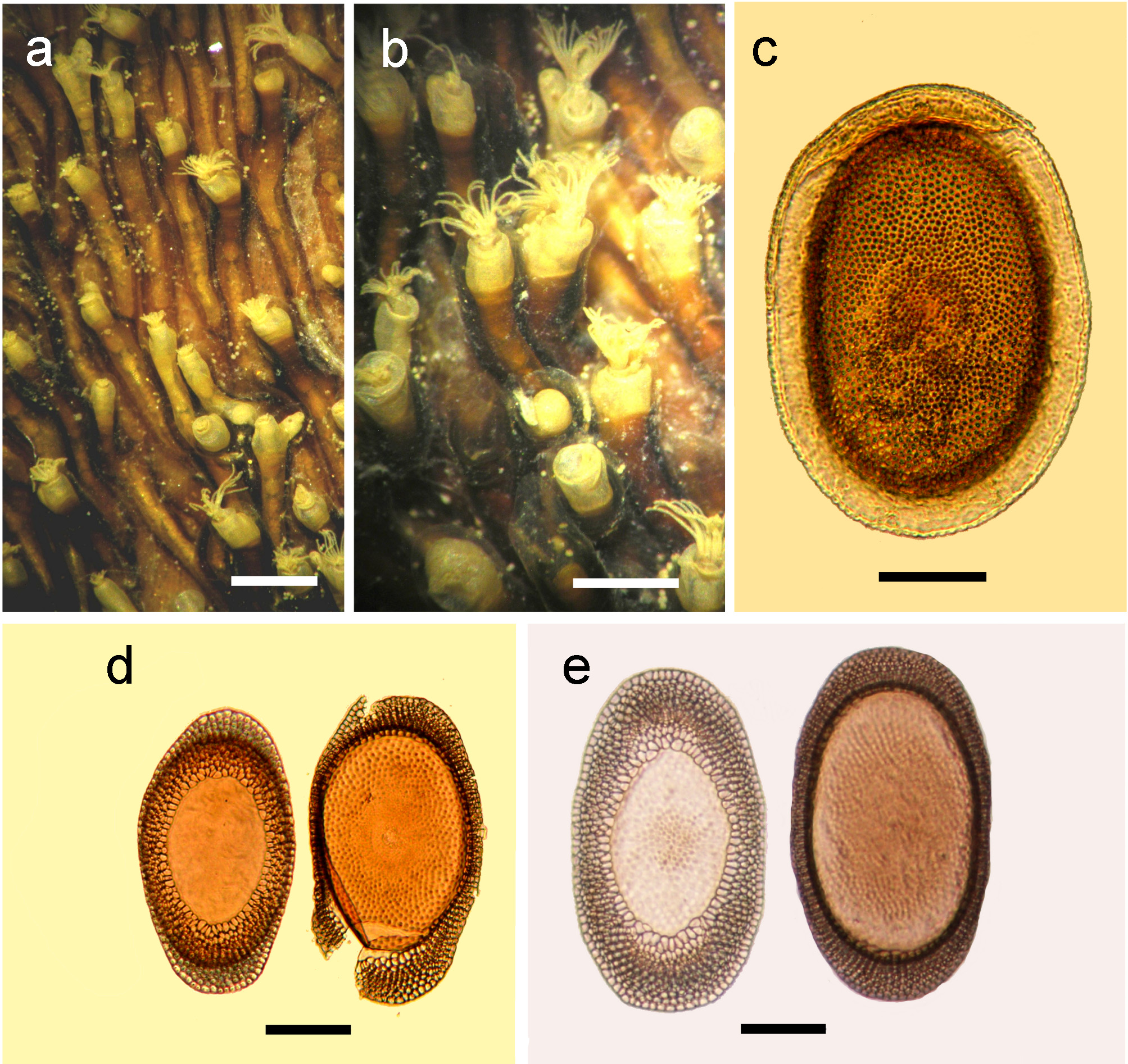
(Fig. 7 a – e)
Wood, Timothy S. (2020): Review of freshwater Bryozoa (Phylactolaemata) of Central Africa with descriptions of two new species. Zootaxa 4820 (3): 581-600, DOI: 10.11646/zootaxa.4820.3.11
Description. The colony ectocyst is clear but heavily sclerotized and dark brown in color (Fig. 7 a – c), with frequent internal thickenings (“ septa ”). An abrupt color change in each zooid shows precisely the transition of the ectocyst from a tough outer covering to a thin membrane (Fig. 7 b). Colonies are remarkably flat with not even the zooid tips raised from the substratum, a feature that Wiebach (1970) found very distinctive. Under crowded conditions, zooecial tubes tend to grow in parallel. Floatoblasts are similar to those of the holotype, except overall they are about 18 % smaller (Fig. 7 d, e). Floatoblast dimensions are shown in Table 3. The sessoblast bears a relatively wide annulus with a thickened, crenulated margin (Fig. 7 e). Dimensions of a single sessoblast not including annulus: length = 500 μm, width = 283 μm. Small tubercles on the frontal valves are typical of most plumatellids.
Wood, Timothy S. (2020): Review of freshwater Bryozoa (Phylactolaemata) of Central Africa with descriptions of two new species. Zootaxa 4820 (3): 581-600, DOI: 10.11646/zootaxa.4820.3.11
Remarks. Both specimens at the MRAC are in excellent condition. A few floatoblasts and sessoblasts are present. The sessoblast of this species, missing in the holotype, is described here for the first time. The small floatoblast size relative to the holotype is striking but possibly the result of environmental factors. The similarity in colony and floatoblast morphology leave little doubt that the MRAC specimens are P. philippinensis. Wiebach correctly identified the MRAC specimens, but placed them in the genus Afrindella, a taxon erected by Annandale & Kemp (1912) as a subgenus of Plumatella. Afrindella is based on the perception that when a strong ectocyst is present a distal portion of the ectocyst folds over the retracted zooid, thus rendering an extra measure of protection. Plumatella philippinensis and Rousselet’s Plumatella tanganyikae were both proposed as candidates for the subgeneric designation. Future genetic profiling may yet prove the Afrindella label to be warranted. Until then, however, I prefer retaining these species within the genus Plumatella.
Wood, Timothy S. (2020): Review of freshwater Bryozoa (Phylactolaemata) of Central Africa with descriptions of two new species. Zootaxa 4820 (3): 581-600, DOI: 10.11646/zootaxa.4820.3.11
Distribution. Equatorial on three continents: Asia, Africa, and (tentatively) South America.
Wood, Timothy S. (2020): Review of freshwater Bryozoa (Phylactolaemata) of Central Africa with descriptions of two new species. Zootaxa 4820 (3): 581-600, DOI: 10.11646/zootaxa.4820.3.11
Export occurrence data
Darwin Core Archive (ZIP)
CLASSIFICATION
Taxonomic Classification Tree

MULTIMEDIA
Media Files(1)
FIGURE 7. Plumatella philippinensis, Specimen No. 440. (a) Colony showing parallel zooecial tubes, scale bar = 2 mm; (b) colony showing zooid detail, scale bar = 1 mm; (c) sessoblast frontal valve, scale bar = 100 μm; (d) floatoblast valves with dorsal valve on the left, scale bar = 100 μm; (e) floatoblast valves of holotype shown for size comparison, scale bar = 100 μm.
Imageimage/png© Wood, Timothy S.Wood, Timothy S.
IMAGES