
AnimaliaNot EvaluatedacceptedspeciesAccepted
Plumatella marlieri
Wiebach, 1970
GBIF:176569460
0year
ABOUT
Descriptions(5)
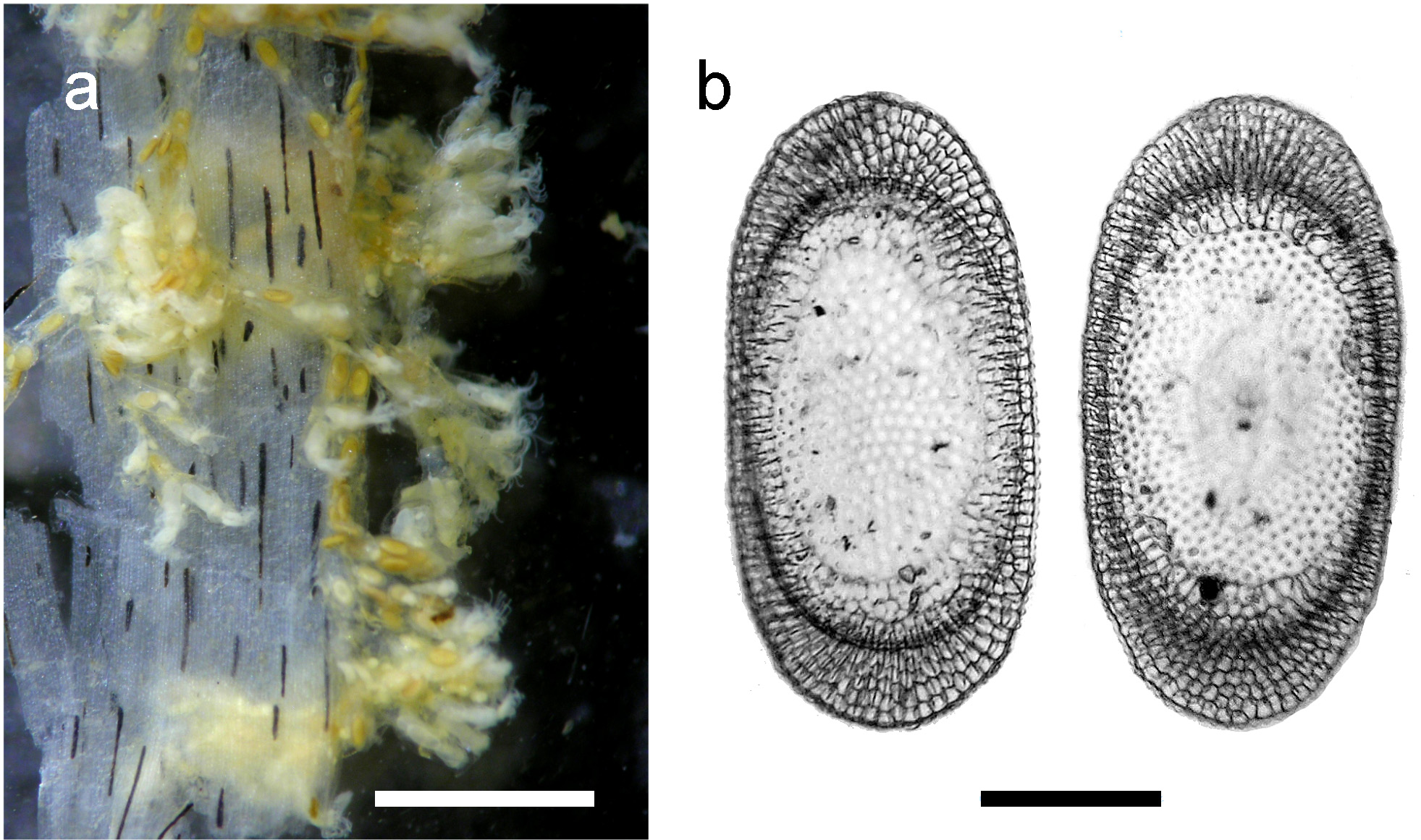
(Fig. 6 a – c)
Wood, Timothy S. (2020): Review of freshwater Bryozoa (Phylactolaemata) of Central Africa with descriptions of two new species. Zootaxa 4820 (3): 581-600, DOI: 10.11646/zootaxa.4820.3.11
Description. The brief diagnosis by Wiebach (1970) is confirmed in this excellent specimen. Zooids occur in clusters attached loosely to leaves of Vallisneria and joined to other clusters by linear series of two or more zooids. The colony wall is completely transparent and mostly colorless, becoming light brown in older tubules (Fig. 6 a). There are no apparent septa, no raphe, and no incrustation. Floatoblast valves are similarly transparent, colorless, and somewhat fragile (Fig. 6 b). When valves are separated the annulus becomes almost invisible compared to the light yellow coloring of the capsule. Small, well-spaced tubercles on the fenestra appear as dark spots under the compound microscope (Fig. 6 c). Floatoblast dimensions are shown in Table 2. The specimen has no sessoblasts.
Wood, Timothy S. (2020): Review of freshwater Bryozoa (Phylactolaemata) of Central Africa with descriptions of two new species. Zootaxa 4820 (3): 581-600, DOI: 10.11646/zootaxa.4820.3.11
Remarks. In this species Wiebach described both thin-walled leptoblasts and “ pycnoblasts ” which was his term for the more typical robust form of floatoblast. However, my own search found only one form which was lightly sclerotized. Some of these were hatching inside the colony, which is uncommon but not unusual among plumatellids, especially in tropical waters. While it is possible that some of these statoblasts forego the standard period of dormancy, there was no sign of new zooids developing inside the intact statoblasts, as occurs in leptoblasts of P. casmiana. There were also no newly established colonies on the substratum, suggesting that floatoblasts were not hatching immediately after their release. The specimen was collected by Georges Marlier, then Director of the Central African Institute for Scientific Research in Uvira. In a letter to Wiebach he wrote, “ The collection was taken from a large tank for rearing fish … fed continuously by water pumped from Lake Tanganyika across from our laboratory. Therefore, the growth environment was artificial, although the water came in a direct line from the lake. ” (Wiebach 1970).
Wood, Timothy S. (2020): Review of freshwater Bryozoa (Phylactolaemata) of Central Africa with descriptions of two new species. Zootaxa 4820 (3): 581-600, DOI: 10.11646/zootaxa.4820.3.11
Distribution. The species is known from a single collection at the northern tip of Lake Tanganyika.
Wood, Timothy S. (2020): Review of freshwater Bryozoa (Phylactolaemata) of Central Africa with descriptions of two new species. Zootaxa 4820 (3): 581-600, DOI: 10.11646/zootaxa.4820.3.11
Material examined. No. 441, labeled as a holotype, collected August, 1959 from DR. Congo at the Aquarium at Ndakalas, Uvira, Lake Tanganyika, by G. Marlier.
Wood, Timothy S. (2020): Review of freshwater Bryozoa (Phylactolaemata) of Central Africa with descriptions of two new species. Zootaxa 4820 (3): 581-600, DOI: 10.11646/zootaxa.4820.3.11
Export occurrence data
Darwin Core Archive (ZIP)
CLASSIFICATION
Taxonomic Classification Tree

IMAGES