
AnimaliaNot EvaluatedacceptedspeciesAccepted
Plumatella kisalensis
Wood, 2020
GBIF:176569464
0year
ABOUT
Descriptions(5)
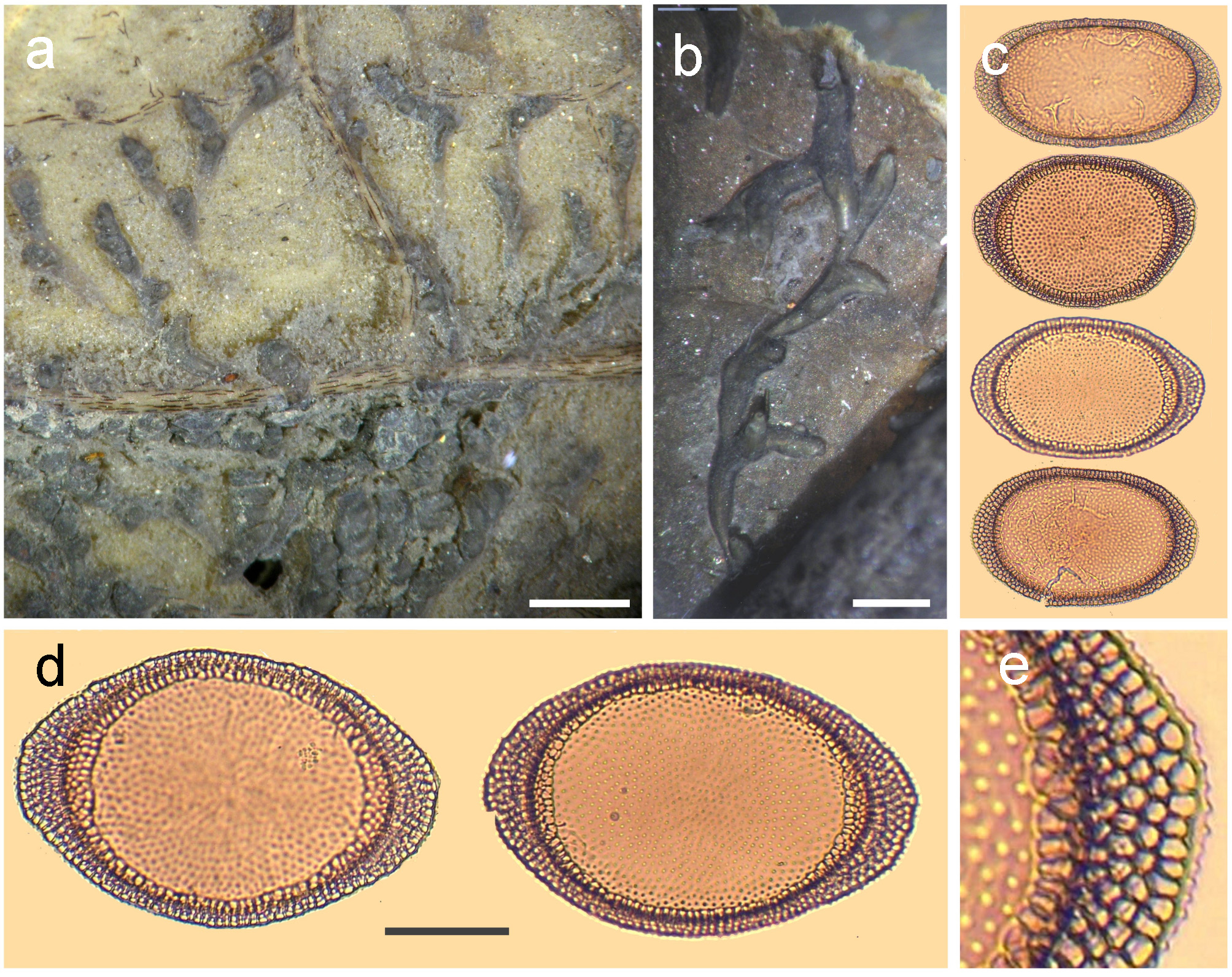
(Fig. 4 a – e)
Wood, Timothy S. (2020): Review of freshwater Bryozoa (Phylactolaemata) of Central Africa with descriptions of two new species. Zootaxa 4820 (3): 581-600, DOI: 10.11646/zootaxa.4820.3.11
Description. Colony spreading, always close to the substratum with only the zooid tips slightly raised (Fig. 4 a, b); zooids variably spaced with occasional individuals stretching forward; zooids often bent at sharp angles; body wall mostly transparent so that polypides and statoblasts are clearly visible; raphe absent or very faint. Floatoblasts broadly oval but variable in shape (Fig. 4 c); large fenestrae on both dorsal and ventral valves and similar in shape to the whole floatoblast (Fig. 4 d); dorsal and ventral fenestrae so similar they are sometimes almost indistinguishable; floatoblast suture with a prominent, serrated edge best seen on separated valves (Fig. 4 e). Floatoblast dimensions are shown in Table 2.
Wood, Timothy S. (2020): Review of freshwater Bryozoa (Phylactolaemata) of Central Africa with descriptions of two new species. Zootaxa 4820 (3): 581-600, DOI: 10.11646/zootaxa.4820.3.11
Remarks. These 15 specimens, identified by Wiebach as Stolella indica, originated from three sites in Central Africa separated by more than 1200 km. The specimen from Lake Edward was growing on filiform leaves of a Certophyllum - like plant, the leaves now all separated from the main stem. Material from Lake Kisale was collected on lotus leaves, now black, soft, and extremely fragile. Colonies from Kakongo-Songo are also on lotus leaves and in fairly good condition (Fig. 4 a, b). Several names were assigned to this material before Wiebach (1964) identified it as Stolella indica Annandale, 1909. Annandale’s original description of S. indica was short on details except to mention clusters of small zooids separated by more elongated zooids. A follow-up description (Annandale 1911) provided little additional information. Fortunately, a specimen labeled, “ Stolella indica - Type ” is found in the freshwater Bryozoa collection, No. Z 3482 / 7, of the Zoological Survey of India in Kolkata. The date and Bulandshahr collection site listed on the label leave little doubt that this is Annandale’s original material. The floatoblasts from the type specimen in India (Fig. 5) bear scant resemblance to the floatoblasts of Wiebach’s “ S. indica ” at the MRAC (Fig. 4 c, d, e). The floatoblasts from India are small, about 360 μm in length. The dorsal fenestra is also relatively small, its length no more than half the overall floatoblast length. The ventral fenestra is only slightly larger, with the annulus encroaching significantly over the capsule, an unusual feature. By contrast, floatoblasts from the MRAC specimens are much larger (Fig. 4 c, d, e and Table 2), the fenestrae are also large relative to the overall floatoblast dimensions. There seems little likelihood that these could be the same species. The common feature shared by the two specimens (India and Congo) is the occasionally elongated zooids that somewhat resemble stolons. However, in the MRAC material the prominence of such elongated zooids seems to have been exaggerated. Specimen No. 6 – 8 includes a small vial which Wiebach has labeled, “ Partie de colonie très typique. ” It contains a few very elongated zooids, as if to justify the Stolella designation, but which in fact are not typical at all of the assembled specimens. The Genus Stolella Annandale, 1909, in the light of more recent collections, seems to have lost its validity. The elongated zooids seen occasionally among several plumatellid species appear to be largely the result of environmental factors and have little to do with phylogeny. In the MRAC material there may be a tendency for elongate zooids to form, but this does not rise to the level of a genus designation. For this reason, I am withdrawing this MRAC material from Stolella and placing in the Genus Plumatella. Wiebach (1964) believed he saw the same two types of floatoblasts in this material as those found in Plumatella casmiana. These were thin-walled leptoblasts which lacked a capsule and hatch upon release, and pycnoblasts with an internal capsule and an initial period of dormancy. However, the morphological differences he described fall well within the continuous spectrum of variation occurring in these specimens (Fig. 4 c and Table 2).
Wood, Timothy S. (2020): Review of freshwater Bryozoa (Phylactolaemata) of Central Africa with descriptions of two new species. Zootaxa 4820 (3): 581-600, DOI: 10.11646/zootaxa.4820.3.11
Etymology. The specific name refers to the type locality, Lake Kisale, located in Haut-Lomami District of the Democratic Republic of Congo.
Wood, Timothy S. (2020): Review of freshwater Bryozoa (Phylactolaemata) of Central Africa with descriptions of two new species. Zootaxa 4820 (3): 581-600, DOI: 10.11646/zootaxa.4820.3.11
Material examined. Nos. 2, 6, 9, 11, 14, 16, 18, 21, 23, 24, and 61 (holotype), all collected 4 August 1937 in DR Congo at Lake Kisale, Bukama Territory, Haut Lomami District, by Paul Brien; Nos. 64, 65, 66 collected Sept, 1947 in Congo, Lake Pango, Fort Cabinda, Congo Central Province, by Edmund Dartevelle; No. 213 collected September, 1937 in Congo at Lake Edward near Kamande, Lualaba Region, Haut Katanga Province, by Paul Brien.
Wood, Timothy S. (2020): Review of freshwater Bryozoa (Phylactolaemata) of Central Africa with descriptions of two new species. Zootaxa 4820 (3): 581-600, DOI: 10.11646/zootaxa.4820.3.11
Export occurrence data
Darwin Core Archive (ZIP)
CLASSIFICATION
Taxonomic Classification Tree

MULTIMEDIA
Media Files(2)
FIGURE 4. Specimen No. 65, Plumatella kisalensis n. sp. (a) Colony on a leaf, scale bar = 2 mm; (b) colony showing greater zooid detail, scale bar = 1 mm; (c) floatoblast valves showing range of size and shape; (d) floatoblast valves with dorsal valve on the left, scale bar = 100 μm; (e) detail of ventral valve showing peripheral suture points and small, well-spaced tubercles.
Imageimage/png© Wood, Timothy S.Wood, Timothy S.

IMAGES