AnimaliaNot EvaluatedacceptedspeciesAccepted
Antipathes virgata

Antipathes virgata

GBIF:177006758

ABOUT

Descriptions(4)

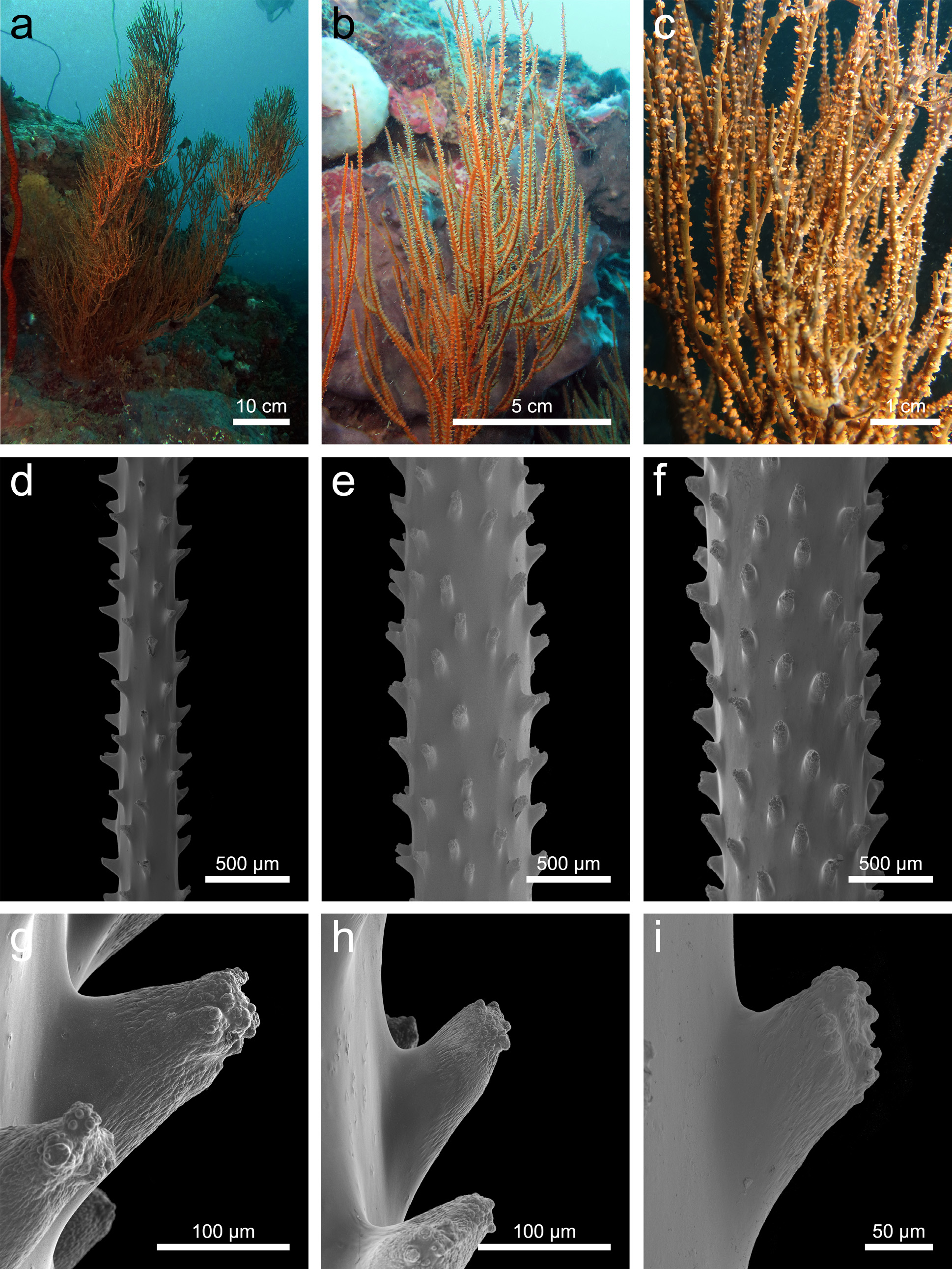
Description. A branched and bushy colony measuring 75 cm in height with a basal diameter of 1.5 cm (Fig. 10, a – c). The branches subdivide pseudo-dichotomously and are vertically elongated and almost parallel, being inserted with an acute angle to the thicker branch (Fig. 10, b, c). On the distal thick branches, smaller branches often originate from the same area and from different sides, giving the colony the general shape of a candelabra (Fig. 10, c). There is no fusion between adjacent branches (Fig. 10, c), but sometimes vertically erected branches can fuse with the main axis when they come in contact. In the upper part of the colony, the terminal branchlets measure up to 9 cm in length. Such branchlets measure around 2 mm in diameter at their base (measured with the tissues), while a shorter branchlet 5.8 cm in length measures 1.2 mm at the base (measured with the tissues). The polyps are generally found in one row, but on branches they are often arranged on both sides giving the appearance of two rows (Fig. 10, c). When they are arranged in a single row, they can twist around the branch. On thicker axes, they are found all around the axis. Polyps appear large with thick and rounded tentacles and measure 1.0 – 1.7 mm in diameter. The interpolypar space is not uniform; the polyps can be close together or be spaced up to 1 mm apart, and 8 – 9 polyps are found along one cm. The spines are conical, sometimes slightly hooked upwards on thin branches and inclined distally on thicker branches (Fig. 10, d – i). Spines have papillae on two-thirds of their surface on every side and multiple, rounded knobs at the apex (Fig. 10, g – i). Spines can also be stout with a flattened and knobbed apex on larger branches (Fig. 10, i). The number of longitudinal rows that can be seen from one aspect varies between five and seven. The polypar and abpolypar spines are equivalent in size, regardless of branch thickness. On all branches measuring less than 0.75 mm in diameter, the spines are consistently no more than 0.14 mm tall, whereas on thicker branches they measure 0.11 – 0.17 mm. The overall mutual distance is consistently within the range of 0.31 to 0.56 mm. Taxonomic remarks. Historically, there have been several descriptions of Antipathes virgata referring to specimens coming from different locations and presenting different states of preservation. The original description of the species was made by Esper (1798, Fig. 11, a) who described a specimen coming from the Indian Ocean that he received as a gift from India. That specimen is lost. In his description, he stated that the specimen could be “ distinguished from any known species by the spreading of its branches and twigs, as well as its growth form ”. He also reported about a stem expanding in a “ fork-like ” shape and branches originating from the same angle, but no details were provided regarding the polyps or the morphology of the spines. In the absence of the type specimen and given the lack of information about taxonomical features, his description is inadequate to define the species (Opresko & Baron-Szabo 2001). Other specimens were then described by Brook (1889, from the Persian Gulf, redescribed by Opresko in 1974, see Fig. 11, d – f), Roule (1905, from the Atlantic Ocean) and Forster Cooper (1909, from Saint-Brandon) which have been later compared by Opresko & Baron-Szabo (2001) in their redescription of Esper’s specimens. The latter authors concluded that it was not possible to determine if all these specimens referred to An. virgata were identical with the one described by Esper, and that it was questionable whether all three authors were dealing with the same species. In any case, a neotype needs to be designated for the species. Although the spines of the present specimen are similar in shape and size as those described from Brook’s specimen (Brook 1889; Opresko & Baron-Szabo 2001, see Figs. 10, 11), they differ in their fine morphology: the spines of the Malagasy specimen are papillose with many small knobs at their tips, while those of Brook’s specimen are smooth with a few large tubercles at their tips (Figs. 10, 11). The branching pattern also appears to be different (Fig. 11, b, d – f). In Brook’s specimen, the branches are mostly on one side of the axis, and they can be bifurcated before twisting and becoming confluent again (Fig. 11, d – e). These features are not observed here. Forster Cooper (1909) also reported about different morphological features with branches becoming confluent and fusing together at some point, as well as polyps arranged in four rows along the branch and sharp, triangular spines. The original illustration given by Esper (1798, Fig. 11, a) shows a similar branching pattern for the whole colony, however, given all the previous considerations and the different localities, this specimen might be different from those of Brook (1889), Roule (1905) and Forster Cooper (1909), and the name An. cf. virgata is used here.
Terrana, Lucas, Bo, Marzia, Opresko, Dennis M., Eeckhaut, Igor (2020): Shallow-water black corals (Cnidaria: Anthozoa: Hexacorallia: Antipatharia) from SW Madagascar. Zootaxa 4826 (1): 1-62, DOI: 10.11646/zootaxa.4826.1.1

Figs. 10, 11 Antipathes virgata Esper, 1788, pt. II, p. 8, pl. XIV Antipathes scoparia Lamarck, t. II, p. 307
Terrana, Lucas, Bo, Marzia, Opresko, Dennis M., Eeckhaut, Igor (2020): Shallow-water black corals (Cnidaria: Anthozoa: Hexacorallia: Antipatharia) from SW Madagascar. Zootaxa 4826 (1): 1-62, DOI: 10.11646/zootaxa.4826.1.1
Distribution. Indian Ocean (type locality, Esper 1798), Persian Gulf (Brook 1889), Cargados Carajos (archipelago of Saint-Brandon, Forster Cooper 1909), Azores, Madeira and Cape Verde (Roule 1905), Madagascar (present study).
Terrana, Lucas, Bo, Marzia, Opresko, Dennis M., Eeckhaut, Igor (2020): Shallow-water black corals (Cnidaria: Anthozoa: Hexacorallia: Antipatharia) from SW Madagascar. Zootaxa 4826 (1): 1-62, DOI: 10.11646/zootaxa.4826.1.1
Material examined. Toliara, 25 m. Distal branches of different diameters, specimen INV. 131349. Depth range. 25 – 45 m.
Terrana, Lucas, Bo, Marzia, Opresko, Dennis M., Eeckhaut, Igor (2020): Shallow-water black corals (Cnidaria: Anthozoa: Hexacorallia: Antipatharia) from SW Madagascar. Zootaxa 4826 (1): 1-62, DOI: 10.11646/zootaxa.4826.1.1

Export occurrence data

Darwin Core Archive (ZIP)

CLASSIFICATION

Taxonomic Classification Tree

MULTIMEDIA

Media Files(2)

FIGURE 10. Antipathes cf. virgata sensu Esper, 1788 specimen INV.131349. (a) Entire colony. (b–c) Close-up views of the branching pattern and the polyps. (d) Section of a branch 0.35 mm in diameter. The polypar side is on the right. (e) Section of a branch 0.74 mm in diameter. The polypar side is on the right. (f) Section of a branch 1 mm in diameter. Polyps are found on both sides on this branch. (g) Polypar spine on a branch 0.60 mm in diameter. (h) Abpolypar spine on the same branch. (i) Example of a stout polypar spine on a branch 0.70 mm in diameter.

Imageimage/png© Terrana, Lucas;Bo, Marzia;Opresko, Dennis M.;Eeckhaut, IgorTerrana, Lucas;Bo, Marzia;Opresko, Dennis M.;Eeckhaut, Igor

FIGURE 11. Comparison of Antipathes virgata Esper, 1788 and related specimens. (a) Original illustration of An. virgata by Esper (Esper Fortsetzungen 2, p. 8, pl. 14, 1798) showing the lower portion of the colony. The colony is from the Indian Ocean (gift from India). He reports a colony measuring around 45 cm with no fusion of the branches. (b) A branch of the specimen An. cf. virgata INV.131349. from Madagascar. (c) A branch of the specimen An. cf. lentipinna INV.131337 from Madagascar showing the same uniserial branching pattern as Brook’s specimen of An. virgata, but with thick ramifications compared to the latter. (d–f) Views of the entire colony, a branch and a skeletal section of Brook’s specimen (Brook 1889) of An. virgata from the British Museum. The ramifications are uniserial and thin compared to the specimen from Madagascar. Photo of Brook’s specimen of An. virgata courtesy of Paul Richens of the NHMUK.

Imageimage/png© Terrana, Lucas;Bo, Marzia;Opresko, Dennis M.;Eeckhaut, IgorTerrana, Lucas;Bo, Marzia;Opresko, Dennis M.;Eeckhaut, Igor

IMAGES

Gallery(2)

See Gallery

Occurrences with images

Source Information

Shallow-water black corals (Cnidaria: Anthozoa: Hexacorallia: Antipatharia) from SW Madagascar

checklist

This dataset contains the digitized treatments in Plazi based on the original journal article Terrana, Lucas, Bo, Marzia, Opresko, Dennis M., Eeckhaut, Igor (2020): Shallow-water black corals (Cnidaria: Anthozoa: Hexacorallia: Antipatharia) from SW Madagascar. Zootaxa 4826 (1): 1-62, DOI: 10.11646/zootaxa.4826.1.1

Abstract

Antipatharians, also known as black corals, represent a small group of anthozoan hexacorallians found in all oceans of the world. They are generally considered a deep-water taxon; however, some of the most diverse communities are known from tropical shallow waters. With a few poorly detailed exceptions, shallow-water black corals from the Indian Ocean and especially those from Madagascar are mostly unknown. In this study, we report for the first time a highly diverse black coral assemblage of the Western Indian Ocean thriving in shallow waters and upper mesophotic depths (10–52 m depth) along the SW coast of Madagascar. A total of 22 species belonging to six genera (Antipathes, Arachnopathes, Cirrhipathes, Cupressopathes, Myriopathes and Stichopathes) and two families (Antipathidae and Myriopathidae) are described, of which 20 are found in the northern pass of the Great Reef of Toliara, thus representing the most diverse site of the areas investigated. Most of the shallow-water species from the Indian Ocean were originally described more than a century ago, sometimes without being reported again until now. All the descriptions herein rely solely on morphology and include detailed in situ pictures and scanning electron microscope images, in addition to range expansions for many species.

Terrana L, Bo M, Opresko D M, Eeckhaut I, plazi (2020). Shallow-water black corals (Cnidaria: Anthozoa: Hexacorallia: Antipatharia) from SW Madagascar. Plazi.org taxonomic treatments database. Checklist dataset https://doi.org/10.11646/zootaxa.4826.1.1 accessed via GBIF.org on 2026-06-16.

CC0Published 8/10/2020View dataset
GBIF Usage Key
177006758
Dataset Key
2bf4f379-5024-4616-b7b7-a48103cb63bf
Origin
source
Backbone Key
2258248
Taxon ID
F57687879373427DFF4CFF39FEDDF910.taxon
Last Crawled
6/10/2026
Last Interpreted
6/10/2026