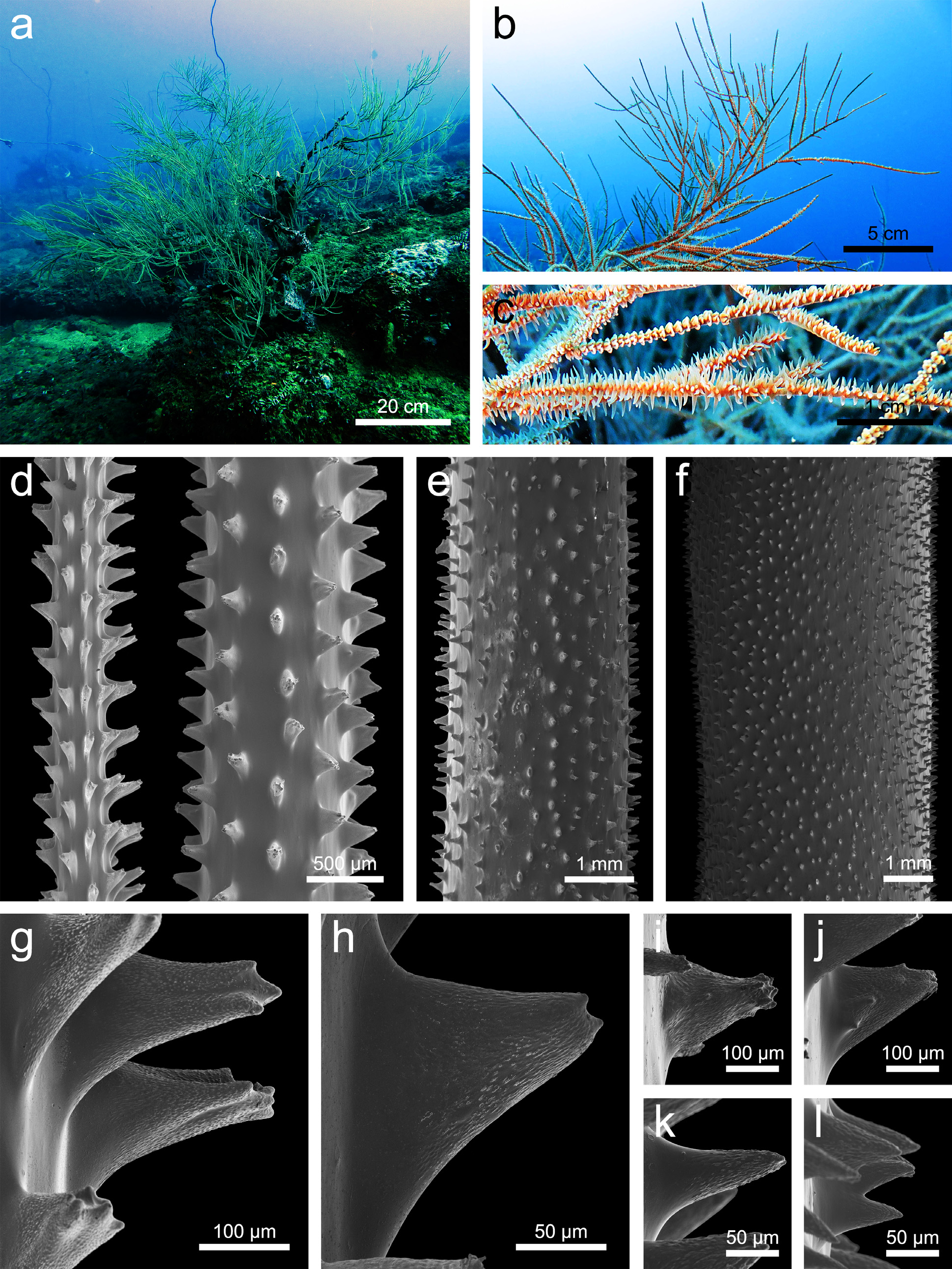
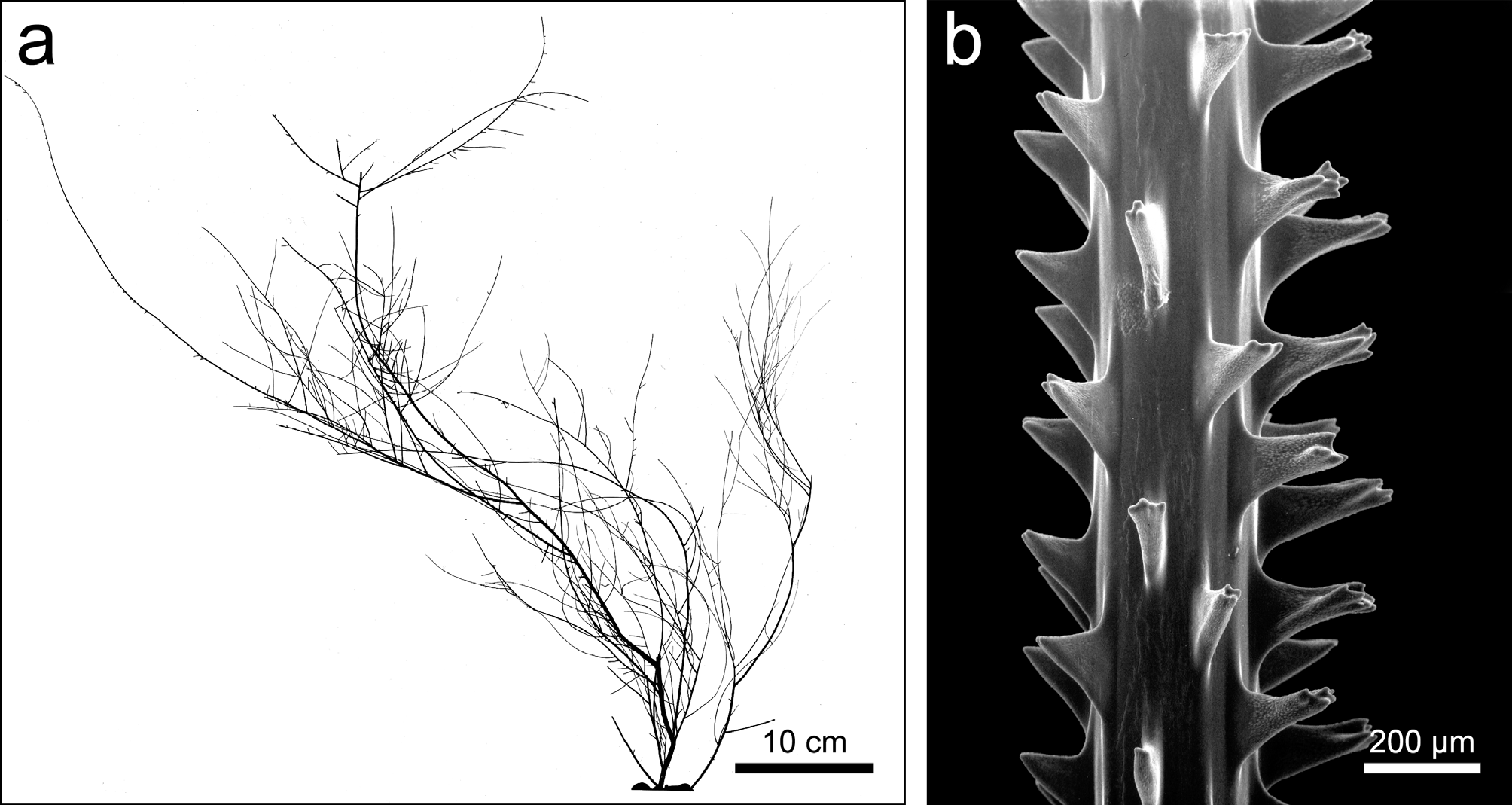
Description. A branched, bushy colony measuring one meter in width and 60 cm in height, with a reddish color (Fig. 7, a – c). The basal stem is entirely covered by epibionts and divides in two thick axes, each around 1 cm in diameter. The branching pattern tends to be uniserial, with terminal branchets usually vertically directed, but not everywhere on the colony, some being curved to reach that position (Fig. 7, a – b). The longest branch bearing branchlets in the fragment is 25 cm. Terminal branchlets measure up to 11 cm in length, but usually less than 5 cm. A terminal branchlet measuring 6.3 cm measures 1 mm at the base (measured with tissues). The terminal branchlets are very irregularly spaced, varying from 4 mm to 30 mm. Due to this variability, the number per branchlet per cm cannot be counted, as sometimes there is no branchlet along one cm. The branchlets are mostly inserted 35 – 45 °, but sometimes almost perpendicularly. The polyps are large, with long tentacles and arranged in a single row on the terminal branches (Fig. 7, c). This row is sometimes not perfectly linear. On thicker branches, polyps are irregularly distributed. They measure 0.8 – 1.3 mm in transverse diameter and are generally close to each other, such as there is no interpolypar space. At places where the row is not continuous and linear, polyps can be spaced up to 0.4 mm apart, and 7 – 8 polyps are found per cm. The spines are conical and either slightly inclined towards the distal part of the branch or perpendicularly inserted to the corallum (Fig. 7, d – f). Their surface is papillose on almost their whole surface, with papillae sometimes elongated towards the tip of the spine (Fig. 7, g – l). Their tip is either simple or multiply forked, with a somewhat coronate arrangement of the apical lobes (Fig. 7, e, g, i). Sometimes two close spines can fuse at their base (Fig. 7, l). There also may be extra lobes on the lateral sides of the spines (Fig. 7, j). Tall conical spines are only seen on the smallest branchlets, where the difference between abpolypar and polypar spines is also the most marked (Fig. 7, d). Spines tend to be conical onthicker branches (Fig. 7, e – f). On thick branches (i. e. 2.6 mm in diameter), some spines are stout (Fig. 7, e – f). On thick branches> 4 mm in diameter, numerous spines are conical with an acute tip (Fig. 7, f). On a branchlet 0.34 mm in diameter, polypar spines measure 0.17 – 0.24 mm and are spaced 0.27 – 0.50 mm apart. Abpolypar spines measure 0.12 – 0.16 mm and are spaced 0.28 – 0.44 mm apart, 6 – 7 longitudinal rows can be seen in one aspect. On a branch 0.95 mm in diameter, polypar spines have same sizes as on thinner branches and they are spaced 0.29 – 0.47 mm apart. The abpolypar spines measure 0.17 – 0.19 mm and are spaced 0.30 – 0.46 mm apart, 6 – 7 longitudinal rows are also seen in one aspect. On a thick branch 4.6 mm in diameter, the rows are no longer visible and the spines measure 0.13 – 0.17 mm. Secondary spines are scarce and not always present (Fig. 7, e – f), they measure up to 0.05 mm. Taxonomic remarks. The present specimen shares similar spine morphology with a complex of shrub-like species composed of Antipathes griggi Opresko, 2009, An. lentipinna Brook, 1889, An. spinulosa (Schultze, 1896), An. fruticosa Gray, 1857 and An. virgata Esper, 1788 (Opresko 2009). A detailed comparison of these species is given in Opresko (2009). Antipathes griggi is known from the Hawaiian Islands, An. spinulosa from Indonesia, An. fruticosa from New Zealand, while only An. lentipinna and An. virgata sensu Brook, 1889, are both from a locality relatively close to Madagascar, the Red Sea. All these species have an irregularly branched corallum and spines with multiple lobes at the apex and papillae or striations on the surface (Opresko 2009). However, only the branching pattern of An. griggi, An. lentipinna and An. fruticosa is similar to the Malagasy specimen. As highlighted by Opresko (2009), the branching of An. fruticosa and An. griggi differ from that of An. lentipinna by being more consistently vertically directed. On the other hand, in An. fruticosa the apical lobes of the spines tend to be more confined to the apex and, in places, have a more coronate arrangement (which is even more true in An. spinulosa) as in An. lentipinna, while on the thicker parts, tips of the spines have a more blunt, rounded appearance (Opresko 2009). Examination of the type specimen of An. lentipinna by Opresko (2009) revealed similar spines as those observed here (Fig. 8). The coronate arrangement of the apical lobes seen in the holotype (Fig. 8, b) is also seen in the Malagasy specimen (Fig. 7, d, g, i). In his description of An. lentipinna, Brook (1889) highlighted the general resemblance of the species with An. virgata, from which it differs mostly by more spreading branches (a comparison between the Malagasy branches and Brook’s specimen of An. virgata is shown in Fig. 11, c – e). The branchlets of An. lentipinna are reported to be 8 – 15 cm, generally collected together near the upper portion of the branch, and generally uniserial (Brook 1889). The spines are reported to be much longer and more slender than those of An. virgata, and simple with no tubercles nor apical lobes in the sample examined by Brook (1889); however, the spine morphology varies from branch to branch in the type (pers. obs. DMO). In addition, Brook did not mention the presence of any secondary spines. In the Malagasy specimen, their presence was scarce and not seen in all branches analyzed. Brook concluded that An. lentipinna was distinguished from A. virgata by the marked difference in diameter between the branches and branchlets. Later work from Summers (1910) also reported An. lentipinna from Mozambique (Portuguese East Africa). Her description was rather vague, and the main features reported were large polyps (2 mm in transverse diameter) and branches onone side only. Considering the slight differences with Brook’s description and the similarities in spine ornamentation and shape as described in Opresko (2009), the name An. lentipinna is assigned to the present specimen.
Terrana, Lucas, Bo, Marzia, Opresko, Dennis M., Eeckhaut, Igor (2020): Shallow-water black corals (Cnidaria: Anthozoa: Hexacorallia: Antipatharia) from SW Madagascar. Zootaxa 4826 (1): 1-62, DOI: 10.11646/zootaxa.4826.1.1