
AnimaliaNot EvaluatedacceptedspeciesAccepted
Antipathes pseudodichotoma
Silberfeld, 1909
GBIF:177006762
0year
ABOUT
Descriptions(4)
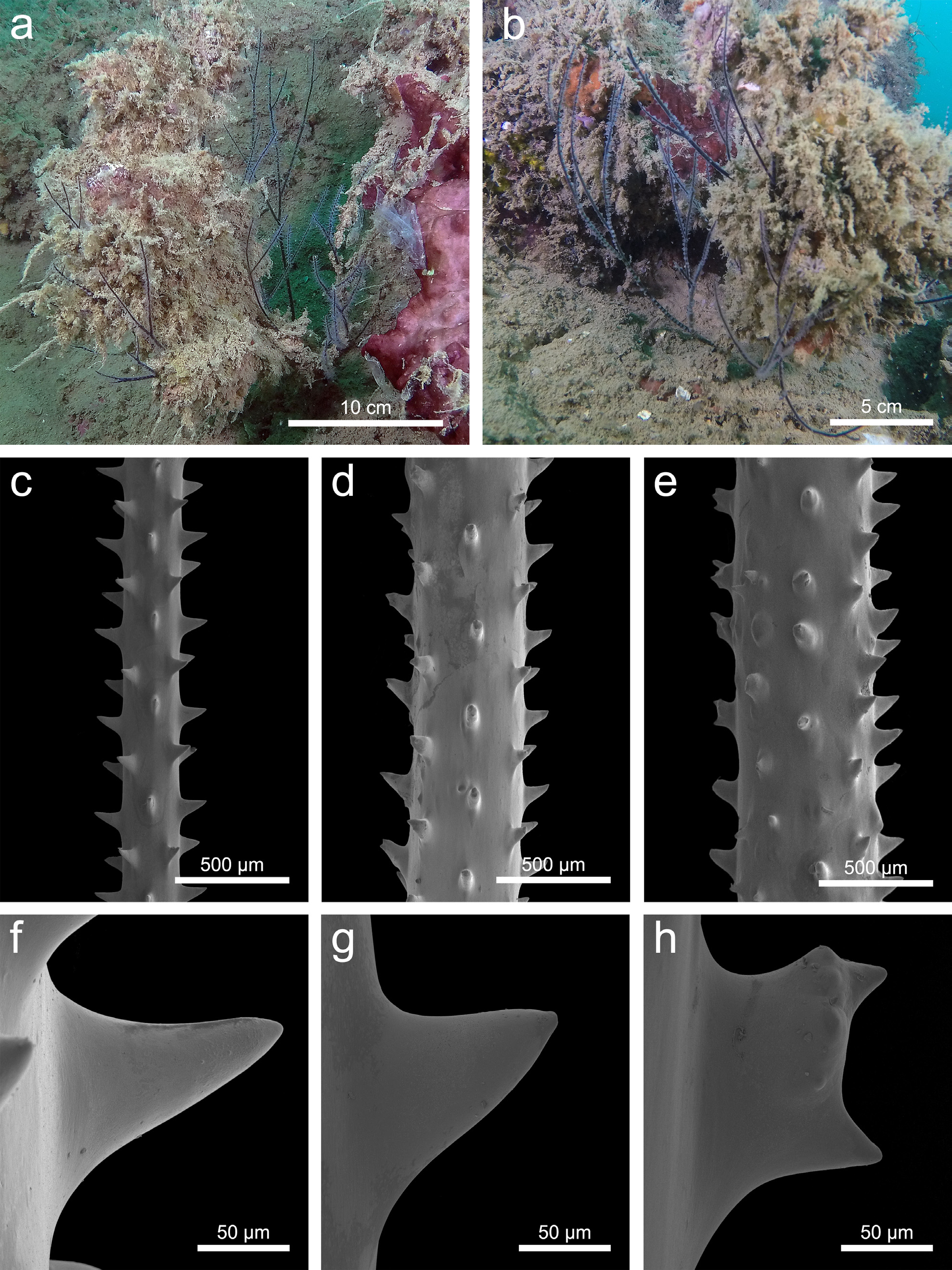
Description. A sparsely branched colony measuring about 25 cm in height (Fig. 9, a, b). The colony shows a pseudo-dichotomous arrangement of the branches and these are not restricted to a two-dimensional plane (Fig. 9, a, b). Pinnulation is not present. The angles of the branches measure between 21 ° and 85 °. The basal diameter of the branches is nearly 2 mm tapering upwards. Polyps are light grey (Fig. 9, a, b) and are located on a single side of the branchlets, but on two rows on thicker branches. The polyp line wraps around the branches making it difficult to determine the polypar and abpolypar side. Polyps on the distal branches measure 0.6 – 1.7 mm in transverse diameter while the interpolypar distance measures up to 0.35 mm on upper branches. There are eight polyps per cm along the examined branches. Four to six longitudinal rows of spines can be seen in one aspect on the upper branches, regardless of the diameter (Fig. 9, c – g). They are triangular, smooth with a pointed tip (Fig. 9, f, g). On a branch 0.26 mm in diameter, the polypar spines have a regular size of 0.12 mm in height and are spaced 0.36 – 0.40 mm apart while the abpolypar spines measure 0.11 – 0.14 mm and are spaced 0.31 – 0.42 mm apart. The spaces between abpolypar spines tend to be more irregular as the branch becomes thicker. On a branch measuring 0.60 mm in diameter, the polypar spines are taller and measure 0.12 – 0.17 mm and are spaced 0.28 – 0.41 mm apart. On such branches, the abpolypar spines are multilobed or irregular in shape (Fig. 9, h). They measure 0.10 – 0.13 mm and are spaced 0.30 – 0.50 mm apart. Taxonomic remarks. A comparison of pseudodichotomous colonies is presented in Opresko (2019), where the spines of Antipathes coronata Opresko, 2019, An. elegans (Thomson & Simpson, 1905), An. gallensis Thomson & Simpson, 1905 and An. sarothrum Pax, 1932 are discussed. All the latter species are characterized by having spines with apical knobs. The type specimen of An. pseudodichotoma is considered to be lost, and the original description is incomplete by lacking information about the spine morphology and the size of the polyps. However, Silberfeld (1909) reported flat (compressed laterally) 0.13 mm high spines (on a branch 0.35 mm in diameter) spaced 0.3 – 0.4 mm apart, but that author did not mention the presence of any knobs on their apex. Five or six longitudinal rows are seen in lateral view. The polyps have been reported to be spaced of 1 – 1.5 mm using the distance between oral cones of adjacent polyps, with eight polyps per cm. This diagnosis is similar to the present specimen, but pending the description of a neotype, the missing information about the spine morphology in the original description cannot confirm any further identification. Consequently, the name An. cf. pseudodichotoma is used here.
Terrana, Lucas, Bo, Marzia, Opresko, Dennis M., Eeckhaut, Igor (2020): Shallow-water black corals (Cnidaria: Anthozoa: Hexacorallia: Antipatharia) from SW Madagascar. Zootaxa 4826 (1): 1-62, DOI: 10.11646/zootaxa.4826.1.1
Fig. 9
Terrana, Lucas, Bo, Marzia, Opresko, Dennis M., Eeckhaut, Igor (2020): Shallow-water black corals (Cnidaria: Anthozoa: Hexacorallia: Antipatharia) from SW Madagascar. Zootaxa 4826 (1): 1-62, DOI: 10.11646/zootaxa.4826.1.1
Distribution. Japan (type locality, Silberfeld 1909), North Pacific Ocean (Molodtsova & Opresko 2020), Madagascar (present study).
Terrana, Lucas, Bo, Marzia, Opresko, Dennis M., Eeckhaut, Igor (2020): Shallow-water black corals (Cnidaria: Anthozoa: Hexacorallia: Antipatharia) from SW Madagascar. Zootaxa 4826 (1): 1-62, DOI: 10.11646/zootaxa.4826.1.1
Material examined. Soalara, 14 m. Fragments collected from the distal portions of the colony, specimen INV. 131364. Depth range. 14 – 30 m.
Terrana, Lucas, Bo, Marzia, Opresko, Dennis M., Eeckhaut, Igor (2020): Shallow-water black corals (Cnidaria: Anthozoa: Hexacorallia: Antipatharia) from SW Madagascar. Zootaxa 4826 (1): 1-62, DOI: 10.11646/zootaxa.4826.1.1
Export occurrence data
Darwin Core Archive (ZIP)
CLASSIFICATION
Taxonomic Classification Tree

MULTIMEDIA
Media Files(1)
FIGURE 9. Antipathes cf. pseudodichotoma Silberfeld, 1909 specimen INV.131364. (a, b) Entire colony measuring about 25 cm in height. (c) Section of a branch 0.24 mm in diameter. The polypar side is on the right. (d) Section of a branch 0.48 mm in diameter. The polypar side is on the right. (e) Section of a branch 0.62 mm in diameter. The polypar side is on the right. (f) Polypar spine on a branch of 0.60 mm in diameter. (g) Abpolypar spine on the same branch. (h) Example of irregular spine.
Imageimage/png© Terrana, Lucas;Bo, Marzia;Opresko, Dennis M.;Eeckhaut, IgorTerrana, Lucas;Bo, Marzia;Opresko, Dennis M.;Eeckhaut, Igor
IMAGES