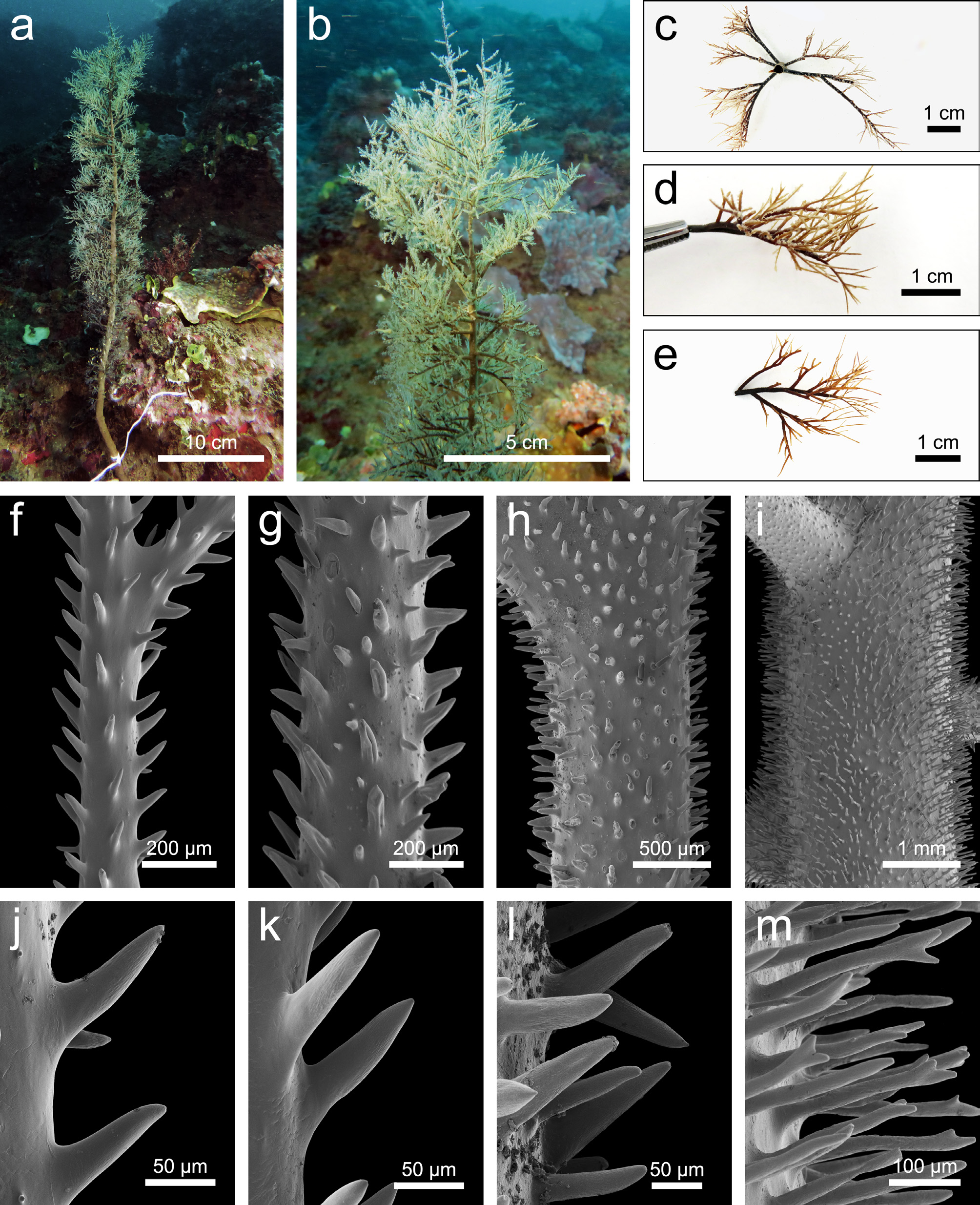
Description. The colony is monopodial with a bottle-brush shape, it measures 40 cm in height and 8 cm in width (Fig. 32, a), with a branch growing near the apex (Fig. 32, b). Primary pinnules are irregularly arranged in about four rows around the stem (Fig. 32, b, c), sometimes two successive primaries are inserted on the same side. These primary pinnules are found around 13 cm above the basal anchorage, but the previous presence of primaries around 4 cm above the plate is clearly seen, indicating that they had been broken off. Primary pinnules are thick and measure up to 5 cm in length, but there is an asymmetry in their length as they do not exceed 3 cm in length on one side (Fig. 32, a, b). However, this asymmetry could be due do breaking events as many primary pinnules are not tapering and have a blunt end. Primary pinnules are almost perpendicularly inserted to the branch or slightly inclined upwards (Fig. 32, a, b). Between five and seven primary pinnules are found along one cm, counting those on all sides of the branch. The primary pinnules are branched to the 5 th order, and more than six secondary subpinnules can be found on one primary (Fig. 32, c – e). The secondary pinnules are always on the same side of the primary pinnules and growing upwards (Fig. 32, b, d). Secondary pinnules are mostly biserial but on some primaries a few uniserial secondaries can be found. Secondary pinnules measure up to 3 cm while tertiaries measure up to 1.5 cm. Higher orders of subpinnules are irregular and usually shorter than the tertiary pinnules. The polyps are monoserial and are arranged on the same side of the pinnules. However, on primary pinnules and thick secondary pinnules the row of polyps is not regular, and on thicker branches they can be found irregularly arranged all around the axis. Polyps are white and measure 0.4 – 0.6 mm. On primary and thick secondary pinnules they are widely spaced, up to 1 mm apart. On subpinnules, their mutual distance is 0.2 – 0.6 mm. There are 10 – 14 polyps per cm on the pinnules and subpinnules. The spines vary in shape; from conical and inclined upwards on the subpinnules, to tall, cylindrical and needlelike spines on the branches (Fig. 32, f – i). On primary and secondary pinnules they are not as acicular as in other myriopathids, but rather have a stout, thick conical shape, sometimes with a blunt apex, and inclined in different directions (Fig. 32, g, h). Moreover, spines on the primaries and secondaries may present grooves on one or several sides of their surfaces (Fig. 32, g, h). The spines are finely papillose on their proximal and distal sides, with papillae elongated towards the tip of the spines and almost looking like faint striations (Fig. 32, j – m). On branches, the spines can be bifid, very often divided near the tip of the spine rather than the base (Fig. 32, m). Individual spines can often be missing in the regular longitudinal rows. On a subpinnule 0.15 mm in diameter, four longitudinal rows are seen from one aspect (Fig. 32, f). Abpolypar and polypar spines have a similar size, measuring 0.08 – 0.11 mm, and are spaced 0.09 – 0.23 mm apart. On a secondary pinnule 0.36 mm in diameter, six longitudinal rows are seen, and polypar and abpolypar spines have similar sizes, measuring 0.10 – 0.14 mm and spaced 0.12 – 0.28 mm apart. On a primary pinnule 0.85 mm in diameter, the longitudinal arrangement is lost, the spines reach 0.17 mm while on a branch 2.2 mm in diameter, they measure 0.20 – 0.26 mm. Taxonomic remarks. This specimen presents the typical bottle-brush shape of Cu. abies. Pinnule sizes are also close to those of Cu. abies, except for their diameter as primary and secondary pinnules are particularly thick for this specimen. Such a narrow, cylindrical shape has already been described in Cu. cylindrica by Brook (1889), but he reported a colony 32 cm tall and 4 cm in diameter, meaning that the maximum length of a primary pinnule would be less than 2 cm, which is less than half the length of the longest primary pinnules observed here. Brook also reported fusions between adjacent pinnules which were not seen in the present specimens. In Cu. abies, the bottlebrush shape is symmetrical as the primary pinnules have a consistent length across the colony. The asymmetry seen here might be due to prevailing current or the presence of symbiotic polychaete, as they are known to induce skeletal modifications (Molodtsova & Budaeva 2007), or possibly due to localized breakage as some primaries were not tapering but showing a blunt end. In addition, spines were regularly missing from a longitudinal row on the secondary and primary pinnules. Furthermore, some spines show a peculiar groove on their surface. Despite these particular skeletal modifications, the present specimen recall Cu. abies. Similar colonies are found in areas of moderate currents, which might explain the thickness of ramifications as well as the absence of large lateral branches and the overall cylindrical appearance. The asymmetrical pinnulation might be environmentally-determined depending on the prevailing current direction.
Terrana, Lucas, Bo, Marzia, Opresko, Dennis M., Eeckhaut, Igor (2020): Shallow-water black corals (Cnidaria: Anthozoa: Hexacorallia: Antipatharia) from SW Madagascar. Zootaxa 4826 (1): 1-62, DOI: 10.11646/zootaxa.4826.1.1