AnimaliaNot EvaluatedacceptedspeciesAccepted
Cupressopathes pumila

Cupressopathes pumila

(Brook, 1889)

GBIF:177006768

0year

ABOUT

Descriptions(3)

Figs. 29, 30
Terrana, Lucas, Bo, Marzia, Opresko, Dennis M., Eeckhaut, Igor (2020): Shallow-water black corals (Cnidaria: Anthozoa: Hexacorallia: Antipatharia) from SW Madagascar. Zootaxa 4826 (1): 1-62, DOI: 10.11646/zootaxa.4826.1.1

Distribution. India (type locality, Brook 1889), western Pacific (Opresko 2001), Madagascar (present study).
Terrana, Lucas, Bo, Marzia, Opresko, Dennis M., Eeckhaut, Igor (2020): Shallow-water black corals (Cnidaria: Anthozoa: Hexacorallia: Antipatharia) from SW Madagascar. Zootaxa 4826 (1): 1-62, DOI: 10.11646/zootaxa.4826.1.1
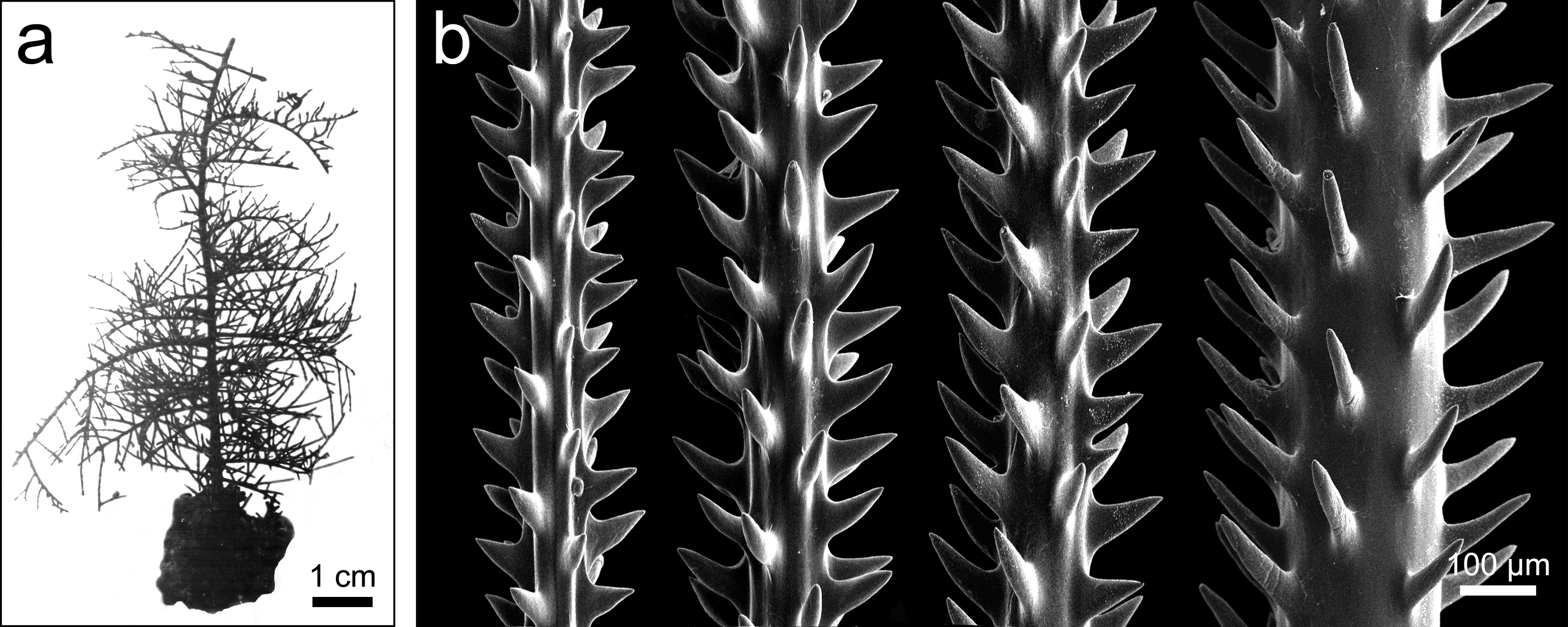
Material examined. Entire colony, Toliara 24 m INV. 131366. Depth range. 20 – 30 m. Decription. The colony is branched and measures about 40 cm high and 25 cm wide with a basal diameter of 6.5 mm (Fig. 29, a). Each branch bears four irregular rows of primary pinnules that reach up to 5 cm in length (Fig. 29, b, c). Primary pinnules are inserted at an angle slightly less than 90 ° to the branch. The arrangement of primary pinnules does not give the typical overall bottle-brush appearance but rather a plumose aspect (Fig. 29, a). There are five to seven primary pinnules along one cm of the axis, counting those on all sides (Fig. 29, c). These primary pinnules can be pinnuated to 4 th order, some can be more densely pinnulated than the others (Fig. 29, d – f). The subpinnules are mostly biserial but they can also be uniserial (Fig. 29, e, f). Subpinnules are inserted at an acute angle to the primary pinnules with a general tendency to grow upwards, but this is not the case in many places (Fig. 29, c – f). Secondary pinnules are generally less than 2.5 cm in length, but at some places they reach lengths up to 5 cm (Fig. 29, e, f). Higher order pinnules are less than 1.5 cm long (Fig. 29, c – f). The polyps are slightly elongated transversally; they measure 0.4 – 1.0 mm in transverse diameter and are spaced 0.15 – 0.35 mm apart, with ten polyps along one cm. Polyps are located on a single side of the branches, but they can twist around it. On thicker branches, polyps are irregularly distributed. The spines on pinnules and subpinnules follow the general gradual change seen within this genus, from conical and horn-shaped to acicular, sharp and needle-like (Fig. 29, g – n). They are finely papillose over two thirds of their height, with the papillae elongated towards the tip of the spines (Fig. 29, m, n). On the subpinnules these papillae tend to appear as faint striations and the spines almost appear smooth (Fig. 29, k, l). The spines are inclined upwards, which is more pronounced on abpolypar side, although on thicker branches this inclination is irregular (Fig. 29, g – j). On a subpinnule 0.13 mm in diameter, the spines are arranged in five longitudinal rows. The polypar spines measure 0.08 – 0.10 mm in height and are spaced 0.12 – 0.20 mm apart, while the abpolypar spines measure 0.07 – 0.09 mm and are spaced 0.11 – 0.18 mm apart. On a primary pinnule of 0.28 mm, six longitudinal rows of spines can be seen. The polypar and abpolypar spines measure 0.10 – 0.14 mm and 0.09 – 0.13 mm, respectively, and they are spaced 0.10 – 0.19 mm and 0.10 – 0.18 mm, respectively. On a thick branch of 1.3 mm in diameter, the longitudinal arrangement is lost, and the spines measure up to 0.26 mm. Bifid spines can also be found on such branches. Taxonomic remarks. The present species differs from Cupressopathes abies in having a smaller, more flattened corallum with several of the primary pinnules developing into side branches (Brook 1889, Opresko 2001, Fig. 30 a). The typical bottle-brushed shape of Cu. abies is not found in this species (Fig. 30, a), as there is a tendency for its primary pinnules to have more irregular lengths along the corallum than those of Cu. abies. In general, compared to Cu. abies, Cu. pumila has more branches and a longer, less dense pinnulation, with a greater tendency for the subpinnules to be bilateral. Spines are similar to those of myriopathids (Fig. 30, b).
Terrana, Lucas, Bo, Marzia, Opresko, Dennis M., Eeckhaut, Igor (2020): Shallow-water black corals (Cnidaria: Anthozoa: Hexacorallia: Antipatharia) from SW Madagascar. Zootaxa 4826 (1): 1-62, DOI: 10.11646/zootaxa.4826.1.1

Export occurrence data

Darwin Core Archive (ZIP)

CLASSIFICATION

Taxonomic Classification Tree

MULTIMEDIA

Media Files(2)

FIGURE 29. Cupressopathes cf. pumila INV.131366. (a) In situ pictures of the whole colony (b) In situ close-up view of a primary pinnule. (c) Detailed view of the branching pattern and the pinnulation of a distal branch. (d) Cross section of a distal branch showing the arrangement of the primary pinnules in four irregular rows. (e–f) Detailed top views of the pinnulation of two primary pinnules showing the biserial arrangement of the subpinnules and the variation in their density. (g) Section of subpinnule 0.13 mm in diameter, polypar side is on the right. (h) Section of primary pinnule 0.25 mm in diameter, polypar side is on the right. (i–j) Sections of two branches 0.30 mm and 1.30 mm in diameter, respectively. (k) Abpolypar spine of subpinnule. (l) Polypar spine of subpinnule. (m) Polypar spine on primary pinnule. (n) Tall, acicular and needle-like spines occurring on thick branch.

Imageimage/png© Terrana, Lucas;Bo, Marzia;Opresko, Dennis M.;Eeckhaut, IgorTerrana, Lucas;Bo, Marzia;Opresko, Dennis M.;Eeckhaut, Igor

FIGURE 30. Cupressopathes pumila (Brook, 1889) type specimen. (a) Entire colony, holotype Brit. Mus. 83.9.13.15. (b) Schizoholotype USNM 100355 showing different sections of 0.08, 0.11, 0.12 and 0.22 mm in diameter, respectively.

Imageimage/png© Terrana, Lucas;Bo, Marzia;Opresko, Dennis M.;Eeckhaut, IgorTerrana, Lucas;Bo, Marzia;Opresko, Dennis M.;Eeckhaut, Igor

IMAGES

Gallery(2)

See Gallery

Occurrences with images

Source Information

Shallow-water black corals (Cnidaria: Anthozoa: Hexacorallia: Antipatharia) from SW Madagascar

checklist

This dataset contains the digitized treatments in Plazi based on the original journal article Terrana, Lucas, Bo, Marzia, Opresko, Dennis M., Eeckhaut, Igor (2020): Shallow-water black corals (Cnidaria: Anthozoa: Hexacorallia: Antipatharia) from SW Madagascar. Zootaxa 4826 (1): 1-62, DOI: 10.11646/zootaxa.4826.1.1

Abstract

Antipatharians, also known as black corals, represent a small group of anthozoan hexacorallians found in all oceans of the world. They are generally considered a deep-water taxon; however, some of the most diverse communities are known from tropical shallow waters. With a few poorly detailed exceptions, shallow-water black corals from the Indian Ocean and especially those from Madagascar are mostly unknown. In this study, we report for the first time a highly diverse black coral assemblage of the Western Indian Ocean thriving in shallow waters and upper mesophotic depths (10–52 m depth) along the SW coast of Madagascar. A total of 22 species belonging to six genera (Antipathes, Arachnopathes, Cirrhipathes, Cupressopathes, Myriopathes and Stichopathes) and two families (Antipathidae and Myriopathidae) are described, of which 20 are found in the northern pass of the Great Reef of Toliara, thus representing the most diverse site of the areas investigated. Most of the shallow-water species from the Indian Ocean were originally described more than a century ago, sometimes without being reported again until now. All the descriptions herein rely solely on morphology and include detailed in situ pictures and scanning electron microscope images, in addition to range expansions for many species.

Terrana L, Bo M, Opresko D M, Eeckhaut I, plazi (2020). Shallow-water black corals (Cnidaria: Anthozoa: Hexacorallia: Antipatharia) from SW Madagascar. Plazi.org taxonomic treatments database. Checklist dataset https://doi.org/10.11646/zootaxa.4826.1.1 accessed via GBIF.org on 2026-06-16.

CC0Published 8/10/2020View dataset
GBIF Usage Key
177006768
Dataset Key
2bf4f379-5024-4616-b7b7-a48103cb63bf
Origin
source
Backbone Key
2258465
Taxon ID
F57687879351425BFF4CFD54FA40FC40.taxon
Last Crawled
6/10/2026
Last Interpreted
6/10/2026