
AnimaliaacceptedgenusAccepted
Myriopathes
Opresko, 2001
GBIF:177006769
0year
ABOUT
Descriptions(3)
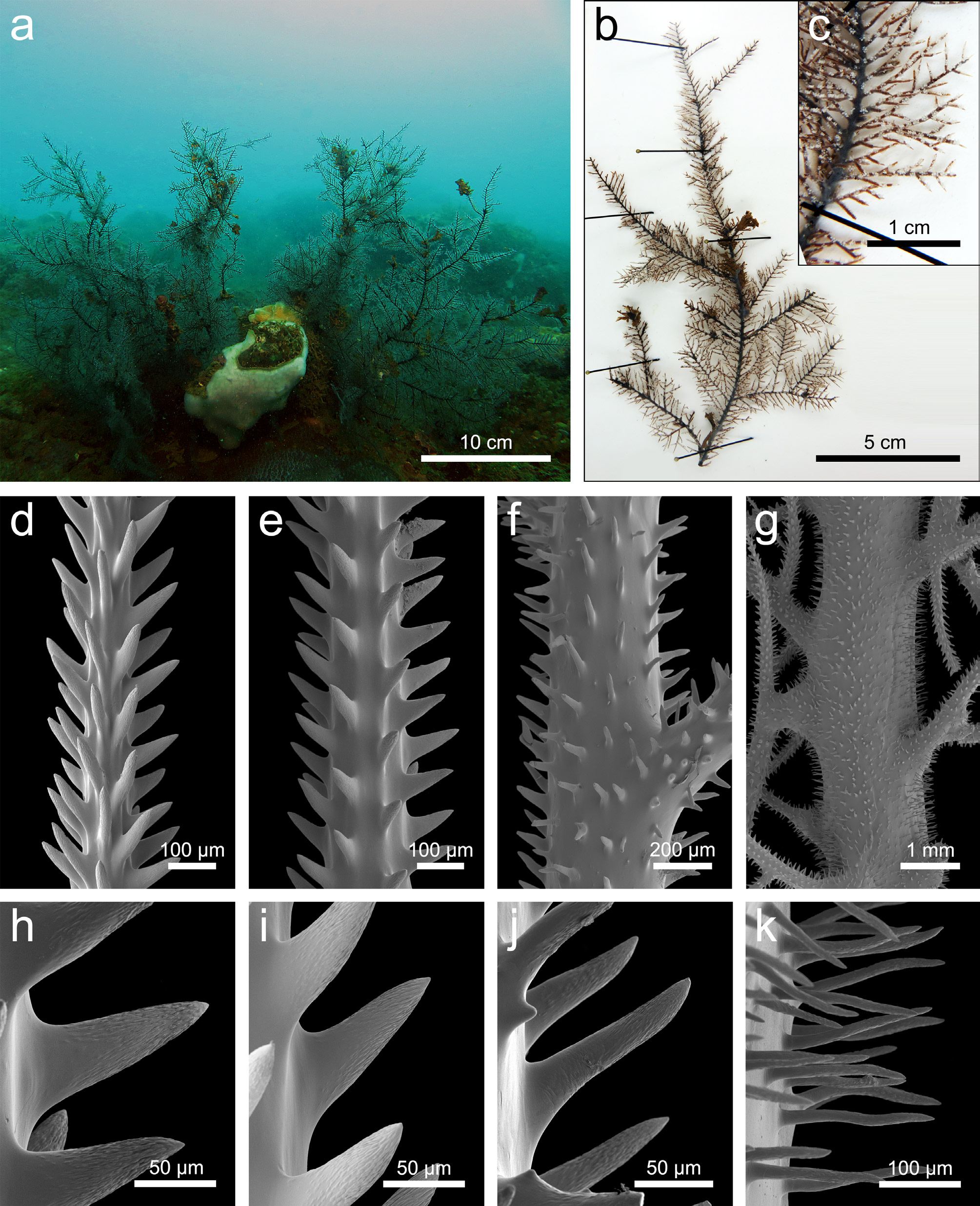
Description. The colony is branched and measures around 35 cm in width and 25 cm in height (Fig. 27, a). Branches are not inserted in a single plane which can result in a general bushy shape of the colony, with branches overlapping (Fig. 27, a). However, each branch is planar and measures up to 10 cm in length (Fig. 27, a, b). The colony is white but the contrast with the dark skeleton is clearly visible (Fig. 27, a, b). The primary pinnules are biserial, alternate, short and slightly inclined towards the anterior side of the colony, they measure up to 1 cm (Fig. 27, a, b). Primary pinnules are inserted 45 – 75 ° to the branch, with an average of 60 ° (Fig. 27, b). In each row the primary pinnules are spaced 1 – 3 mm apart, mostly 1.3 – 1.4 mm (Fig. 27, b, c). There are generally 11 – 12 primary pinnules occurring along one cm of a branch, counting those in both lateral rows (Fig. 27, b). When secondary pinnules are present, up to three uniserial ones can be found on a primary, after which they become biserial and alternate and the primary pinnules become a branch (Fig. 27, b, c). Secondary pinnules measure up to 3 mm in length, but mostly around 1.5 mm (Fig. 27, b, c). They are usually inserted out of the plane formed by the primaries (Fig. 27, b, c) but some fuse with overlapping pinnules (Fig. 27, g). There are no tertiary pinnules. The polyps are located on a single side of the pinnules, except on thicker branches where they can occur irregularly on all sides of the axis. Polyps measure 0.5 – 0.6 mm and are spaced up to 0.7 mm apart, for 11 – 12 polyps per cm. The spines on the pinnules are conical and either straight or slightly horn-shaped (Fig. 27, d, e). They are inclined upwards, but the inclination is greater on abpolypar side (Fig. 27, d, e). Their surface is clearly papillose, with papillae elongated towards the tip of the spines (Fig. 27, h – k). On a subpinnule measuring 0.10 mm in diameter, 5 – 6 longitudinal rows are seen (Fig. 27, d). There are no differences in size between polypar and abpolypar spines, they measure 0.10 – 0.13 mm and their mutual distance is 0.11 – 0.20 mm. On a primary pinnule measuring 0.36 mm in diameter, polypar and abpolypar spines have similar sizes, they measure 0.10 – 0.14 mm and are spaced 0.07 – 0.20 mm (Fig. 27, f). The spines become more numerous and taller, narrower and needle-like on thicker branches (Fig. 27, g). Bifid spines are almost never found, and the longitudinal arrangement is lost (Fig. 27, g). On these branches there is no distinction between polypar and abpolypar spines. They measure 0.12 – 0.22 mm in height on a branch 1.8 mm in diameter, and the mutual distance cannot be calculated as the longitudinal arrangement is lost. Taxonomic remarks. The most important features of this species are the short length of the primary pinnules, the uniserial secondary pinnules, the absence of tertiary pinnules and the fusions occurring between adjacent pinnules. Species without tertiary pinnules are represented by M. ulex, M. panamensis, and M. spinosa while the pinnulation of M. rugosa is too poorly described to be compared. In M. spinosa it is reported that up to three uniserial secondaries are present, but the description lacks details to be confident with the identification. Therefore, the present specimen is not assigned to a nominal species. Genus Cupressopathes Opresko, 2001 This genus is characterized by a bottle-brush pinnulation with four very irregular or quasi-spiral rows of primary pinnules, and uniserial, bilateral or irregularly arranged higher order pinnules. The type species Cupressopathes abies (Linnaeus, 1758) has been redescribed by Opresko (2001) while establishing the family Myriopathidae. There are currently five nominal species: Cu. abies (Linnaeus, 1758), Cu. pumila (Brook, 1889), Cu. paniculata (Esper, 1796), Cu. gracilis (Thomson & Simpson, 1905) known throughout the Indo-Pacific, and the recently described Cu. simplex Opresko, 2019 from New Zealand (Opresko 2019).
Terrana, Lucas, Bo, Marzia, Opresko, Dennis M., Eeckhaut, Igor (2020): Shallow-water black corals (Cnidaria: Anthozoa: Hexacorallia: Antipatharia) from SW Madagascar. Zootaxa 4826 (1): 1-62, DOI: 10.11646/zootaxa.4826.1.1
Fig. 27
Terrana, Lucas, Bo, Marzia, Opresko, Dennis M., Eeckhaut, Igor (2020): Shallow-water black corals (Cnidaria: Anthozoa: Hexacorallia: Antipatharia) from SW Madagascar. Zootaxa 4826 (1): 1-62, DOI: 10.11646/zootaxa.4826.1.1
Material examined. Branches of one colony, Soalara 15 m specimen INV. 131336. Depth range. 15 – 30 m.
Terrana, Lucas, Bo, Marzia, Opresko, Dennis M., Eeckhaut, Igor (2020): Shallow-water black corals (Cnidaria: Anthozoa: Hexacorallia: Antipatharia) from SW Madagascar. Zootaxa 4826 (1): 1-62, DOI: 10.11646/zootaxa.4826.1.1
Export occurrence data
Darwin Core Archive (ZIP)
CLASSIFICATION
Taxonomic Classification Tree

MULTIMEDIA
Media Files(1)
FIGURE 27. Myriopathes sp. INV.131336. (a) In situ picture of the entire colony. (b) Close-up view of a branch and the pinnules. (c) Close-up view showing the pinnulation in details. (d) Section of subpinnule 0.10 mm in diameter, polypar side is on the right. (e) Section of primary pinnule 0.18 mm in diameter, polypar side is on the right. (f) Section of primary pinnule 0.41 mm in diameter, polypar side is on the right. (g) Section of branch 1.8 mm in diameter. (h) Polypar spine of a subpinnule. (i) Abpolypar spine of a subpinnule. (j) Tall, cylindrical spine on a primary pinnule. (k) Needle-like spines of a branch.
Imageimage/png© Terrana, Lucas;Bo, Marzia;Opresko, Dennis M.;Eeckhaut, IgorTerrana, Lucas;Bo, Marzia;Opresko, Dennis M.;Eeckhaut, Igor
IMAGES