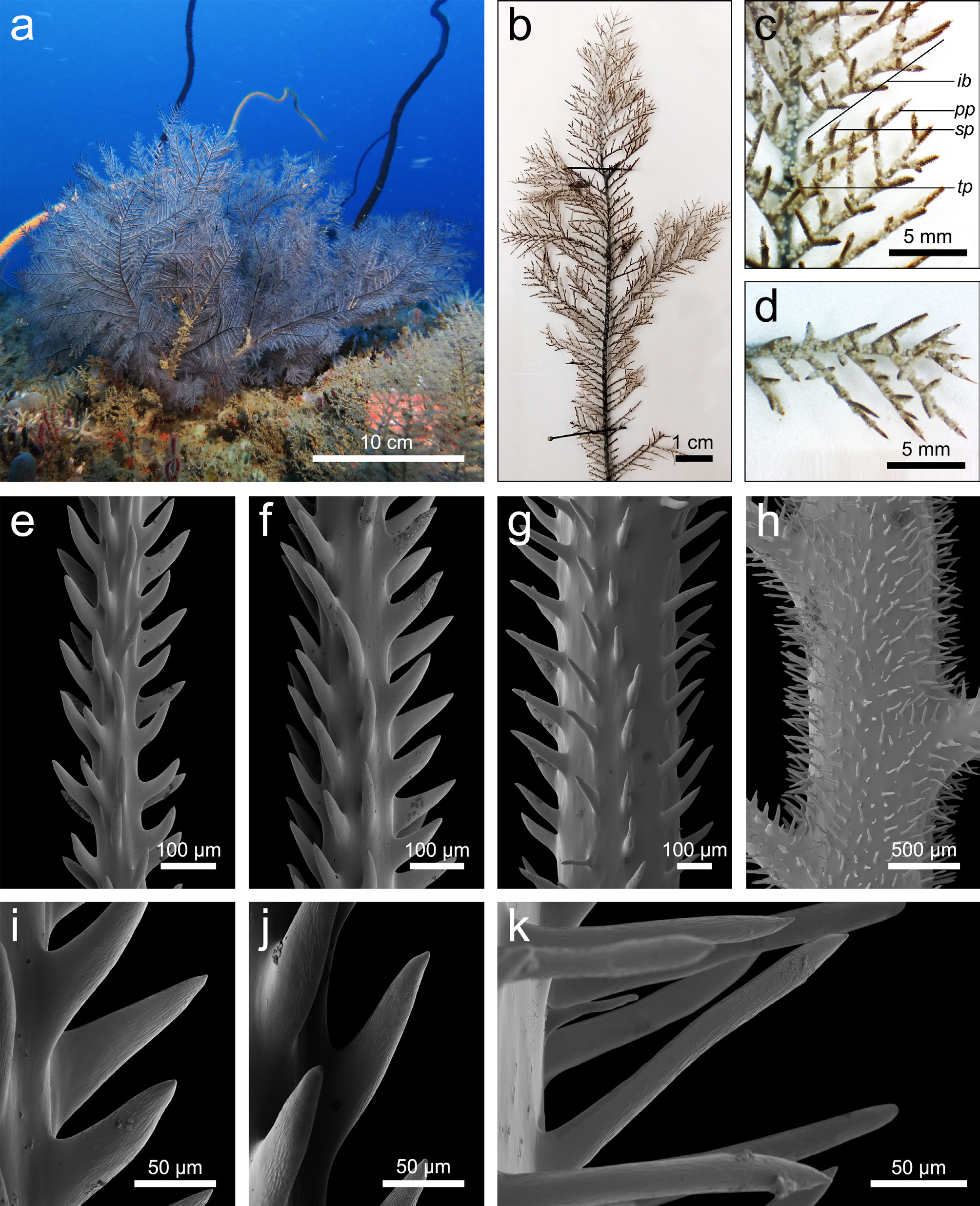
Description. The colony is branched and measures around 35 cm in width and 20 cm in height, with a basal diameter of 3 mm (Fig. 24, a). The branching pattern is planar and flabellate, and the colony is white colored (Fig. 24, a). It is branched up to the 6 th order with branches measuring up to 15 cm in length (Fig. 24, a). The branches tend to form individual fronds separated from each other but overlapping (Fig. 24, a). The primary pinnules are biserial alternate and measure 2.5 – 11.5 mm, but average 7 mm (Fig. 24, b). They are inclined 30 – 60 ° to the branch, with an average of 45 ° (Fig. 24, b). In each row the primary pinnules are spaced 1.0 – 3.0 mm apart, with an average of 1.7 mm (Fig. 24, b). There are generally 7 – 8 primary pinnules occurring along one cm of a branch, counting those in both lateral rows (Fig. 24, b). Secondary pinnules measure up up to 3 mm in length with an average of 2 mm and are always present (Fig. 24, b – d). The first secondary pinnule is generally inserted around 1 mm above the base of the primary pinnule, but sometimes further away. They are also inserted out of the plane formed by the primary pinnules (Fig. 24, c, d). Up to four uniserial secondaries are found on primaries, afterwards they tend to be biserial on the distal part of the primaries when they become incipent branches (Fig. 24 b – d). Short single tertiary pinnules are also present, but not on all secondary pinnules (Fig. 24, c, d). The polyps are located on a single side of the pinnules, but on thicker branches they can be spaced irregularly all around the axis. Polyps measure up to 1 mm and are spaced up to 0.7 mm apart, for about 10 – 12 polyps per cm. The spines on the pinnules are tall, conical and either straight or slightly horn-shaped, and they are inclined upwards (Fig. 24, e, f). They are slightly papillose on two-thirds of their surface, with papillae slightly elongated towards the tip of the spines (Fig. 24, i, j). On a subpinnule measuring 0.09 mm in diameter, five longitudinal rows of spines are seen, and there are no differences in the size of the polypar and abpolypar spines which measure 0.08 – 0.12 mm and are spaced 0.09 – 0.16 mm apart, except on polypar side where the mutual distance reaches up to 0.18 mm (Fig. 24, e). On a primary pinnule 0.14 mm in diameter, there are also no differences in the size of the polypar and abpolypar spines, which measure 0.10 – 0.14 mm. The abpolypar spines are spaced 0.10 – 0.18 mm apart, and the polypar spines up to 0.23 mm apart (Fig. 24, f). However, the inclination of abpolypar spines is more pronounced than the polypar spines (Fig. 24, f). The spines become more numerous and taller, narrower and needlelike as the axis gets thicker, with the longitudinal rows being lost (Fig. 24, g, h). On thick branches about 1 mm in diameter, their inclination is no longer very regular, and some are inclined basally as well as distally and others are perpendicular to the axis (Fig. 24, h). On such branches, the spines are needle-like and still slightly papillose, with the papillae elongated towards the tip of the spine (Fig. 24, k). Bifid spines are almost absent (Fig. 24, g). On these branches there is no distinction between polypar and abpolypar spines. They measure 0.14 – 0.22 mm in height on a branch 0.9 mm in diameter, and the mutual distance cannot be calculated as the longitudinal arrangement is lost. Taxonomic remarks. Among the Myriopathes species with a flabellate corallum, which encompasses M. ulex, M. panamensis, M. stechowi, M. spinosa, M. rugosa and M. myriophylla (see Opresko 2001), only M. myriophylla has a pinnulation pattern similar to that of the Malagasy specimen and only M. myriophylla has tertiary pinnules. In the type specimen, the primary pinnules are up to 7 mm long and the secondary pinnules 2 mm long. These lengths are similar to those seen in the Malagasy specimen. The secondary pinnules of the latter specimen do not have the tendency to be on the lowermost portion of each primary as much as in M. myriophylla (Opresko 2001), as they are generally found 1 mm from the base of the primary. Additionally, a single tertiary pinnule occurs in the present specimen as seen in the neotype of M. myriophylla described by Opresko (2001). Therefore, the present specimen is assigned to M. cf. myriophylla and the slight differences (seen in angles of insertions of the pinnules, their number per cm or the maximum length of the pinnules for instance) are considered here as small variations.
Terrana, Lucas, Bo, Marzia, Opresko, Dennis M., Eeckhaut, Igor (2020): Shallow-water black corals (Cnidaria: Anthozoa: Hexacorallia: Antipatharia) from SW Madagascar. Zootaxa 4826 (1): 1-62, DOI: 10.11646/zootaxa.4826.1.1