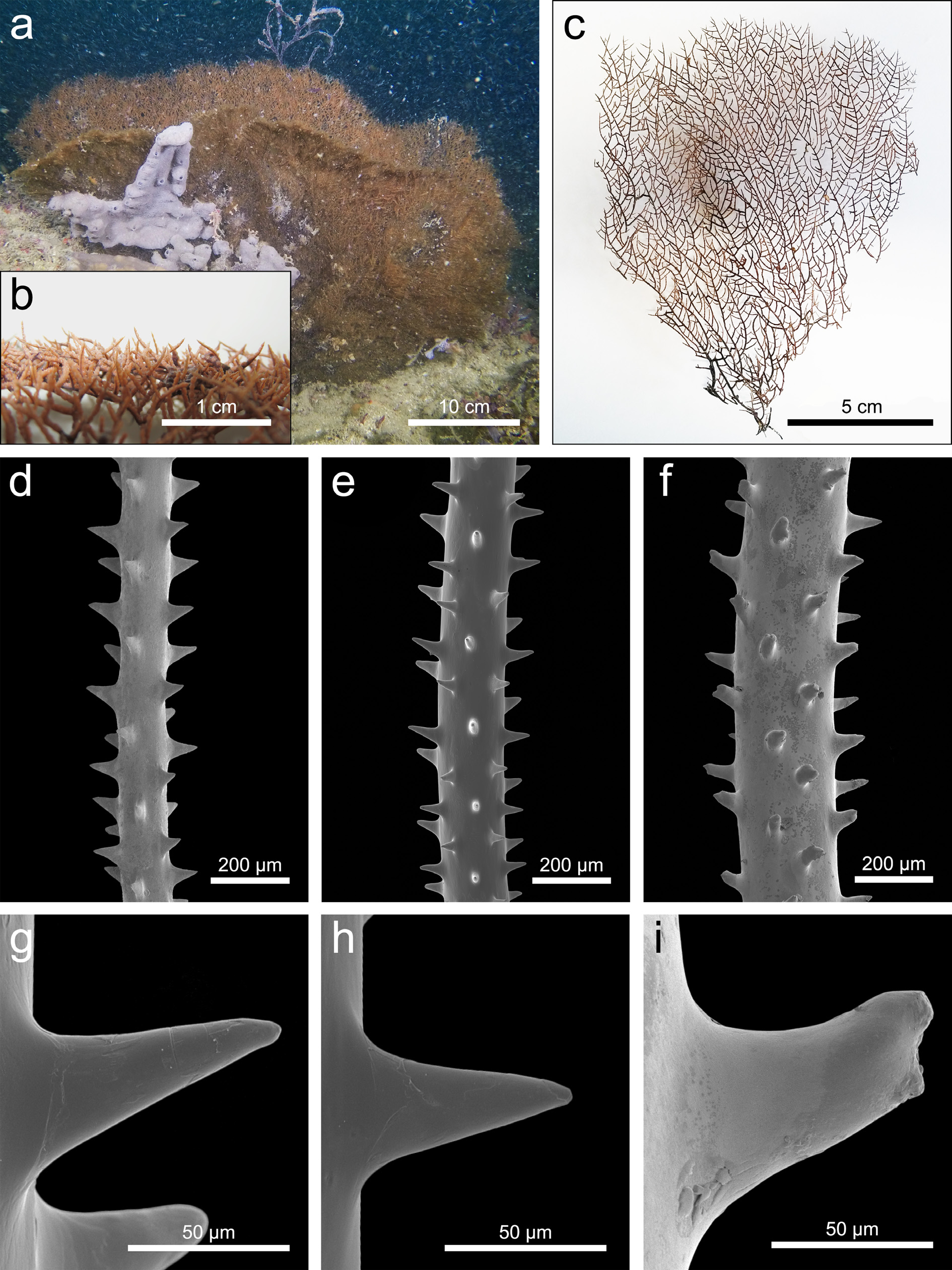
Description. A branched, flabellate and highly anastomosed colony with a brownish color (Fig. 4, a). It measures 45 cm wide and 30 cm high, but larger colonies exist. The general appearance is that of a fan, but with a distinctly horizontal plate-like portion towards the most distal portion of the corallum which extends out perpendicular to the plane of the fan (Fig. 4, a). This plate-like portion is not found on every specimen. The corallum is reticulated; the branches grow almost vertically and bear branchlets which are slightly bent upwards and often fused with the adjacent branchlets (Fig. 4, c). These branchlets measure 1.0 – 6.0 mm in length and generally have a biserial alternate arrangement, although branchlets can be sub-opposite or opposite to a branchlet on the other side with an average spacing of 1.9 ± 0.9 mm and 7 – 13 branchlets per cm. Branchlets are inserted on the branches with angles varying between 60 – 100 ° with an average of 79 ± 10 ° in a single plane. A third order of branchlets is rarely found, they measure 0.8 – 2.0 mm in length with a uniserial arrangement. When present, these small branchlets are inserted with angles varying between 60 – 100 ° with an average of 85 ± 15 °. Terminal branchlets which are not fused are sometimes projecting out of the plane of the fan, mostly on one side (Fig. 4, b). The polyps are all located on the same side of the colony, and 9 – 12 polyps are found per cm. Polyps measure 0.6 – 0.9 mm in transverse diameter and are spaced 0.06 – 0.95 mm apart, with an average of 0.32 ± 0.15 mm. Living expanded tentacles seen during the day are small, thick and rounded at the tip. Polyps are arranged in a single row except on the thicker branches where they are less uniform in arrangement and further apart. The spines are smooth, conical with a sharp apex and generally stand at right angle to the corallum, although sometimes the distal margin is slightly inclined upwards (Fig. 4, d – h). Spines are arranged in 5 - 6 longitudinal rows. On a branchlet measuring 0.14 mm in diameter, polypar and abpolypar spines have the same size range of 0.06 - 0.09 mm and are spaced 0.19 – 0.29 mm and 0.16 – 0.27 mm apart, respectively. On a branch measuring 0.24 mm in diameter, polypar spines measure 0.07 – 0.10 mm and are spaced 0.10 – 0.35 mm apart, while abpolypar spines measure 0.06 – 0.09 mm and are spaced 0.17 – 0.30 mm apart. On such branches, some spines show irregular shapes and growths and can be multi-lobed (Fig. 4, f, i). Taxonomic remarks. Within the Antipathidae, anastomosed colonies are also found within Arachnopathes Milne Edwards H., 1857, which shows a distinctly bush-like corallum (Opresko 2006). Similarly, within Stylopathidae, there are species with anastomosed ramifications as well as genera, such as Tylopathes, with a similar spine and polyp arrangement; nevertheless, no shallow-water species are known in this family (Opresko 2006). This species was originally described from the Indian Ocean by Pallas (1766). In the literature, most of the descriptions of this species have been made during the 19 th century, with a specimen from Madagascar in the British Museum Collection described by Brook (1889) and very similar to the present specimen. In Brook’s specimen, the flattened plate-like portion of the fan is also present. He reports subalternating branchlets measuring 3 to 6 mm, bent upwards and usually fused, as well as free branchlets out of the plane of the fan. Five longitudinal rows of spines can be seen from one aspect. These spines have a sharp apex, most of them being inserted at right angle but some hooked upwards. Schultze (1896) also describes a specimen from Moluccas, Indonesia having very similar features as the present one. His specimen has 3 – 5 mm long terminal branchlets with numerous fusions, some of the free ones growing out of the plane of the fan as well. The spines are conical and narrow, smooth with rounded or sharp tips, and inserted at right angle to the corallum. They measure 0.095 mm and five to six rows can be seen from one aspect. The transverse diameter of the polyps measures 0.75 mm and ten are found per cm. On the other hand, the small specimen (10 cm) described by Brito & Ocana (2004) from Canary Islands only shares the size (0.1 mm) and the morphology of the spines, which were reported as being conical. It has longer branchlets (1 – 10 mm long) and more longitudinal rows of spines (5 – 8). The photo of the colony presented by these authors reveal a main axis reaching the distal part of the colony, from which numerous thinner branches and branchlets arise, a feature which is not seen in the Malagasy specimen. Considering these differences and the locality (East Atlantic), a reexamination of Brito & Ocana’s specimen should be conducted. A neotype should be described for this species, as the type material is lost.
Terrana, Lucas, Bo, Marzia, Opresko, Dennis M., Eeckhaut, Igor (2020): Shallow-water black corals (Cnidaria: Anthozoa: Hexacorallia: Antipatharia) from SW Madagascar. Zootaxa 4826 (1): 1-62, DOI: 10.11646/zootaxa.4826.1.1