AnimaliaacceptedgenusAccepted
Phalacrostemma

Phalacrostemma

Marenzeller, 1895

GBIF:177008354

0year

ABOUT

Descriptions(4)

Description. Body incomplete, reddish-brown preserved in alcohol, gradually tapering to posterior end (Fig 10 A). Body length 4.0 mm from paleae to parathoracic segments, 0.9 mm maximum in body width. Opercular lobes completely fused with distal end perpendicular to longitudinal axis (Fig 10 B). Operculum with 12 pairs of broken outer paleae; outer paleae golden as simple spines with pointed tips and compact thecae with straight, not expanded margins (Fig. 10 A, E – G). One pair of inner paleae present, amber, with smooth surface and tapering tips. Eight pairs of robust and tapering opercular papillae, peripheral to outer paleae (Fig. 10 B – C), not extending to tip of outer paleae. Two pairs of flattened nuchal hooks, with poorly developed limbation on concave side (Fig. 10 D). A medial organ present at dorsal junction of opercular lobes. Eyes not observed. Tentacular filaments absent (Fig. 10 B – C). A pair of buccal flaps present (Fig. 10 B). A pair of short robust palps, not extending to operculum (Fig. 10 B). Thoracic segment 1 (chaetiger 1) with pair of long and tapering neuropodial cirri and capillary chaetae (Fig. 10 B – C). Thoracic segment 2 (chaetiger 2) with one pair of broad triangular lateral lobes between branchia and neuropodia (Fig. 10 C). Eight pairs of dorsal tapering branchiae present from thoracic segment 2, largest ones on parathoracic segments, reducing posteriorly in size from abdominal segment 8. Segments 3 – 6 (parathoracic) with two types of notochaetae arranged in transverse rows; about 4 – 6 robust nonretractile lanceolate chaetae interspersed with some fine capillaries (Fig. 10 A, H). Segments 3 – 6 with two types of neurochaetae arranged transversely, about four fine lanceolate chaetae interspersed with several fine short capillaries. Notopodial lanceolate chaetae much stouter than those in neuropodia (Fig. 10 A). Abdominal notopodia as erect expanded tori, with number of uncini within torus decreasing posteriorly. Neuropodia with long fine capillaries. Cauda lost (Fig. 10 A). Tube unknown.
Zhang, Jinghuai, Hutchings, Pat, Burghardt, Ingo, Kupriyanova, Elena (2020): Two new species of Sabellariidae (Annelida, Polychaeta) from the abyss of eastern Australia. Zootaxa 4821 (3): 487-510, DOI: 10.11646/zootaxa.4821.3.4
Fig. 10
Zhang, Jinghuai, Hutchings, Pat, Burghardt, Ingo, Kupriyanova, Elena (2020): Two new species of Sabellariidae (Annelida, Polychaeta) from the abyss of eastern Australia. Zootaxa 4821 (3): 487-510, DOI: 10.11646/zootaxa.4821.3.4
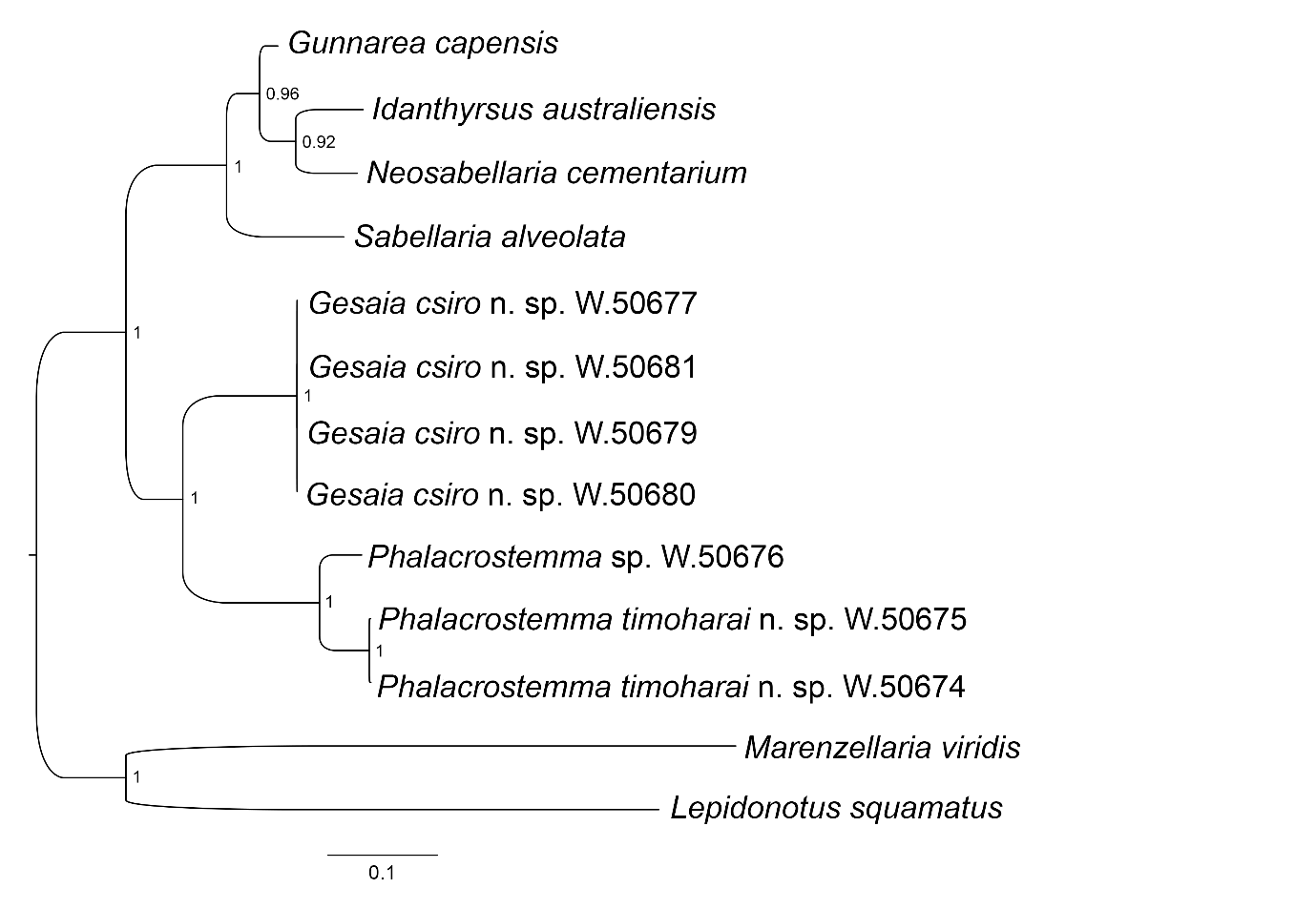
Remarks. This single specimen from 1761 – 1770 m is different from the specimens of P. timoharai n. sp. It has 12 pairs of outer paleae (but many are broken), a pair of inner paleae, two pairs of nuchal hooks and non-retractile lanceolate notopodial chaetae on segments 3 – 6 (Fig. 10 F & Table 3). While the specimen clearly represents a new species as also confirmed by molecular results (Fig. 11), it is too damaged to be described formally as a new species. We have included it here to highlight that an additional species of this genus is present in the Coral Sea.
Zhang, Jinghuai, Hutchings, Pat, Burghardt, Ingo, Kupriyanova, Elena (2020): Two new species of Sabellariidae (Annelida, Polychaeta) from the abyss of eastern Australia. Zootaxa 4821 (3): 487-510, DOI: 10.11646/zootaxa.4821.3.4
Material examined. St. 128, 23 º 37.872´– 23 º 39.54´S 154 º 39.582´– 154 º 38.628´E, 1761 – 1770 m, beam trawl, 13 th June 2017, AM W. 50676, 1 spec. (tissue sample taken).
Zhang, Jinghuai, Hutchings, Pat, Burghardt, Ingo, Kupriyanova, Elena (2020): Two new species of Sabellariidae (Annelida, Polychaeta) from the abyss of eastern Australia. Zootaxa 4821 (3): 487-510, DOI: 10.11646/zootaxa.4821.3.4

Export occurrence data

Darwin Core Archive (ZIP)

CLASSIFICATION

Taxonomic Classification Tree

MULTIMEDIA

Media Files(2)

FIGURE 10. Photos of Phalacrostemma sp. (AM W.50676). A. Anterior end, lateral view. B. Close-up view of buccal cavity with palps, ventral view. C. Close-up view of anterior end, lateral view. D. Nuchal hooks. E–G. Close-up view of distal (E), middle (F) and proximal (G) parts of outer paleae. H. Notochaetae from segment 6. Abbreviations: bf, buccal flaps; cac, capillary chaeta; lac, lanceolate chaetae; nec, neuropodial cirri; nh, nuchal hooks; op, outer paleae; pa, palp; s, segment.

Imageimage/png© Zhang, Jinghuai;Hutchings, Pat;Burghardt, Ingo;Kupriyanova, ElenaZhang, Jinghuai;Hutchings, Pat;Burghardt, Ingo;Kupriyanova, Elena

FIGURE 11. Bayesian majority rule consensus phylogram of the family Sabellariidae based on the concatenated dataset of COI, 16S, 18S and 28S sequences. Outgroups: Marenzellaria viridis and Lepidonotus squamatus. Numbers next to branches are posterior probabilities obtained from the Bayesian analysis.

Imageimage/png© Zhang, Jinghuai;Hutchings, Pat;Burghardt, Ingo;Kupriyanova, ElenaZhang, Jinghuai;Hutchings, Pat;Burghardt, Ingo;Kupriyanova, Elena

IMAGES

Gallery(2)

See Gallery

Occurrences with images

Source Information

Two new species of Sabellariidae (Annelida, Polychaeta) from the abyss of eastern Australia

checklist

This dataset contains the digitized treatments in Plazi based on the original journal article Zhang, Jinghuai, Hutchings, Pat, Burghardt, Ingo, Kupriyanova, Elena (2020): Two new species of Sabellariidae (Annelida, Polychaeta) from the abyss of eastern Australia. Zootaxa 4821 (3): 487-510, DOI: 10.11646/zootaxa.4821.3.4

Abstract

In May–June 2017 an expedition on board RV ‘Investigator’ sampled benthic communities along the lower slope and abyss of eastern Australia from off Tasmania to the Coral Sea. Over 200 sabellariid specimens of the genera Phalacrostemma and Gesaia were collected during the voyage and deposited in the Australian Museum. Here we describe two new species Gesaia csiro n. sp. (4414–4436 m) and Phalacrostemma timoharai n. sp. (1013–1093 m). We did not formally describe another species of Phalacrostemma due to poor condition of the single specimen. Gesaia csiro n. sp. is the first record of the genus from Australian waters (only a planktonic larva attributed to the genus has previously been recorded), and it can be distinguished from other congeners by the smooth surface of inner paleae, distal thecae of outer paleae with long, irregular and expanded distal fringe and circled distal margin. Phalacrostemma timoharai n. sp. differs from congeners by the following combination of characters: presence of the buccal flap, absence of tentacular filament, 18–22 pairs of outer paleae, two pairs of neuropodial cirri on first thoracic segment, and only one pair of lateral lobes on second thoracic segment. Morphological descriptions are accompanied by mitochondrial cytochrome c oxidase subunit 1 (COI) and ribosomal (16S, 18S and 28S) sequence data. A key to all Australian species of sabellariids is given.

Zhang J, Hutchings P, Burghardt I, Kupriyanova E, plazi (2020). Two new species of Sabellariidae (Annelida, Polychaeta) from the abyss of eastern Australia. Plazi.org taxonomic treatments database. Checklist dataset https://doi.org/10.11646/zootaxa.4821.3.4 accessed via GBIF.org on 2026-06-15.

CC0Published 8/3/2020View dataset
GBIF Usage Key
177008354
Dataset Key
30186aa6-d5ef-4204-907b-1b6bc37af396
Origin
source
Backbone Key
2326482
Taxon ID
857C86680E7DFFF2B9F13C9FFAF5EEC8.taxon
Last Crawled
6/10/2026
Last Interpreted
6/10/2026