AnimaliaNot EvaluatedacceptedspeciesAccepted
Gesaia csiro

Gesaia csiro

Zhang, Hutchings, Burghardt & Kupriyanova, 2020

GBIF:177008358

0year

ABOUT

Descriptions(9)

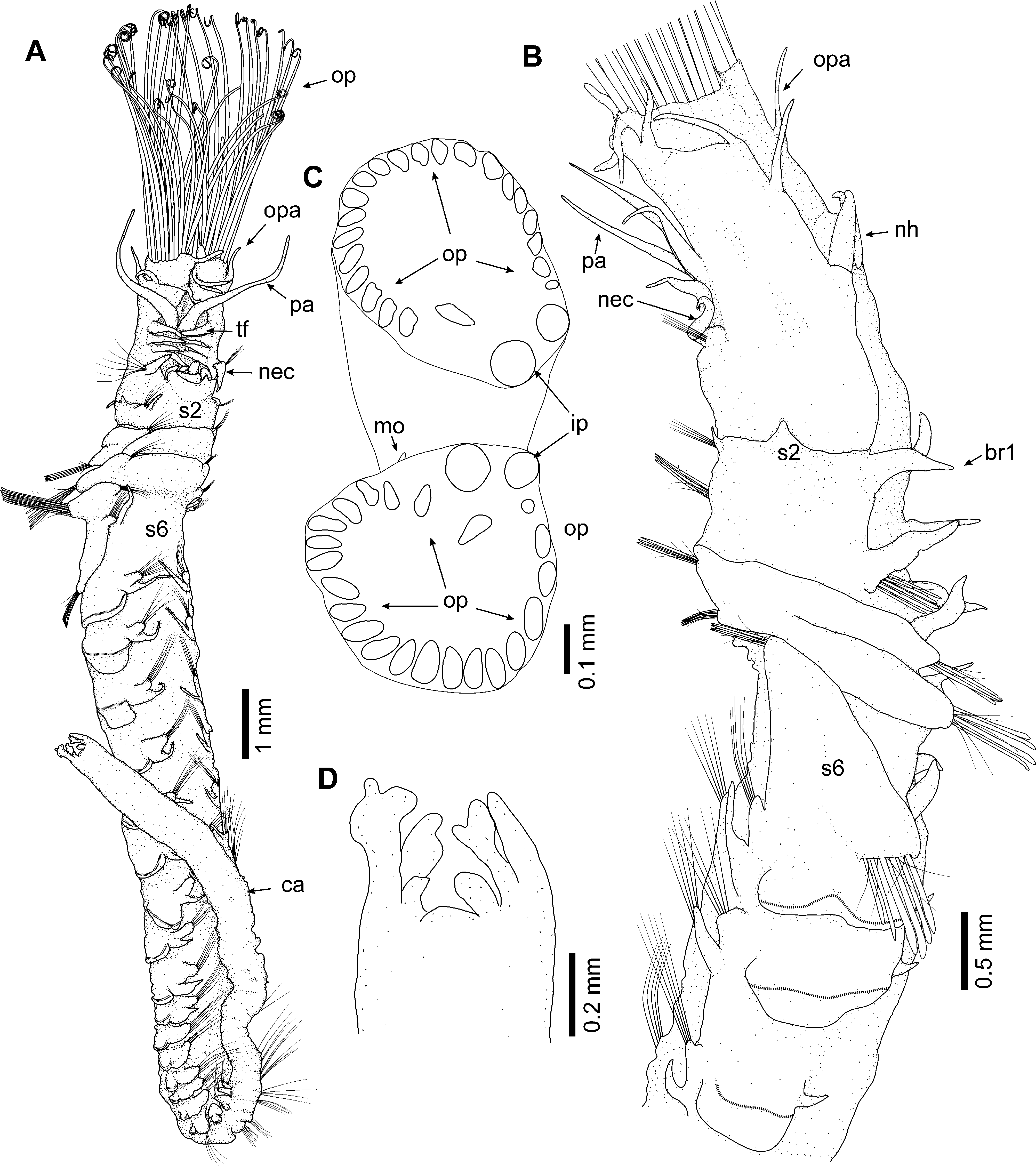
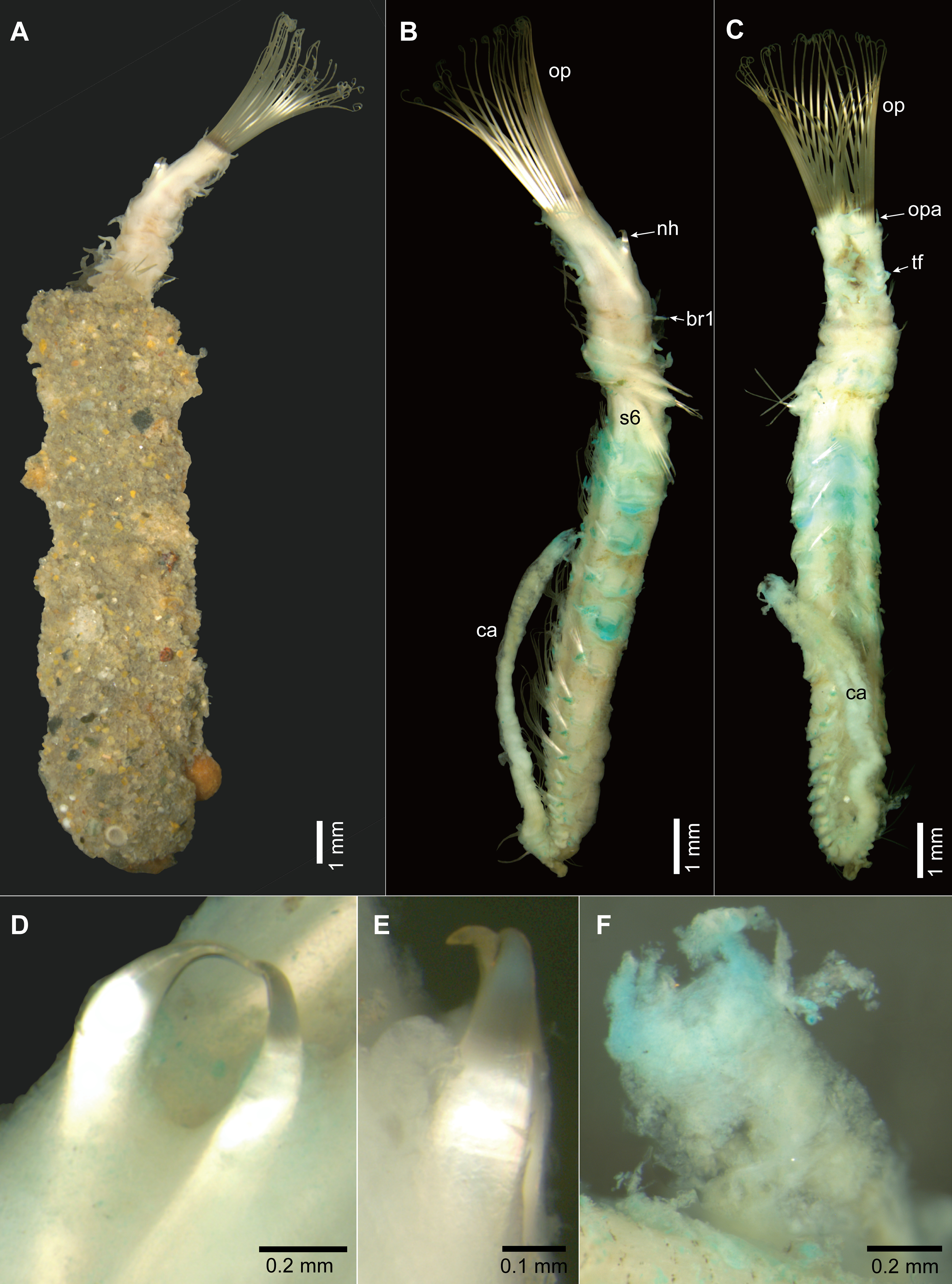
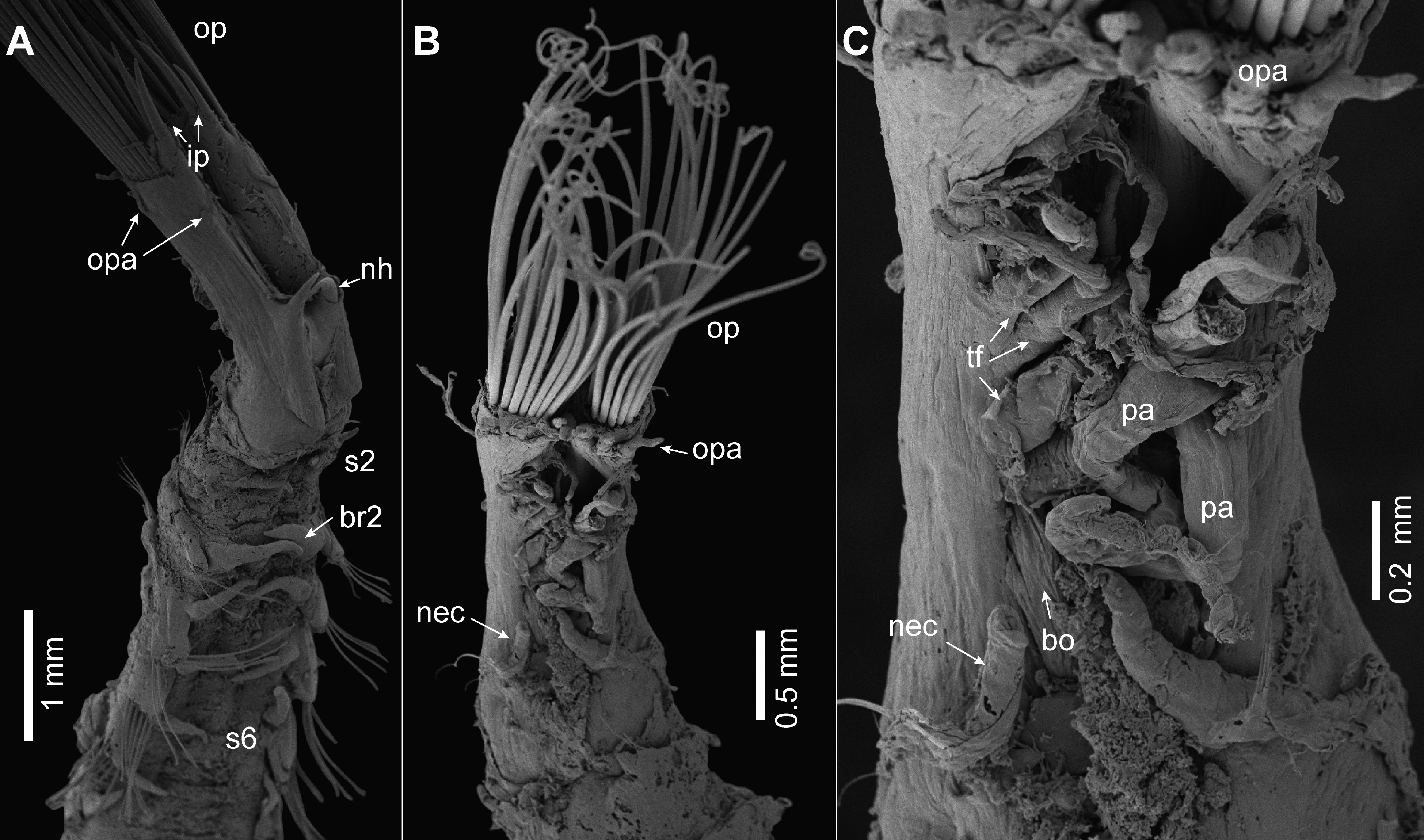
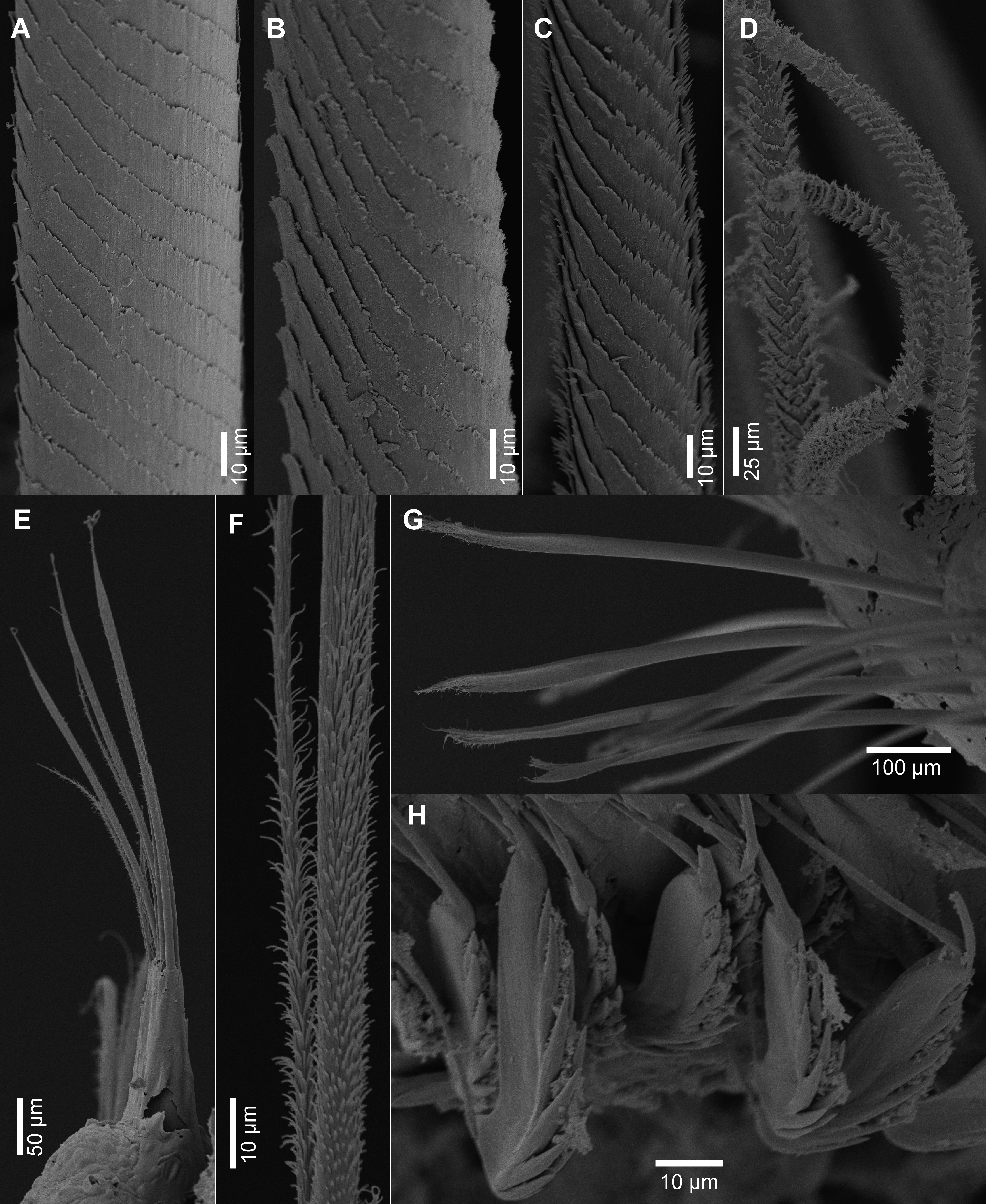
Description. Holotype white after preservation in alcohol. Body tapering from abdomen to cauda, long cauda folded back onto ventrum. Holotype 14.5 mm in body length (length of paleae 4 mm, of operculum and thorax 2.5 mm, of abdomen 6 mm and of cauda 2 mm); 1.7 mm maximum body width (Figs 2 A, 3 B – C). Operculum completely divided into two elongated lobes with distal ends perpendicular to longitudinal axis (Figs 3 B – C, 4 A). Operculum with 22 pairs of outer paleae, arranged in a circle around opercular lobes (Fig. 2 C); outer paleae golden, slightly flattened, elongated, ending in fine tips rolled inward (Figs 2 A, C, 3 A – C, 4 B). Thecae ornamented, arranged diagonally; basal thecae complete, with slightly serrated distal edges (Fig. 5 A); thecae of middle part complete, distal edges slightly-expanded with weakly serrated margins (Fig. 5 B) and with short irregular distal fringes (Fig. 5 C); thecae of distal part with elongated tips, and margins with heavily serrated margins (Fig. 5 D). Two inner paleae on each opercular lobe; these paleae straight, circular in cross-section, golden, with smooth surface and tapering tips (Figs 2 C, 4 A). Six pairs of opercular papillae, arranged spirally from nuchal hooks to ventral-inner distal end of operculum (Figs 2 A – B, 4 A – C). A pair of cylindrical nuchal hooks, conspicuously curved without limbation (Figs 2 B, 3 B, D – E, 4 A). A small medial organ at dorsal junction of opercular lobes (Fig. 2 C). Eyes absent. Three pairs of tentacular filaments (Figs 2 A, 3 C, 4 C). Buccal flaps absent (Fig. 4 C). Pair of fine long palps extended beyond operculum (Figs 2 A, 4 C). Segment 1 (thoracic) with a pair of long tapering neuropodial cirri and capillary chaetae (Figs 2 A – B; 4 C). Segment 2 (thoracic) with a pair of triangular lateral lobes between dorsal branchia and neuropodia with capillary chaetae, notopodia absent (Figs 2 B, 4 A). Eleven pairs of dorsal tapering branchiae present on chaetigers 2 – 12, largest ones on chaetigers 3 – 6, subsequently reducing posteriorly in size (Figs 2 B, 4 A). Segments 3 – 4 respectively with one ventral lobe, without neuropodial cirri (Figs 2 A – B, 3 B – C, 4 A). Segments 3 – 6 (parathoracic) with two types of chaetae on noto- and neuropodia arranged in transverse rows: notopodia with 5 – 6 long robust lanceolate chaetae interspersed with few fine capillaries (Figs 2 A – B, 4 A; 5 G); neuropodia with about four fine lanceolate chaetae interspersed with several fine capillaries (Fig. 5 E – F). Notopodial lanceolate chaetae much stouter than neuropodial ones (Figs 2 A – B, 3 B, 5 E – G). Notopodial lanceolate chaetae on segment 6 directed more posteriorly than those on segments 3 – 5. Abdominal notopodial tori decreasing in size posteriorly, with number of uncini per row decreasing respectively. Each uncinus with two longitudinal rows of teeth (Fig. 5 H). Neuropodia bearing long fine capillaries with fringes of thecae (Figs 2 A – B, 3 B – C). Cauda fine long, about two third length of abdomen (Figs 2 A, 3 B – C). Anus flat with three appendages on each side (Figs 2 D, 3 F). Tube made of fine sand. Variability. The paratypes are 19.6 – 30.1 mm in length (measured without cauda), 1.7 – 2.3 mm in width, have 21 – 23 chaetigers (only counting specimens with cauda), 15 – 24 pairs of outer paleae, 2 – 3 pairs of inner paleae, 5 – 8 pairs of opercular papillae, and 3 – 6 pairs of tentacular filaments. Several specimens from AM W. 58081 have two pairs of nuchal hooks, an anterior pair of small hooks and a pair of large hooks posteriorly, which suggests that these hooks may be regenerating.
Zhang, Jinghuai, Hutchings, Pat, Burghardt, Ingo, Kupriyanova, Elena (2020): Two new species of Sabellariidae (Annelida, Polychaeta) from the abyss of eastern Australia. Zootaxa 4821 (3): 487-510, DOI: 10.11646/zootaxa.4821.3.4

Figures 2 – 5, Table 2
Zhang, Jinghuai, Hutchings, Pat, Burghardt, Ingo, Kupriyanova, Elena (2020): Two new species of Sabellariidae (Annelida, Polychaeta) from the abyss of eastern Australia. Zootaxa 4821 (3): 487-510, DOI: 10.11646/zootaxa.4821.3.4
Diagnosis. (after Capa & Hutchings 2019). Operculum with lobes completely fused to each other and distal disc perpendicular to operculum. Eight to 10 pairs of long and conical papillae around opercular lobes. Tentacular filaments absent or present along margins of buccal cavity. Buccal flaps present (or secondarily absent). One pair of palps similar in length to operculum. Median organ at dorsal junction of opercular lobes. Outer paleae arranged in a spiral, with straight cylindrical or slightly flattened blades with ornamented thecae. Few (two to eight) pairs of inner opercular paleae arranged in a short line on dorsal half of inner margin of opercular lobes, with straight cylindrical or slightly flattened blades with smooth margins. Two to five pairs of nuchal hooks with limbation on concave margin. Neuropodia of segment 1 with one to three pairs of cirri. Thoracic branchiae present. Four parathoracic segments. Parathoracic notopodia with lanceolate chaetae interspersed with capillaries, neuropodia with fine lanceolate chaetae interspersed with capillaries.
Zhang, Jinghuai, Hutchings, Pat, Burghardt, Ingo, Kupriyanova, Elena (2020): Two new species of Sabellariidae (Annelida, Polychaeta) from the abyss of eastern Australia. Zootaxa 4821 (3): 487-510, DOI: 10.11646/zootaxa.4821.3.4
Remarks. Gesaia csiro n. sp. differs from congeners by a combination of characters such as smooth surface of inner paleae, distal thecae of outer paleae with long, irregular and expanded distal fringe, distal margin of distal thecae of outer paleae circled and nearly horizontal to the longitudinal axis of blade (Table 2). Gesaia csiro n. sp. has smooth surface of inner paleae and thus differs from G. elegans Fauvel, 1911, G. hessi Kirtley, 1994 and G. ryani Kirtley, 1994 that are characterized by poorly ornamented surfaces of inner paleae. Gesaia csiro n. sp. has long expanded distal fringe of distal thecae of outer paleae, while G. ryani lacks the distal fringe altogether, and in G. hartmanae Kirtley, 1994 and in G. lanai Kirtley, 1994 this distal fringe is short and unexpanded. Gesaia csiro n. sp. can be distinguished from G. fauchaldi Kirtley, 1994, G. fossae Kirtley, 1994, and G. vityazia Kirtley, 1994 by the distal margin of distal thecae of outer paleae: the margin of distal thecae is complete, not splayed and horizontal in G. csiro n. sp., but G. fauchaldi and G. vityazia have hemithecate distal margins, while G. fossae has complete, splayed distal margin. Kirtley (1994) described seven new Gesaia species from the upper bathyal to lower abyssal zone of the Pacific, Atlantic, South Indian and Southern oceans. Since Kirtley (1994) and until this study, no new species of Gesaia were described, but most of the descriptions of Kirtley (1994) are based entirely on the morphology of the paleae, with few body characters described. Specimens of Gesaia are easily broken at segment 7, and it is difficult to extract entire animals from their tubes as the posterior part of the body is fragile and breaks off. While the characters of the paleae do not get distorted during preservation and are useful to identify these species, a comprehensive review of the genus based on freshly collected material with entire body described would be very useful.
Zhang, Jinghuai, Hutchings, Pat, Burghardt, Ingo, Kupriyanova, Elena (2020): Two new species of Sabellariidae (Annelida, Polychaeta) from the abyss of eastern Australia. Zootaxa 4821 (3): 487-510, DOI: 10.11646/zootaxa.4821.3.4
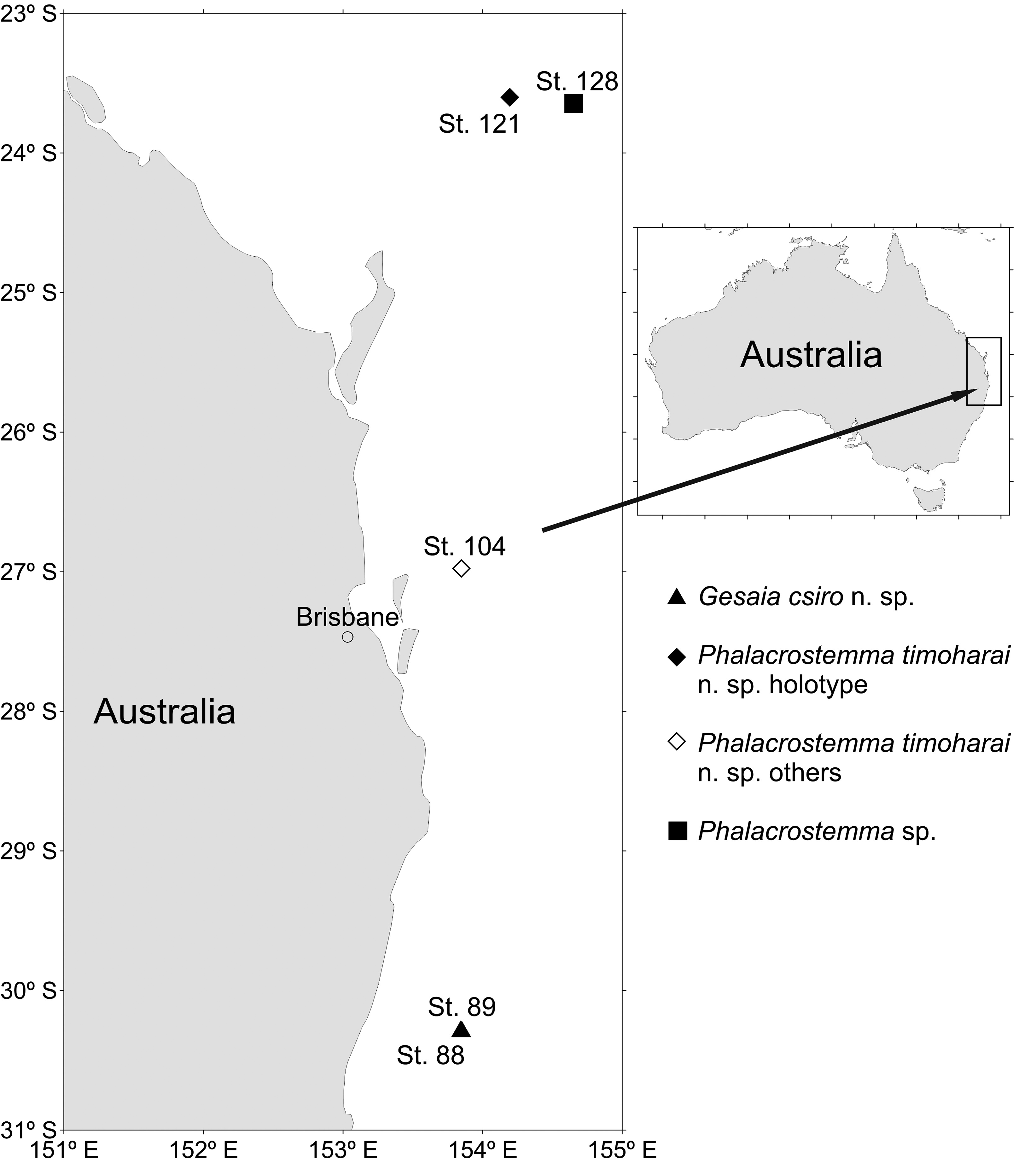
Distribution. Off the east coast of Australia from 30 º 15.798´– 30 º 17.358´S. The species is known only from type locality (Fig. 1). Habitat. Depths 4401 – 4481 m. Tubes built of fine sand forming colonies on substrate.
Zhang, Jinghuai, Hutchings, Pat, Burghardt, Ingo, Kupriyanova, Elena (2020): Two new species of Sabellariidae (Annelida, Polychaeta) from the abyss of eastern Australia. Zootaxa 4821 (3): 487-510, DOI: 10.11646/zootaxa.4821.3.4
Etymology. The species was named after the Commonwealth Scientific and Industrial Research Organisation (CSIRO) that manages and operates R / V “ Investigator ” as the Marine National Facility. Genus Phalacrostemma Marenzeller, 1895
Zhang, Jinghuai, Hutchings, Pat, Burghardt, Ingo, Kupriyanova, Elena (2020): Two new species of Sabellariidae (Annelida, Polychaeta) from the abyss of eastern Australia. Zootaxa 4821 (3): 487-510, DOI: 10.11646/zootaxa.4821.3.4
Material examined. Holotype with tube, St. 89, 30 º 15.798´– 30 º 17.358´S, 153 º 51.522´– 153 º 50.628´E, 4414 – 4436 m, Brenke epibenthic sledge, 6 th June 2017, AM W. 49506. Paratypes: St. 88, 30 º 15.840´– 30 º 17.202´S, 153 º 52.2´– 153 º 49.812´E, 4401 – 4481 m, beam trawl, 6 th June 2017, AM W. 50680, 140 specs; AM W. 50681, 12 specs, W. 50681.001 (tissue sample taken). St. 89, 30 º 15.798´– 30 º 17.358´S 153 º 51.522´– 153 º 50.628´E, 4414 – 4436 m, Brenke epibenthic sledge, 6 th June 2017, AM W. 52780, 4 specs; AM W. 50680.001 to AM W. 50680.004, 4 dry specs, mounted on SEM stubs. Other material examined: St. 89, 30 º 15.798´– 30 º 17.358´S 153 º 51.522´– 153 º 50.628´E, 4414 – 4436 m, Brenke epibenthic sledge, 6 – 7 th June 2017, AM W. 50678, 29 specs; AM W. 50679, 11 specs (tissue sample taken); St. 128, 23 ° 37.8667 ’ S 154 ° 39.5833 ’ E, 1761 – 1770 m, 13 th June 201, beam trawl, AM W. 50677, 7 specs (tissue sample taken).
Zhang, Jinghuai, Hutchings, Pat, Burghardt, Ingo, Kupriyanova, Elena (2020): Two new species of Sabellariidae (Annelida, Polychaeta) from the abyss of eastern Australia. Zootaxa 4821 (3): 487-510, DOI: 10.11646/zootaxa.4821.3.4
Type locality. Off Pelagossa Island, Adriatic Sea.
Zhang, Jinghuai, Hutchings, Pat, Burghardt, Ingo, Kupriyanova, Elena (2020): Two new species of Sabellariidae (Annelida, Polychaeta) from the abyss of eastern Australia. Zootaxa 4821 (3): 487-510, DOI: 10.11646/zootaxa.4821.3.4
Type species. Phalacrostemma cidariophilum Marenzeller, 1895, by monotypy.
Zhang, Jinghuai, Hutchings, Pat, Burghardt, Ingo, Kupriyanova, Elena (2020): Two new species of Sabellariidae (Annelida, Polychaeta) from the abyss of eastern Australia. Zootaxa 4821 (3): 487-510, DOI: 10.11646/zootaxa.4821.3.4

Export occurrence data

Darwin Core Archive (ZIP)

CLASSIFICATION

Taxonomic Classification Tree

MULTIMEDIA

Media Files(5)

FIGURE 1. Map illustrating the sampling localities of Gesaia csiro n. sp., Phalacrostemma timoharai n. sp. and Phalacrostemma sp.

Imageimage/png© Zhang, Jinghuai;Hutchings, Pat;Burghardt, Ingo;Kupriyanova, ElenaZhang, Jinghuai;Hutchings, Pat;Burghardt, Ingo;Kupriyanova, Elena

FIGURE 2. Line drawings of Gesaia csiro n. sp. holotype (AM W.49506). A. Entire animal, ventral view. B. Anterior end, lateral view. C. Diagramatic presentation of arrangement of paleae on each opercular lobe. D. Anus. Abbreviations: br, branchiae; ca, cauda; ip, inner paleae; mo, medial organ; nec, neuropodial cirrus; nh, nuchal hooks; op, outer paleae; opa, opercular papillae; pa, palp; s, segment; tf, tentacular filaments.

Imageimage/png© Zhang, Jinghuai;Hutchings, Pat;Burghardt, Ingo;Kupriyanova, ElenaZhang, Jinghuai;Hutchings, Pat;Burghardt, Ingo;Kupriyanova, Elena

FIGURE 3. Photos of Gesaia csiro n. sp. holotype (AM W.49506). A. Anterior end with tube (anterior parts broken), lateral view. B. Entire body, lateral view. C. Entire body, ventral view. D–E. Close-up view of nuchal hooks. F. Anus. Abbreviations: br1, branchia of chaetiger 2; ca, cauda; nh, nuchal hooks; op, outer paleae; opa, opercular papilla; s, segment; tf, tentacular filaments.

Imageimage/png© Zhang, Jinghuai;Hutchings, Pat;Burghardt, Ingo;Kupriyanova, ElenaZhang, Jinghuai;Hutchings, Pat;Burghardt, Ingo;Kupriyanova, Elena

FIGURE 4. SEM of Gesaia csiro n. sp. (AM W.50680.004). A. Anterior end, dorso-lateral view. B. Anterior end, ventral view. C. Close-up view of buccal cavity. Abbreviations: bo, buccal organ; br, branchiae; ip, inner paleae; nec, neuropodial cirrus; nh, nuchal hooks; op, outer paleae; opa, opercular papillae; pa, palp; s, segment; tf, tentacular filaments.

Imageimage/png© Zhang, Jinghuai;Hutchings, Pat;Burghardt, Ingo;Kupriyanova, ElenaZhang, Jinghuai;Hutchings, Pat;Burghardt, Ingo;Kupriyanova, Elena

FIGURE 5. SEM micrographs of Gesaia csiro n. sp. chaetae (AM W.50680.004).A–D. Close-up view of proximal (A), middle (B), middle distal (C), and distalmost parts (D) of outer paleae. E. Neuropodium from segment 4. F. Close-up view of neurochaetae from segment 4. G. Notopodial lanceolate chaetae from parathoracic segment. H. Abdominal notopodial uncini.

Imageimage/png© Zhang, Jinghuai;Hutchings, Pat;Burghardt, Ingo;Kupriyanova, ElenaZhang, Jinghuai;Hutchings, Pat;Burghardt, Ingo;Kupriyanova, Elena

IMAGES

Gallery(5)

See Gallery

Occurrences with images

Source Information

Two new species of Sabellariidae (Annelida, Polychaeta) from the abyss of eastern Australia

checklist

This dataset contains the digitized treatments in Plazi based on the original journal article Zhang, Jinghuai, Hutchings, Pat, Burghardt, Ingo, Kupriyanova, Elena (2020): Two new species of Sabellariidae (Annelida, Polychaeta) from the abyss of eastern Australia. Zootaxa 4821 (3): 487-510, DOI: 10.11646/zootaxa.4821.3.4

Abstract

In May–June 2017 an expedition on board RV ‘Investigator’ sampled benthic communities along the lower slope and abyss of eastern Australia from off Tasmania to the Coral Sea. Over 200 sabellariid specimens of the genera Phalacrostemma and Gesaia were collected during the voyage and deposited in the Australian Museum. Here we describe two new species Gesaia csiro n. sp. (4414–4436 m) and Phalacrostemma timoharai n. sp. (1013–1093 m). We did not formally describe another species of Phalacrostemma due to poor condition of the single specimen. Gesaia csiro n. sp. is the first record of the genus from Australian waters (only a planktonic larva attributed to the genus has previously been recorded), and it can be distinguished from other congeners by the smooth surface of inner paleae, distal thecae of outer paleae with long, irregular and expanded distal fringe and circled distal margin. Phalacrostemma timoharai n. sp. differs from congeners by the following combination of characters: presence of the buccal flap, absence of tentacular filament, 18–22 pairs of outer paleae, two pairs of neuropodial cirri on first thoracic segment, and only one pair of lateral lobes on second thoracic segment. Morphological descriptions are accompanied by mitochondrial cytochrome c oxidase subunit 1 (COI) and ribosomal (16S, 18S and 28S) sequence data. A key to all Australian species of sabellariids is given.

Zhang J, Hutchings P, Burghardt I, Kupriyanova E, plazi (2020). Two new species of Sabellariidae (Annelida, Polychaeta) from the abyss of eastern Australia. Plazi.org taxonomic treatments database. Checklist dataset https://doi.org/10.11646/zootaxa.4821.3.4 accessed via GBIF.org on 2026-06-14.

CC0Published 8/3/2020View dataset
GBIF Usage Key
177008358
Dataset Key
30186aa6-d5ef-4204-907b-1b6bc37af396
Origin
source
Backbone Key
10792268
Taxon ID
857C86680E76FFF7B9F139C1FDE0EFA3.taxon
Last Crawled
6/10/2026
Last Interpreted
6/10/2026