
AnimaliaacceptedfamilyAccepted
Plutoniumidae

Plutoniumidae

Bollman, 1893

GBIF:177020712

0year

ABOUT

Descriptions(5)

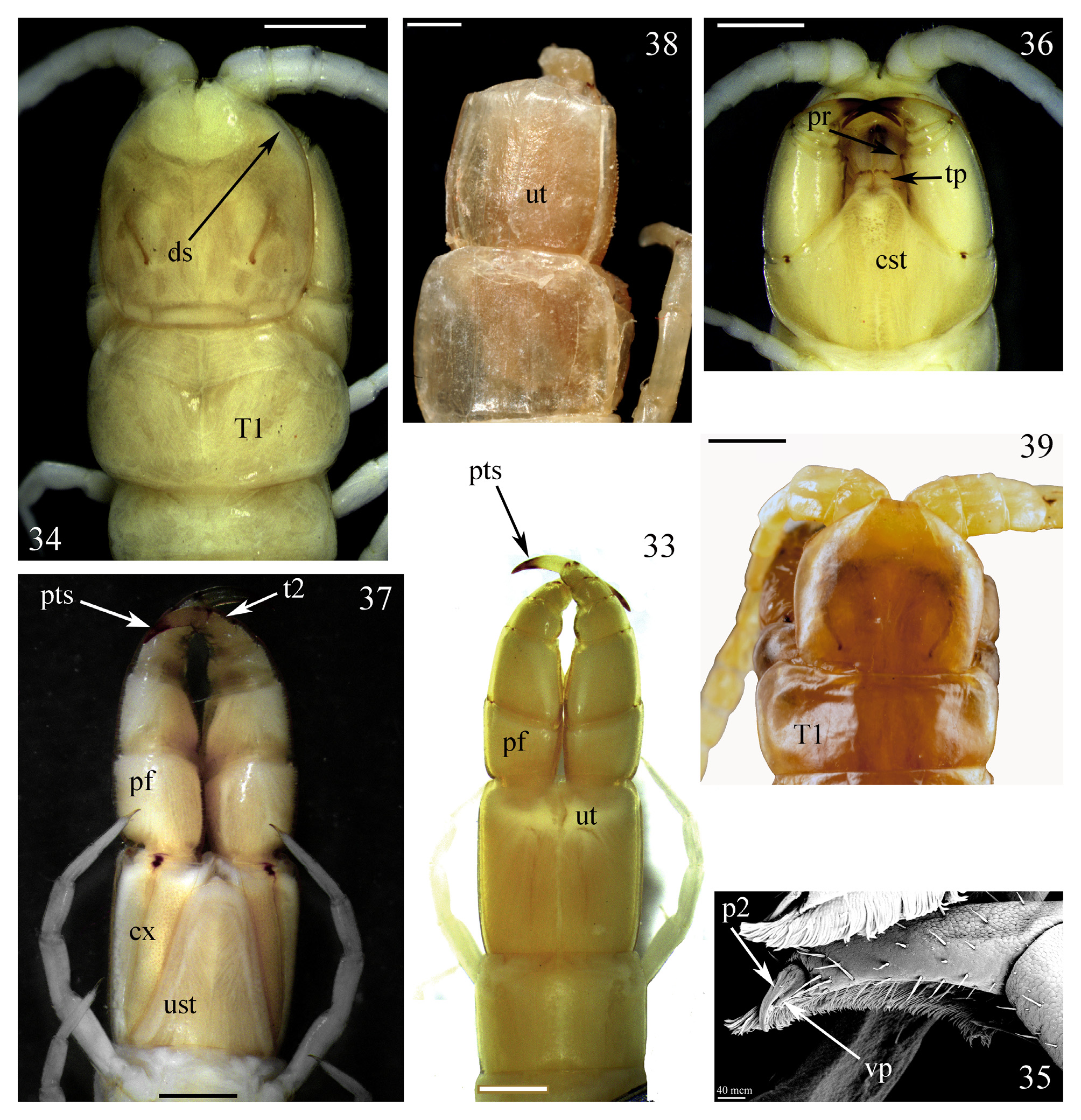
Diagnosis. Eyes absent, light / depigmented spots at their place (Fig. 34). Labrum with a single median tooth. Slender pretarsus of maxillae 2 (Fig. 35) not pectinate, consisting of two well-distinguishable parts (darker basal and a semi-transparent apical ones), curved and pointed apically. Pretarsus (at least in Theatops) is accompanied by welldeveloped ventral projection (Fig. 35) which is of the same shape as pretarsus but visibly thinner and shorter (sometimes nearly as long as it; see below); it is never accompanied by accessory spine (s). Anterior margin of forcipular coxosternite with well-developed tooth-plates (Fig. 36), forcipular trochantero-prefemur with simple processes of various length. Sternites with a single longitudinal median suture, developed to varying degrees (hardly visible in some Theatops). 21 LBS; spiracles (figs 1 AB in Vahtera et al. 2012 b) on LBS 2 – 20 or on macrosegments only (if so LBS 7 with or without spiracles). Ultimate LBS considerably elongated with ultimate tergite nearly twice as long the penultimate one. Coxopleuron virtually without process (Fig. 37), sometimes with a single spine at its place. Tarsus of legs 1 – 19 monopartite; legs with two tibial spurs and one tarsal spur. Ultimate legs forcipulate (Figs 33, 37), swollen, strongly sclerotized, truly “ pincer-shaped ” (sensu Schileyko 2009) with all articles much shortened and enlarged, excluding falcate pretarsus which is considerably elongated being at least as long as corresponding tarsus 2 (or much longer; see below). Dorsal and medial surface of both prefemur and femur flat, these articles with or without (Fig. 37) ventral spines. Edgecombe & Bonato (2011: 395) also wrote: “ Poison calyx extending into the forcipular coxosternite … Gizzard with stiff anteriorly / directed projections; projections evenly curved, covered by multifurcating scales that spirally encircle the projection, branching into slender, needle-like spines ”. Number of subtaxa. 2 genera.
Schileyko, Arkady A., Vahtera, Varpu, Edgecombe, Gregory D. (2020): An overview of the extant genera and subgenera of the order Scolopendromorpha (Chilopoda): a new identification key and updated diagnoses. Zootaxa 4825 (1): 1-64, DOI: 10.11646/zootaxa.4825.1.1
Remarks. Treated as a family in Edgecombe & Bonato (2011: 395), Edgecombe et al. (2012: 770), Vahtera et al. (2012 a: 9, 2012 b: 229, 2013: 580), Bonato et al. (2017: 2).
Schileyko, Arkady A., Vahtera, Varpu, Edgecombe, Gregory D. (2020): An overview of the extant genera and subgenera of the order Scolopendromorpha (Chilopoda): a new identification key and updated diagnoses. Zootaxa 4825 (1): 1-64, DOI: 10.11646/zootaxa.4825.1.1
Sexual dimorphism. Unknown.
Schileyko, Arkady A., Vahtera, Varpu, Edgecombe, Gregory D. (2020): An overview of the extant genera and subgenera of the order Scolopendromorpha (Chilopoda): a new identification key and updated diagnoses. Zootaxa 4825 (1): 1-64, DOI: 10.11646/zootaxa.4825.1.1
Range. Southern Europe (Southern Iberian Peninsula, Southern Italian Peninsula, Balkan Peninsula, Sardinia, Sicily); South-West, East and South-East of USA, Northern Mexico; Central China (Sichuan, Hunan, Gansu).
Schileyko, Arkady A., Vahtera, Varpu, Edgecombe, Gregory D. (2020): An overview of the extant genera and subgenera of the order Scolopendromorpha (Chilopoda): a new identification key and updated diagnoses. Zootaxa 4825 (1): 1-64, DOI: 10.11646/zootaxa.4825.1.1
Synonyms. Theatopidae Verhoeff, 1906; Theatopinae Verhoeff, 1906; Theatopsidae Verhoeff, 1907.
Schileyko, Arkady A., Vahtera, Varpu, Edgecombe, Gregory D. (2020): An overview of the extant genera and subgenera of the order Scolopendromorpha (Chilopoda): a new identification key and updated diagnoses. Zootaxa 4825 (1): 1-64, DOI: 10.11646/zootaxa.4825.1.1

Export occurrence data

Darwin Core Archive (ZIP)

CLASSIFICATION

Taxonomic Classification Tree

MULTIMEDIA

Media Files(1)

FIGURES 33–39. Theatops posticus (Say, 1821); Sad. Rc 6488; 33 ultimate and penultimate LBS + ultimate legs dorsally; Theatops spinicaudus Wood, 1862; Ad. Rc 6489 34 head + LBS 1 dorsally; Theatops erythrocephalus (C. L. Koch, 1847); ZMB 3393 35 apical part of maxilla 2 laterally; Theatops spinicaudus Wood, 1862; Ad. Rc 6489 36 head + forcipular segment ventrally; Theatops posticus (Say, 1821); Sad. Rc 6488 37 LBS 21 + ultimate legs ventrally; Tonkinodentus lestes Schileyko, 1992; Holotype ad. Rc 6358 38 ultimate + penultimate LBS dorsally 39 cephalic plate + LBS 1 dorsally; (cst)—forcipular coxosternite, (cx)—coxopleuron, (ds)—depigmented eye spot, (p2)—non pectinate pretarsus of maxilla 2, (pf)—prefemur, (pr)—trochantero-prefemural process, (pts)—pretarsus, (T1)—tergite 1, (t2)—tarsus 2, (tp)—forcipular tooth-plate, (ust)—ultimate sternite, (ut)—ultimate tergite, (vp)—short ventral projection of pretarsus of maxilla 2.

Imageimage/png© Schileyko, Arkady A.;Vahtera, Varpu;Edgecombe, Gregory D.Schileyko, Arkady A.;Vahtera, Varpu;Edgecombe, Gregory D.

IMAGES

Gallery(1)

See Gallery

Occurrences with images

Source Information

An overview of the extant genera and subgenera of the order Scolopendromorpha (Chilopoda): a new identification key and updated diagnoses

checklist

This dataset contains the digitized treatments in Plazi based on the original journal article Schileyko, Arkady A., Vahtera, Varpu, Edgecombe, Gregory D. (2020): An overview of the extant genera and subgenera of the order Scolopendromorpha (Chilopoda): a new identification key and updated diagnoses. Zootaxa 4825 (1): 1-64, DOI: 10.11646/zootaxa.4825.1.1

Abstract

The extant genera and subgenera of the order Scolopendromorpha are critically reviewed and provided with updated diagnoses and a new identification key; the most recent revisions of scolopendromorph genera are concisely summarised. Rhoda Meinert, 1886 and Cryptops (Chromatanops) Verhoeff, 1906 are suggested to be a junior synonyms of Scolopendropsis Brandt, 1841 and Cryptops (Cryptops) Leach, 1814, respectively. The subgeneric status is formally fixed for Cryptops (Paracryptops) Pocock, 1891 and Cormocephalus (Campylostigmus) Ribaut, 1923; the taxonomic status of the former genus Kanparka Waldock & Edgecombe, 2012 is discussed. As a result of synonymies, the number of scolopendromorph genera and subgenera is currently 37. The formal status of the former tribes Scolopendrini Leach, 1814, Asanadini Verhoeff, 1907 and Arrhabdotini Attems, 1930 is briefly discussed; the presence of the sexual dimorphism among the taxa of generic level is overviewed.

Schileyko A A, Vahtera V, Edgecombe G D, plazi (2020). An overview of the extant genera and subgenera of the order Scolopendromorpha (Chilopoda): a new identification key and updated diagnoses. Plazi.org taxonomic treatments database. Checklist dataset https://doi.org/10.11646/zootaxa.4825.1.1 accessed via GBIF.org on 2026-06-14.

CC0Published 8/10/2020View dataset
GBIF Usage Key
177020712
Dataset Key
5ab5f5c8-481e-4d1a-8643-21e72c367278
Origin
source
Backbone Key
4420453
Taxon ID
03DE092DFFE4D71DFF13F9202E0BDF0A.taxon
Last Crawled
6/10/2026
Last Interpreted
6/10/2026