
AnimaliaacceptedsubgenusAccepted
Haplocryptops

Haplocryptops

Verhoeff, 1934

GBIF:177020722

0year

ABOUT

Descriptions(6)

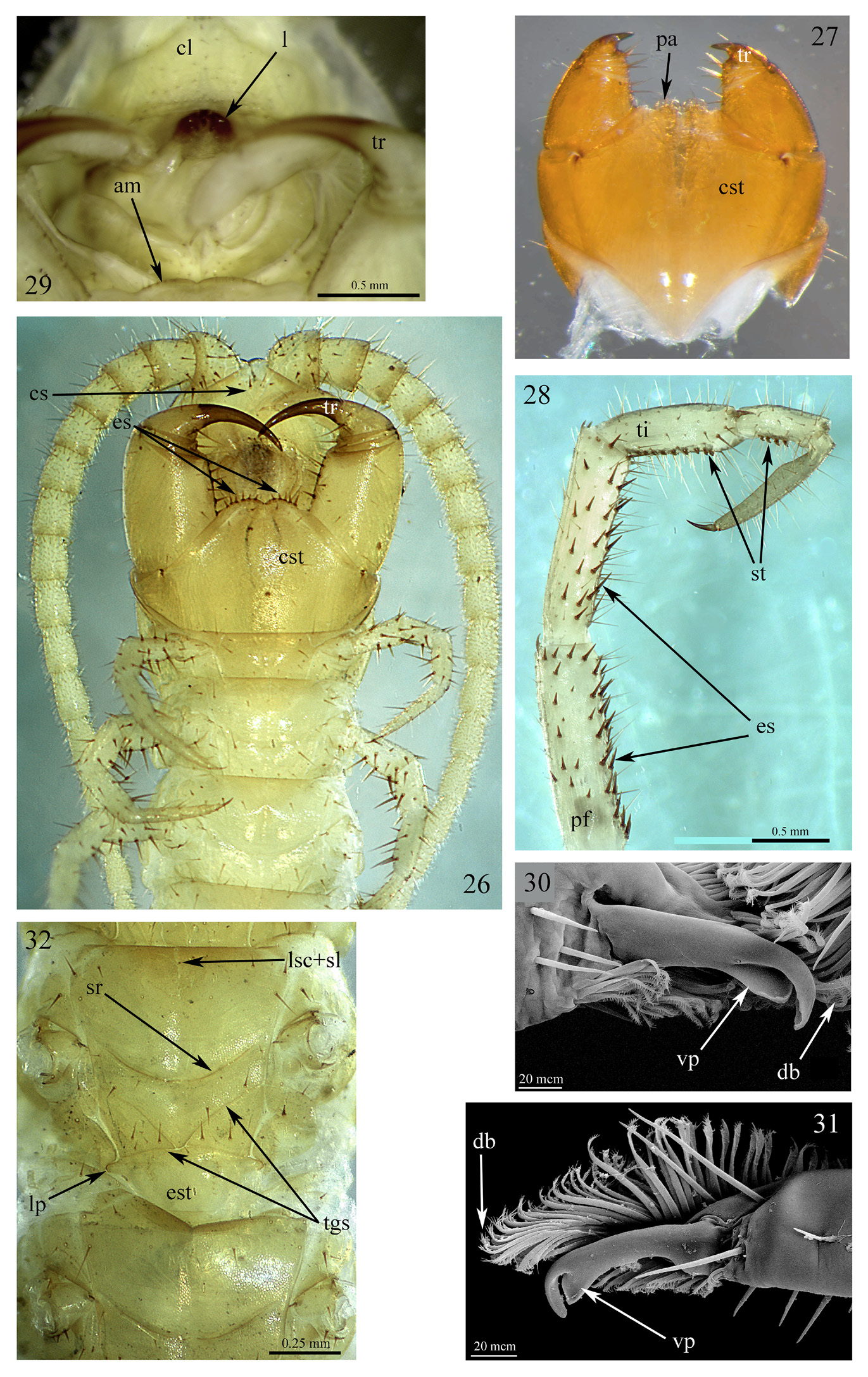
Diagnosis. Clypeus without setose plates. Pretarsus of maxillae 2 slender, from slightly to strongly hooked apically, with (Fig. 31) or without ventral projection. Very dense dorsal brush (Fig. 31) visibly longer than (or as long as) pretarsus, consisting of tiny and virtually transparent setae. Anterior margin of forcipular coxosternite with short, blunt, apically slightly rounded lobes which have no chitinised margin; a few long setae placed at bases of these projections; sharply pointed tarsungula very short (Fig. 27), barely (or even not) overlapping each other when adducted. Sternites with well-developed transverse thickening between coxae of legs and with very wide and shallow incomplete longitudinal depression (not sulcus) at the place of median suture. Short endosternite well bordered by transverse suture, but in most LBS not visible, being covered by the following sternite. Number of species. 5 (Edgecombe & Bonato 2011: 395, Bonato et al. 2016).
Schileyko, Arkady A., Vahtera, Varpu, Edgecombe, Gregory D. (2020): An overview of the extant genera and subgenera of the order Scolopendromorpha (Chilopoda): a new identification key and updated diagnoses. Zootaxa 4825 (1): 1-64, DOI: 10.11646/zootaxa.4825.1.1
Diagnosis. Thin pretarsus of maxillae 2 slightly curved and pointed apically, without ventral projection (figs 64, 65 in Verhoeff 1934); dorsal brush of maxilla 2 composed of very short setae being considerably shorter than pretarsus. Anterior margin of forcipular coxosternite virtually straight (fig. 66 in Verhoeff 1934); tarsungula long, overlapping each other by at least 1 / 3 of their length when adducted. Number of species. 1.
Schileyko, Arkady A., Vahtera, Varpu, Edgecombe, Gregory D. (2020): An overview of the extant genera and subgenera of the order Scolopendromorpha (Chilopoda): a new identification key and updated diagnoses. Zootaxa 4825 (1): 1-64, DOI: 10.11646/zootaxa.4825.1.1
Remarks. The most recent morphological accounts on Paracryptops were given by Chagas-Jr and Shelley (2004: 3) and Schileyko (2007: 91). Treated as a genus in Edgecombe & Bonato (2011: 395). Based on both molecular and morphological results Vahtera et al. (2012 a: 13) wrote that Paracryptops “ nested within Cryptops ” without formalizing the new taxonomic stratus of the latter, although in their subsequent work (2012 b) they treated Paracryptops as a genus again. Taking into consideration the unequivocal results obtained by Vahtera et al. (2012 a), we propose this taxon to be a subgenus of Cryptops, i. e. C. (Paracryptops) Pocock, 1891 stat. nov. Seven adult specimens from Vietnam (Rc 6535, 6658, 7130, 7383, 7433) of C. (P.) indicus Silvestri, 1924 restudied by light microscopy show the pretarsus of maxillae 2 being slightly curved and lacking ventral projection (s) and sternal median suture being absent (an uncommon conditionin Cryptopidae), sometimes replaced by poorlydeveloped median sulcus.
Schileyko, Arkady A., Vahtera, Varpu, Edgecombe, Gregory D. (2020): An overview of the extant genera and subgenera of the order Scolopendromorpha (Chilopoda): a new identification key and updated diagnoses. Zootaxa 4825 (1): 1-64, DOI: 10.11646/zootaxa.4825.1.1
Remarks. Treated as a subgenus in Edgecombe & Bonato (2011: 393), Lewis (2016 a: 575), Bonato et al. (2016). No information is available on clypeal setose plates, the configuration of sternal sutures / sulci, or the presence and shape of endosternites. At the moment the subgenus Haplocryptops is known only from the holotype of Cryptops (H.) acapulcensis and an incomplete (without ultimate legs) specimen from Jalisco (also Mexico) assigned to C. (H.) cf. acalpuncensis by Cupul-Magaña (2012). The subgeneric diagnosis provided by Edgecombe & Bonato’s (2011) attempted to distill characters regarded as diagnosis of Haplocryptops by Verhoeff (1934). It states (p. 393): “ Second maxillary claw [= pretarsus] simple, pointed rather than with a ventral flange; dorsal brush on second maxillae composed of very short setae. Forcipular coxosternite lacking median suture ”. The last sentence is not diagnostic because a bulk of species of the nominate subgenus do not exhibit this suture at all (Fig. 29). According to Verhoeff’s (1934) figure 65 the pretarsus of maxilla 2 in C. (H.) acapulcensis is actually pointed apically (not rounded as in some species of nominotypical subgenus) and has no rounded ventral process (“ ventral flange ”). This process (fig. 69 in Verhoeff 1934 and fig. 285 in Attems 1930) should be present in Palearctic species studied by Verhoeff (1934); who wrote (p. 40) “ Diese Putzapparat fand ich bei allen unsern paläarctischen Arten in derselben Weise ausgebildet, nich dagegen bei der in Betracht kommenden mexicanischen Art … ”. However as this structure is not characteristic for all species of Cryptops (Cryptops) and since it is also present in some species of Trigonocryptops (see above) it should not be used for separation of Haplocryptops. Also, according to the Verhoeff ‘ s (1934) figures 64 and 65, the maxillary 2 dorsal brush of Haplocryptops seems to consist of remarkably short setae, the apical setae being much shorter than the pretarsus. However, as the length of the dorsal brush varies considerably among species of Cryptops (see Verhoeff’s and Attems’ drawings mentioned above) this condition cannot guarantee the definite separation of Haplocryptops. Cupul-Magaña (2012: 4) gave no data on structures / details of maxillae 2 in his specimen of C. (H.) acapulcensis. Summing up, the differences between Haplocryptops and the nominate subspecies seem to be minor and not significant, leaving us to doubt the validity of the former. However, we prefer to keep this subgenus until representative material from the type locality is studied. (!) Cryptops (Paracryptops) Pocock, 1891 stat. nov. Figs 27, 31
Schileyko, Arkady A., Vahtera, Varpu, Edgecombe, Gregory D. (2020): An overview of the extant genera and subgenera of the order Scolopendromorpha (Chilopoda): a new identification key and updated diagnoses. Zootaxa 4825 (1): 1-64, DOI: 10.11646/zootaxa.4825.1.1
Type species. Cryptops (Haplocryptops) acapulcensis Verhoeff, 1934 (by monotypy).
Schileyko, Arkady A., Vahtera, Varpu, Edgecombe, Gregory D. (2020): An overview of the extant genera and subgenera of the order Scolopendromorpha (Chilopoda): a new identification key and updated diagnoses. Zootaxa 4825 (1): 1-64, DOI: 10.11646/zootaxa.4825.1.1
Type species. Paracryptops weberi Pocock, 1891 (by monotypy).
Schileyko, Arkady A., Vahtera, Varpu, Edgecombe, Gregory D. (2020): An overview of the extant genera and subgenera of the order Scolopendromorpha (Chilopoda): a new identification key and updated diagnoses. Zootaxa 4825 (1): 1-64, DOI: 10.11646/zootaxa.4825.1.1

Export occurrence data

Darwin Core Archive (ZIP)

CLASSIFICATION

Taxonomic Classification Tree

MULTIMEDIA

Media Files(1)

FIGURES 26–32. Cryptops (Trigonocryptops) martinicensis Schileyko, Iorio & Coulis, 2018; Ad. paratype CIRAD P8A 26 head, forcipular segment + LBS 1–3 ventrally; Cryptops (Paracryptops) weberi Pocock, 1891; MCZ DNA 102459 27 forcipular segment ventrally; Cryptops (Trigonocryptops) martinicensis Schileyko, Iorio & Coulis, 2018; Ad. holotype MNHN 459 28 right ultimate leg medially; Cryptops (C.) caucasius Verhoeff, 1934; Ad. Rc 8003 29 cephalic plate + anterior margin of forcipular coxosternite ventrally; Cryptops australis (Newport, 1845); AM KS 30 apical part of maxilla 2 laterally; Cryptops (Paracryptops) weberi Pocock, 1891; MCZ DNA 102459 31 apical part of of maxilla 2 laterally; Cryptops (Trigonocryptops) martinicensis Schileyko, Iorio & Coulis, 2018; Ad. holotype MNHN 459 32 LBS 3 ventrally; (am)—anterior margin of forcipular coxosternite, (cl)—clypeus, (cs)—clypeal setose plate, (cst)—forcipular coxosternite, (db)—apical setae of dorsal brush, (es)—enlarged (spiniform) setae, (est)—endosternite, (l)—labrum, (lp)—lateral projection of endosternite, (ls)—long setae, (lsc)—sternal median longitudinal sulcus, (pa)—short rounded projection of anterior margin of forcipular coxosternite, (pf)—prefemur, (sl)—sternal median longitudinal suture, (sr)—sternal transverse ridge, (st)—saw teeth, (sts)—sternal transverse suture, (tgs)—sternal trigonal sutures, (ti)—tibia, (tr)—tarsungula, (vp)—ventral projection of pretarsus of maxilla 2.

Imageimage/png© Schileyko, Arkady A.;Vahtera, Varpu;Edgecombe, Gregory D.Schileyko, Arkady A.;Vahtera, Varpu;Edgecombe, Gregory D.

IMAGES

Gallery(1)

See Gallery

Occurrences with images

Source Information

An overview of the extant genera and subgenera of the order Scolopendromorpha (Chilopoda): a new identification key and updated diagnoses

checklist

This dataset contains the digitized treatments in Plazi based on the original journal article Schileyko, Arkady A., Vahtera, Varpu, Edgecombe, Gregory D. (2020): An overview of the extant genera and subgenera of the order Scolopendromorpha (Chilopoda): a new identification key and updated diagnoses. Zootaxa 4825 (1): 1-64, DOI: 10.11646/zootaxa.4825.1.1

Abstract

The extant genera and subgenera of the order Scolopendromorpha are critically reviewed and provided with updated diagnoses and a new identification key; the most recent revisions of scolopendromorph genera are concisely summarised. Rhoda Meinert, 1886 and Cryptops (Chromatanops) Verhoeff, 1906 are suggested to be a junior synonyms of Scolopendropsis Brandt, 1841 and Cryptops (Cryptops) Leach, 1814, respectively. The subgeneric status is formally fixed for Cryptops (Paracryptops) Pocock, 1891 and Cormocephalus (Campylostigmus) Ribaut, 1923; the taxonomic status of the former genus Kanparka Waldock & Edgecombe, 2012 is discussed. As a result of synonymies, the number of scolopendromorph genera and subgenera is currently 37. The formal status of the former tribes Scolopendrini Leach, 1814, Asanadini Verhoeff, 1907 and Arrhabdotini Attems, 1930 is briefly discussed; the presence of the sexual dimorphism among the taxa of generic level is overviewed.

Schileyko A A, Vahtera V, Edgecombe G D, plazi (2020). An overview of the extant genera and subgenera of the order Scolopendromorpha (Chilopoda): a new identification key and updated diagnoses. Plazi.org taxonomic treatments database. Checklist dataset https://doi.org/10.11646/zootaxa.4825.1.1 accessed via GBIF.org on 2026-06-17.

CC0Published 8/10/2020View dataset
GBIF Usage Key
177020722
Dataset Key
5ab5f5c8-481e-4d1a-8643-21e72c367278
Origin
source
Taxon ID
03DE092DFFE1D71FFF13F9CD2CFDDB58.taxon
Last Crawled
6/10/2026
Last Interpreted
6/10/2026