
Scolopendrinae
Leach, 1814
GBIF:177020725
ABOUT
Descriptions(2)
Export occurrence data
Darwin Core Archive (ZIP)
CLASSIFICATION
Taxonomic Classification Tree

MULTIMEDIA
Media Files(6)
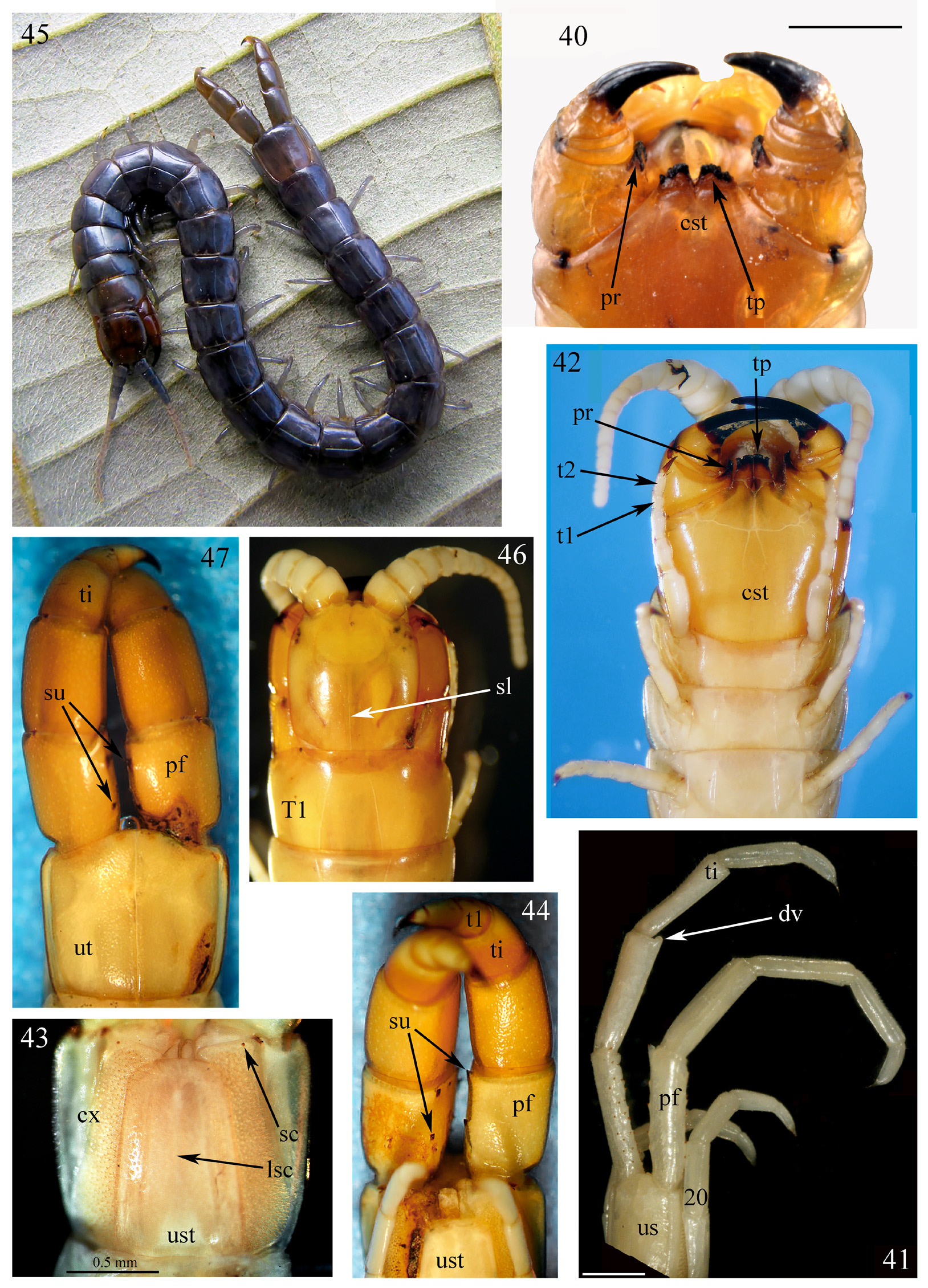
FIGURES 40–47. Tonkinodentus lestes Schileyko, 1992; Holotype adt Rc 6358 40 forcipular segment ventrally; Sad. Rc 6555 41 ultimate LBS, legs 20 + ultimate legs dorso-laterally; Scolopendropsis duplicata Chagas-Jr, Edgecombe & Minelli, 2008; Paratype IBSP 2392 or MNRJ 15306 (photo by Dr. Amazonas Chagas-Jr) 42 head, forcipular segment + LBS 1–3 ventrally; Holotype MNRJ 15258 43 ultimate LBS ventrally; Paratype IBSP 2392 or MNRJ 15306 (photo by Dr. Amazonas Chagas-Jr) 44 posterior half of ultimate LBS + ultimate legs ventrally; Scolopendropsis bahiensis Brandt, 1841; Live specimen (photo by Dr. Adriano Kury) 45 general view dorsally; Scolopendropsis duplicata Chagas-Jr, Edgecombe & Minelli, 2008 (photos by Dr. Amazonas Chagas-Jr); Paratype IBSP 2392 or MNRJ 15306 46 head + LBS 1 dorsally 47 ultimate LBS + ultimate legs dorsally; (20)—leg 20, (cx)—coxopleuron, (cst)—forcipular coxosternite, (dv)—distoventrolateral process of femur, (lsc)—sternal median longitudinal sulcus, (sl)—cephalic median longitudinal suture, (pf)—ultimate prefemur, (pr)—trochantero-prefemoral process, (sc)—spine at place of coxopleural process, (su)—spines of ultimate prefemur, (T1)—tergite 1, (t1)—tarsus 1, (t2)— tarsus 2, (ti)—tibia, (tp)—forcipular tooth-plate, (ust)—ultimate sternite, (ut)—ultimate tergite.

FIGURES 48–54. Scolopendra mirabilis Porat, 1876 48 Locomotory legs of mid-body LBS laterally; Scolopendra cingulata Latreille, 1829; Ad. Rc 8007) 49 ultimate LBS + prefemora of ultimate legs ventrally; Scolopendra canidens Newport, 1844; Ad. Rc 6222 50 forcipular segment ventrally; Scolopendra subspinipes Leach, 1815; Ad. Rc 8010 51 left pleura of LBS 14–15 laterally; Ad. Rc 8010 52 head + LBS 1 dorsally; Sad. CDT 53 forcipular segment ventrally; Ad. Rc 8010 54 LBS 21 + ultimate legs dorso-laterally; (20)—leg 20, (ap)—apical spines of coxopleural process, (csp)—corner spine of ultimate prefemur, (cst)— forcipular coxosternite, (cx)—coxopleuron, (im)—intersclerite membrane, (o)—ocelli, (p)—single pleurites, (pr)—trochantero-prefemoral process, (pts)—pretarsus, (s)—spiracle covered by flap, (su)—ventral spines of ultimate prefemur, (T1)—tergite 1, (T15)—tergite 15, (t1)—tarsus 1, (t2)—tarsus 2, (tas)—tarsal spur, (tp)—forcipular tooth-plate, (ust)—ultimate sternite.
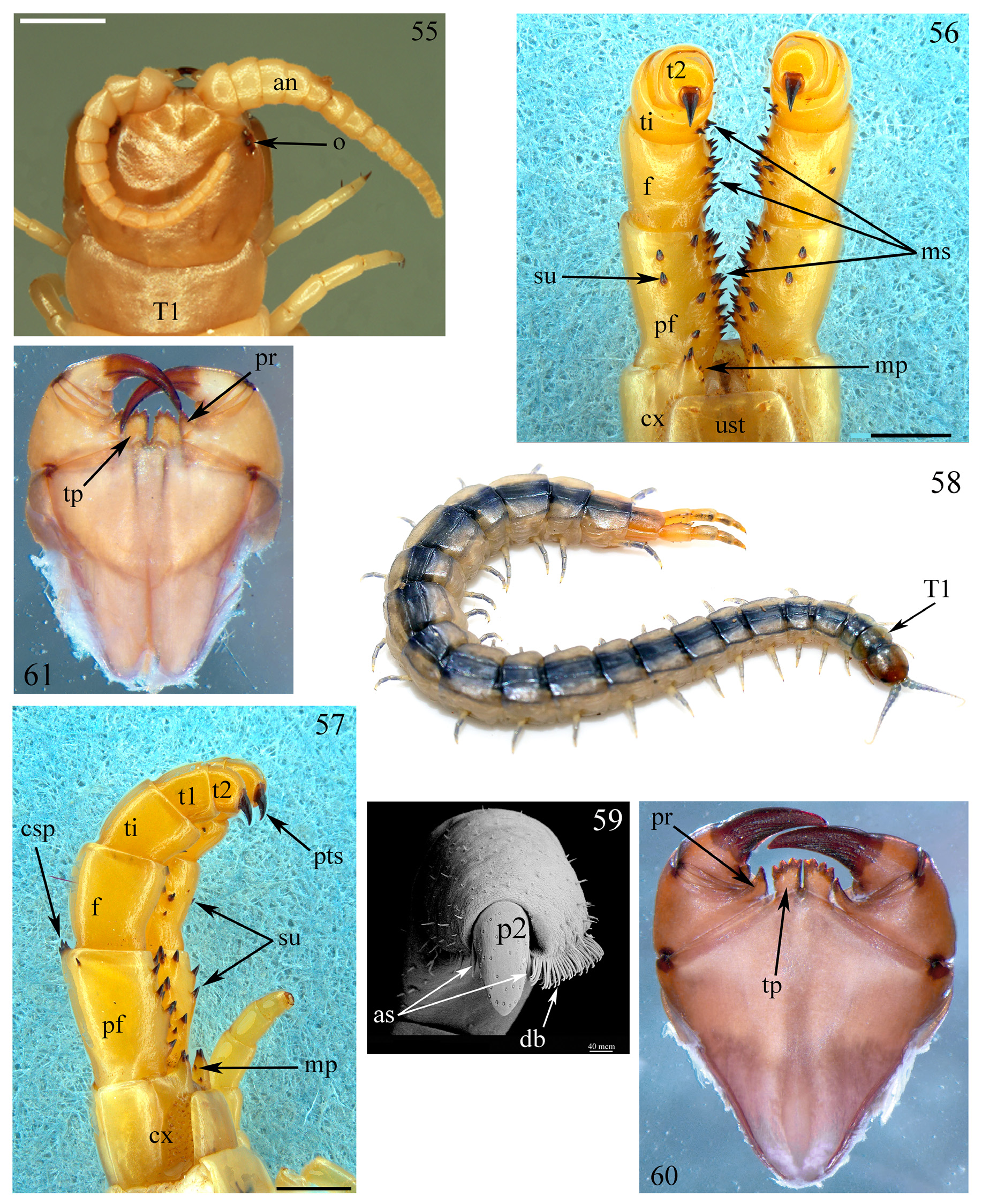
FIGURES 55–61. Kanparka (=Scolopendra) leki Waldock & Edgecombe, 2012; WAM T79350 55 head + LBS 1 dorsally; WAM T99422 56 posterior part of LBS 21 + ultimate legs ventrally 57 LBS 21 + left ultimate leg laterally; Arthrorhabdus mjobergi Kraepelin, 1916; Live specimen (photo by Mark A. Newton, corrected; available at https://marknewton.smugmug. com/, https://www.wildsouthaustralia.info/ Centipedes/Arthrorhabdus-spp/i-NkWPntT/A) 58 generalview dorsally; Arthrorhabdus formosus Pocock, 1891; ZMB 4942 59 apical part of maxilla 2 dorsally; 60 forcipular segment ventrally; Cormocephalus (Campylostigmus) orientalis Ribaut, 1923; BMNH 61 forcipular segment ventrally; (as)—accessory spines, (cp)—coxopleural process, (csp)—corner spine of ultimate prefemur, (cx)—coxopleuron, (db)—dorsal brush, (f)—ultimate femur, (mp)—medial spines of coxopleural process, (ms)—medial spines of ultimate prefemur, femur, tibia, (o)—ocelli, (p2)—pretarsus of maxilla 2, (pf)—ultimate prefemur, (pr)—trochantero-prefemoral process, (pts)—not enlarged ultimate pretarsus, (su)—a few ventral spines of ultimate femur and prefemur, (T1)—tergite 1, (t1)—ultimate tarsus 1, (t2)—ultimate tarsus 2, (ti)—ultimate tibia, (tp)—forcipular tooth-plate, (ust)—ultimate sternite.
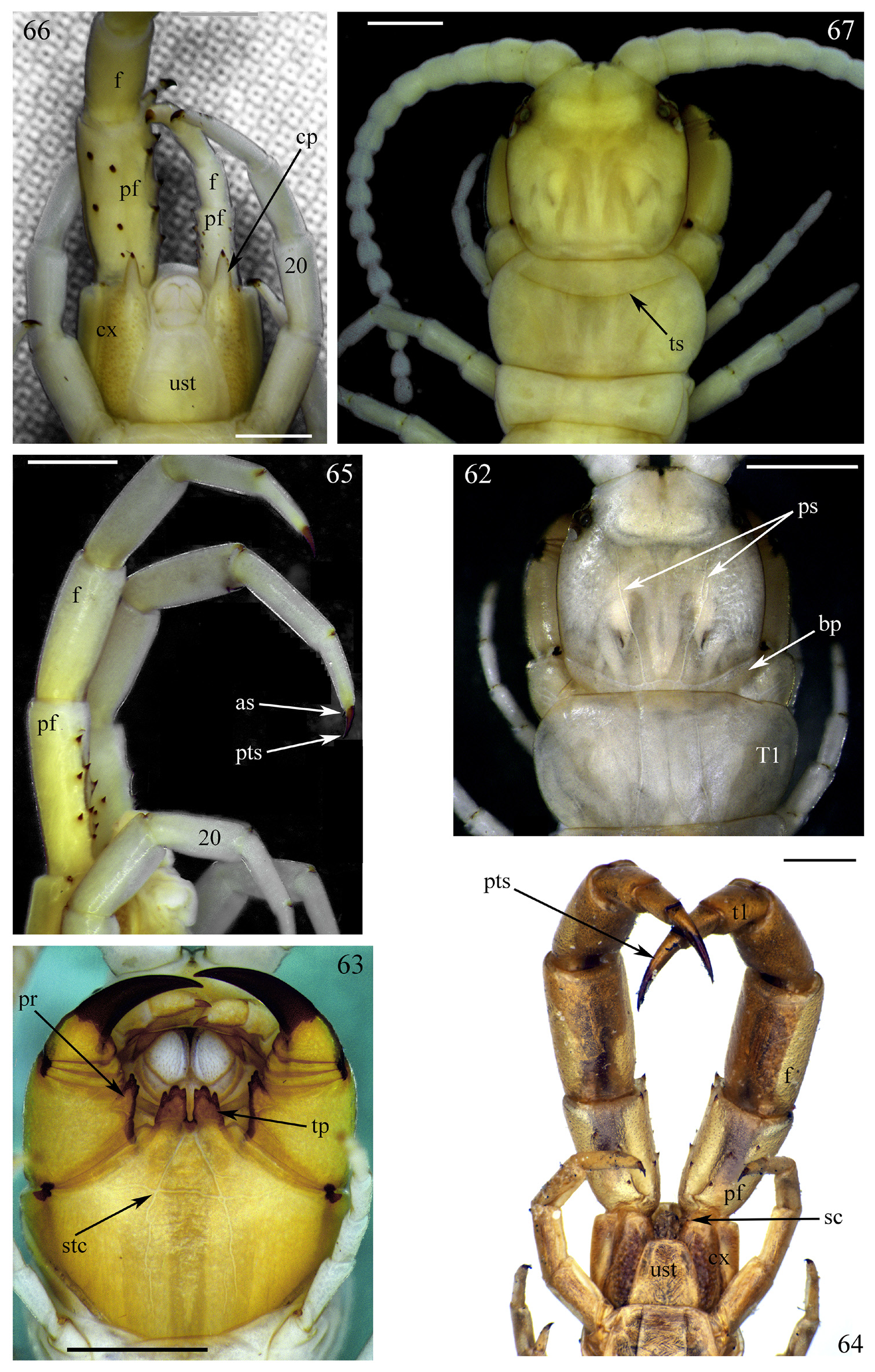
FIGURES 62–67. Cormocephalus sp.; Sad. Rc 7468 62 head + LBS 1 dorsally 63 head + forcipular segment ventrally; Cormocephalus guildingii Newport, 1845; Holotype MYRI-016-01 OMNH (photo by Dr. Danner J. Mann) 64 LBS 20, 21 and ultimate legs ventrally; Cormocephalus punctatus Porat, 1871; Ad. Rc 7022 65 ultimate legs laterally; Hemiscolopendra marginata (Say, 1821); Sad. Rc 6494 66 LBS 21, prefemur + femur of left ultimate leg and much reduced (regenerated) right ultimate leg ventrally; Hemiscolopendra marginata (Say, 1821); Sad. Rc 6494 67 head + LBS 1–2 dorsally; (20)—leg 20, (as)—accessory spines, (bp)—basal plates, (cp)—coxopleural process, (cx)—coxopleuron, (f)—ultimate femur, (pf)—ultimate prefemur, (pr)—trochantero-prefemoral process, (ps)—cephalic paramedian sutures, (pts)—pretarsus, (sc)—spine at place of coxopleural process, (stc)—sutures of forcipular coxosternite, (T1)—tergite 1, (tp)—forcipular tooth-plate, (ts)—anterior transverse suture of tergite 1, (ust)—ultimate sternite.
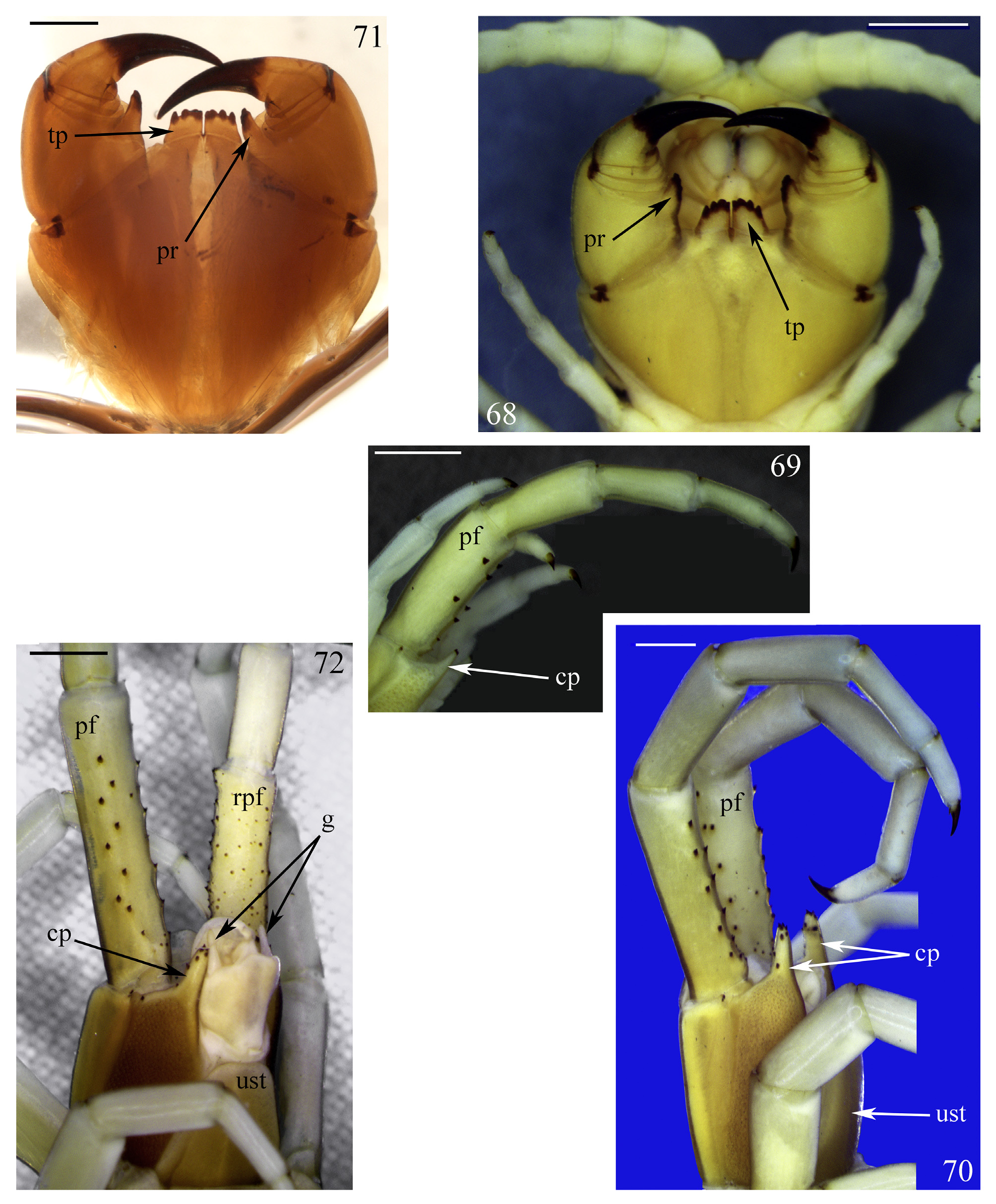
FIGURES 68–72. Hemiscolopendra marginata (Say, 1821); Sad. Rc 6494 68 forcipular segment ventrally 69 left coxopleuron and left ultimate leg laterally; Akymnopellis chilensis (Gervais, 1847); Female Rc 7463 70 left side of ultimate LBS and ultimate legs laterally; BMNH, BM 1904.1.0.29.1–3 71 forcipular segment ventrally; Ad. male Rc 8005 72 LBS 21 and prefemora of ultimate legs ventro-laterally; (cp)—coxopleural process, (g)—gonopods, (pf)—normally developed left prefemur, (pr)—trochantero-prefemoral process, (rpf)—abnormally small (regenerated) right prefemur, (tp)—forcipular tooth-plates, (ust)—ultimate sternite.
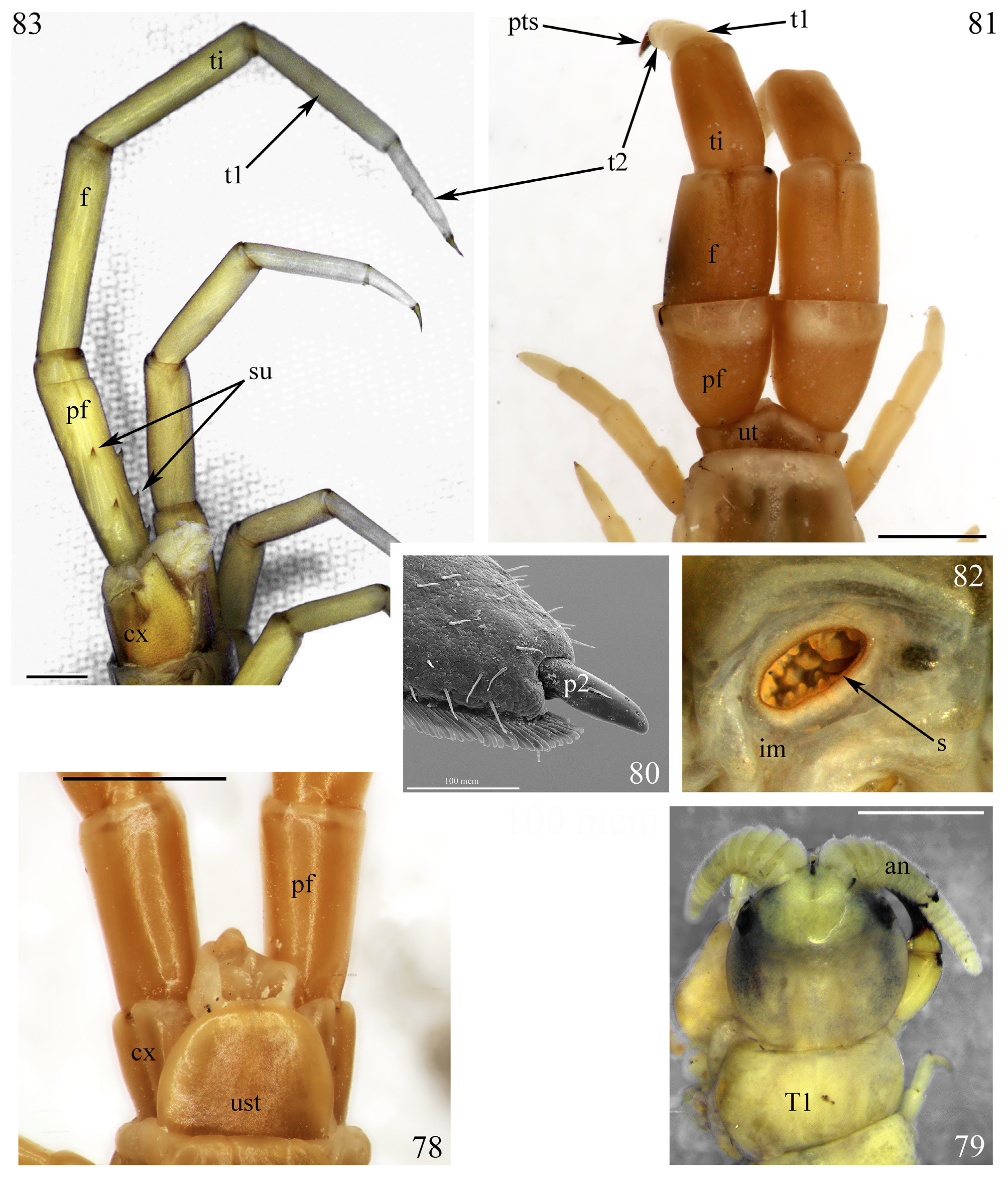
FIGURES 78–83. Asanada sokotrana Pocock, 1899; BMNH 1934.2.15.151–154 78 LBS 21 ventrally; Asanada indica Jangi & Dass, 1984; Smaller ad. Rc 7484 79 head + LBS 1 dorsally; Asanada brevicornis Meinert, 1886; BMNH 1889.7.15.21–23 80 apical part of maxilla 2 dorso-laterally; Asanada sokotrana Pocock, 1899; BMNH 1899.7.4.85–86 81 LBS 20–21 and ultimate legs dorsally; Otostigmus (O.) multidens Haase, 1887; Ad. Rc 7510 82 right pleuron of LBS 3 laterally; Otostigmus (O.) multidens nordicus Schileyko, 1995; Ad. Rc 6747 83 left side of ultimate LBS + right ultimate leg medially; (an)—antenna, (cx)—coxopleuron, (f)—ultimate femur, (im)—intersclerite membrane, (p2)—pretarsus of maxilla 2, (pf)—ultimate prefemur, (pts)—non enlarged ultimate pretarsus, (s)—open spiracle with atrium, (su)—spines of ultimate prefemur, (T1)—tergite 1, (t1)—tarsus 1, (t2)—tarsus 2, (ti)—tibia, (ust)—ultimate sternite, (ut)—ultimate tergite.
IMAGES