
AnimaliaacceptedtribeAccepted
Otostigmini

Otostigmini

Kraepelin, 1903

GBIF:177020729

0year

ABOUT

Descriptions(6)

Number of subtaxa. 6 genera (3 subgenera in genus Otostigmus). “ Ca 200 species in six genera ” sensu Edgecombe & Bonato (2011: 400).
Schileyko, Arkady A., Vahtera, Varpu, Edgecombe, Gregory D. (2020): An overview of the extant genera and subgenera of the order Scolopendromorpha (Chilopoda): a new identification key and updated diagnoses. Zootaxa 4825 (1): 1-64, DOI: 10.11646/zootaxa.4825.1.1
Sexual dimorphism. Present in 3 taxa of genus-group.
Schileyko, Arkady A., Vahtera, Varpu, Edgecombe, Gregory D. (2020): An overview of the extant genera and subgenera of the order Scolopendromorpha (Chilopoda): a new identification key and updated diagnoses. Zootaxa 4825 (1): 1-64, DOI: 10.11646/zootaxa.4825.1.1
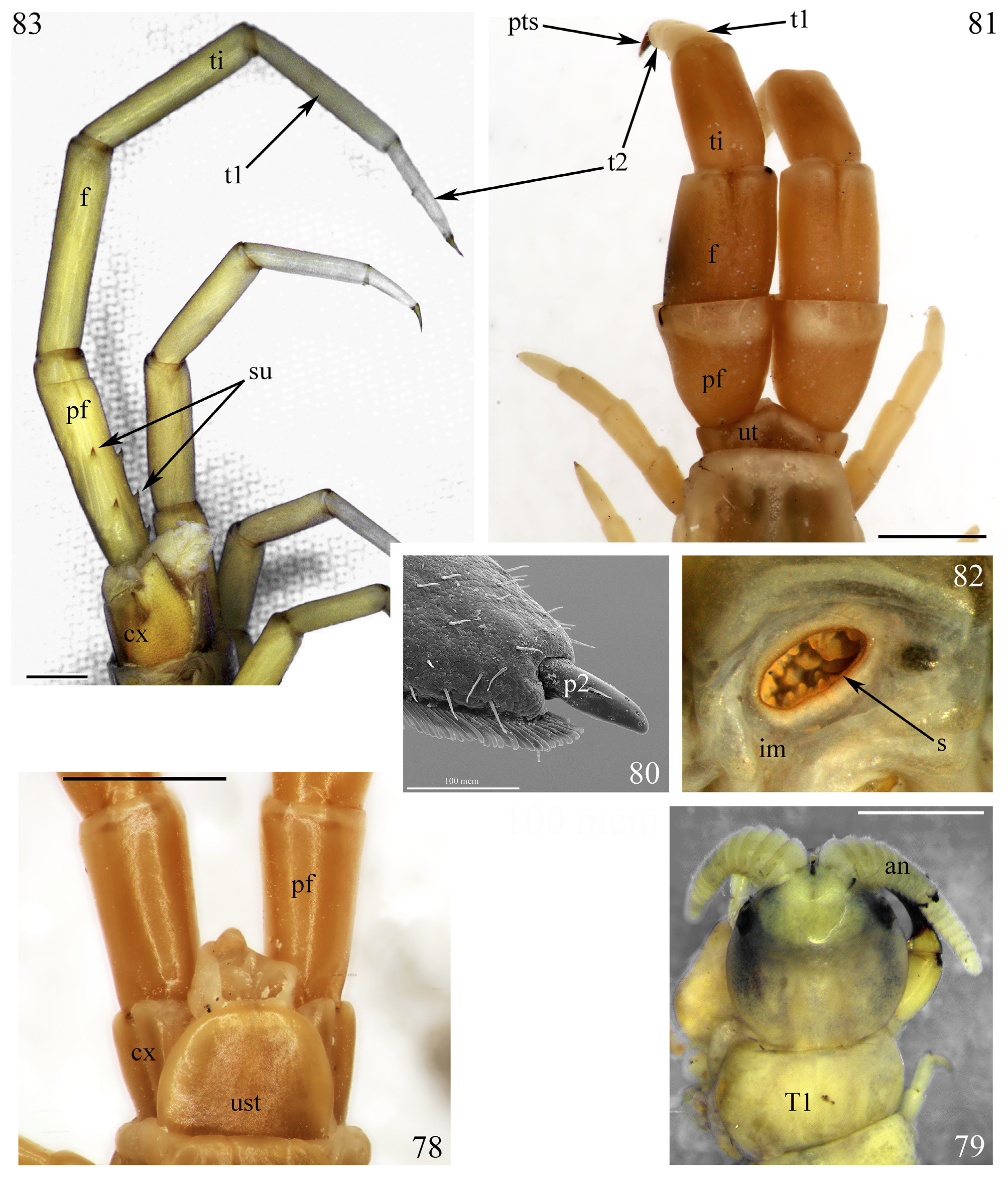
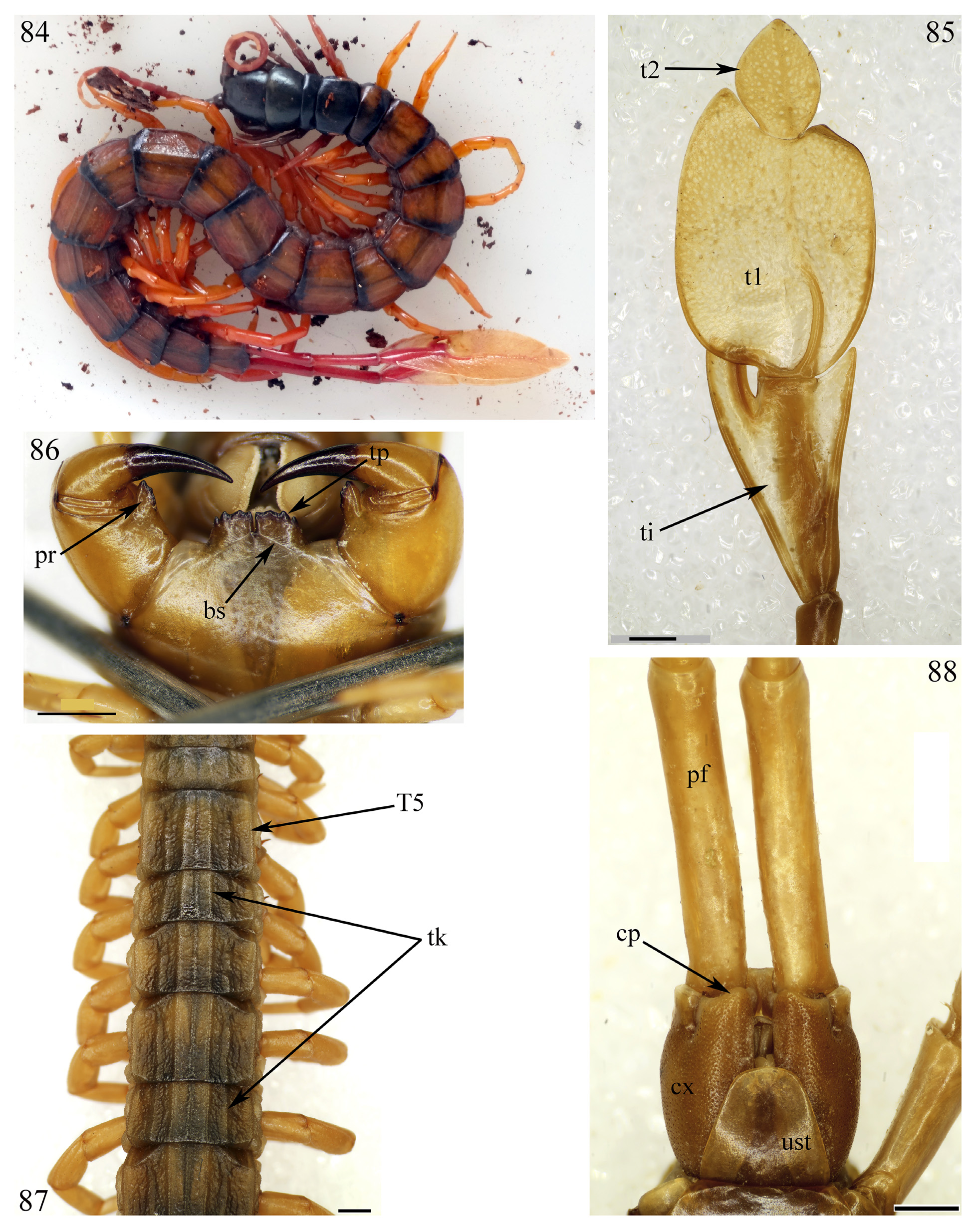
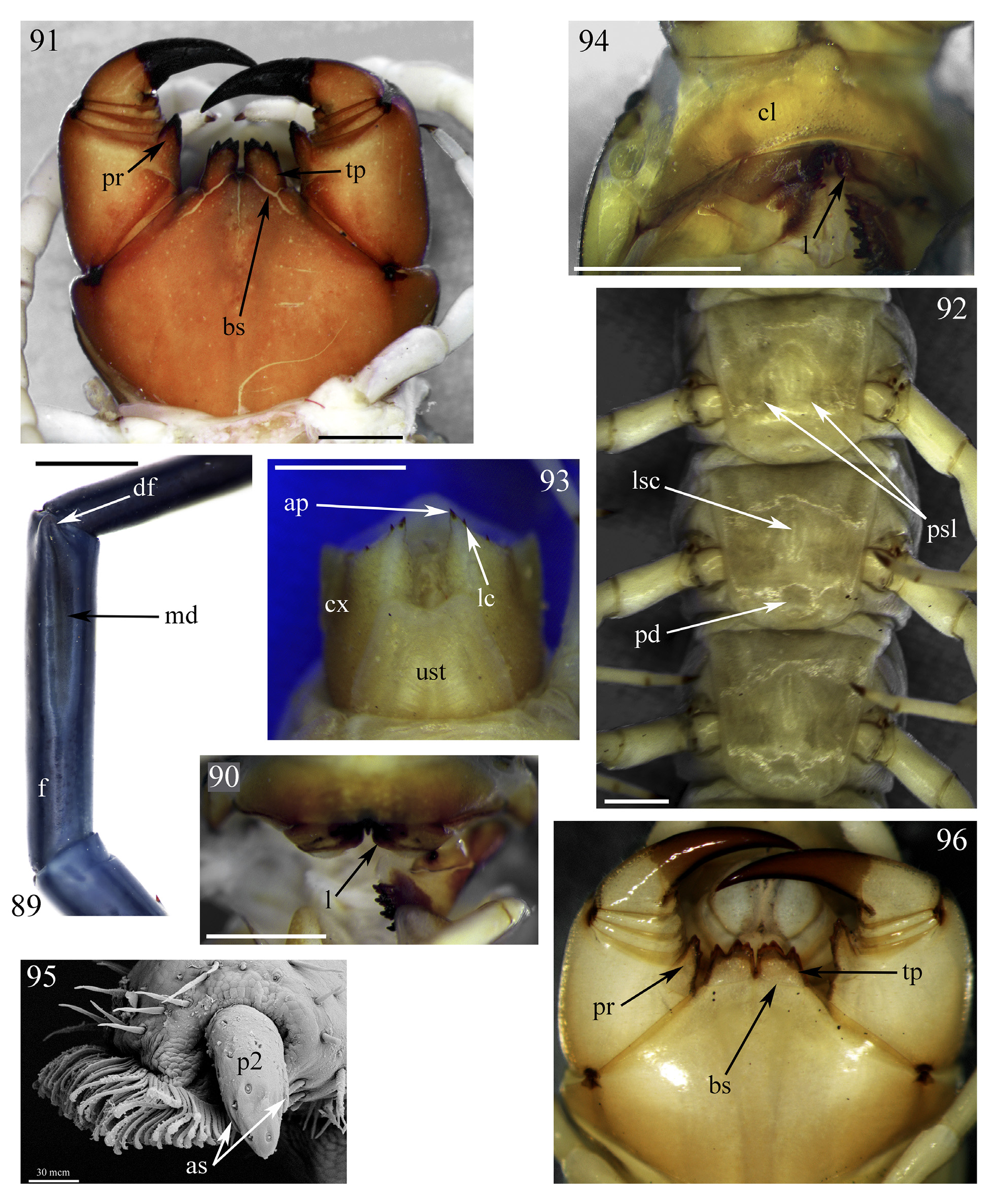
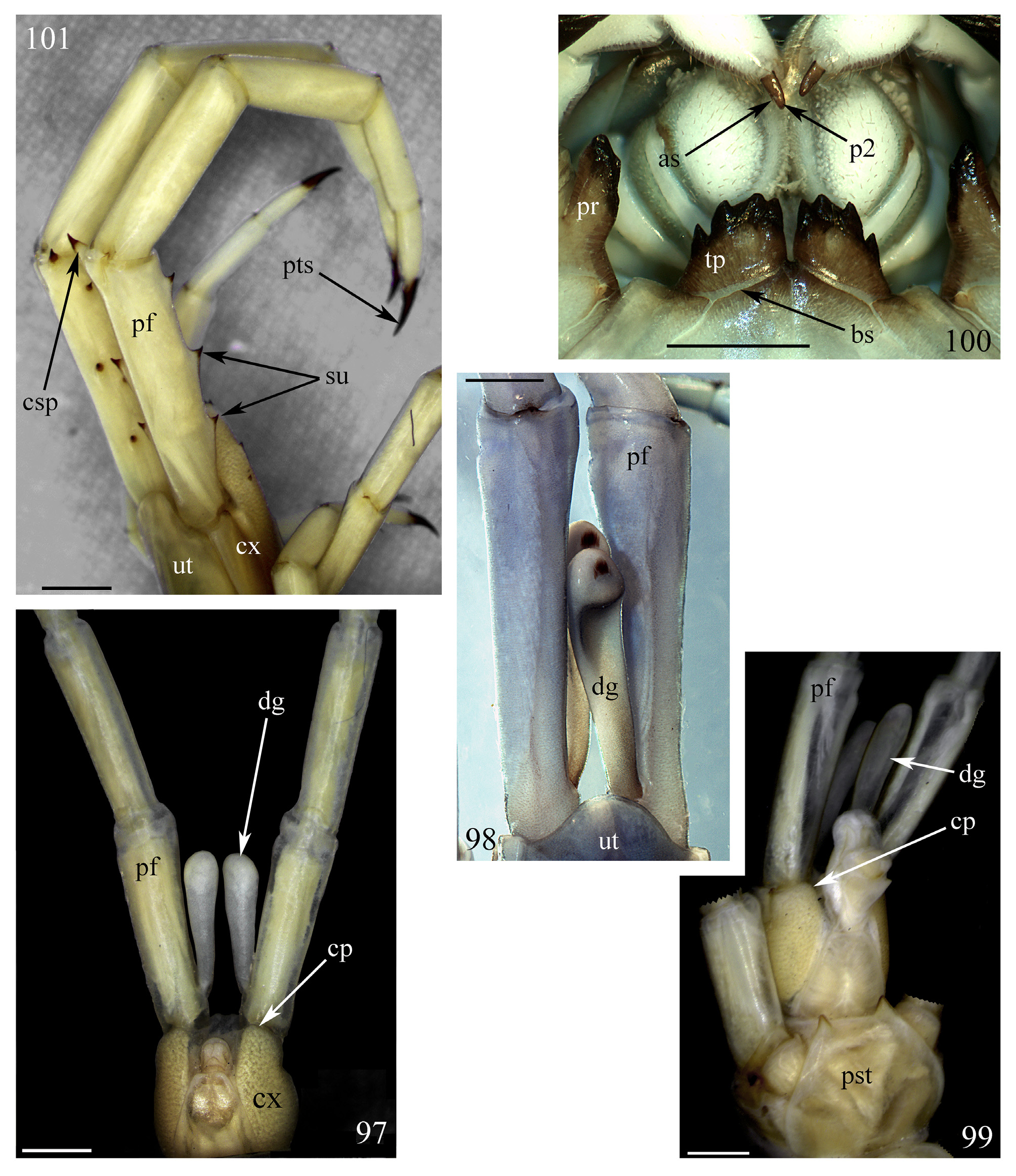
Diagnosis. Antenna relatively long (i. e. reaching at least to posterior margin of tergite 4 when reflexed), basal antennal articles cylindrical (not strongly flattened), definitely longer than wide. Median tooth of labrum (Fig. 95) well developed (except for Edentistoma, former tribe Arrhabdotini; see below). Forcipular tooth-plates present (except for Edentistoma), their basal sutures form a virtually straight line (Fig. 96), right angle (Fig. 91) or an obtuse angle (Fig. 86, 100, 106); trochantero-prefemoral process present in most genera. Tarsungula long in most of genera (Fig. 96), much elongated in Edentistoma and visibly shortened in Sterropristes (compare Fig. 114 and Fig. 120); their inner surface rounded or with 1 or 2 sharp longitudinal ridges, rarely saw-like (in Sterropristes only). LBS 7 with or without spiracles. Pleuron (Figs 82, 103) with intersclerite membrane well visible, without set of longitudinal pleurites anteriorly. Coxopleuron with (Fig. 104, 105) or without (in Otostigmus (Parotostigmus) (Fig. 99) and Alipes) well-developed process. Ultimate leg pretarsus claw-shaped, well-developed in most genera. Edgecombe & Bonato (2011: 400) also wrote: “ Border between labral and clypeal part of epipharynx strongly curved forwards ... Testicular vesicles oriented oblique to central deferens duct ”.
Schileyko, Arkady A., Vahtera, Varpu, Edgecombe, Gregory D. (2020): An overview of the extant genera and subgenera of the order Scolopendromorpha (Chilopoda): a new identification key and updated diagnoses. Zootaxa 4825 (1): 1-64, DOI: 10.11646/zootaxa.4825.1.1
Remarks. Treated as a tribe in Edgecombe & Bonato (2011: 400), Vahtera et al. (2012 a: 7, 2012 b: 235), Vahtera et al. (2013: 578), Vahtera & Edgecombe (2014: 2, 5, 7). In 2013 Vahtera et al. wrote (p. 578): “ The generic classification of Otostigmini has a poor fit to phylogenetic relationships, although nodal support within this tribe is weak ”.
Schileyko, Arkady A., Vahtera, Varpu, Edgecombe, Gregory D. (2020): An overview of the extant genera and subgenera of the order Scolopendromorpha (Chilopoda): a new identification key and updated diagnoses. Zootaxa 4825 (1): 1-64, DOI: 10.11646/zootaxa.4825.1.1
Range. As for family.
Schileyko, Arkady A., Vahtera, Varpu, Edgecombe, Gregory D. (2020): An overview of the extant genera and subgenera of the order Scolopendromorpha (Chilopoda): a new identification key and updated diagnoses. Zootaxa 4825 (1): 1-64, DOI: 10.11646/zootaxa.4825.1.1
Synonyms. Arrhabdotini Attems, 1930
Schileyko, Arkady A., Vahtera, Varpu, Edgecombe, Gregory D. (2020): An overview of the extant genera and subgenera of the order Scolopendromorpha (Chilopoda): a new identification key and updated diagnoses. Zootaxa 4825 (1): 1-64, DOI: 10.11646/zootaxa.4825.1.1

Export occurrence data

Darwin Core Archive (ZIP)

CLASSIFICATION

Taxonomic Classification Tree

MULTIMEDIA

Media Files(6)

FIGURES 78–83. Asanada sokotrana Pocock, 1899; BMNH 1934.2.15.151–154 78 LBS 21 ventrally; Asanada indica Jangi & Dass, 1984; Smaller ad. Rc 7484 79 head + LBS 1 dorsally; Asanada brevicornis Meinert, 1886; BMNH 1889.7.15.21–23 80 apical part of maxilla 2 dorso-laterally; Asanada sokotrana Pocock, 1899; BMNH 1899.7.4.85–86 81 LBS 20–21 and ultimate legs dorsally; Otostigmus (O.) multidens Haase, 1887; Ad. Rc 7510 82 right pleuron of LBS 3 laterally; Otostigmus (O.) multidens nordicus Schileyko, 1995; Ad. Rc 6747 83 left side of ultimate LBS + right ultimate leg medially; (an)—antenna, (cx)—coxopleuron, (f)—ultimate femur, (im)—intersclerite membrane, (p2)—pretarsus of maxilla 2, (pf)—ultimate prefemur, (pts)—non enlarged ultimate pretarsus, (s)—open spiracle with atrium, (su)—spines of ultimate prefemur, (T1)—tergite 1, (t1)—tarsus 1, (t2)—tarsus 2, (ti)—tibia, (ust)—ultimate sternite, (ut)—ultimate tergite.
Imageimage/png© Schileyko, Arkady A.;Vahtera, Varpu;Edgecombe, Gregory D.Schileyko, Arkady A.;Vahtera, Varpu;Edgecombe, Gregory D.

FIGURES 84–88. Alipes multicostis Imhoff, 1854; Live specimen CDT (photo by Dmitry Telnov) 84 general view dorsally; Alipes grandidieri Lucas, 1864; BMNH 1959.3.8 85 distal part of ultimate leg laterally; Alipes appendiculatus Pocock, 1896; BMNH1950.3.9.2 86 forcipular segment ventrally 87 LBS 4–10 dorsally; Alipes grandidieri Lucas, 1864; BMNH1959.3.8 88 LBS 21 + prefemora of ultimate legs ventrally; (bs)—basal suture of forcipular tooth-plate, (cp)—very short spineless coxopleural process, (cx)—coxopleuron, (pf)—ultimate prefemur, (pr)—trochantero-prefemoral process, (t1)—flattened tarsus 1, (t2)—flattened tarsus 2, (T5)—terite 5, (ti)—flattened tibia, (tk)—tergal longitudinal keels, (tp)—forcipular tooth-plate, (ust)—ultimate sternite.
Imageimage/png© Schileyko, Arkady A.;Vahtera, Varpu;Edgecombe, Gregory D.Schileyko, Arkady A.;Vahtera, Varpu;Edgecombe, Gregory D.

FIGURES 89–96. Digitipes coonoorensis Jangi & Dass, 1984; Male CES 091088 89 femur of right ultimate leg medially; Digitipes sp.; Ad. Rc 7565 90 clypeal part of head ventrally 91 forcipular segment ventrally 92 LBS 13–15 ventrally; Otostigmus (O.) multidens nordicus Schileyko, 1995; Ad. Rc 6545 93 LBS 21 ventrally; Ad. Rc 6747 94 anterior part of head ventrally; Otostigmus (O.) astenus (Kohlrausch, 1881); MCZ DNA 102463 95 pretarsus of maxilla 2; Sad. Rc 7507 96 forcipular segment ventrally; (ap)—apical spines of coxopleural process, (as)—accessory spines, (bs)—basal suture of forcipular toothplate, (cl)—clypeus, (cx)—coxopleuron, (df)—conical distomedial process of ultimate femur, (f)—ultimate femur, (l)—labrum, (lc)—lateral spine of coxopleural process, (lsc)—sternal median longitudinal sulcus, (md)—medial longitudinal depression of ultimate femur, (p2)—pretarsus of maxilla 2, (pd)—sternal posterior depression, (pr)—trochantero-prefemoral process, (psl)—sternal paramedian sulci, (tp)—forcipular tooth-plate, (ust)—ultimate sternite.
Imageimage/png© Schileyko, Arkady A.;Vahtera, Varpu;Edgecombe, Gregory D.Schileyko, Arkady A.;Vahtera, Varpu;Edgecombe, Gregory D.

FIGURES 97–101. Otostigmus (Parotostigmus) scabricauda (Humbert et Saussure, 1870); Ad. male Rc 6730 97 LBS 21 and prefemora + femora of ultimate legs ventrally; Otostigmus (P.) salticus Schileyko, Iorio & Coulis, 2018; Ad. holotype male MNHN 460 98 posterior margin of ultimate tergite + prefemora of ultimate legs dorsally; Otostigmus (P.) diringshofeni Bücherl, 1969; Ad. male Rc 7981 99 LBS 21 + prefemora of ultimate legs ventrally; Otostigmus (P.) salticus Schileyko, Iorio & Coulis, 2018; Ad. holotype male MNHN 460 100 anterior margin of forcipular coxosternite + maxillae 2 ventrally; Ethmostigmus rubripes spinosus (Newport, 1845); Juv. Rc 7174 101 left side of ultimate LBS + ultimate legs laterally; (as)—accessory spine, (bs)—basal suture of forcipular tooth-plate, (cp)— practically reduced spineless coxopleural process, (csp)—corner spine of ultimate prefemur, (cx)—coxopleuron, (dg)—digitiform process of ultimate prefemur, (p2)—pretarsus of maxilla 2, (pf)—ultimate prefemur, (pr)—trochantero-prefemoral process, (pst)—penultimate sternite, (pts)—ultimate pretarsus, (su)—ventral spines of ultimate prefemur, (tp)—forcipular tooth-plate, (ut)—ultimate tergite.

Imageimage/png© Schileyko, Arkady A.;Vahtera, Varpu;Edgecombe, Gregory D.Schileyko, Arkady A.;Vahtera, Varpu;Edgecombe, Gregory D.

FIGURES 102–107. Ethmostigmus rubripes spinosus (Newport, 1845); Juv. Rc 7174 102 forcipular segment ventrally; Ethmostigmus rubripes platycephalus (Newport, 1845); Ad. Rc 7514 103 left pleuron of LBS 3 laterally; Ad. Rc 7513 104 LBS 21 ventrally; Sad. СDT 105 coxopleural processes + prefemora of ultimate legs ventrally; Rhysida longipes (Newport, 1845); Ad. Rc 6683 106 anterior margin of forcipular coxosternite ventrally 107 coxopleural processes, legs 20 + ultimate legs laterally; (ap)—apical spine, (bs)—basal suture of forcipular tooth-plate, (cp)—coxopleural process, (csp)—corner spine of ultimate prefemur, (cx)—coxopleuron, (im)—intersclerite membrane, (lc)—lateral spines of coxopleural process, (pf)—ultimate prefemur, (pr)—trochantero-prefemoral process, (pts)—ultimate pretarsus, (rpf)—abnormally small (regenerated) right ultimate prefemur, (rpr)—rudiment of trochantero-prefemoral process, (s)—open spiracle without atrium, (scs)— spine at place of corner spine of ultimate prefemur, (su)—spines of ultimate prefemur, (t1)—ultimate tarsus 1, (tp)—forcipular tooth-plates, (ust)—ultimate sternite.
Imageimage/png© Schileyko, Arkady A.;Vahtera, Varpu;Edgecombe, Gregory D.Schileyko, Arkady A.;Vahtera, Varpu;Edgecombe, Gregory D.

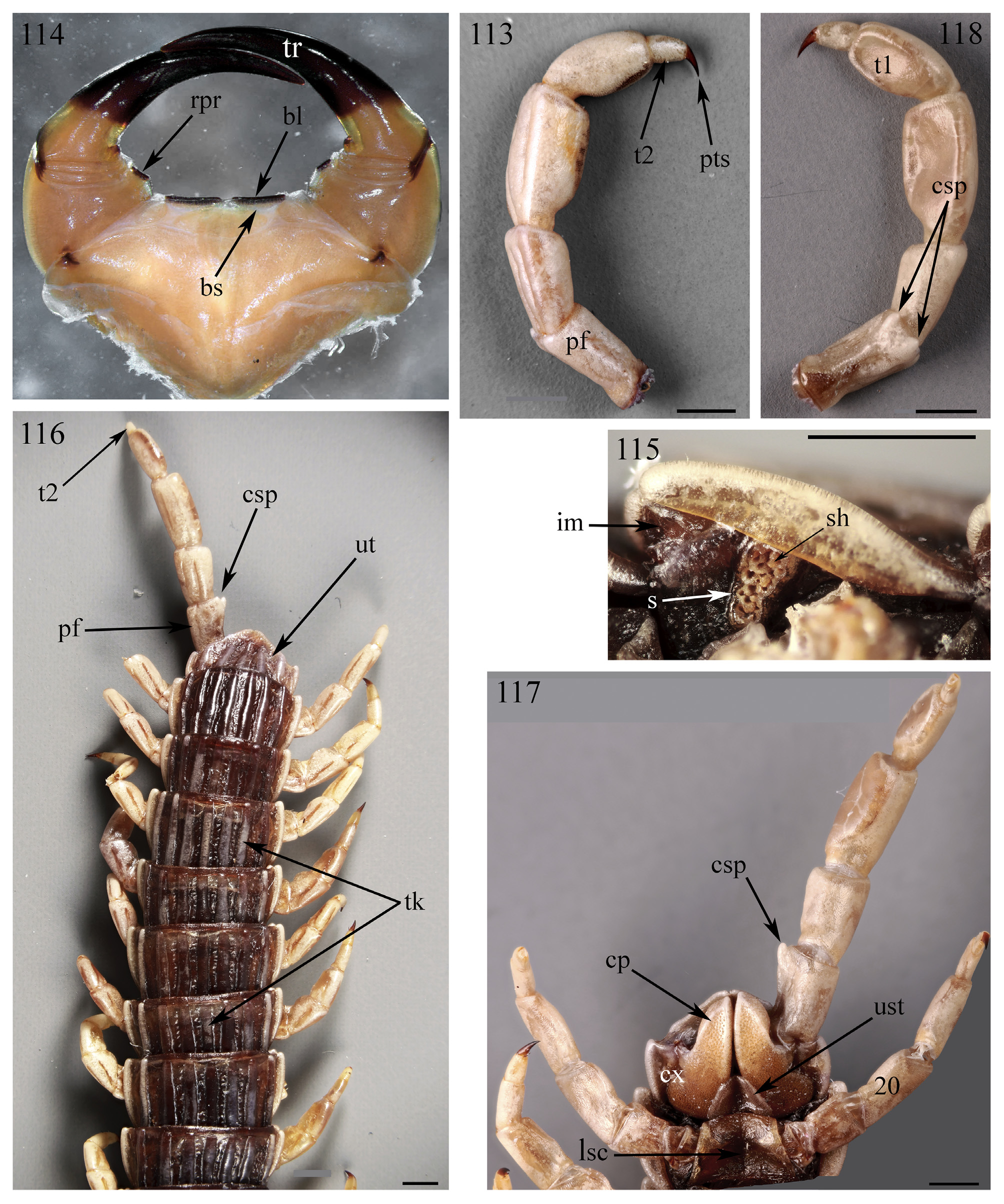
FIGURES 113–118. Edentistoma octosulcatum Tömösváry, 1882; Voucher ZMUT_Chi01 113 left ultimate leg laterally; ZMB 3618 114 forcipular segment ventrally; Voucher ZMUT_Chi01 115 right pleuron of LBS 7 laterally 116 LBS 13–21+ right ultimate leg dorsally 117 LBS 20–21+ right ultimate leg ventrally 118 left ultimate leg medially; (20)—leg 20, (bl)—low blade-like lobe in place of forcipular tooth-plate, (bs)—basal suture of blade-like lobe, (cp)—spineless coxopleural process, (csp)—spineless “corner spine(s)” of ultimate prefemur, (cx)—coxopleuron, (im)—intersclerite membrane, (lsc)—sternal median longitudinal sulcus, (pf)—relatively short ultimate prefemur, (pts)—pretarsus, (rpr)—rudiment of trochantero-prefemoral process, (s)—open spiracle without atrium, (sh)—spiracle hump, (t1)—tarsus 1, (t2)—tarsus 2, (tk)—tergal longitudinal keels, (tr)—visibly elongated tarsungula, (ust)—ultimate sternite, (ut)—ultimate tergite.

Imageimage/png© Schileyko, Arkady A.;Vahtera, Varpu;Edgecombe, Gregory D.Schileyko, Arkady A.;Vahtera, Varpu;Edgecombe, Gregory D.

IMAGES

Gallery(6)

See Gallery

Occurrences with images

Source Information

An overview of the extant genera and subgenera of the order Scolopendromorpha (Chilopoda): a new identification key and updated diagnoses

checklist

This dataset contains the digitized treatments in Plazi based on the original journal article Schileyko, Arkady A., Vahtera, Varpu, Edgecombe, Gregory D. (2020): An overview of the extant genera and subgenera of the order Scolopendromorpha (Chilopoda): a new identification key and updated diagnoses. Zootaxa 4825 (1): 1-64, DOI: 10.11646/zootaxa.4825.1.1

Abstract

The extant genera and subgenera of the order Scolopendromorpha are critically reviewed and provided with updated diagnoses and a new identification key; the most recent revisions of scolopendromorph genera are concisely summarised. Rhoda Meinert, 1886 and Cryptops (Chromatanops) Verhoeff, 1906 are suggested to be a junior synonyms of Scolopendropsis Brandt, 1841 and Cryptops (Cryptops) Leach, 1814, respectively. The subgeneric status is formally fixed for Cryptops (Paracryptops) Pocock, 1891 and Cormocephalus (Campylostigmus) Ribaut, 1923; the taxonomic status of the former genus Kanparka Waldock & Edgecombe, 2012 is discussed. As a result of synonymies, the number of scolopendromorph genera and subgenera is currently 37. The formal status of the former tribes Scolopendrini Leach, 1814, Asanadini Verhoeff, 1907 and Arrhabdotini Attems, 1930 is briefly discussed; the presence of the sexual dimorphism among the taxa of generic level is overviewed.

Schileyko A A, Vahtera V, Edgecombe G D, plazi (2020). An overview of the extant genera and subgenera of the order Scolopendromorpha (Chilopoda): a new identification key and updated diagnoses. Plazi.org taxonomic treatments database. Checklist dataset https://doi.org/10.11646/zootaxa.4825.1.1 accessed via GBIF.org on 2026-06-16.

CC0Published 8/10/2020View dataset
GBIF Usage Key
177020729
Dataset Key
5ab5f5c8-481e-4d1a-8643-21e72c367278
Origin
source
Taxon ID
03DE092DFFDAD723FF13F9432DA3DE9A.taxon
Last Crawled
6/10/2026
Last Interpreted
6/10/2026