
Otostigminae
Kraepelin, 1903
GBIF:177020730
ABOUT
Descriptions(2)
Export occurrence data
Darwin Core Archive (ZIP)
CLASSIFICATION
Taxonomic Classification Tree

MULTIMEDIA
Media Files(7)
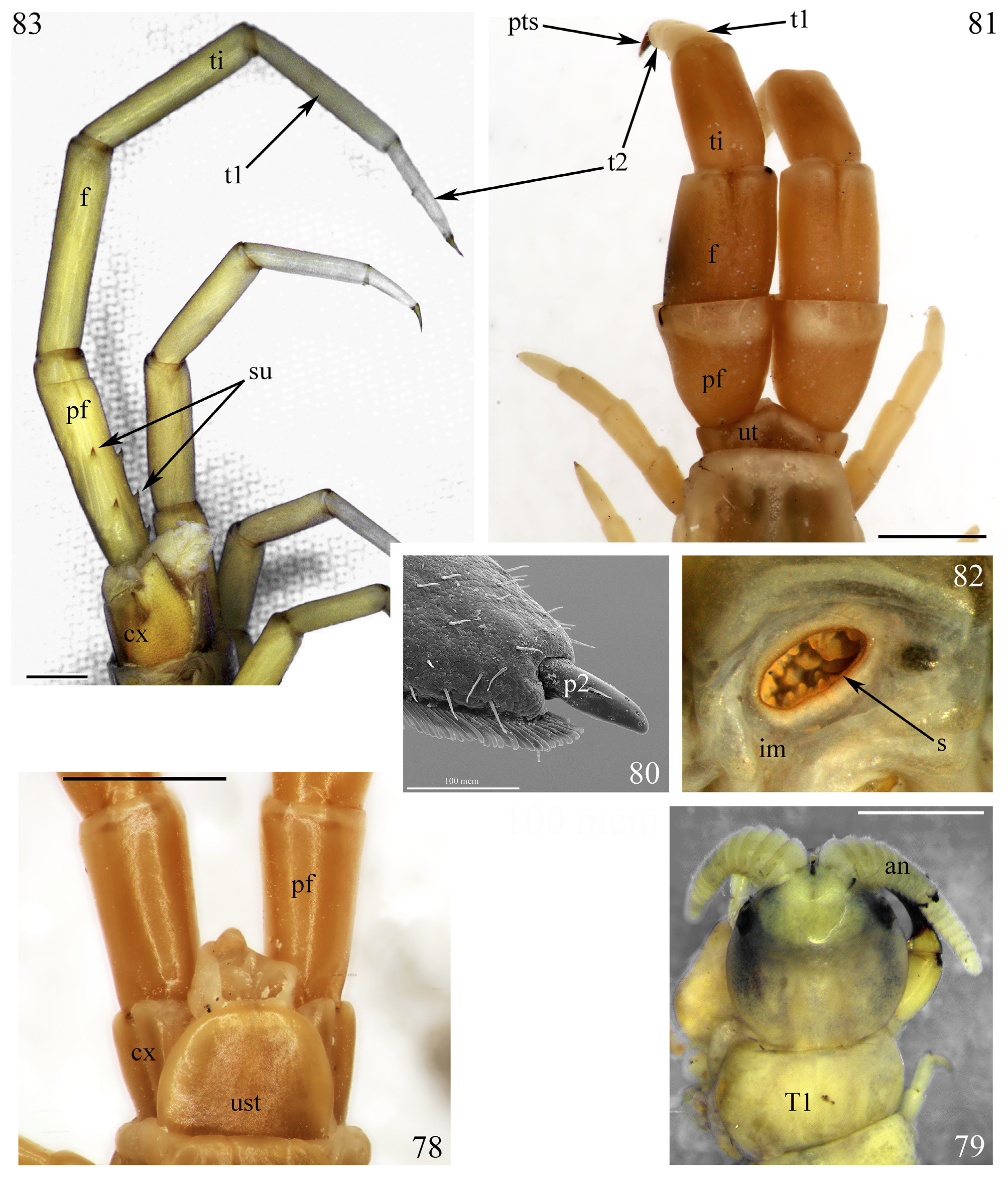
FIGURES 78–83. Asanada sokotrana Pocock, 1899; BMNH 1934.2.15.151–154 78 LBS 21 ventrally; Asanada indica Jangi & Dass, 1984; Smaller ad. Rc 7484 79 head + LBS 1 dorsally; Asanada brevicornis Meinert, 1886; BMNH 1889.7.15.21–23 80 apical part of maxilla 2 dorso-laterally; Asanada sokotrana Pocock, 1899; BMNH 1899.7.4.85–86 81 LBS 20–21 and ultimate legs dorsally; Otostigmus (O.) multidens Haase, 1887; Ad. Rc 7510 82 right pleuron of LBS 3 laterally; Otostigmus (O.) multidens nordicus Schileyko, 1995; Ad. Rc 6747 83 left side of ultimate LBS + right ultimate leg medially; (an)—antenna, (cx)—coxopleuron, (f)—ultimate femur, (im)—intersclerite membrane, (p2)—pretarsus of maxilla 2, (pf)—ultimate prefemur, (pts)—non enlarged ultimate pretarsus, (s)—open spiracle with atrium, (su)—spines of ultimate prefemur, (T1)—tergite 1, (t1)—tarsus 1, (t2)—tarsus 2, (ti)—tibia, (ust)—ultimate sternite, (ut)—ultimate tergite.
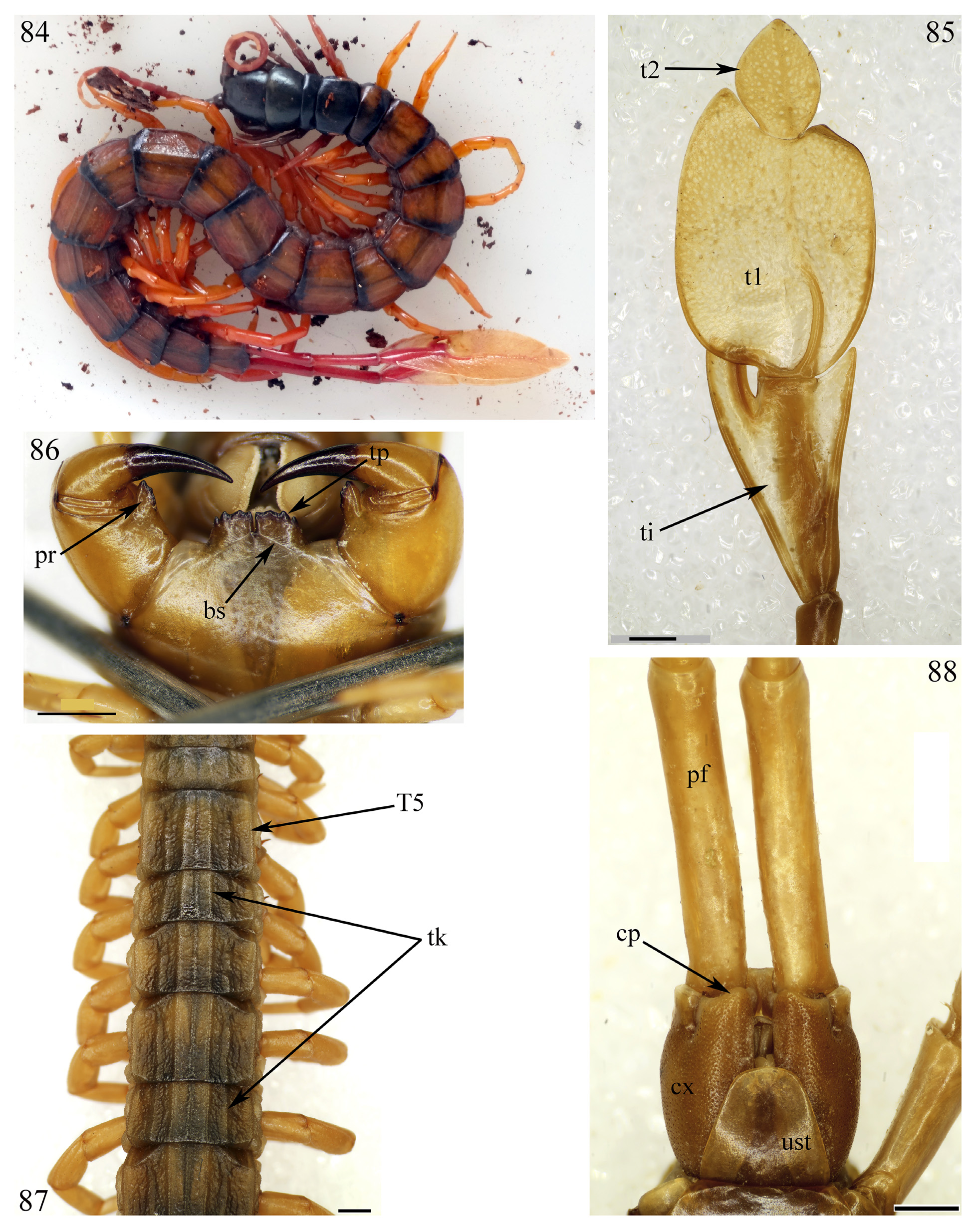
FIGURES 84–88. Alipes multicostis Imhoff, 1854; Live specimen CDT (photo by Dmitry Telnov) 84 general view dorsally; Alipes grandidieri Lucas, 1864; BMNH 1959.3.8 85 distal part of ultimate leg laterally; Alipes appendiculatus Pocock, 1896; BMNH1950.3.9.2 86 forcipular segment ventrally 87 LBS 4–10 dorsally; Alipes grandidieri Lucas, 1864; BMNH1959.3.8 88 LBS 21 + prefemora of ultimate legs ventrally; (bs)—basal suture of forcipular tooth-plate, (cp)—very short spineless coxopleural process, (cx)—coxopleuron, (pf)—ultimate prefemur, (pr)—trochantero-prefemoral process, (t1)—flattened tarsus 1, (t2)—flattened tarsus 2, (T5)—terite 5, (ti)—flattened tibia, (tk)—tergal longitudinal keels, (tp)—forcipular tooth-plate, (ust)—ultimate sternite.
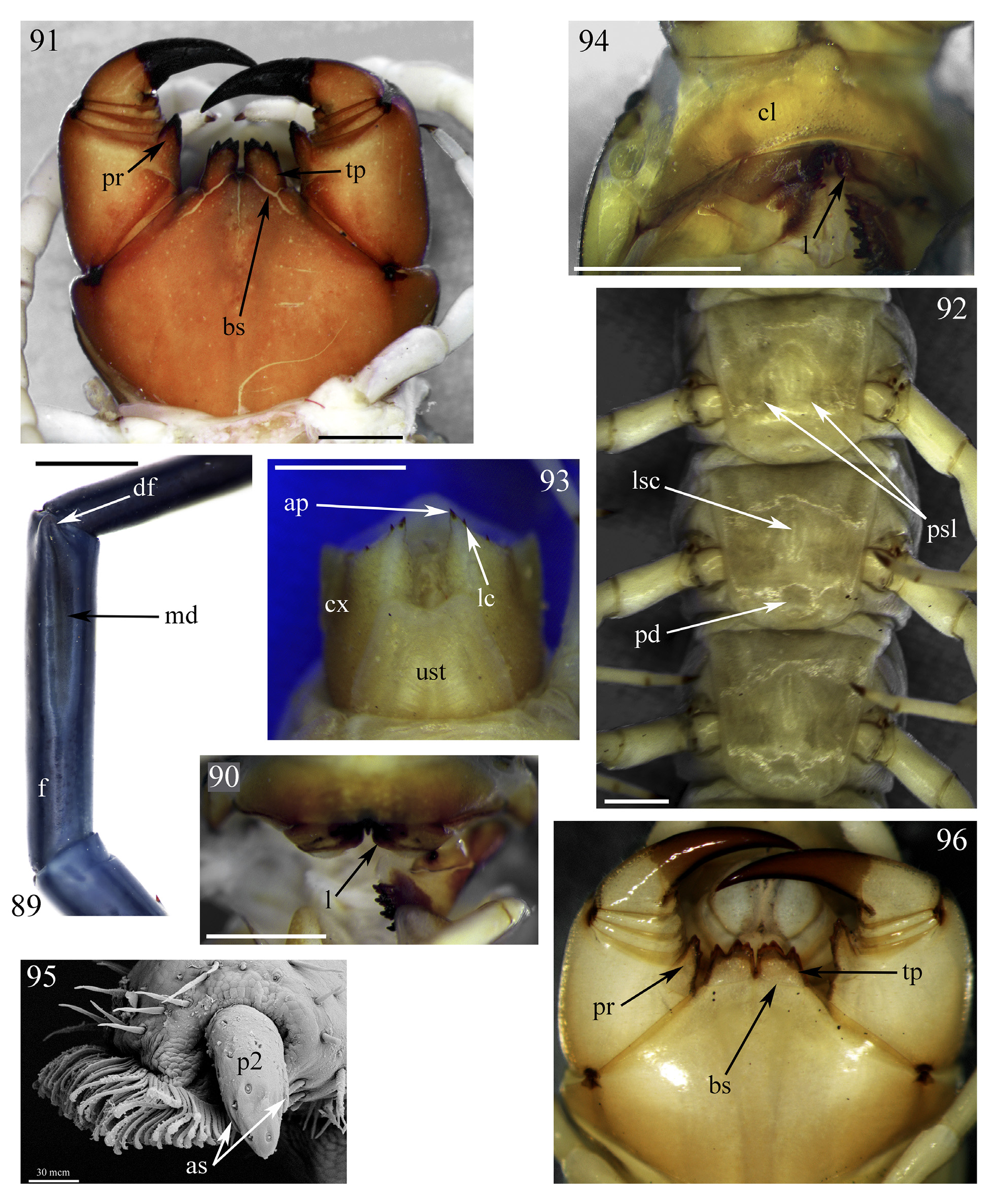
FIGURES 89–96. Digitipes coonoorensis Jangi & Dass, 1984; Male CES 091088 89 femur of right ultimate leg medially; Digitipes sp.; Ad. Rc 7565 90 clypeal part of head ventrally 91 forcipular segment ventrally 92 LBS 13–15 ventrally; Otostigmus (O.) multidens nordicus Schileyko, 1995; Ad. Rc 6545 93 LBS 21 ventrally; Ad. Rc 6747 94 anterior part of head ventrally; Otostigmus (O.) astenus (Kohlrausch, 1881); MCZ DNA 102463 95 pretarsus of maxilla 2; Sad. Rc 7507 96 forcipular segment ventrally; (ap)—apical spines of coxopleural process, (as)—accessory spines, (bs)—basal suture of forcipular toothplate, (cl)—clypeus, (cx)—coxopleuron, (df)—conical distomedial process of ultimate femur, (f)—ultimate femur, (l)—labrum, (lc)—lateral spine of coxopleural process, (lsc)—sternal median longitudinal sulcus, (md)—medial longitudinal depression of ultimate femur, (p2)—pretarsus of maxilla 2, (pd)—sternal posterior depression, (pr)—trochantero-prefemoral process, (psl)—sternal paramedian sulci, (tp)—forcipular tooth-plate, (ust)—ultimate sternite.
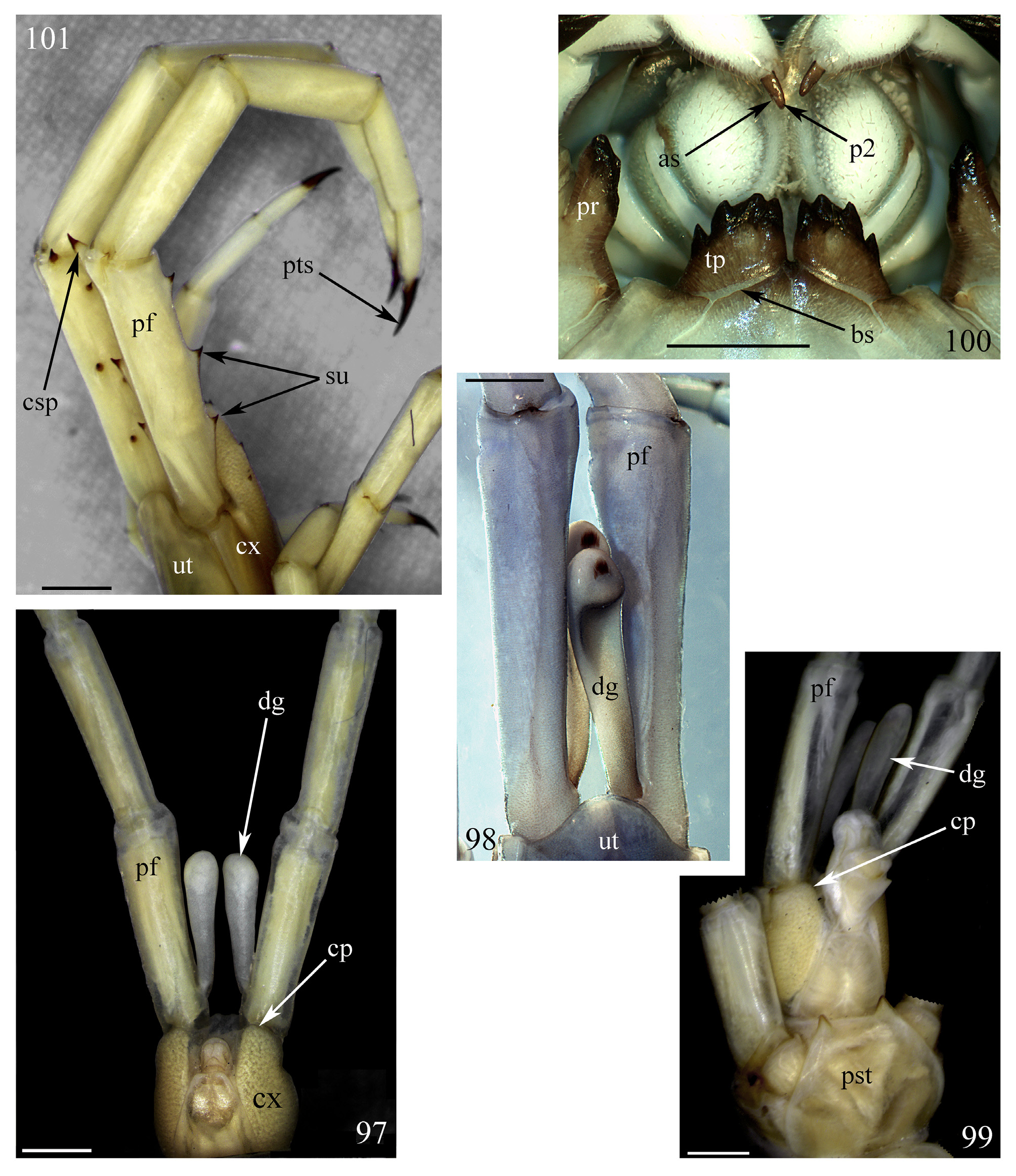
FIGURES 97–101. Otostigmus (Parotostigmus) scabricauda (Humbert et Saussure, 1870); Ad. male Rc 6730 97 LBS 21 and prefemora + femora of ultimate legs ventrally; Otostigmus (P.) salticus Schileyko, Iorio & Coulis, 2018; Ad. holotype male MNHN 460 98 posterior margin of ultimate tergite + prefemora of ultimate legs dorsally; Otostigmus (P.) diringshofeni Bücherl, 1969; Ad. male Rc 7981 99 LBS 21 + prefemora of ultimate legs ventrally; Otostigmus (P.) salticus Schileyko, Iorio & Coulis, 2018; Ad. holotype male MNHN 460 100 anterior margin of forcipular coxosternite + maxillae 2 ventrally; Ethmostigmus rubripes spinosus (Newport, 1845); Juv. Rc 7174 101 left side of ultimate LBS + ultimate legs laterally; (as)—accessory spine, (bs)—basal suture of forcipular tooth-plate, (cp)— practically reduced spineless coxopleural process, (csp)—corner spine of ultimate prefemur, (cx)—coxopleuron, (dg)—digitiform process of ultimate prefemur, (p2)—pretarsus of maxilla 2, (pf)—ultimate prefemur, (pr)—trochantero-prefemoral process, (pst)—penultimate sternite, (pts)—ultimate pretarsus, (su)—ventral spines of ultimate prefemur, (tp)—forcipular tooth-plate, (ut)—ultimate tergite.

FIGURES 102–107. Ethmostigmus rubripes spinosus (Newport, 1845); Juv. Rc 7174 102 forcipular segment ventrally; Ethmostigmus rubripes platycephalus (Newport, 1845); Ad. Rc 7514 103 left pleuron of LBS 3 laterally; Ad. Rc 7513 104 LBS 21 ventrally; Sad. СDT 105 coxopleural processes + prefemora of ultimate legs ventrally; Rhysida longipes (Newport, 1845); Ad. Rc 6683 106 anterior margin of forcipular coxosternite ventrally 107 coxopleural processes, legs 20 + ultimate legs laterally; (ap)—apical spine, (bs)—basal suture of forcipular tooth-plate, (cp)—coxopleural process, (csp)—corner spine of ultimate prefemur, (cx)—coxopleuron, (im)—intersclerite membrane, (lc)—lateral spines of coxopleural process, (pf)—ultimate prefemur, (pr)—trochantero-prefemoral process, (pts)—ultimate pretarsus, (rpf)—abnormally small (regenerated) right ultimate prefemur, (rpr)—rudiment of trochantero-prefemoral process, (s)—open spiracle without atrium, (scs)— spine at place of corner spine of ultimate prefemur, (su)—spines of ultimate prefemur, (t1)—ultimate tarsus 1, (tp)—forcipular tooth-plates, (ust)—ultimate sternite.

FIGURES 108–112. Rhysida longipes (Newport, 1845); Ad. Rc 7003 108 left pleuron of LBS 3 laterally; Ad, Rc 7003 109 LBS 21 ventrally; Alluropus calcaratus (Pocock, 1891) (photos by Warut Siriwut); Ad. male CUMZ 00470 110 LBS 20, 21 + ultimate legs dorso-laterally; Ad. female CUMZ 00501 111 head, forcipular segment and LBS 1, 2 ventrally; Ad. female CUMZ 00501 112 LBS 20, 21 + prefemora of ultimate legs ventrally; (20)—leg 20, (ap)—apical + ventral subapical spines of coxopleural process, (cp)—coxopleural process, (csp)—corner spine of ultimate prefemur, (dd)—male’s dorsodistal projection of ultimate tarsus 1, (im)—intersclerite membrane, (lc)—lateral spine of coxopleural process, (pfs)—prefemoral spur of leg 1, (pr)—trochantero-prefemural process, (pts)—pretarsus, (s)—spiracle, (sh)— spiracle hump, (su)—spines of ultimate prefemur, (t1)—male’s enlarged ultimate tarsus 1, (t2)—male’s slim ultimate tarsus 2, (tp)—forcipular tooth-plates, (ust)—ultimate sternite, (ut)—ultimate tergite.
IMAGES