
AnimaliaNot EvaluatedacceptedspeciesAccepted
Monandrocarpa monotestis
(Tokioka, 1953)
GBIF:179906389
0year
ABOUT
Descriptions(1)
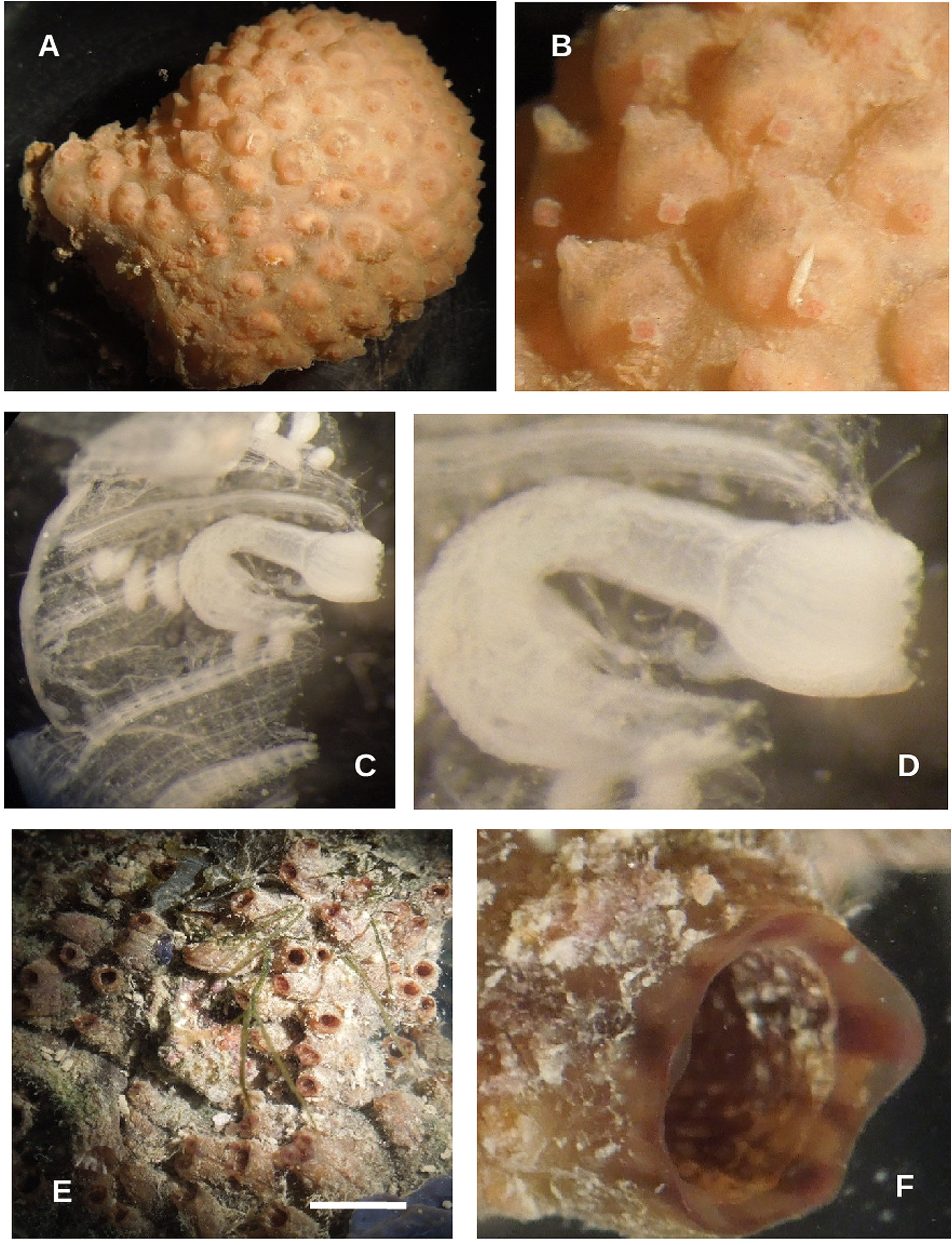
Figure 8 A – D Colonies globular in the present collection, zooids all on the surface; most of the interior is empty colorless transparent tunic. Four branchial folds per side. Zooids with a few endocarps, small and globular, scattered on body wall; none in gut loop. Stomach elongated, ridged, with large curved caecum at posterior end; anus plain but bilobed. Gonads elongate, single testis almost as long as entire gonad. # 1169, tunic about 4 mm thick, tough. Elongate colony 4.5 cm long x 3.3 cm wide, plus smaller attached colony. Zooids about 4 mm in length. Nine gonads on left side, seven on right. Branchial formula: Left DL 0 (6) 0 (2) 1 (6) 0 (2) 1 E right DL 0 (8) 0 (2) 0 (7) 0 (3) 0 E # 4647, examined by F. Monniot. Single colony, attached by the narrow end only, about 3.5 cm long x 3 cm wide at widest part (Fig. 8 A – D). Zooids about 5 mm long, measured across both siphons. Numerous long slender oral tentacles,> 60. Dorsal tubercle a small button, ganglion immediately behind it; dorsal lamina plain. Zooids with up to nine elongate gonads on each side in a single row ventrally, close to the endostyle. Second branchial fold from DL the lowest. Branchial formula: E 1 (3) 3 (7) 2 (3) 2 (10) 0 DL E 0 (3) 1 (8) 1 (3) 1 (10) 0 DL for another zooid Distribution: Japan, China, Korea. Detailed references: Tokioka (1953, 1967 as Polyandrocarpa (Eusynstyela) monotestis), Monniot F. (2009 a), Seo & Rho (2014 as E. monotestis).
Lambert, Gretchen, Lee, Serina Siew-Chen, Teo, Serena Lay-Ming (2021): Ascidians collected during the 2013 Singapore Strait International Marine Biodiversity Workshop. Zootaxa 4933 (1): 1-38, DOI: 10.11646/zootaxa.4933.1.1
Export occurrence data
Darwin Core Archive (ZIP)
CLASSIFICATION
Taxonomic Classification Tree

MULTIMEDIA
Media Files(1)
FIGURE 8. A–D: Monandrocarpa monotestis. A: whole colony 3.5 cm in length; B: enlargement of four zooids; C: gut, intestine and a few left side gonads; D: curved caecum at posterior end of gut. E, F: Polyandrocarpa rollandi. E: part of colony, scale bar 8 mm; F: oral siphon showing reddish striping.
Imageimage/png© Lambert, Gretchen;Lee, Serina Siew-Chen;Teo, Serena Lay-MingLambert, Gretchen;Lee, Serina Siew-Chen;Teo, Serena Lay-Ming
IMAGES