
AnimaliaNot EvaluatedacceptedspeciesAccepted
Diplosoma simile
(Sluiter, 1909)
GBIF:179906418
0year
ABOUT
Descriptions(1)
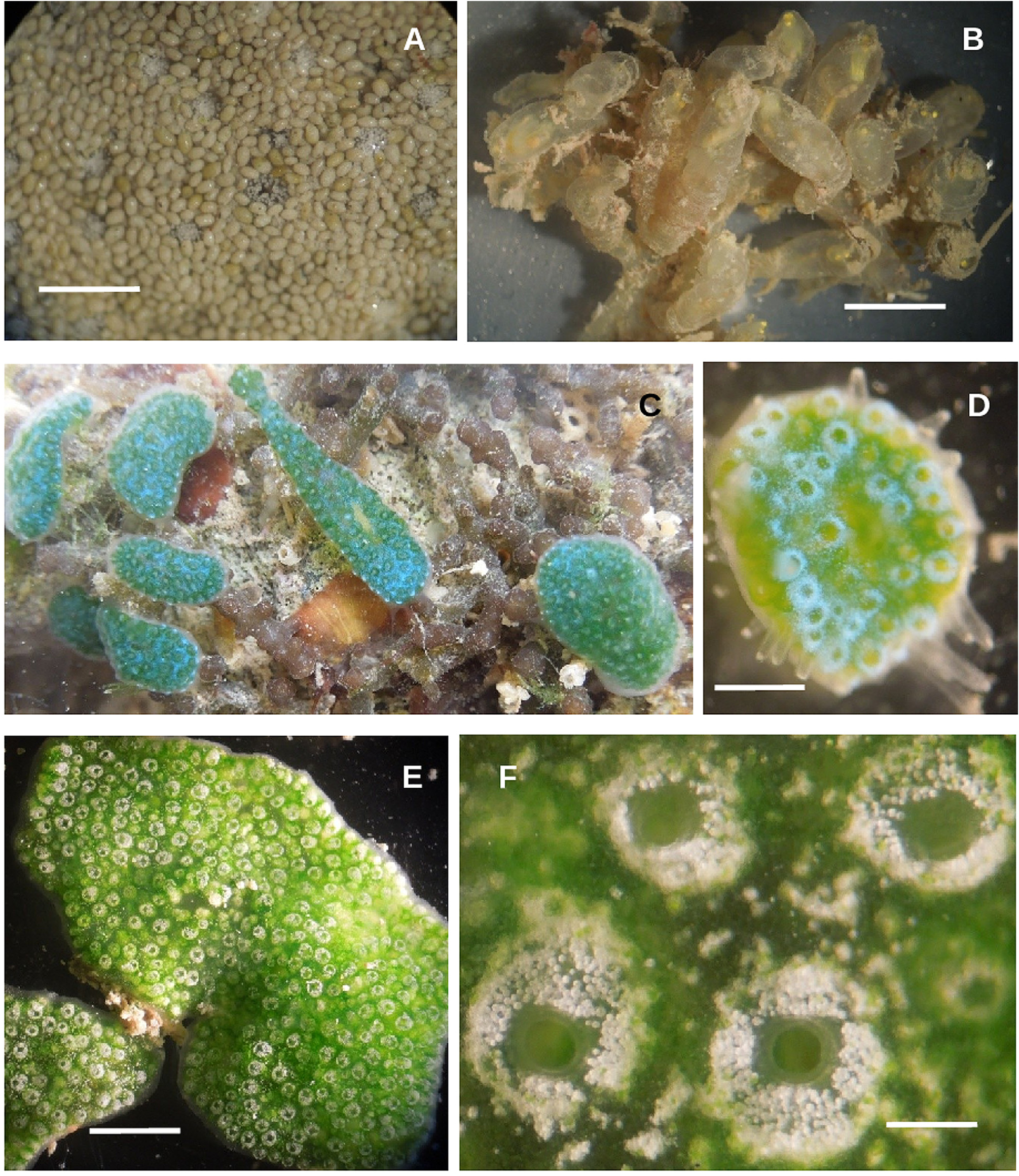
Figure 2 C, D As with many photosymbiotic didemnids, the colonies are often (though not always) small and occur as close clonal groupings due to repeated divisions (Fig. 2 C). They are always very clean, never any overgrowth by other species, and nearly always are easily seen by the bright iridescent blue around and often between the siphons that contrasts with the green of the rest of the tunic due to the presence of Prochloron in the common cloacal canals. Tunic surface layer clear, with bladder cells. The colonies are always in shallow water and adhere strongly to the substrate due to numerous tunic extensions (Fig. 2 D) as mentioned by Kott (1980). No collection number, tidepool in front of lab on 5 / 19 / 2013; # 1190, many tiny colonies; # 2605, intertidal, on dead coral; # 2645, intertidal on dead coral; # 3816, intertidal, numerous small colonies. Common throughout the tropical west Pacific: Indonesia, Philippines, Taiwan, Singapore, Fiji, Indian Ocean, Australia, Caroline Is., Palau, Guam, Hawaii, Eniwetok, Japan, New Caledonia. Recently discovered in Caribbean Panama (Hirose et al. 2012). Detailed descriptions with figures: Kott (1980, 2001), Monniot C. & Monniot F. (1987), Monniot F. & Monniot C. (1996, 2001), Hirose & Nozawa (2010), Hirose et al. (2012), Su et al. (2013), Hirose & Hirose (2013), Hirose (2014), Hirose et al. (2014). Other references: Eldredge (1967 as D. virens), Kott (1981, 1982), Monniot F. (1994), Abbott et al. (1997), Lee et al. (2016).
Lambert, Gretchen, Lee, Serina Siew-Chen, Teo, Serena Lay-Ming (2021): Ascidians collected during the 2013 Singapore Strait International Marine Biodiversity Workshop. Zootaxa 4933 (1): 1-38, DOI: 10.11646/zootaxa.4933.1.1
Export occurrence data
Darwin Core Archive (ZIP)
CLASSIFICATION
Taxonomic Classification Tree

MULTIMEDIA
Media Files(1)
FIGURE 2. A: Didemnum psammatodes; B: Euherdmania cf. digitata; C, D: Diplosoma simile; E, F: Lissoclinum punctatum. Scale bars: A, 1 mm; B, 6 mm; D, 5 mm; E, 5 mm; F, 0.4 mm.
Imageimage/png© Lambert, Gretchen;Lee, Serina Siew-Chen;Teo, Serena Lay-MingLambert, Gretchen;Lee, Serina Siew-Chen;Teo, Serena Lay-Ming
IMAGES