
AnimaliaNot EvaluatedacceptedspeciesAccepted
Rhopalaea macrothorax
Tokioka, 1953
GBIF:179906427
0year
ABOUT
Descriptions(1)
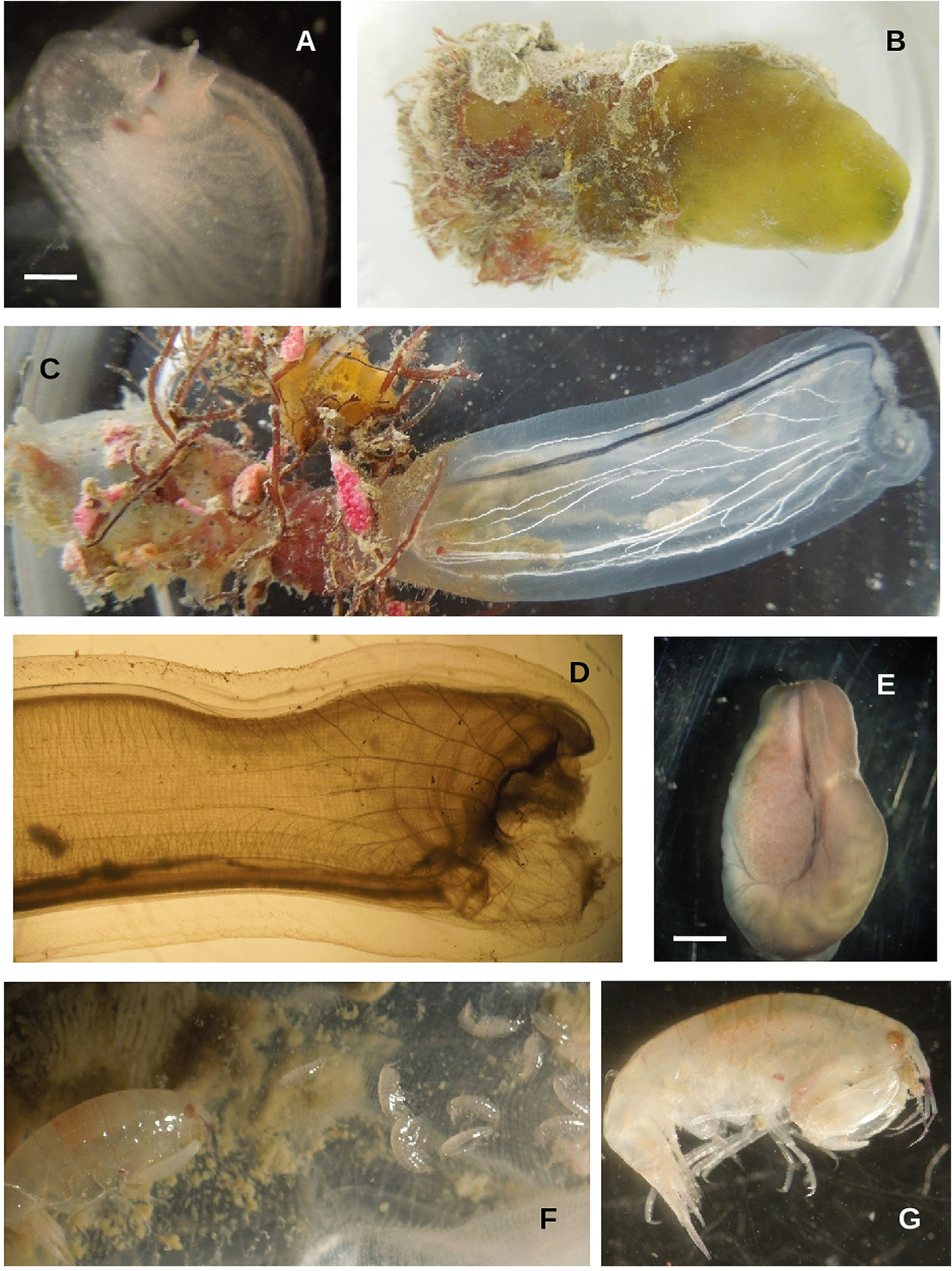
Figure 1 C – G As with Rhopalaea crassa, zooids are always solitary. Six irregular oral and atrial lobes, each one subdivided into irregular sub-lobes. A distinctive dark blue line encircles the oral siphon and extends along the endostyle to the posterior end of the thorax (Fig. 1 C) as described by Monniot F. & Monniot C. (2008). Dorsal tubercle with a single longitudinal slit. Four stigmata per mesh. The muscle pattern is quite variable between specimens, but usually at least one or two longitudinal muscles extend the entire length of the thorax. In the microscope under reflected light the major muscles look white (Fig. 1 C) but not with transmitted light (Fig. 1 D). There are a few horizontal muscle fibers crossing the anterior thorax; this region usually has a few shallow horizontal folds, probably as a result of contraction. Short dense fine horizontal fibers extend from the dorsal and ventral sides of the thorax almost the full length of the thorax (Fig. 1 D). The sperm duct opens slightly anterior to the anus but with less of a curve than illustrated in Monniot F. & Monniot C. (2008). Gonad on dorsal side of intestinal loop (Fig. 1 E). # 1160 C, thorax 3.5 cm in length, total length including tunic 6.5 cm. Six pigment spots on oral siphon, 11 spots on atrial siphon. Oral tentacles 22, of two sizes plus a few very tiny ones, all at the base of a very short velum. About 150 rows of stigmata, the last 6 – 8 very small and narrow and extend posterior to the esophagus. About 44 longitudinal vessels anteriorly on the left, about 38 on the right side. Large amphipod 5.5 mm long, Leucothoe sp., plus 23 small juveniles, in branchial sac (Fig 1 F, G). # 1173, single zooid, thorax 3.7 cm in length, total length 6.2 cm. About 130 rows of stigmata. One Leucothoe sp. amphipod in thorax, same species as specimen # 1160 C. # 4170, one specimen, 5.5 cm in length. One Leucothoe sp. amphipod in branchial sac. # 4620, three specimens, one with Leucothoe sp. amphipod in branchial sac. # SD 178, two specimens, one fixed in formalin the other in ethanol, sent to Gustav Paulay. Distribution: Indonesia, India, Malaysia, Japan. Detailed descriptions with figures: Tokioka (1953), Monniot F. & Monniot C. (2008), Mondal et al. (2017). Additional reference: Monniot F. & Monniot C. (2001).
Lambert, Gretchen, Lee, Serina Siew-Chen, Teo, Serena Lay-Ming (2021): Ascidians collected during the 2013 Singapore Strait International Marine Biodiversity Workshop. Zootaxa 4933 (1): 1-38, DOI: 10.11646/zootaxa.4933.1.1
Export occurrence data
Darwin Core Archive (ZIP)
CLASSIFICATION
Taxonomic Classification Tree

MULTIMEDIA
Media Files(1)
FIGURE 1. A: Clavelina moluccensis; B: Rhopalaea crassa 5.3 cm in length; C–G, Rhopalaea macrothorax. C: entire zooid, 6.5 cm in length; D: anterior thorax showing muscle pattern and siphons; E: abdomen with stomach at the upper right, large gonad on the left in the intestinal loop; F: clutch of 23 immature amphipods (Leucothoe sp.) with adult in branchial sac; G: adult amphipod, closeup, 5.5 mm in length. Scale bars: A, 1.4 mm; E, 2 mm.
Imageimage/png© Lambert, Gretchen;Lee, Serina Siew-Chen;Teo, Serena Lay-MingLambert, Gretchen;Lee, Serina Siew-Chen;Teo, Serena Lay-Ming
IMAGES