
AnimaliaNot EvaluatedacceptedspeciesAccepted
Phallusia arabica
Savigny, 1816
GBIF:179906451
0year
ABOUT
Descriptions(1)
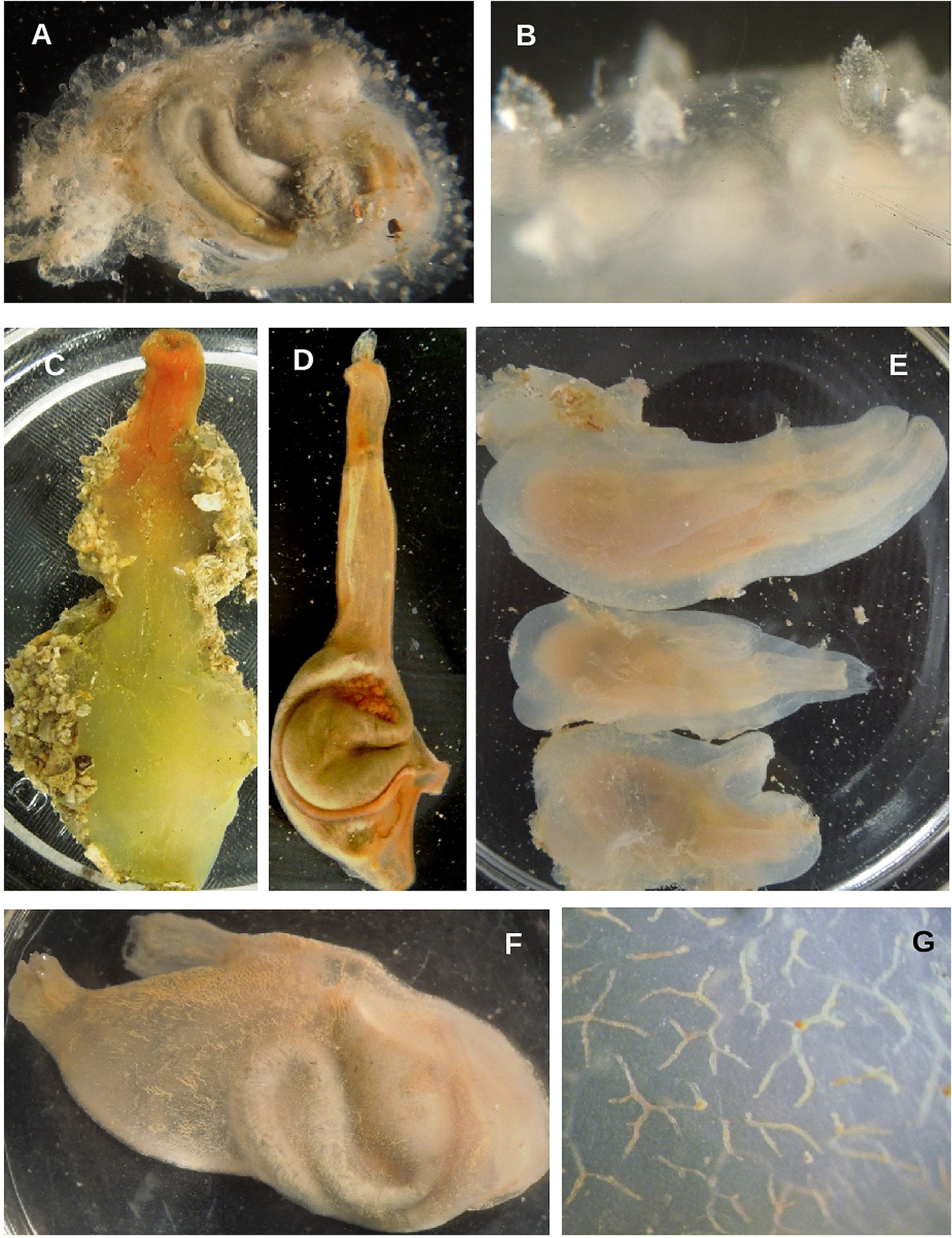
Figure 5 E – G Thick translucent cartilaginous tunic on all specimens, very well supplied with a network of blood vessels. Dorsal lamina double anteriorly, smooth but toothed posteriorly beginning at the top of the gut loop. Accessory openings of neural duct close to and just anterior to and to the right (mostly) of the neural ganglion. Dorsal tubercle in an elongated V, flat but with several openings that are longitudinal slits. Prepharyngeal band not papillated or else very minutely so. Ganglion far from dorsal tubercle, at the base of the atrial siphon. Musculature a very fine network of longitudinal and diagonally horizontal fibers across the entire right side. Stomach horizontal, both ascending and descending limbs of intestine narrow but rectum enlarged before anus. Anus distinctly but irregularly lobed, about 15 - 20 rather large rounded lobes folded back. For the non-expert, it may be difficult to distinguish the various species of Phallusia, and many have been misidentified as P. nigra Savigny, 1816. See Lee et al. (2013) for detailed description and comparison of P. arabica, P. nigra and P. philippinensis Millar, 1975. # 0176, three individuals; # 1221, three specimens 3.3, 4, and 5.5 cm long (Fig. 5 E). # 4648, juvenile 3.5 cm in length; body removed from tunic 2.9 cm long. Oral siphon with seven lobes, atrial siphon torn at tip. About 58 oral tentacles of various sizes. Smaller oral tentacles colorless, largest ones filled with yellowish corpuscles as described by Kott (1985). Branchial sac with four or five stigmata per mesh but not yet plicated, does not extend posteriorly beyond the stomach. No gonads. Distribution: Indonesia, Philippines, Singapore, Taiwan, Vietnam, Madagascar. Detailed descriptions with illustrations: Kott (1985), Monniot F. & Monniot C. (1996), Monniot C. (1997 b), Monniot F. (2010), Lee et al. (2013). Additional reference: Lee et al. (2016).
Lambert, Gretchen, Lee, Serina Siew-Chen, Teo, Serena Lay-Ming (2021): Ascidians collected during the 2013 Singapore Strait International Marine Biodiversity Workshop. Zootaxa 4933 (1): 1-38, DOI: 10.11646/zootaxa.4933.1.1
Export occurrence data
Darwin Core Archive (ZIP)
CLASSIFICATION
Taxonomic Classification Tree

MULTIMEDIA
Media Files(1)
FIGURE 5. A, B: Ascidia sydneiensis about 1.5 cm in length. A: left side in tunic; B: closeup of a few clear tunic tubercles. C, D: Ascidia gemmata 7.9 cm in length in tunic (C) and left side, 7.2 cm long with tunic removed (D); E–G: Phallusia arabica. E: three individuals, largest 5.5 cm in length; F: left side of another individual 2.9 cm in length out of tunic; G: closeup of tunic blood vessels.
Imageimage/png© Lambert, Gretchen;Lee, Serina Siew-Chen;Teo, Serena Lay-MingLambert, Gretchen;Lee, Serina Siew-Chen;Teo, Serena Lay-Ming
IMAGES