
AnimaliaNot EvaluatedacceptedspeciesAccepted
Bonellia pumicea
Sluiter, 1891
GBIF:179906576
0year
ABOUT
Descriptions(4)
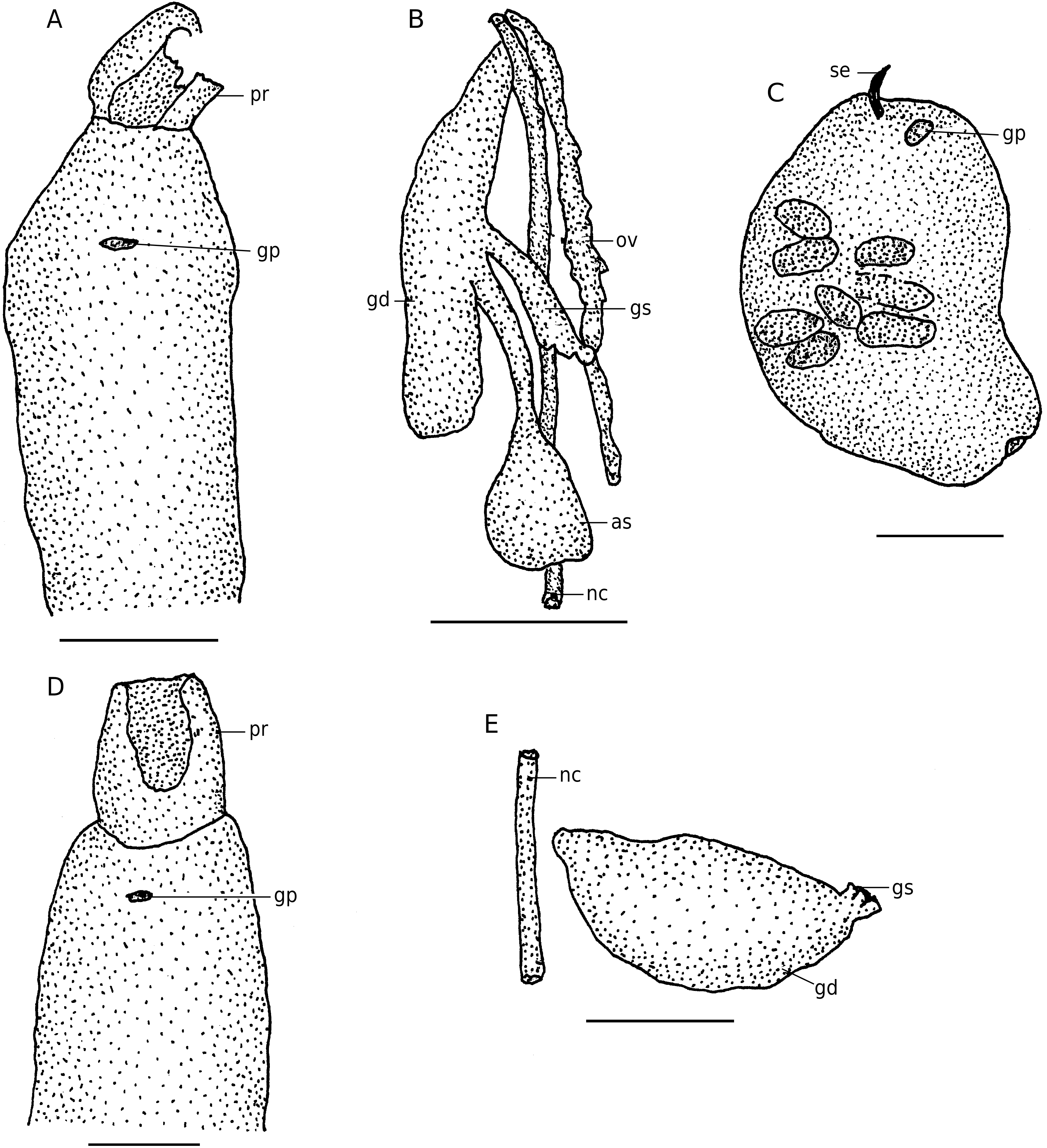
(Fig. 4 C)
Biseswar, Ramlall (2010): Report on deep-sea bonelliids (Echiura) from the East Equatorial Atlantic Ocean. Zoosystema 32 (1): 139-154, DOI: 10.5252/z2010n1a7, URL: http://www.bioone.org/doi/abs/10.5252/z2010n1a7
DESCRIPTION Colour of trunk in preserved specimen is grey; proboscis is missing. Trunk is oval in outline, 1.5 mm long and 1 mm across broadest part (Fig. 4 C). Integument is thin and transparent, coils of gut visible. Single ventral seta present on left side, right one is missing, probably fallen off. Seta goldenyellow with cylindrical shaft and flattened, curved terminal blade. Papillae microscopic, visible only at anterior end of trunk. Gonoduct single, on left side of nerve cord with basally located gonostome, gut contents moulded into oval faecal pellets, anal vesicles two main tubes bearing tubules which branch once or twice before terminating in ciliated funnels.
Biseswar, Ramlall (2010): Report on deep-sea bonelliids (Echiura) from the East Equatorial Atlantic Ocean. Zoosystema 32 (1): 139-154, DOI: 10.5252/z2010n1a7, URL: http://www.bioone.org/doi/abs/10.5252/z2010n1a7
REMARKS The species B. pumicea was originally described from a single female from Sumatra by Sluiter (1891). This species is fairly well known as it has been recorded and redescribed from the North Atlantic by DattaGupta (1981) and Biseswar (1992). Bonellia pumicea is closely related to B. plumosa DattaGupta, 1981 but differs in the structure of the body wall and blood vascular system. Stephen & Edmonds (1972) have mentioned the presence of white papillae as the main feature to separate B. pumicea from the rest of the species in the genus Bonellia. According to DattaGupta (1981), B. plumosa has a broad ring sinus located at the junction of the pro- and mid-intestine. The discovery of this species from the West African continental margin is a new record and extends its range of distribution southwards in the Atlantic.
Biseswar, Ramlall (2010): Report on deep-sea bonelliids (Echiura) from the East Equatorial Atlantic Ocean. Zoosystema 32 (1): 139-154, DOI: 10.5252/z2010n1a7, URL: http://www.bioone.org/doi/abs/10.5252/z2010n1a7
MATERIAL EXAMINED. — East Equatorial Atlantic Ocean. BIOZAIRE 1, ROV-PL 79 - 3 CL 3, stn ZB-B, 07 ° 18.31 ’ S, 012 ° 04.83 ’ E, 374 m, 7. I. 2001, 1 ♀.
Biseswar, Ramlall (2010): Report on deep-sea bonelliids (Echiura) from the East Equatorial Atlantic Ocean. Zoosystema 32 (1): 139-154, DOI: 10.5252/z2010n1a7, URL: http://www.bioone.org/doi/abs/10.5252/z2010n1a7
Export occurrence data
Darwin Core Archive (ZIP)
CLASSIFICATION
Taxonomic Classification Tree

MULTIMEDIA
Media Files(1)
FIG. 4. — A, B,?Sluiterina sp.; A, ventral view of anterior part of female; B, gonoduct; C, Bonellia pumicea Sluiter, 1891, ventral view of female; D, E, Eubonellia longistomum Fisher, 1946; D, ventral view of anterior part of female; E, gonoduct. Abbreviations: as, accessory sac; gd, gonoduct; gp, genital pore; gs, gonostome; nc, nerve cord; ov, ovary; pr, proboscis, se, seta. Scale bars: A, B, 3 mm; C, E, 0.5 mm; D, 1 mm.
Imageimage/png© Biseswar, RamlallBiseswar, Ramlall
IMAGES