
AnimaliaNot EvaluatedacceptedspeciesAccepted
Choanostomellia filatovae
(Zenkevitch, 1964)
GBIF:179906581
0year
ABOUT
Descriptions(4)
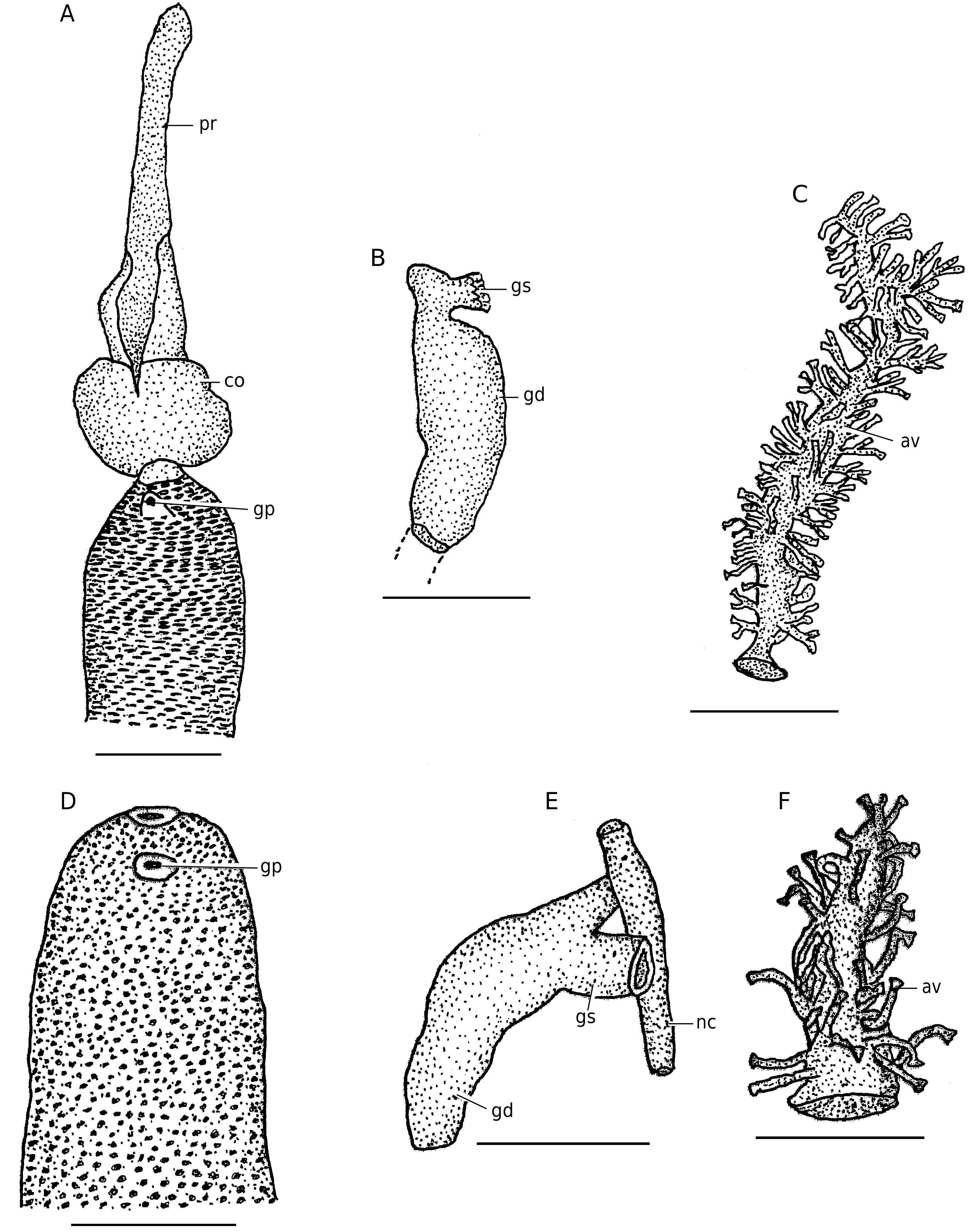
(Fig. 2 A, B)
Biseswar, Ramlall (2010): Report on deep-sea bonelliids (Echiura) from the East Equatorial Atlantic Ocean. Zoosystema 32 (1): 139-154, DOI: 10.5252/z2010n1a7, URL: http://www.bioone.org/doi/abs/10.5252/z2010n1a7
DESCRIPTION Colour of proboscis and trunk of preserved specimen from off coast of Angola is cream while in specimen from Gulf of Guinea proboscis is pink and trunk is reddish-brown. In former specimen proboscis is 120 mm long including collar which is 7 mm broad. Corresponding measurements of specimen from Gulf of Guinea is 45 mm and 12 mm respectively. Trunk of this specimen is 80 mm long and 18 mm across broadest part. Only 40 mm of anterior end of trunk of specimen from off coast of Angola is intact, rest is missing. Proboscis is broad proximally but narrows gradually towards distal end (Fig. 2 A). Anterior margin of proboscis is evenly rounded. In proximal half lateral margins of proboscis curl inwards forming tubular structure. Broad funnel-like collar is incised ventrally (Fig. 2 A). Body wall is thick and opaque. Elongated papillae are densely arranged in transverse rows on anterior half of trunk, posterior half is smooth and devoid of papillae. Single genital pore is located on raised eminence of body wall about 5 mm away from anterior tip of trunk (Fig. 2 A). Distal ends of gonoducts are damaged in both specimens. Single, tubular gonoduct is located on left side of nerve cord with basally placed gonostome (Fig. 2 B). Gonostomal lip with small lobes around margin. Only foregut is intact, rest of alimentary canal is missing including blood system. Coelom is filled with oval faecal pellets. Anal vesicles are tubular into which open many branching tubules terminating in ciliated funnels (Fig. 2 C).
Biseswar, Ramlall (2010): Report on deep-sea bonelliids (Echiura) from the East Equatorial Atlantic Ocean. Zoosystema 32 (1): 139-154, DOI: 10.5252/z2010n1a7, URL: http://www.bioone.org/doi/abs/10.5252/z2010n1a7
REMARKS The genus Choanostomellia is distinguished by the presence of a deeply incised, funnel-like collar that surrounds the proximal part of the proboscis and pharynx and a single gonoduct on the left side of the nerve cord with a basally located gonostome. The genus is also characterised by the absence of ventral setae. Three species are currently known in the genus Choanostomellia, namely, C. filatovae, C. bruuni Zenkevitch, 1964 and C. vinogradovae Murina, 1978. Choanostomellia bruuni was originally recorded from the northern Arabian Sea at a depth of 3676 m while C. filatovae was recorded off Japan in waters 1693 m deep (Stephen & Edmonds 1972). DattaGupta (1981) recorded and redescribed both these species from the North Atlantic Ocean. The species C. vinogradovae was recorded by Murina (1978) from the western Pacific at a depth of 4395 m. The present specimens from the East Equatorial Atlantic Ocean closely conform with the descriptions provided by Zenkevitch (1964) and DattaGupta (1981). Unfortunately, the description provided by Zenkevitch (1964) makes no mention of the anal vesicles. The anal vesicles were also missing in the specimen described by DattaGupta (1981). The anal vesicles of C. filatovae is described here for the first time. The specimen from off the coast of Angola with a proboscis length of 120 mm is much larger in size than those described previously. The discovery of C. filatovae from off the coast of Angola in the vicinity of 7 ° S latitude is the first report of its occurrence in this region and considerably extends its range of distribution.
Biseswar, Ramlall (2010): Report on deep-sea bonelliids (Echiura) from the East Equatorial Atlantic Ocean. Zoosystema 32 (1): 139-154, DOI: 10.5252/z2010n1a7, URL: http://www.bioone.org/doi/abs/10.5252/z2010n1a7
MATERIAL EXAMINED. — East Equatorial Atlantic Ocean. Continental margin of Angola, ZAIANGO-BIOL 2, CP 07, 7 ° 30.87 ’ S, 11 ° 33.95 ’ E, 1359 m, 28. VIII. 2000, 1 ♀. Gulf of Guinea, BIOZAIRE 3, CP 11, stn ZB-D, 5 ° 50.5840 ’ S, 8 ° 20.0380 ’ E, 3978 m, 20. XII. 2003, 1 ♀.
Biseswar, Ramlall (2010): Report on deep-sea bonelliids (Echiura) from the East Equatorial Atlantic Ocean. Zoosystema 32 (1): 139-154, DOI: 10.5252/z2010n1a7, URL: http://www.bioone.org/doi/abs/10.5252/z2010n1a7
Export occurrence data
Darwin Core Archive (ZIP)
CLASSIFICATION
Taxonomic Classification Tree

MULTIMEDIA
Media Files(1)
FIG. 2. — A-C, Choanostomellia filatovae (Zenkevitch, 1964); A, ventral view of anterior part of female; B, gonoduct; C, right anal vesicle; D-F, Torbenwolffia galatheae Zenkevitch, 1966; D, ventral view of anterior part of female; E, gonoduct; F, left anal vesicle. Abbreviations: av, anal vesicle; co, collar; gd, gonoduct; gp, genital pore; gs, gonostome; nc, nerve cord; pr, proboscis. Scale bars: A, 5 mm; B, 2 mm; C, E, F, 1 mm; D, 4 mm.
Imageimage/png© Biseswar, RamlallBiseswar, Ramlall
IMAGES