
AnimaliaNot EvaluatedacceptedspeciesAccepted
Alomasoma nordpacificum
Zenkevitch, 1958
GBIF:179906583
0year
ABOUT
Descriptions(4)
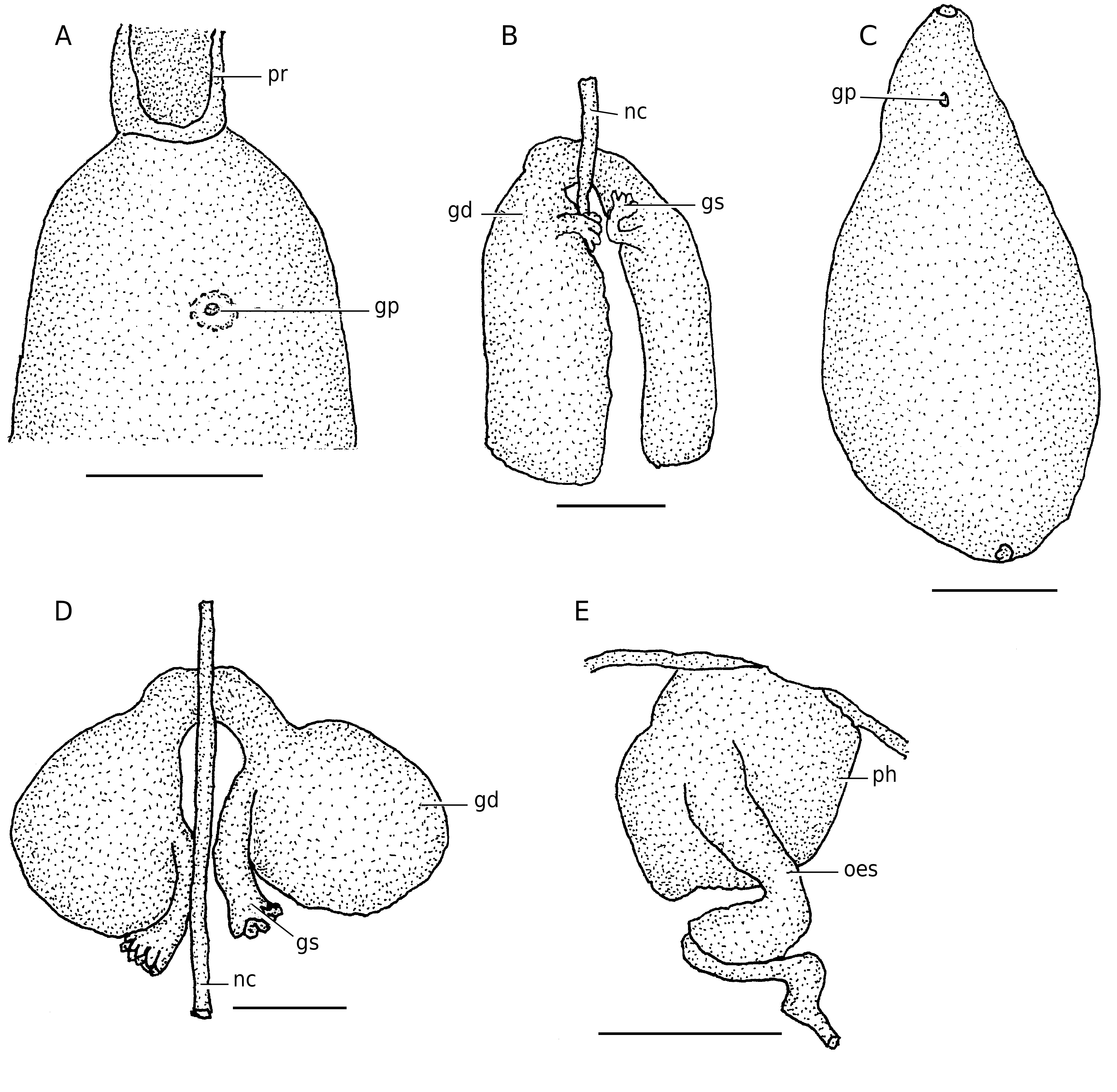
(Fig. 1 C-E)
Biseswar, Ramlall (2010): Report on deep-sea bonelliids (Echiura) from the East Equatorial Atlantic Ocean. Zoosystema 32 (1): 139-154, DOI: 10.5252/z2010n1a7, URL: http://www.bioone.org/doi/abs/10.5252/z2010n1a7
DESCRIPTION Colour of trunk of preserved specimens is beige. Probosces missing in both specimens. Posterior end of trunk damaged in one female. In other specimen trunk is pear-shaped (Fig. 1 C), 35 mm long and 17 mm across broadest part. Integument is thick and opaque in anterior half of trunk but thin and transparent in posterior half. Round to oval papillae closely arranged only on anterior half of trunk, posterior half is smooth and devoid of papillae. Single genital pore is located about 5 mm away from anterior end of trunk (Fig. 1 C). Ventral setae absent. Gonoducts one pair (Fig. 1 D), small, spherical, unite proximally beneath nerve cord and open to exterior by a single genital pore. Gonostomes set on long stalks, basal in position. Gonostomal lips petaloid (Fig. 1 D). Only foregut is intact, rest of intestine is missing including blood system. Pharynx is bulbous, clearly demarcated from oesophagus (Fig. 1 E). Gut contents moulded into oval faecal pellets. Anal vesicles are branching tubules terminating in ciliated funnels and opening into rectum.
Biseswar, Ramlall (2010): Report on deep-sea bonelliids (Echiura) from the East Equatorial Atlantic Ocean. Zoosystema 32 (1): 139-154, DOI: 10.5252/z2010n1a7, URL: http://www.bioone.org/doi/abs/10.5252/z2010n1a7
REMARKS The genus Alomasoma is distinguished in possessing two gonoducts which unite proximally to form a common duct which opens to the exterior by a single genital pore. The gonostomes are basal and set on long stalks. Anal vesicles are branching tubules terminating in ciliated funnels. The genus Alomasoma is closely related to the genus Amalosoma Fisher, 1948. In the latter genus the two gonoducts open to the exterior separately. Furthermore, a specialized genital slit is present anterior to the genital pore in Amalosoma but absent in Alomasoma. The species A. nordpacificum has been described by DattaGupta (1981) and Biseswar (2005) from the North Atlantic. The discovery of this species in the East Equatorial Atlantic Ocean considerably extends its range of distribution.
Biseswar, Ramlall (2010): Report on deep-sea bonelliids (Echiura) from the East Equatorial Atlantic Ocean. Zoosystema 32 (1): 139-154, DOI: 10.5252/z2010n1a7, URL: http://www.bioone.org/doi/abs/10.5252/z2010n1a7
MATERIAL EXAMINED. — East Equatorial Atlantic Ocean. GulfofGuinea, BIOZAIRE 3, CP 13, stnZB-C, 7 ° 39.7530 ’ S, 10 ° 1.2916 ’ E, 3991 m, 23. XII. 2003, 2 ♀♀.
Biseswar, Ramlall (2010): Report on deep-sea bonelliids (Echiura) from the East Equatorial Atlantic Ocean. Zoosystema 32 (1): 139-154, DOI: 10.5252/z2010n1a7, URL: http://www.bioone.org/doi/abs/10.5252/z2010n1a7
Export occurrence data
Darwin Core Archive (ZIP)
CLASSIFICATION
Taxonomic Classification Tree

MULTIMEDIA
Media Files(1)
FIG. 1. — A, B, Alomasoma belyaevi Zenkevitch, 1964; A, ventral view of anterior part of female; B, gonoducts; C-E, A. nordpacificum Zenkevitch,1958; C, ventral view of trunk of female;D, gonoducts;E, anterior end of trunk cavity showing the pharynx and oesophagus. Abbreviations: gd, gonoduct; gp, genital pore; gs, gonostome; nc, nerve cord; oes, oesophagus; ph, pharynx; pr, proboscis. Scale bars: A, 2 mm; B, 1 mm; C, E, 4 mm; D, 0.5 mm.
Imageimage/png© Biseswar, RamlallBiseswar, Ramlall
IMAGES