
AnimaliaNot EvaluatedacceptedspeciesAccepted
Alomasoma belyaevi
Zenkevitch, 1964
GBIF:179906584
0year
ABOUT
Descriptions(4)
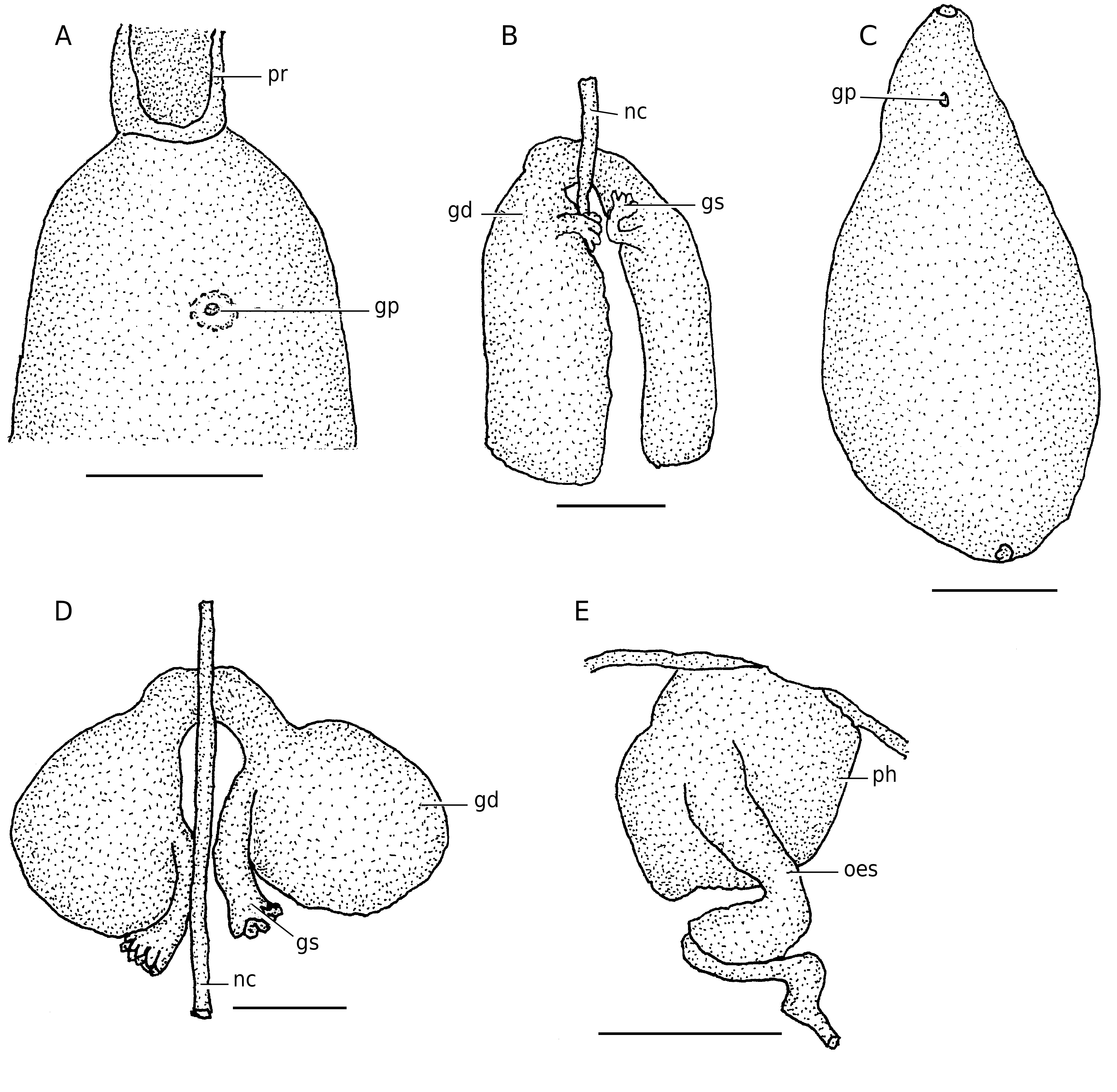
(Fig. 1 A, B)
Biseswar, Ramlall (2010): Report on deep-sea bonelliids (Echiura) from the East Equatorial Atlantic Ocean. Zoosystema 32 (1): 139-154, DOI: 10.5252/z2010n1a7, URL: http://www.bioone.org/doi/abs/10.5252/z2010n1a7
DESCRIPTION Colour of trunk of preserved specimens is reddishbrown. In one female only small proximal part of proboscis is attached to trunk, rest damaged. Trunk is cylindrical, 30 mm long and 12 mm across broadest part. Part of body wall damaged on ventral side of trunk. In other two specimens, probosces are missing and posterior ends of trunk are damaged. Anterior end of trunk covered with small rounded papillae, remainder of trunk smooth and devoid of papillae. Single genital pore is located about 5 mm away from anterior end of trunk (Fig. 1 A). Ventral setae absent. Gonoducts one pair (Fig. 1 B), large, sac-like, uniting proximally beneath nerve cord and opening to exterior by single genital pore. In one female, gonoducts compactly filled with eggs. Gonostomes small, basal in position (Fig. 1 B). Gonostomal lips with minute lobes around margin. Except for oesophagus and foregut, rest of alimentary canal is damaged in all specimens including blood system and anal vesicles.
Biseswar, Ramlall (2010): Report on deep-sea bonelliids (Echiura) from the East Equatorial Atlantic Ocean. Zoosystema 32 (1): 139-154, DOI: 10.5252/z2010n1a7, URL: http://www.bioone.org/doi/abs/10.5252/z2010n1a7
REMARKS Alomasoma belyaevi was originally described by Zenkevitch (1964) from the North-West Pacific Ocean at depths ranging from 2826 - 2843 m. Zenkevitch (1966) also reported the occurrence of this species in the Gulf of Panama. Alomasoma belyaevi has been recorded and briefly described by Saiz-Salinas et al. (2000) from Antarctic and adjacent waters. The latter authors have described male specimens in the genus Alomasoma for the first time. According to Stephen & Edmonds (1972) all the specimens have been found at great depths. The anatomy of this species is fairly well known as it has been described from numerous specimens. Alomasoma belyaevi is close to A. rhynchollulus DattaGupta, 1981 from the North Atlantic. According to DattaGupta (1981), A. rhynchollulus differs from all the other species in the genus in possessing a minute triangular proboscis. The discovery of A. belyaevi from the East Equatorial Atlantic Ocean is a new record for this region which considerably extends its range of distribution.
Biseswar, Ramlall (2010): Report on deep-sea bonelliids (Echiura) from the East Equatorial Atlantic Ocean. Zoosystema 32 (1): 139-154, DOI: 10.5252/z2010n1a7, URL: http://www.bioone.org/doi/abs/10.5252/z2010n1a7
MATERIAL EXAMINED. — East Equatorial Atlantic Ocean. Gulf of Guinea, BIOZAIRE 3, CP 10, stn ZB-D, 5 ° 50.6300 ’ S, 8 ° 20.0600 ’ E, 3977 m, 19. XII. 2003, 1 ♀. — CP 11, stn ZB-D, 05 ° 50.5840 ’ S, 008 ° 20.0380 ’ E, 3978 m, 20. XII. 2003, 1 ♀. — CP 22, stn R 10, 05 ° 46.9700 ’ S, 009 ° 44.1828 ’ E, 3121 m, 3. I. 2004, 1 ♀.
Biseswar, Ramlall (2010): Report on deep-sea bonelliids (Echiura) from the East Equatorial Atlantic Ocean. Zoosystema 32 (1): 139-154, DOI: 10.5252/z2010n1a7, URL: http://www.bioone.org/doi/abs/10.5252/z2010n1a7
Export occurrence data
Darwin Core Archive (ZIP)
CLASSIFICATION
Taxonomic Classification Tree

MULTIMEDIA
Media Files(1)
FIG. 1. — A, B, Alomasoma belyaevi Zenkevitch, 1964; A, ventral view of anterior part of female; B, gonoducts; C-E, A. nordpacificum Zenkevitch,1958; C, ventral view of trunk of female;D, gonoducts;E, anterior end of trunk cavity showing the pharynx and oesophagus. Abbreviations: gd, gonoduct; gp, genital pore; gs, gonostome; nc, nerve cord; oes, oesophagus; ph, pharynx; pr, proboscis. Scale bars: A, 2 mm; B, 1 mm; C, E, 4 mm; D, 0.5 mm.
Imageimage/png© Biseswar, RamlallBiseswar, Ramlall
IMAGES